Introduction
- Human Rights Watch submits the following information regarding Thailand’s human rights record since its 2021 Universal Periodic Review (UPR), including efforts toward implementing UPR recommendations, as well as developments in the human rights situation since then. This submission is not a complete assessment of all recommendations supported by Thailand, nor a comprehensive review of all measures taken by Thailand to protect human rights.
Efforts to restore civilian democratic rule after many years of military rule have been seriously undermined by inappropriate judicial intervention. Successive Thai governments have done little to address outstanding human rights problems, despite Thailand’s pledges made prior to its election to the United Nations Human Rights Council in 2025.[1] Authorities continue to restrict fundamental rights—particularly freedom of expression and peaceful assembly—using lèse-majesté (insulting the monarchy), sedition, and cyber-crime laws. Authorities have failed to protect human rights defenders from reprisals by state agencies and private companies. There has been little effort to resolve enforced disappearances. Impunity for security force abuses—particularly in ethnic Malay Musim areas in the southern border provinces—continues unabated. Refugees and asylum seekers remain at risk of arrest and forced return.
Restrictions on Freedoms of Expression and Peaceful Assembly
- Thailand accepted multiple recommendations regarding freedom of expression at the 2021 UPR.[2] But expression of critical and dissenting opinions remains restricted. Since the military coup in 2014, at least 1,997 people have been prosecuted in Thailand for exercising their rights to free expression and peaceful assembly.[3]
- The continued use of Penal Code section 112 on lèse-majesté (insulting the monarchy), which carries punishment of from 3 to 15 years in prison for each offense, violates the right to freedom of expression. As of February 2026, at least 285 people have been prosecuted under lèse-majesté charges since the 2014 military coup.[4] Pretrial detention is unnecessary and long, and penalties for many convictions are very harsh. In December 2025, the Supreme Court sentenced democracy activist Mongkol Thirakhot to 46 years in prison for lèse-majesté offenses related to 27 Facebook posts.[5] In April 2025, Thai authorities detained leading Thai studies scholar Paul Chambers for a day on lèse-majesté and cybercrime charges and revoked his visa.[6] Although the prosecutor decided not to press charge against Chambers, he subsequently left Thailand.[7]
- Judicial interpretation of lèse-majesté offenses varies by different courts, making convictions arbitrary and sometimes going beyond what is stipulated in the law. In September 2022, the Bangkok South Criminal Court sentenced Jatuporn Sae-Ung to three years in prison on lèse-majesté charges for wearing a Thai national dress at a democracy protest in a context that authorities claimed was done to mock Queen Suthida.[8]
- Thai authorities have often detained critics of the monarchy for months before trial without access to bail. All bail applications have been denied for Arnon Nampa, a prominent human rights lawyer and democracy activist who faces multiple lèse-majesté charges related to his speeches and online commentary calling for reforms of the monarchy. In August 2024, the United Nations Working Group on Arbitrary Detention called for his immediate release.[9]
- The lèse-majesté law itself has essentially become irrevocable. In August 2024, the Constitutional Court dissolved the opposition Move Forward Party for advocating reform of the Penal Code section 112 and imposed 10-year political bans on its executive members.[10] In addition, 44 politicians from the now-dissolved Move Forward Party are also facing prosecution in an ethics case, which could result in a lifetime ban from politics, for proposing to the parliament a bill to amend the lèse-majesté law.[11] These actions were based on the Constitutional Court’s ruling in January 2024 that the party’s campaign to amend the lèse-majesté law and its support for monarchy reform movements amounted to an attempt to abolish Thailand’s constitutional democracy with the king as head of state.[12] In February 2026, the Bangkok Criminal Court sentenced prominent free speech activist Pimsiri Petchnamrob to 32 months in prison under section 112 of the Penal Code.[13] This case was related to her speech during a democracy rally in Bangkok in November 2020 that referred to a 2017 statement by the United Nations expert on freedom of expression that the lèse-majesté law should have no place in a democratic country.[14]
- Prime Minister Anutin Charnvirakul has opposed efforts to reform the Penal Code section 112, as well as proposals to pardon those charged with lèse-majesté.[15]
- Making comments about the monarchy can also be a serious criminal offense under section 14 of the Computer-Related Crime Act. As of February 2025, at least 222 people have been prosecuted under computer-related crime charges.[16]
- Thai authorities have also used sedition charges under section 116 of the Penal Code to prosecute over 150 democracy activists and dissidents for alleged criticism of the monarchy.[17]
- At least 1,469 people believed to be involved in 2020 democracy rallies were still being prosecuted for violating Covid-19 containment measures adopted by the Emergency Decree, even though that decree was lifted in October 2022.[18]
Recommendations
- Reform Penal Code section 112 on lèse-majesté, ensure the right to bail for those charged with lèse-majesté, adopt a moratorium on prosecutions and pretrial detention of people under the lèse-majesté law, and ensure that the adoption of any comprehensive amnesty bill includes critics of the monarchy.
- Reform the Computer-Related Crime Act and the sedition law under the Penal Code section 116 in compliance with international human right standards.
- Dismiss all pending Covid-19 restriction-related charges.
Cease harassment and persecution of all people for exercising their rights to free expression and peaceful assembly.
Protection for Human Rights Defenders
12. Thailand has not fulfilled its obligations to ensure human rights defenders can carry out their work in a safe and enabling environment, in line with the United Nations Declaration on Human Rights Defenders.
- The killing and enforced disappearance of human rights defenders and other civil society activists is a serious blot on Thailand’s human rights record. Since 2001, more than 20 human rights defenders and civil society activists have been killed. Even in serious criminal cases involving the public interest that are referred to the Justice Ministry’s Department of Special Investigation (DSI), those responsible have not been punished. Cover-up actions have blocked efforts to prosecute soldiers who fatally shot ethnic Lahu activist Chaiyaphum Pasae in March 2017 in Chiang Mai province; a forestry official accused of abducting and murdering ethnic Karen activist Porlajee Rakchongchareon in April 2014 in Phetchaburi province; and police officers allegedly responsible for the enforced disappearance of Muslim lawyer Somchai Neelapaijit in March 2004 in Bangkok.[19]
- Thai authorities have not protected activists and whistleblowers from vexatious or retaliatory lawsuits by state agencies and private companies, despite the adoption of the National Action Plans on Business and Human Rights in 2019 and 2023. Thailand has yet to repeal criminal defamation laws and enact effective measures against the use of strategic litigation to silence public criticism. In September 2025, the public prosecutor in Nonthaburi province indicted prominent environmentalist Witoon Lianchamroon and the BioThai Foundation for criminal defamation.[20] The case was brought by Charoen Pokphand Foods following an academic forum in 2024 alleging the company’s fish farms were responsible for environmental harms caused by the spread of an invasive fish species, Blackchin Tilapia.
- On November 11, 2025, United Nations human rights experts expressed concerns about reports of death threats and online attacks against Senator Angkhana Neelapaijit, a former national human rights commissioner, and Human Rights Watch Thailand advisor Sunai Phasuk as a result of their comments regarding possible international humanitarian law violations in the Thailand-Cambodia border conflict.[21]
Recommendations
- Ensure that all allegations and complaints of harassment and attacks targeting human rights defenders be investigated promptly, independently, impartially, and thoroughly.
Draft and enact legal protection against SLAPP cases.
Measures to Resolve Torture and Enforced Disappearance
- Thailand is a state party to the United Nations Convention against Torture and Other Cruel, Inhuman or Degrading Treatment or Punishment and the International Convention for the Protection of All Persons from Enforced Disappearance, but enforcement of the Thailand’s Prevention and Suppression of Torture and Enforced Disappearance Act, which took effect in February 2023, remains weak.
- In May 2025, the Criminal Court for Corruption and Misconduct Cases in Rayong province found two army instructors guilty in the death of Pvt. Worapratch Phadmasakul and sentenced them to 15 and 20 years in prison, respectively.[22] Eleven senior conscripts face 10-year prison terms for assisting the crime. These are the first convictions under Thailand’s Prevention and Suppression of Torture and Enforced Disappearance Act, which took effect in February 2023. But there are still credible reports of torture used as a form of punishment of military conscripts.
Since 1980, the United Nations Working Group on Enforced or Involuntary Disappearances has recorded 76 cases of enforced disappearance in Thailand. At least nine Thai dissidents who fled persecution in Thailand were forcibly disappeared in neighboring countries during the government of Prime Minister Gen. Prayut Chan-ocha, allegedly in the context of cross-border violations of human rights, known as transnational repression.[23] None of these cases have either been resolved or seriously investigated by Thai authorities, even after the National Human Rights Commission of Thailand publicly urged Thai authorities to take action in June 2024.[24]
Recommendations
- Ensure that all allegations and complaints of torture, ill-treatment, and enforced disappearance be investigated promptly, independently, impartially, and thoroughly.
- Appropriately prosecute those responsible for serious human rights abuses. Seek penalties for those convicted commensurate with the gravity of the offense.
Ensure that the victims of torture, ill-treatment and enforced disappearance be provided with fair and full reparation.
Impunity for State-Sponsored Abuses
- The armed conflict in Thailand’s southern Pattani, Yala, Narathiwat, and Songkhla provinces has resulted in more than 7,000 deaths by ethnic insurgents and government forces since January 2004. Successive governments have failed to prosecute members of security forces responsible for torture, unlawful killings, and other abuses of ethnic Malay Muslims. In many cases, Thai authorities provided financial compensation to victims or their families in exchange for their agreement not to speak out against the security forces and not file criminal cases against officials. The 20-year statute of limitations on the Tak Bai massacre, which left 85 dead and several hundred injured, ended in October 2024, preventing further legal action.[25]
- Despite overwhelming evidence that soldiers were responsible for most casualties during the 2010 political confrontations with the United Front for Democracy Against Dictatorship (UDD), known as the “Red Shirts,” which left at least 99 dead and more than 2,000 injured, no military personnel or government officials from the administration of then-Prime Minister Abhisit Vejjajiva have been charged. The 20-year statute of limitations of criminal cases related to this incident will expire in 2030.[26]
- The 2007 Independent Committee for the Investigation, Study and Analysis of the Formulation and Implementation of Narcotic Suppression Policy found that the policy formulation and assessment of the 2003 “war on drugs” disregarded respect for human rights and due process of law.[27] The Thai government has yet to implement the committee’s recommendation that there should be a further inquiry into the killing of 2,819 people during the anti-drug campaign to bring those responsible for abuses to account, as well as to end the cycle of abuse and impunity in drug suppression operations. Victims and family members of victims of human rights violations committed in the context of drug suppression operations have not received prompt, fair, and adequate compensation for these abuses.
Recommendations
- Appropriately prosecute those responsible for serious human rights abuses. Seek penalties for those convicted commensurate with the gravity of the offense.
Ratify the Rome Statute of the International Criminal Court (ICC) and implement the statute in national legislation, including by incorporating provisions to cooperate promptly and fully with the International Criminal Court and to investigate and prosecute war crimes, crimes against humanity, and genocide before its national courts in accordance with international law.
Protection for Refugees, Asylum Seekers, and Migrant Workers
- Although not a party to the 1951 Refugee Convention relating to the Status of Refugees or its 1967 Protocol, Thailand has a long and globally recognized reputation for being a refuge for people fleeing war and persecution. But Thai authorities in recent years have violated the domestic and international prohibitions against refoulement by collaborating with foreign governments to arrest and return refugees and asylum seekers to countries where they are likely to face persecution or torture.[28]
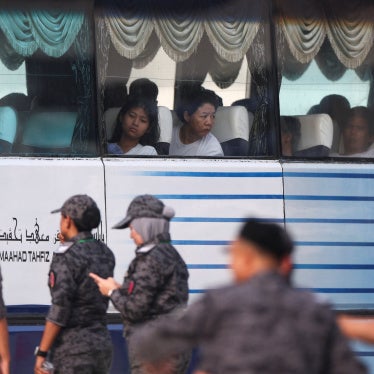
- In February 2025, the government of Prime Minister Paetongtarn Shinawatra sent 40 Uyghur men to China, where they may have faced torture, arbitrary detention, and long-term imprisonment.[29]
- In a November 2025 report, Human Rights Watch documented how Vietnam has increasingly engaged in transnational repression in Thailand.[30] In June 2024 Vietnamese authorities were involved in the arrest in Thailand of a Vietnamese dissident, Y Quynh Bdap, who was subsequently extradited to Vietnam in November 2025.[31] Thai police have continued to detain Vietnamese refugees and asylum seekers, including those recognized by the United Nations Refugee Agency, UNHCR, at times at the apparent request of Vietnamese authorities. Vietnamese officials have been observed inside Thai immigration detention facilities allegedly pressuring detained refugees and asylum seekers to return to Vietnam.[32]
- Cambodian exiles are also facing increasing risks in Thailand. In November 2024, Thai authorities forcibly returned six Cambodian political opposition activists and a young child putting them at risk of unfair trials and mistreatment in Cambodia.[33] After the murder of former Cambodian opposition parliamentarian Lim Kinya in Bangkok on January 7, 2026, many critics of the Cambodian government living in Thailand have expressed concern for their safety.[34] There has been no progress in police investigation of the killing of Lao refugee Bounsuan Kitiyano in Ubon Ratchathani province in May 2023.[35]
- Thai authorities have refused to consider Lao, Hmong, Uyghur, Rohingya, and North Koreans for refugee status under the National Screening Mechanism.[36] While presented as a step towards greater international protection, the National Screening Mechanism and its implementing regulations largely exclude certain nationalities from access, including migrant workers from Myanmar, Cambodia and Laos. Several hundred Rohingya, including many children, continue to be held in indefinite detention in squalid conditions in immigration detention centers across the country.[37]
- Thailand has sheltered a large number of refugees from Myanmar since the mid-1980s. More than 100,000 Myanmar refugees living in Thailand in camps along the border for four decades lost access to essential food and medical aid due to funding cuts by the United States on July 31, 2025 and by other countries, putting their well-being at serious risk. In August 2025 the Paetongtarn government finally approved measures allowing Myanmar refugees to work legally.[38] The current Anutin government has maintained this policy.
- More recent migrants from Myanmar also need attention. Since the 2021 military coup in Myanmar, millions of Myanmar nationals have sought safety in Thailand fleeing violence, persecution, a collapsing economy, and aid blockages. Nearly half of all Myanmar nationals in Thailand are estimated to be undocumented. Human Rights Watch, in a July 2025 report, documented that Thailand is denying Myanmar nationals a regular path to secure legal status, with authorities using their vulnerabilities to exploit or extort money from them, or push them back into Myanmar. [39]
- Hundreds of thousands of Cambodian workers left Thailand after border clashes between the two countries in July and December 2025, fearing mistreatment and immigration raids.[40] In November 2025, the Anutin government announced the suspension of a policy that allows about 100,000 migrant workers from Cambodia to stay in Thailand for an additional year after their work permits expire.[41]
Recommendations
- Ratify the 1951 Refugee Convention and its 1967 Protocol without reservations, and ensure that Thai immigration law, regulations, and policies fully comply with international and domestic obligations on non-refoulement.
- Cease collaboration in transnational repression with foreign governments.
- Thoroughly and impartially investigate allegations of harassment, intimidation, threats, surveillance, and forced returns from Thailand by foreign governments or their agents against refugees and asylum seekers in Thailand and the role of Thai officials in such actions.
- Implement a Temporary Protection Policy for Myanmar nationals who have fled Myanmar since the 2021 coup, allowing for legal status, freedom of movement, and access to health care, education, and work.[42]
- Repeal Thailand’s National Screening Mechanism implementing regulations that restrict protection based on the nationality of those that can apply.
Labor Rights
- The Thai government, while upholding numerous labor rights protections and social protections for Thai workers, continues to delay labor rights reforms and has failed to adopt key protections for millions of migrant workers in Thailand at risk of trafficking, exploitation, and underpayment or non-payment of wages. Despite numerous promises by successive governments, Thailand has failed to reform its labor laws to allow non-Thai migrant workers the rights to start or lead unions. The government has also often failed to protect Thai labor leaders and workers from retaliation for organizing.
Migrant workers of all nationalities are barred by Thailand’s Labor Relations Act from organizing and establishing labor unions or serving as a government-recognized labor union leader.[43]
Recommendations
- Ratify the International Labor Organization (ILO) Conventions No. 87 (guaranteeing workers the right to organize and form trade unions freely) and No. 98 (ensuring workers’ rights to collective bargaining and protection against anti-union discrimination); and respond to comments and implement recommendations made by the ILO Committee of Experts on Convention No. 29 (on forced labor) and Convention No. 105 (on state-imposed forced labor).
- Reform Thailand’s labor laws—specifically the Labor Relations Act and the Labor Protection Act—in consultation with trade unions and labor groups, including by providing migrant workers the right to organize trade unions or serve as union leaders.
Border Clashes with Cambodia
- Border clashes between Thailand and Cambodia from July 24-28 and December 8-27, 2025 killed and injured civilians and damaged civilian objects, medical facilities, and religious and cultural sites.[44] Thailand accused Cambodia of carrying out indiscriminate attacks with multi-barrel rocket launchers and using anti-personnel mines. Cambodia alleged that Thai airstrikes and artillery fire had damaged Ta Krabey Temple and the UNESCO World Heritage site of Preah Vihear Temple in Cambodia.[45] Thailand used internationally prohibited cluster munitions.[46]
Recommendations
- Set a clear timeline with Cambodia to urgently establish a fact-finding mechanism within the framework of the 1997 Mine Ban Treaty, and to carry out mine clearance without delay.
[1] Ministry of Foreign Affairs, “Thailand’s Candidature to the Human Rights Council (HRC) for the Term 2025-2027,” available at: https://image.mfa.go.th/mfa/0/OznAy3tii2/HRC/%E0%B9%81%E0%B8%9C%E0%B9%88%E0%B8%99%E0%B8%9E%E0%B8%B1%E0%B8%9A_THAILAND4HRC_outline.pdf
[2] UPR 39 Thailand Thematic List of Recommendations, available at: https://www.ohchr.org/sites/default/files/2022-05/UPR39_Thailand_Thematic_List_of_Recommendations.doc
[3] Thai Lawyers for Human Rights, “Political Prosecution in Thailand,” March 5, 2026, available at: https://www.facebook.com/photo.php?fbid=1331531032150697&set=pb.100058814370219.-2207520000&type=3
[4] Thai Lawyers for Human Rights, “Political Prosecution in Thailand,” March 5, 2026, available at: https://www.facebook.com/photo.php?fbid=1331531032150697&set=pb.100058814370219.-2207520000&type=3
[5] Bangkok Post, “Activist sentenced to 46 years over Facebook posts,” December 12, 2025, available at: https://www.bangkokpost.com/thailand/general/3154819/activist-sentenced-to-46-years-over-facebook-posts
[6] Human Rights Watch, “Thailand: US Scholar Detained on Royal Insult Charge,” April 8, 2025, available at: https://www.hrw.org/news/2025/04/08/thailand-us-scholar-detained-royal-insult-charge
[7] CNN, “Prosecutors in Thailand drop royal defamation case against US scholar,” May 1, 2025, available at: https://edition.cnn.com/2025/05/01/asia/thailand-lese-majeste-paul-chambers-intl-hnk
[8] Thai Lawyers for Human Rights, “Jatuporn "New" Sae-Ung sentenced to three years in prison for mocking Queen Suthida,” September 15, 2022, available at: https://www.facebook.com/photo.php?fbid=1331531032150697&set=pb.100058814370219.-2207520000&type=3
[9] Human Rights Council Working Group on Arbitrary Detention, “Opinion No. 28/2024 concerning Arnon Nampa (Thailand),” October 9, 2024, available at: https://www.ohchr.org/sites/default/files/documents/issues/detention-wg/opinions/session100/a-hrc-wgad-2024-28-thailand-advance-edited.pdf
[10] Human Rights Watch, “Thailand: Constitutional Court Dissolves Opposition Party,” August 7, 2024, available at: https://www.hrw.org/news/2024/08/07/thailand-constitutional-court-dissolves-opposition-party
[11] Bangkok Post, “People’s Party Preparing Defence in Ethics Case,” March 31, 2026, available at: https://www.bangkokpost.com/thailand/politics/3228039/peoples-party-preparing-defence-in-ethics-case
[12] Human Rights Watch, “Thailand: Court Ruling Could Subvert Democratic Rule,” April 10, 2024, available at: https://www.hrw.org/news/2024/04/10/thailand-court-ruling-could-subvert-democratic-rule
[13] Human Rights Watch, “Thailand: Free Speech Activists Get 32-Month Sentences,” February 23, 2026, available at: https://www.hrw.org/news/2026/02/24/thailand-free-speech-activists-get-32-month-sentences
[14] Human Rights Council Special Procedures, “Thailand: UN rights expert concerned by the continued use of lèse-majesté prosecutions,” February 6, 2017, available at: https://www.ohchr.org/en/press-releases/2017/02/thailand-un-rights-expert-concerned-continued-use-lese-majeste-prosecutions
[15] Bhum Jai Thai Party, “Bhum Jai Thai Opposes 112 Amendment,” October 19, 2022, available at: https://bhumjaithai.com/news/80723
[16] Thai Lawyers for Human Rights, “Political Prosecution in Thailand,” March 5, 2026, available at: https://www.facebook.com/photo.php?fbid=1331531032150697&set=pb.100058814370219.-2207520000&type=3
[17] Thai Lawyers for Human Rights, “Political Prosecution in Thailand,” March 5, 2026, available at: https://www.facebook.com/photo.php?fbid=1331531032150697&set=pb.100058814370219.-2207520000&type=3
[18] Thai Lawyers for Human Rights, “Political Prosecution in Thailand,” March 5, 2026, available at: https://www.facebook.com/photo.php?fbid=1331531032150697&set=pb.100058814370219.-2207520000&type=3
[19] Human Rights Watch, “Letter to Thailand Prime Minister Anutin Charnvirakul,” November 19, 2025, available at: https://www.hrw.org/news/2025/11/19/letter-to-thailand-prime-minister-anutin-charnvirakul
[20] BioThai Foundation, “Prosecutor Indicts “BioThai” in Defamation Case Filed by CPF Over Blackchin Tilapia Data,” September 11, 2025, available at: https://biothai.org/prosecutor-indicts-biothai-in-defamation-case-filed-by-cpf-over-blackchin-tilapia-data/
[21] Human Rights Council Special Procedures, “Thailand: UN Experts Alarmed by Renewed Harassment and Intimidation of Human Rights Defenders Angkhana Neelapaijit and Sunai Phasuk,” November 11, 2025, available at: https://www.ohchr.org/en/press-releases/2025/11/thailand-un-experts-alarmed-renewed-harassment-and-intimidation-human-rights#:~:text=GENEVA%20%E2%80%93%20UN%20experts*%20today%20expressed%20grave%20concern,human%20rights%20defenders%2C%20Angkhana%20Neelapaijit%20and%20Sunai%20Phasuk
[22] Human Rights Watch, “Thailand: Army Trainers Jailed for Conscript’s Death,” June 5, 2025, available at: https://www.hrw.org/news/2025/06/05/thailand-army-trainers-jailed-conscripts-death
[23] Human Rights Watch, “We Thought We Were Safe,” May 16, 2025, vailable at: https://www.hrw.org/feature/2024/05/16/we-thought-we-were-safe/repression-and-forced-return-of-refugees-in-thailand
[24] National Human Rights Commission of Thailand, “Report on Human Rights Violations 22/2567,” February 20, 2025, available at: https://static.nhrc.or.th/file/content/pdf/27662/22-1716800488.pdf
[25] Human Rights Watch, “Thailand: 20 Years of Injustice for Tak Bai Massacre Victims,” October 28, 2024, available at: https://www.hrw.org/news/2024/10/28/thailand-20-years-injustice-tak-bai-massacre-victims
[26] Human Rights Watch, “Thailand’s 2010 Red Shirt Protests and the Government Crackdown,” May 3, 2011, available at: https://www.hrw.org/report/2011/05/03/descent-chaos/thailands-2010-red-shirt-protests-and-government-crackdown
[27] National Human Rights Commission of Thailand, “Executive Summary: Independent Committee for the Investigation, Study and Analysis of the Formulation and Implementation of Narcotic Suppression Policy,“ available at: https://lms.nhrc.or.th/ulib/document/Summary/S09696.pdf
[28] Human Rights Watch, “We Thought We Were Safe,” May 16, 2025, available at: https://www.hrw.org/feature/2024/05/16/we-thought-we-were-safe/repression-and-forced-return-of-refugees-in-thailand
[29] Human Rights Watch, “Thailand: 40 Uyghurs Forcibly Sent to China,” February, 27, 2024, available at: https://www.hrw.org/news/2025/02/27/thailand-40-uyghurs-forcibly-sent-china
[30] Human Rights Watch, “Thailand: Vietnamese Refugees at Risk from Hanoi,” November 13, 2025, available at: https://www.hrw.org/news/2025/11/13/thailand-vietnamese-refugees-at-risk-from-hanoi
[31] Human Rights Watch, “Thailand: Montagnard Activist Extradited to Vietnam,” December 1, 2025, available at: https://www.hrw.org/news/2025/12/02/thailand-montagnard-activist-extradited-to-vietnam
[32] Human Rights Watch, “Thailand: Vietnamese Refugees at Risk from Hanoi,” November 13, 2025, available at: https://www.hrw.org/news/2025/11/13/thailand-vietnamese-refugees-at-risk-from-hanoi
[33] Human Rights Watch, “Thailand: Cambodian Refugees Forcibly Returned,” November 29, 2024, available at: https://www.hrw.org/news/2024/11/29/thailand-cambodian-refugees-forcibly-returned
[34] Human Rights Watch, “Thailand: Cambodian Opposition Politician Gunned Down,” January 9, 2025, available at: https://www.hrw.org/news/2025/01/09/thailand-cambodian-opposition-politician-gunned-down
[35] Human Rights Watch, “Thailand: Lao Refugee Gunned Down,” May 24, 2023, available at: https://www.hrw.org/news/2023/05/24/thailand-lao-refugee-gunned-down
[36] Human Rights Watch, “Letter to Thailand Prime Minister Anutin Charnvirakul,” November 19, 2025, available at: https://www.hrw.org/news/2025/11/19/letter-to-thailand-prime-minister-anutin-charnvirakul
[37] Fortify Rights, “Thailand: Ensure 'National Screening Mechanism' is Accessible to All Refugees," December 15, 2022, available at: https://www.fortifyrights.org/tha-inv-2022-12-15/
[38] Bangkok Post, “Myanmar refugees now allowed to work in Thailand,” October 1, 2025, available at: https://www.bangkokpost.com/thailand/general/3113985/myanmar-refugees-now-allowed-to-work-in-thailand
[39] Human Rights Watch, “I’ll Never Feel Secure,” July 14, 2925, available at: https://www.hrw.org/report/2025/07/14/ill-never-feel-secure/undocumented-and-exploited-myanmar-nationals-in-thailand
[40] Human Rights Watch, “Cambodia: Returned Migrant Workers Face Hunger, Joblessness,” November 25, 2025, available at: https://www.hrw.org/news/2025/11/25/cambodia-returned-migrant-workers-face-hunger-joblessness
[41] Bangkok Post, “Thailand Rules Out Extension of Stay for Cambodian Workers,” November 10, 2025, available at: https://www.bangkokpost.com/business/general/3134558/thailand-rules-out-extension-of-stay-for-cambodian-workers
[42] Human Rights Watch, “I’ll Never Feel Secure,” July 14, 2925, available at: https://www.hrw.org/report/2025/07/14/ill-never-feel-secure/undocumented-and-exploited-myanmar-nationals-in-thailand
[43] Human Rights Watch, “World Report 2026,” available at: https://www.hrw.org/world-report/2026/country-chapters/thailand
[44] Human Rights Watch, “Thailand/Cambodia: Protect Civilians Amid Border Clashes,” December 23, 2025, available at: https://www.hrw.org/news/2025/12/23/thailand/cambodia-protect-civilians-amid-border-clashes
[45] Human Rights Watch, “Thailand/Cambodia: Protect Civilians Amid Border Clashes,” December 23, 2025, available at: https://www.hrw.org/news/2025/12/23/thailand/cambodia-protect-civilians-amid-border-clashes
[46] Human Rights Watch, “Thailand/Cambodia: Protect Civilians Amid Border Clashes,” December 23, 2025, available at: https://www.hrw.org/news/2025/12/23/thailand/cambodia-protect-civilians-amid-border-clashes