- The Chinese government is interrogating Uyghur Australians visiting Xinjiang, pressing them to collect information on Uyghurs in Australia, including Uyghur language schools.
- The Chinese government exploits the vulnerability of separated Uyghur families as an opportunity for surveillance and strict monitoring of the Uyghur community in Australia, which has a chilling effect on diaspora activities.
- Australia and other governments should respond to Beijing’s intimidation of the Uyghur diaspora with public statements, clear travel advisories, safe reporting channels, criminal investigations, and support for family reunification.
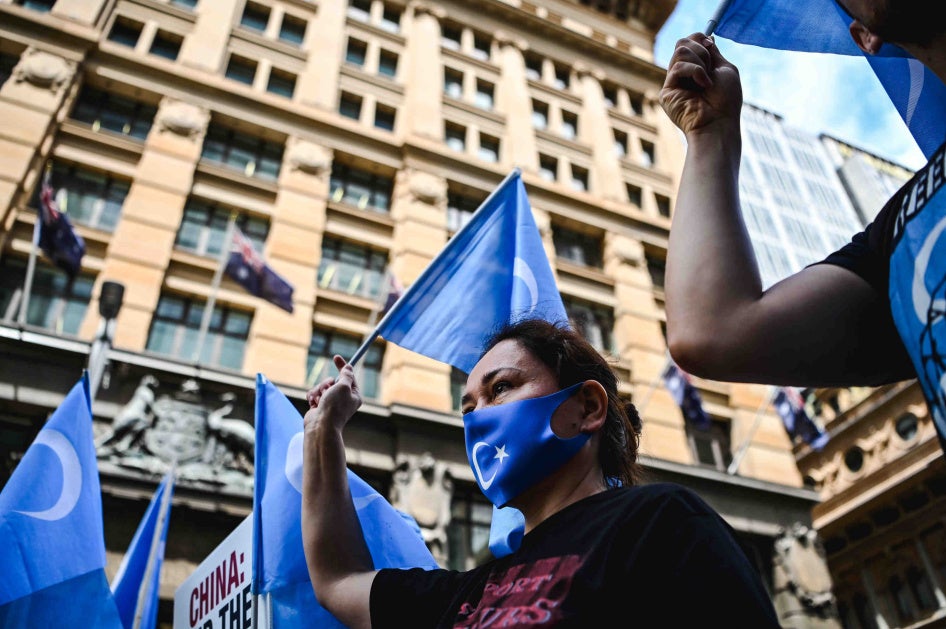
(Sydney) – The Chinese government is interrogating Uyghur Australians visiting Xinjiang, pressing them to collect information on Uyghurs in Australia, Human Rights Watch said today as its executive director, Philippe Bolopion, visited Australia.
Chinese authorities have long engaged in transnational repression—human rights abuses committed beyond a country’s borders to curtail dissent—against Uyghurs living abroad and their relatives in Xinjiang, by targeting activists critical of the Chinese government. By pressing visitors to provide information about Uyghur activists, organizations, and language schools in Australia, the authorities are repressing the rights of Uyghurs in Australia to freedom of expression, association, culture, and family life.
“The Chinese government exploits the vulnerability of separated Uyghur families as an opportunity for surveillance and disruption of communities abroad,” said Philippe Bolopion, executive director at Human Rights Watch. “Interrogating Uyghurs visiting Xinjiang and strict monitoring of diaspora activities have a chilling effect emblematic of Beijing’s transnational repression in Australia.”
Human Rights Watch interviewed 11 Uyghur Australian citizens and permanent residents in Sydney, Melbourne, and Adelaide in April and May 2026. They included recent visitors to Xinjiang and Australia-based activists.
Uyghurs in Australia who have been unable to visit their families in Xinjiang said they have no information about relatives there or can communicate with them only under strict official surveillance, with Chinese government officials monitoring their calls.
In recent years, the Chinese government has permitted Uyghurs from Australia and elsewhere in the diaspora to make restricted visits to the Xinjiang Uyghur Autonomous Region. Such visits are important for many Uyghur families who have been separated since the government’s abusive Strike Hard Campaign in Xinjiang began in 2016. However, these visits have also provided the local authorities with opportunities to question or interrogate visitors and monitor their movements.
Uyghurs living abroad who have been able to visit Xinjiang need to pass stringent Chinese government vetting processes. Those with foreign passports eligible for a visa-free program that began in 2024 have been told by their families in Xinjiang that they need to undergo background checks and obtain prior approval from local authorities.
Three Uyghur Australians, who are not activists, described traveling to Xinjiang on Australian passports under this visa-free program. They said their families in Xinjiang had to seek permission from local authorities before their visits.
One said they first had to check in at a government-designated hotel, rather than their family home, and that their relatives in Xinjiang told them they would face problems with the authorities if they did not comply. The visiting Australians also said they had to report their daily activities in Xinjiang to local authorities and were kept under heavy surveillance, especially when traveling outside Urumqi, the regional capital, where restrictions seem less severe than in other cities.
Another Uyghur Australian said authorities interrogated him more than a dozen times, once for more than seven hours: “They asked for addresses and phone numbers of several prominent Uyghur activists in Australia.” When he said he did not have that information, the police pressed him to monitor the activists’ activities upon returning to Australia and photograph them during events.
A third person who was also interrogated by the police in Xinjiang said she was put under severe pressure because she feared for her and her family’s safety. “How could I say no to anything they asked me to do?”
Others interviewed said they were questioned about Uyghur language schools in Australia; in Xinjiang the authorities have sought to erase Uyghur culture and language.
Some Uyghur Australians interviewed said they would not return to Xinjiang, even with the visa-free program, because they feared being detained or imprisoned, and would not be able to communicate with their families free from government control.
On August 7, Human Rights Watch sent a summary of its findings to the Chinese and Australian governments. The Chinese government has not responded. Australia’s Department of Home Affairs responded on August 14 and said in part, “The Australian Government takes the issue of all forms of foreign interference, including transnational repression seriously. It is unacceptable for any foreign Government to target members of community in ways that prevent individuals from exercising their fundamental rights and freedoms in Australia.”
Australian officials have raised the cases of separated Uyghur Australian families with their counterparts in Beijing but with little success. In December 2020, the Uyghur Australian Sadam Abdusalam reunited with his wife and child with support from the Australian government.
But numerous other Uyghur families in Australia remain unable to reunite with even immediate family members because their loved ones are banned from leaving Xinjiang. They also worry that their peaceful actions in Australia affect their families’ freedom in Xinjiang or any eventual opportunity to reunite.
The Chinese government’s abuses against visiting Uyghur Australians have enabled transnational repression by remotely isolating and marginalizing Uyghur activists in Australia, as other Uyghurs fear being seen with them at public events.
In July, China’s new Law on Promoting Ethnic Unity and Progress took effect. The law contains provisions having extraterritorial application that could be used to deny rights to Uyghurs abroad, and other diaspora groups. Article 63 broadly states that “organizations and individuals outside the territory of the People’s Republic of China” that “undermine national unity and progress or incite ethnic division” will be held “legally accountable.”
The Australian government and other affected governments should adopt measures to protect their citizens and residents from Beijing’s acts of transnational repression, Human Rights Watch said.
“The Chinese government’s transnational repression poses a serious threat to the rights and freedoms of Uyghur Australians who wish to maintain family ties in Xinjiang while preserving their culture and identity in Australia,” Bolopion said. “Australia and other affected governments should take meaningful steps to address these concerns.”
For accounts of repression against Uyghurs in Australia, please see below.
China’s Crimes Against Humanity in Xinjiang
Over the past decade, the Chinese government has committed widespread and systematic abuses against Uyghurs and other Turkic Muslims in Xinjiang that constitute crimes against humanity. These include mass arbitrary detention, unjust imprisonment, mass surveillance, religious persecution, and forced labor.
Beijing’s transnational repression derives its impact abroad from these crimes. Chinese authorities use the vulnerability of relatives in Xinjiang, restrictions on travel and communication, and fear of retaliation to pressure Uyghurs abroad.
Since the start of Chinese leader Xi Jinping’s Strike Hard Campaign in Xinjiang in late 2016, the authorities have arbitrarily confiscated Uyghurs’ passports in the region, and punished Uyghurs for contacting family members and others abroad. While the authorities are now permitting select Uyghurs to travel internationally or to visit family members in Xinjiang, they continue to exert tight control over those who travel.
Interrogation and Pressure to Monitor Uyghurs in Australia
Uyghur Australian citizens interviewed said they experienced heavy surveillance and interrogation while they were visiting Xinjiang. They said that Chinese authorities used controlled family visits to question them and pressure them to monitor Uyghur community life after they returned to Australia.
One visitor said:
I renounced my [Chinese] citizenship more than a decade ago, but the police had all the information about me. They asked me about everything—my connection to Xinjiang, even [pressed me] to tell them the primary school I went to. They also repeatedly asked questions about my life in Australia, my friends, family, and others in the diaspora. They specifically asked for addresses, phone numbers, and other information about multiple prominent activists. I told them I didn’t know and that I don’t go to political events. Then they said, “You have to give us something.”
Then they started asking me to monitor Uyghur organizations [in Australia] and provide them with more information about their activities. “If possible, take photos of people in community gatherings,” they said. “We know it is difficult for you and looks suspicious, but you can try.”
A second visitor said:
I had to register with local authorities and report my everyday activities to the point-of-contact person, including places I visited and people I met. They interrogated me once and started asking questions about my life and people I know in Australia.... I don’t think I will return. I didn’t feel safe. I felt like they could do anything or detain me.... How could I say no to anything they asked me to do? In that situation, I panicked and only thought about complying with everything and returning to Australia safely.
A third visitor said:
From what I have witnessed, every Uyghur I met back home lives in fear. Children speak [Mandarin] Chinese at school, and when they accidentally speak Uyghur, it can escalate with local authorities [concluding that] parents have ideological problems. When I tried to go to an Eid [Islamic] prayer during my visit, I went to four different mosques and they were all closed. No one [around me] dared to go to a mosque anyway. Everyone back home says things are getting back to normal in public settings. But in private, some people told me about horrible things that happened over the last 10 years.
Family Separation as Leverage Against Uyghurs in Australia
Many Uyghur Australians remain separated from their families in Xinjiang and are deeply concerned for their safety. Chinese government threats or pressure against their relatives in Xinjiang are powerful tools for silencing Uyghurs across borders, deterring criticism of Beijing’s human rights violations in Xinjiang, and promoting a false sense of normalcy in the region. One Uyghur man whose family members are all in Xinjiang said he did not feel free in Australia because of Chinese government intimidation:
Everything I know and everyone I love are back in the homeland [Xinjiang] under immense pressure and social control. Anything that I do here in Australia that the Chinese government thinks is problematic can destroy their lives, even if my acts are peaceful or lawful.
A Uyghur man said that his spouse is serving an arbitrary long prison term for a vague charge of “inciting ethnic hatred,” which Xinjiang authorities often use to punish peaceful expression of Uyghur identity, and that his two children are with his parents in Xinjiang and prevented from traveling on their own. “The Chinese government keeps my family hostage to restrict my freedoms here in Australia,” he said.
He also said that Chinese authorities used controlled communication with relatives in Xinjiang to pressure him for information about other people in the Uyghur community in Australia:
Last year, when they [Chinese authorities] got in touch with me, they asked for information about other people in the community [in Australia], which I declined to give. The Chinese government told my family [in Xinjiang] that they cannot speak to me without their authorization. Officials came to my family’s house to facilitate a call with me. Why should I need government officials to talk to my parents or children?
Others said they have had no contact at all as Xinjiang authorities punished people for contacting relatives abroad during the Strike Hard Campaign and exerted strict surveillance, especially toward activists critical of the Chinese government. One Uyghur individual said they learned about their father’s death in 2020 from a third party six months after he died, and had no communication with their elderly mother since 2017.
The authorities have also silenced people’s activism in Australia through limits on their communication with their families in Xinjiang. One woman said that local officials had tried to pressure her through a family member in Xinjiang to stop her peaceful activism against Beijing’s mass arbitrary detention campaign.
A Uyghur Australian who previously pressed for his spouse’s release from detention has been advocating for Australian officials to help press Chinese authorities to allow his spouse to leave Xinjiang. The Chinese authorities have targeted the activist for engaging in peaceful activities, including with retaliatory interrogations and house arrests of family members in Xinjiang. The activist said:
It’s been 10 years since I lost contact with the love of my life, who was unjustly imprisoned and recently completed her sentence. Even after her release, the Chinese government puts immense pressure on her not to contact me. Authorities did not allow her to apply for a passport. It’s a no-release release, where she has no freedom even outside the prison. Family separation caused severe mental and emotional trauma for me. I need my government to press [Beijing] for my reunion with my family members.
Targeting Uyghur Language Schools in Australia
Chinese authorities have questioned visiting Uyghur Australians about Uyghur language schools in Australia, undermining these communities’ exercise of language and cultural rights.
Australia, home to approximately 5,000 Uyghurs, established one of the first Uyghur language schools in the diaspora in Adelaide in 1992 to preserve Uyghur language and culture abroad. There are currently four Uyghur language weekend schools in Australia: in Sydney, Melbourne, Adelaide, and Brisbane.
Diaspora members said student numbers at the language schools have declined in recent years, in part because some Uyghur Australians visiting Xinjiang faced intimidation for sending their children to those schools. Uyghur diasporas in the US and Canada have observed a similar pattern, as Chinese consulates have denied visas to some Uyghurs because their children attend Uyghur schools.
One recent Xinjiang visitor said the authorities pressured them to provide information about the activities of a Uyghur language school in Adelaide:
[The police] specifically asked me if my children go to Uyghur weekend school and who their teacher is. The police said, “When you return to Australia, gather information about Uyghur schools, and whose children go to those schools. If you apply for longer-term residency in Xinjiang in the future, those collaborations will strengthen your application.”
These pressure tactics target diaspora efforts to preserve Uyghur language and culture while the government is seeking to erase Uyghur identity in Xinjiang. The recent visitor said:
My Australian-born child went back to my homeland with me. I wanted them to have a memory of their hometown and experience playing on streets with other Uyghur kids in the neighborhoods where I grew up. Despite being raised in Australia, they speak fluent Uyghur. However, kids around their age in the Uyghur neighborhood [in Xinjiang], where some of my family still lives, could not speak any Uyghur. They only spoke [Mandarin] Chinese, so my kid could not even communicate with them. I’ll try even harder to keep the Uyghur language alive here in Australia. After what I saw back there, I won’t be going back again.
Chilling Effect on Uyghur Community Life in Australia
Beijing’s pressure has a chilling effect beyond formal activism, affecting social events, community gatherings, and ordinary family life among Uyghurs in Australia. Australian activists said that many diaspora members are fearful of the Chinese government’s reach.
“Some of my close relatives did not invite me to their weddings here in Australia, because I am politically active,” one Uyghur activist said. He said that the organizers feared for the safety of some participants’ family members in Xinjiang simply for appearing in a public event with him. “It’s a devastating case of transnational repression harming our social life.”
Another Uyghur activist, who runs a nongovernmental organization in Adelaide, said some members of the organization were repeatedly interrogated by Xinjiang police during their visits about her and her organization. When they returned to Australia, they told her that they could no longer appear with her in any public setting.
The founder of a nongovernmental organization in Sydney said:
Uyghurs deprived of their freedoms in a free land—this is how I describe many members of the Uyghur community in Australia who are fearful of the Chinese government’s long arm and therefore shy away from exercising their rights here in Australia. Uyghurs who have family ties back in the homeland [Xinjiang] are afraid of retaliation and therefore do not risk anything, so they don’t come to protests, which is understandable. But even social events or Uyghur language [weekend] schools are problematic for them; that, to me, is an extreme example of transnational repression.
One diaspora member said many Uyghurs do not report intimidation because they fear retaliation and do not believe the Australian government has done enough to protect them:
I am an Australian. I live in Australia and am free to exercise my rights. But when the Chinese government comes after me when I do so, I don’t believe my government is doing enough to protect me.... Many members of the diaspora do not report incidents of intimidation [to the Australian government] because they feel their reporting will result in further retaliation.... Are we less Australian than any other Australian? We need more protection for the community so we can preserve our language and culture in Australia, which are under existential threat in our homeland.
Another diaspora member said that the Australian government needs to do more to press Beijing to release their loved ones and allow them to travel abroad:
Families of Uyghur Australians are families of Australians. They should be assisted and supported by the [Australian] government with faster visa processes, restoration of communication, and consular services. Australian government officials listened to me in tears when I shared my story with them several times in the last couple of years, but nothing has really changed in my life. Some Uyghurs are going back to see their long-separated families. Good for them. Why can’t I? Simply because I spoke out against the injustice against my family? Why should I be punished for exercising my freedoms here in Australia?
China’s Transnational Repression in Australia
Chinese authorities have engaged in transnational repression in Australia through tactics aimed at silencing critics and deterring activism, targeting not only Uyghurs, but Tibetans, Hongkongers, Chinese dissidents, and researchers and academics. Reported cases include pressure on family members in China, harassment and intimidation, disinformation campaigns, protest disruptions, sexual harassment, and violations of academic freedom. The Guardian reported in April that Chinese authorities charged a Chinese student with secession and sentenced him to six years in prison because he participated in protests while studying in Sydney.
The Australian government considers “coercion of an individual by threatening their family or associates overseas to force them to comply” a form of foreign interference under the Criminal Code Act 1995 if linked to a foreign government or proxy. Canberra has issued joint statements on transnational repression, conducted outreach to affected communities, and established a National Security Hotline for reporting such incidents. However, these efforts remain insufficient to meaningfully address the full extent of the Chinese government’s transnational repression in Australia.
Recommendations to the Australian Government
The Australian government should:
- In addition to existing travel advisories, issue a travel advisory for Uyghur Australians visiting Xinjiang, and for other minority groups targeted by the Chinese government, informing them specifically about Chinese government transnational repression, with clear instructions for reporting incidents and seeking consular services.
- Work with affected communities to draft and enact specific, comprehensive legislation on transnational repression, as existing legislation on foreign interference does not capture the full extent of transnational repression. The legislation should be consistent with human rights norms and address threats and intimidation, disinformation campaigns, protest disruptions, sexual harassment, and violations of academic freedom by the Chinese government against Australian residents, citizens, and their families in China.
- In addition to investigating incidents of transnational repression, publicize findings and hold those responsible accountable, including through targeted sanctions, travel bans, or visa denials on responsible foreign officials.
- Provide clear, accessible guidance, especially to naturalized Uyghur citizens with connections to Xinjiang, and other affected communities in Australia on reporting transnational repression, including harassment or threats involving relatives in Xinjiang, and ensure reports are handled safely and confidentially.
- Engage in confidence-building measures with affected diaspora communities and provide psychosocial, digital security, and legal support for victims of transnational repression.
- Publicly condemn the Chinese government for crimes against humanity in Xinjiang, including on the fourth anniversary of the landmark UN human rights office report on Xinjiang on August 31.
- Press for the release of arbitrarily detained family members of Uyghur Australians and other members of diaspora communities.
- Expedite family reunification of Uyghur Australians through established humanitarian visa and family reunification visa programs, and press Chinese officials to respect the rights of family members to leave China.