(Nairobi) – An apparent Ethiopian government airstrike on a residential compound in Ethiopia’s northern Tigray region on August 20, 2026, should be investigated as a possible war crime, Human Rights Watch said today. The attack wounded 13 civilians, including seven children.
The airstrike hit the Daero neighborhood of Mekelle, Tigray’s regional capital, which had no evident military targets, making the strike unlawfully indiscriminate. Ethiopian authorities should impartially and transparently investigate the attack, prosecute those responsible for any wrongdoing, and adequately compensate the victims.
“The resumption of hostilities in northern Ethiopia heightens concerns about unlawful attacks and the grave threat posed to civilians,” said Laetitia Bader, deputy Africa director at Human Rights Watch. “To prevent further harm to civilians, the Ethiopian military needs to abide by the laws of war and ensure that they take all feasible precautions before carrying out any attack.”
Between August 21 and September 6, Human Rights Watch interviewed three survivors of the Daero attack, two medical workers, and two residents who visited the site. Human Rights Watch also analyzed satellite imagery and verified photographs and videos depicting the attack site and remnants of an air-dropped munition. Additional photographs and descriptions of blast and fragmentation injuries were consistent with the detonation of an air-dropped general-purpose bomb. Human Rights Watch contacted and wrote to the army’s spokesperson with key questions but at publication had received no response.
On the same day as the attack on the compound, a second airstrike hit Quiha, a neighborhood near Mekelle’s airport that has been used for military purposes. There were no reported casualties in the second strike.
The strikes occurred amid renewed clashes between the Ethiopian federal government and forces of Tigray’s main political party, the Tigray People’s Liberation Front (TPLF), which fought during the 2020-2022 armed conflict. The parties had signed an African Union-mediated cessation of hostilities agreement in November 2022.
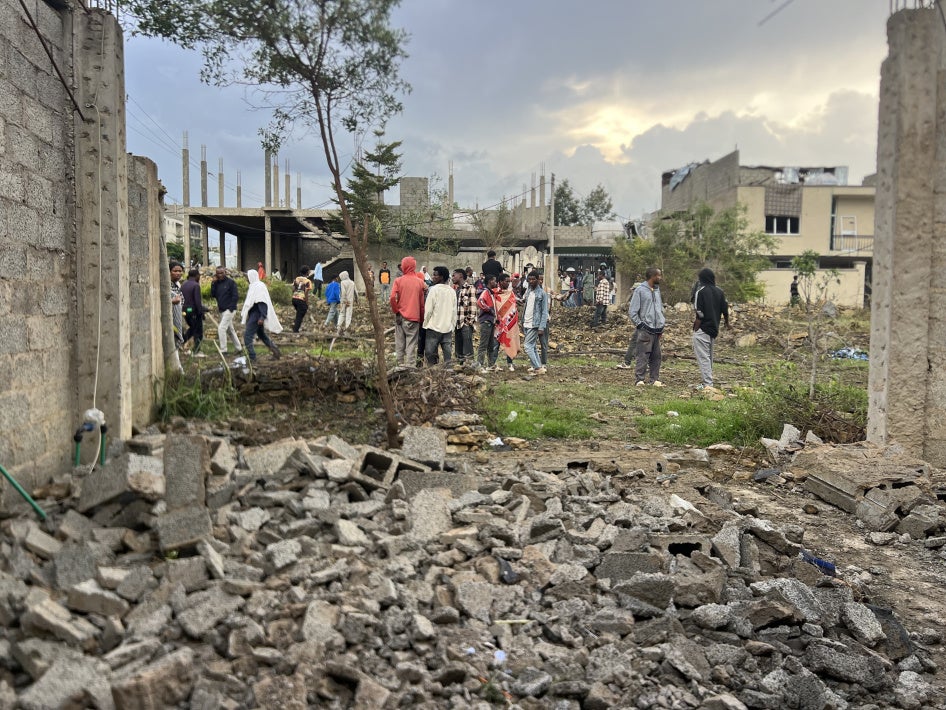
Heavy fighting erupted between Ethiopian federal forces and Tigrayan forces on August 1 near the country’s border with Sudan, and sporadic clashes have continued. Tigrayan regional authorities have accused the federal government of carrying out several airstrikes causing civilian casualties. On September 21, a drone struck an aid convoy in Tigray, which the United States government condemned. On September 23, Tigrayan forces controlled key regional airports, leading Ethiopian airlines to suspend flights. Fighting intensified in Tigray, and spread to the Amhara and Afar regions, pitting federal forces against several armed groups, including Tigrayan forces. Daero residents said that on August 20, shortly after 11 a.m., they saw a likely fighter jet drop a munition that struck an open area in a residential compound for teachers and their families. Residents provided accounts and photos of collapsed walls, doors, and ceilings as the detonation’s blast wave significantly damaged concrete block houses surrounding the impact area.
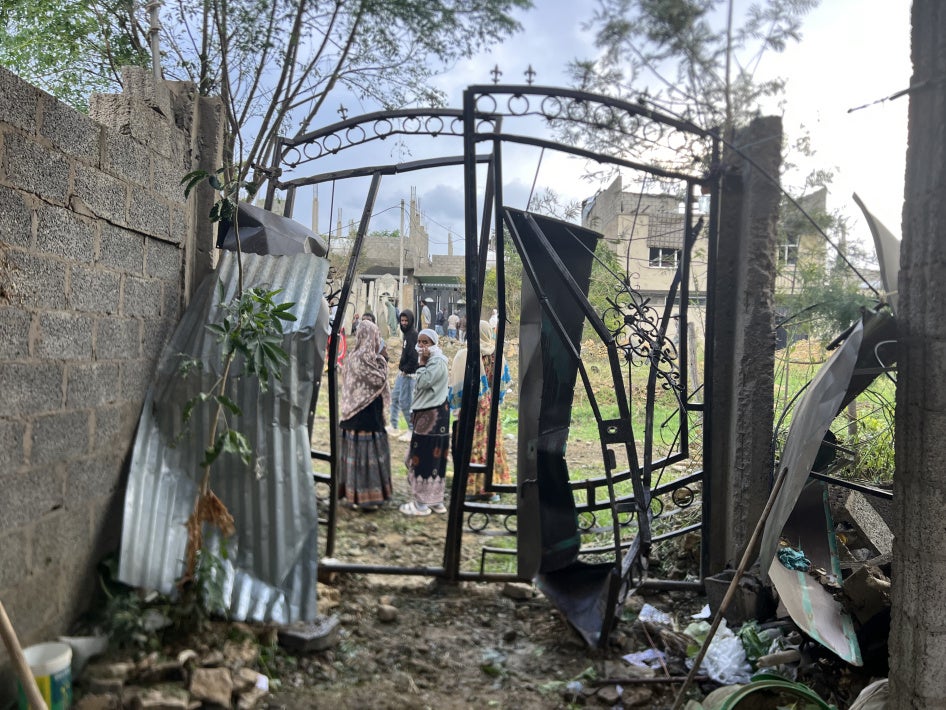
One survivor, who suffered a blast-related soft tissue injury and a deep scalp wound requiring surgery, said: “I was inside with my family when I heard a very loud sound. I went out. A plane came lower and then climbed before it released a weapon. The explosion caused the wall of my compound to completely collapse.”
Another survivor, whose four relatives were injured, said: “My children were in the kitchen. The explosion caused the house to fall on them. I had to dig three of them out from under the corrugated metal and wood.”
A Mekelle resident who went to the site soon after the attack described seeing a “blackened crater” in the compound. The strike “had impacted around 10 houses on both sides of the [residential] block,” the resident said, and caused “holes in the walls [of the houses] struck by some kind of shrapnel.”
A satellite image captured on September 1 shows a crater measuring about four meters in diameter and the collapsed wall of one house. Human Rights Watch also examined photographs and videos recorded by a witness on the day of the attack showing the strike’s aftermath. One video shows a crater in the courtyard and the same collapsed concrete wall visible in satellite imagery. Several photographs show gates and windows shattered by the blast, weapon remnants of various-sized steel fragments, and remnants of the bomb body within the crater.
International humanitarian law, also called the laws of war, requires warring parties to distinguish between military objectives and civilians. Parties must take all feasible precautions to verify that targets are military objectives. Indiscriminate attacks, which strike military targets and civilians or civilian objects without distinction, including attacks not directed at a specific military objective, are prohibited. Individuals who commit serious violations of the laws of war with criminal intent—that is, deliberately or recklessly—can be prosecuted for war crimes.
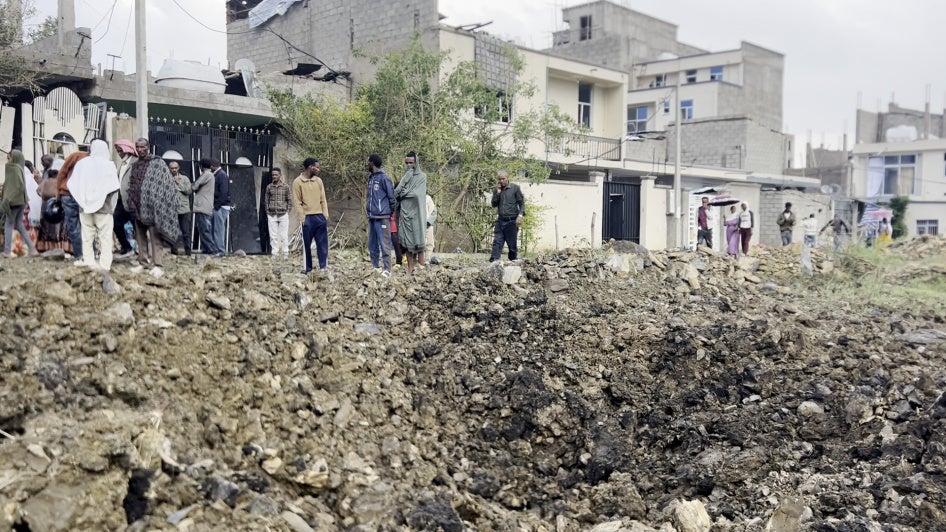
Residents and witnesses said that they saw no Tigrayan fighters or other military presence at the compound or in the vicinity before or following the strike. Human Rights Watch found no evidence to support some public reporting suggesting that the Daero attack was a failed attempt to strike Tigrayan military and civilian leaders nearby. Residents said they rushed the wounded to Ayder Referral Hospital, Tigray’s largest public hospital, for treatment. Medical workers said they treated 13 patients with trauma wounds, including 10 with soft tissue or mild chest injuries, and 3 with more severe injuries, including a 12-year-old girl who had a complicated leg fracture that required surgery.
Availability of medical care in Tigray is minimal. One medical worker said Ayder lacked basic supplies: “We have nothing … We’ve not received anything from the federal government for the last 4-5 months … lifesaving equipment, tubes, anesthesia and the like, unless patients buy from a private pharmacy, we can’t treat.”
Two teachers said they were still living in damaged homes in the compound. Some families of those injured were struggling to afford medical treatment. One survivor whose daughter was harmed in the attack said: “The kids aren’t playing outside anymore. My injured daughter is still in the hospital. We buy everything from outside – the hospital only provides a bed. She needs medication daily, which we can’t afford.”
Following the November 2022 truce, the African Union established a monitoring mechanism, but it has not reported publicly on abuses against civilians. The AU should urgently convene the parties under the agreement’s framework and ensure that the mechanism provides a robust human rights monitoring component and public reporting.
The AU, the UN, concerned governments, and the AU mediator, former Nigerian President Olusegan Obasanjo, and other key leaders, should also publicly call on all warring parties, including those that haven’t signed the agreement, to protect civilians and facilitate impartial investigations into alleged war crimes, Human Rights Watch said.
The UN Office of the High Commissioner for Human Rights should closely monitor the situation in Ethiopia, release regular public reports, and brief the UN Human Rights Council. Ethiopia should endorse the Political Declaration on Strengthening the Protection of Civilians from the Humanitarian Consequences Arising from the Use of Explosive Weapons in Populated Areas.
“The Ethiopian government is legally obligated to impartially investigate the airstrike in Daero and take appropriate action to reduce civilian harm,” Bader said. “Concerned governments should press all the warring parties to meet their international humanitarian law obligations and hold those responsible for abuses to account.”