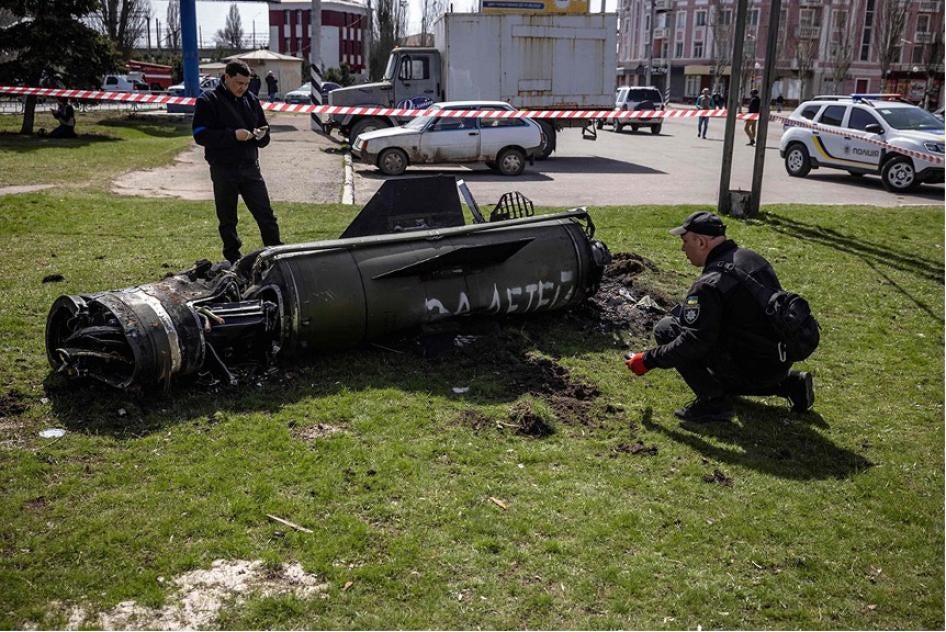
On a brisk spring morning in April 2022, hundreds of Ukrainian civilians crowded in and around a train station in the eastern city of Kramatorsk. They were anxiously waiting for trains to take them to the relative safety of western Ukraine as Russian forces attacked and advanced.
Videos captured the scene: people sipped tea, gathered their families and shifted their belongings around the station. A loud crack split the air. Several people flinched. Then dozens of small bombs rained down on them. The submunitions — or bomblets, as they are called — dispensed from a Russian short-range ballistic missile, high above the train station, fell to the ground, detonated and spread more than 15,000 metal fragments in every direction. Over a hundred people were killed and injured, including many children.
World leaders weighed in and stridently condemned the attack. The world’s attention was fixed on this flagrant breach of the laws of war.
It is a truism that wars are riven with violence, destruction and loss. At times, the violence may seem endless and, for those who experience it, can feel limitless. But conduct in war has moral, ethical and legal limits. And those limits are aimed at limiting suffering, particularly the suffering of civilians. One area where these limits have often found greater success is in the numerous rules, treaties, conventions and instruments that impose limits on the weapons used. Often these limits are derived from the horrifying experiences of their use and the human toll they are capable of exacting.
During the First World War armies used poison gas, which countries had sought to limit thorough hundreds of years of agreements. Toxic chemicals were released from cylinders or loaded into artillery projectiles and lobbed across the front lines. Chlorine and phosgene gas, both choking agents, killed tens of thousands by causing lungs to fill with fluid. Blistering agents, such as so-called “mustard gas”, were dispersed from artillery-fired canisters and wafted over trench lines onto unprotected soldiers.
Nations responded by outlawing chemical and biological weapons in a 1925 Geneva Protocol and again in the 1993 Chemical Weapons Convention (CWC). As of today, 193 countries have ratified the 1993 treaty.
Since the CWC came into force, there have been violations — notably by Iraq under Saddam Hussein and by Syria under Bashar Al-Assad. But the use of chemical warfare remains uniformly condemned and institutions have been erected specifically for monitoring and investigating the production, stockpiling, transfer and use of these weapons.
The use of incendiary weapons, which produce fire through a chemical reaction, has also been regulated. As was evident during attacks by Russian and Syrian armed forces against opposition-held Syrian cities and towns between 2015 and 2024, their use is exceptionally cruel and causes lethal and life-altering injuries.
In 1980, following the extensive use of napalm by the US military in Southeast Asia, states adopted a treaty significantly restricting their use in populated areas. While more should be done to strengthen the law — including by expanding it to cover white phosphorus, which causes horrific burns when used in populated areas — governments have acknowledged that the suffering imposed by these weapons needs to be limited.
Other weapons have been comprehensively banned in widely adopted treaties — most notably antipersonnel landmines in 1997 and cluster munitions in 2008. Impetus for these bans was the clear determination that, on balance, these weapons impose massive indiscriminate harm and suffering on civilians.
Though cluster munitions and antipersonnel mines are still used by a small minority of countries — often in a manner that violates the laws of war — the rationale for banning them is clear. Even in a world saturated with horror and short on attention, their use draws condemnation, just as it did with the attack on Kramatorsk or recent use of cluster munitions by Iran in attacks on Israel.
Time and time again, global outrage builds as anguish mounts for the communities who bear the horrifying consequences of such weapons — and the grinding machinery of international law imposes new limits.
Just as the twentieth century introduced new technology to the practices of war, so too has the twenty-first century. With the increased use of artificial intelligence on the battlefield, the spectre of autonomous weapons systems now hangs over the world. These killing machines without meaningful human control over life-and-death decisions — which Human Rights Watch, among others, has long sought to prohibit and regulate — have fast become the latest candidate for entry into this macabre dialectic of development, disaster, rebuke and regulation.
It is crucial for countries to keep up with, and remain ahead of, the pace of weapon development. It is not too late for countries to act to impose limits on lethal autonomous weapons before we again lament the clarity of hindsight.
While it may seem that the world is racked by limitless war and violence, limits nonetheless exist — even if they are often tested and frequently flouted, as they were on that deadly April morning in Kramatorsk. The key is to ensure that those who find it convenient to forget, disregard, distort and otherwise divert our attention do not erode those limits.
This opinion piece is a part of a three-part series, published by the ABC, about the Attention Economy of Suffering, delivered in partnership with the Ethics Centre.