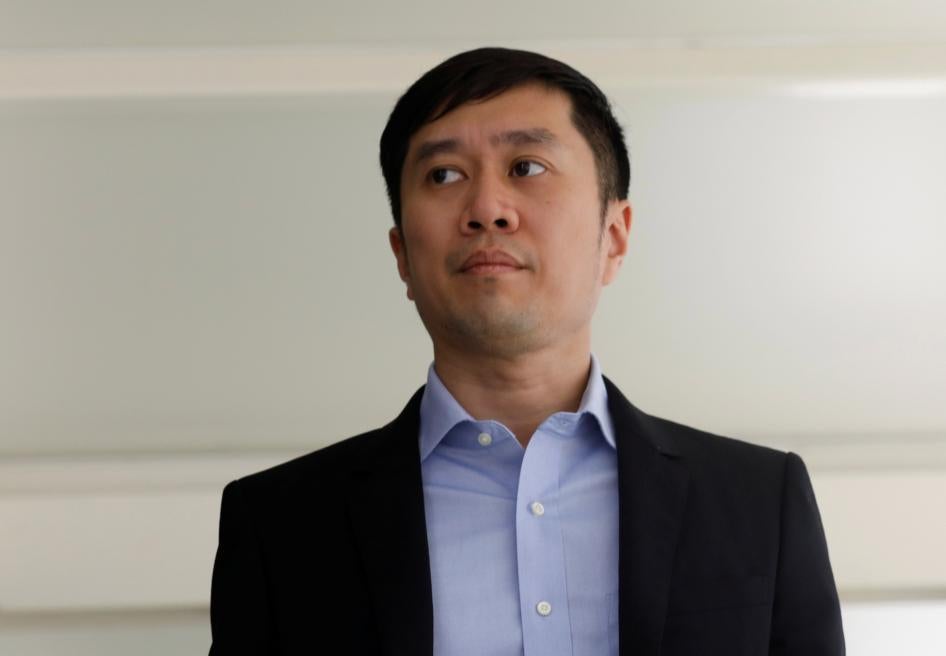
(London) – The Singaporean government should immediately drop all charges against a human rights activist, Jolovan Wham, for organizing and participating in peaceful gatherings, Human Rights Watch, Asian Forum for Human Rights and Development (FORUM-ASIA), Amnesty International, and CIVICUS said today.
Wham is scheduled to stand trial at Singapore’s State Court on April 6, 2026, facing three charges under the Public Order Act for his alleged participation in candlelight vigils commemorating death row prisoners between 2022 and 2025 that were held without a police permit.
Singaporean authorities frequently use overly broad and restrictive laws—including the Public Order Act—to restrict individuals’ rights to freedom of peaceful assembly and expression, and to silence criticism of the government, particularly regarding its use of the death penalty. The persistent legal harassment of Wham and other human rights defenders and anti-death penalty activists is part of a wider crackdown on dissent that has stifled informed public debate on capital punishment in Singapore.
Under the Public Order Act, any “cause-related” assembly requires a police permit—even for an individual acting alone—if it is held in a public place or in a private venue if members of the public are invited. The law also grants the police commissioner broad discretion to reject applications for an assembly “directed towards a political end,” particularly when a foreign national is involved.
Human rights groups have long documented the pattern of judicial harassment of Wham for his activism.
In February 2017, Wham was fined S$8,000 (approximately US$5,900) for organizing a silent protest on a train during the 30th anniversary of Operation Spectrum, a government crackdown on political dissent in 1987, when scores of activists were arrested for allegedly being part of a “Marxist conspiracy” to undermine the government.
In October 2018, the High Court of Singapore found Wham guilty of contempt for a Facebook post in April 2018 in which he questioned the independence of Singapore’s judiciary. He served seven days in jail, instead of paying a S$5,000 (US$3,700) fine.
In January 2019, Wham was convicted for organizing an indoor event called Civil Disobedience and Social Movements. He served 10 days in jail for violating the Public Order Act by not having a permit for a foreigner to speak at the event. At the same time, he was also fined S$1,200 (US$900) for refusing to sign the police statement, he contended that the police refused to provide him with a copy.
In November 2020, Wham faced two charges of staging an “illegal assembly” for holding a cardboard sign with a smiley face drawn on it to show his support for climate activists and for a 2018 protest calling on authorities to drop criminal defamation charges against two journalists and human rights defenders, Terry Xu and Daniel De Costa.
In February 2022, Wham was also fined S$3,000 (US$2,200) for holding an “illegal assembly” by displaying a sign outside the State Courts in 2018 during which he took a photo. Wham opted to serve a 15-day jail sentence instead of paying the fine.
On February 3, 2025, Wham was charged with five additional offenses under the Public Order Act for his alleged participation in candlelight vigils between March 2022 and April 2023. Activists who gathered outside the court on the day of his hearing are currently under investigation, believed to be linked to their peaceful assembly.
The continued criminalization of peaceful assemblies in Singapore directly contravenes international human rights law and standards and is a blatant attempt to silence criticism of the government, including its continued use of capital punishment.
The Universal Declaration of Human Rights, which is widely considered to be reflective of customary international law, states in article 20 that “[e]veryone has the right to freedom of peaceful assembly.” While Singapore has not ratified the International Covenant on Civil and Political Rights (ICCPR), article 21 guarantees the right of peaceful assembly.
The statement by the United Nations Human Rights Committee, which interprets the covenant, General Comment No. 37 (2020) states that peaceful assemblies should not be criminalized, and that states must facilitate and protect such gatherings. It also states that “[t]he right of peaceful assembly … [t]ogether with other related rights … constitutes the very foundation of a system of participatory governance based on democracy, human rights, the rule of law, and pluralism.”
On May 12, Singapore’s human rights record will be reviewed by other countries at the UN Human Rights Council under the Universal Periodic Review. During its previous cycle in 2021, Singapore supported several recommendations on peaceful assembly, including to “ensure that laws and policies on the rights to freedom of expression, peaceful assembly and association comply with the relevant international human rights standards.” However, Singapore authorities have continued to file cases against Wham and other activists for their peaceful activism under the draconian Public Order Act.
The Singaporean authorities should immediately drop all charges against Wham and other activists who are being prosecuted solely for exercising their right to peaceful assembly, and cease any further judicial harassment against Wham, Human Rights Watch, FORUM-ASIA, Amnesty International, and CIVICUS said.
The Singaporean government should also ratify the ICCPR and its optional protocols, joining the vast majority of countries worldwide that have already ratified it, and take concrete steps to uphold the right to peaceful assembly.