(New York, March 26, 2026) – The geographic spread, speed of escalation, and open disregard for international norms by all parties one month into the Middle East conflict are a critical stress test for the international legal order created to protect civilians during armed conflict, Human Rights Watch said today.
Statements by top officials from the United States, Israel, and Iran demonstrate a willingness to violate fundamental protections of international humanitarian law, reveal callous disregard for civilian life and property, and signal that those in power do not consider themselves bound by the law. All world leaders should urgently speak out in defense of the rules that protect civilians everywhere, strongly condemn violations, and demand accountability.
“As the Middle East conflict has spread and intensified, so too has the dangerous rhetoric by leaders on all sides, including open threats to commit war crimes,” said Philippe Bolopion, executive director of Human Rights Watch. “This explosive combination, building on world leaders’ longstanding failure to hold those responsible for serious violations of international law to account, is threatening the rules-based order that has long sought to protect civilians.”
Since the United States and Israel began their assault on Iran on February 28, 2026, and as Iran responded and Israel escalated attacks in Lebanon, all parties to the conflict have been responsible for serious violations of the laws of war, including possible war crimes. Officials’ inflammatory public statements have included open threats to kill civilians and destroy critical civilian infrastructure, suggestions that abuses by one side justify abuses by the other, and dismissal of international law and rules of engagement.
US President Donald Trump and Defense Secretary Pete Hegseth have in the past month alone made numerous public statements showing disregard for international humanitarian law, also called the laws of war.
Hegseth stated on March 13 that “no quarter” would be given to “our enemies” in Iran. Declaring no quarter––the refusal to spare enemy combatants’ lives by accepting their surrender––is a war crime.
On March 21, President Trump warned in a social media post that, if Iran didn’t “FULLY OPEN, WITHOUT THREAT, the Strait of Hormuz, within 48 HOURS,” the United States “will hit and obliterate their various POWER PLANTS, STARTING WITH THE BIGGEST ONE FIRST!” Trump later postponed but did not revoke his threat.
The laws of war protect from attack civilian infrastructure and objects indispensable to the survival of the civilian population––which could include power plants, oil and gas facilities, and water desalination plants––and attacks on these facilities could amount to war crimes. Even if such infrastructure is used in part for military purposes, an attack would likely be disproportionate and thus unlawful.
Iran’s reply to Trump’s statement indicated a willingness to commit a similar violation. Iran’s Khatam al-Anbiya military command headquarters spokesman, Ebrahim Zolfaqari, responded to Trump’s post by stating that if Iran’s fuel and energy infrastructure were attacked, “then all electricity power plants, energy infrastructure, and information technology systems of the Zionist regime in the region will be struck on a wide scale… all similar infrastructure which have American shareholders will be fully destroyed... [and] all electricity power plants in countries in the region that host American bases will be legitimate targets.”
Iranian officials have also claimed that all of a country’s companies, banks, and commercial ships are military objectives, which violates the presumption under the laws of war that they are protected civilian objects.
Iranian authorities have also threatened to commit further human rights violations against their own population, as they have done repeatedly, including in January, when security forces carried out countrywide massacres of protesters and bystanders.
Ahmad-Reza Radan, the commander of the Iranian police force, told state television in a program aired on March 10 that if people take to the streets “at the will of the enemy,” then “we will not see them as a protester or something else; we will see them as the enemy and do with them what we do with the enemy. … All of our guys are ready with their fingers on the triggers to safeguard their revolution, to back their people and country.” The next day, the Islamic Revolutionary Guard Corps’ Intelligence Organization issued a statement warning that any protests would be faced “with [even] a harsher blow than that of January 8.”
Senior Israeli officials and military leaders have also made numerous problematic statements, including threats to carry out unlawful attacks in Iran and Lebanon. The Israeli military’s Arabic spokesperson issued a statement on X on March 3 calling for representatives of the Iranian government to leave Lebanon before they would be targeted.
Attacks targeting political leaders or government officials are prohibited unless the leader is a member of the armed forces or a civilian directly participating in hostilities. Deliberately attacking a civilian violates the laws of war, and constitutes a war crime.
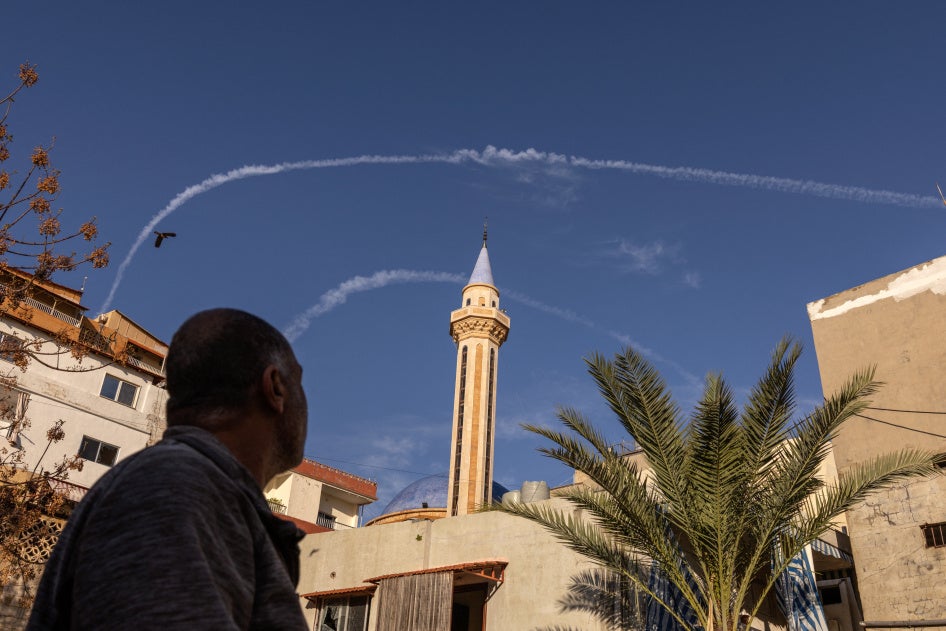
Statements about Lebanon by Israeli officials also indicate an intent to forcibly displace residents, destroy civilian homes, and conduct strikes that could target civilians, all violations of the laws of war.
During armed conflict, such warnings, threats to commit serious crimes, and other dangerous rhetoric have been followed by military action that violates the laws of war and has had grave consequences for civilians across the region.
Serious violations of the laws of war during the first month of conflict include:
- A US attack on a primary school in Minab in southern Iran that killed scores of civilians, including many children;
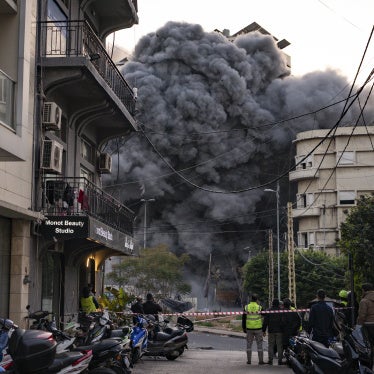
- Israel’s use of white phosphorus over homes and targeting of financial institutions in Lebanon;
- Iranian attacks on hotels, residential buildings, financial centers, and airports in the Gulf;
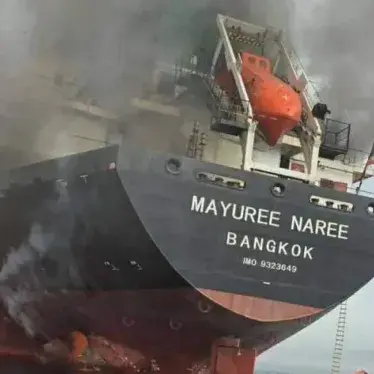
- Iranian attacks on commercial ships in the Strait of Hormuz;
- Israeli and Iranian attacks on oil and gas infrastructure; and
- Iran’s use of internationally banned cluster munitions in attacks on Israel.
The attacks, as well as the threat of attacks, on commercial ships in the Strait of Hormuz and on oil and natural gas facilities in Iran and the Gulf states also appear to have contributed to significant global cost increases in energy and may also result in cost increases in food, fertilizer essential for agriculture, and transportation worldwide, as well as significant environmental damage.
This could cause economic catastrophe and food insecurity to civilians in Iran and across the Gulf and economically marginalized people across the globe. The World Food Programme estimates that almost 45 million more people could fall into acute food insecurity or worse should the conflict continue through the middle of the year and if oil prices remain above US$100 per barrel.
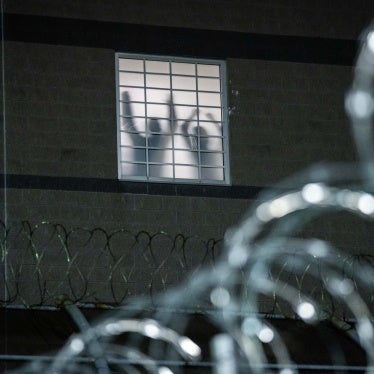
The toll of the conflict on civilians so far, and the extent of violations and potential war crimes, remains unknown, in part due to censorship by involved governments. In Iran, the government has imposed an unlawful blanket internet shutdown and arrested hundreds of people for alleged contact with media outlets outside Iran, taking footage of strike sites, and sending such footage to the media.
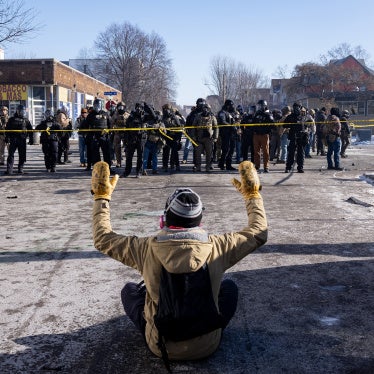
In the United States, Trump and Hegseth have attacked the media for its Iran coverage, and Federal Communications Commission Chair Brendan Carr accused media outlets of publishing “fake news” and threatened their broadcasting licenses.
Israeli officials have banned live broadcasts of city skylines, prohibited the reporting of precise locations of missile or rocket impacts, and detained journalists deemed to have violated these restrictions.
Countries in the Gulf Cooperation Council, including in Bahrain, Kuwait, Qatar, and the United Arab Emirates, have also detained people for allegedly posting images and footage of attacks on social media.
In Lebanon, the Iranian-backed armed group Hezbollah has banned all filming “under any circumstances” in the southern suburbs of Beirut.
In the face of this disregard for international humanitarian law and the potential far-reaching consequences of this conflict for civilians across the globe, world leaders––including allies of the United States, Israel, and Iran––should speak out for the need to respect international human rights and humanitarian law, strongly condemn violations, insist on accountability, and ensure that they are not complicit in serious violations by the warring parties.
Common Article 1 of the 1949 Geneva Conventions provides that states “undertake to respect and to ensure respect” for the conventions “in all circumstances.” This obligation binds the parties to the conflict in the Middle East to respect the conventions and ensure their respect by their armed forces at all times, regardless of the conduct of other parties.
The International Committee of the Red Cross’ authoritative commentary on the Geneva Conventions states that to “ensure respect” requires all states parties to the conventions “take proactive steps” to stop violations of the conventions and to “bring an erring Party to a conflict back to an attitude of respect for the Conventions, in particular by using their influence on that Party.” It includes the obligation “to prevent violations when there is a foreseeable risk that they will be committed.” Customary international humanitarian law also provides that states must exert their influence, to the degree possible, to stop violations of international humanitarian law.
The current Middle East conflict is occurring in the context of ongoing war crimes, crimes against humanity and acts of genocide in Gaza––committed by Israel with significant support from the United States since October 7, 2023––and Iran’s crimes against humanity against its own population. Impunity for these crimes and states failing to consistently apply international humanitarian law elsewhere, including in Sudan and Ukraine, have contributed to the dangerous disregard of the rules designed to protect civilians in war occurring today.
“The words of leaders are especially consequential during wartime,” Bolopion said. “Rhetoric that mocks or dismisses the laws of war is dangerously corrosive and can be seen to encourage grave violations that inevitably prove harmful to civilians. It’s increasingly clear that other governments urgently need to weigh in and press for greater protection of civilians.”
Additional concerning statements by US officials, some of which threaten to violate international humanitarian law, include:
- On March 2, Hegseth said that the United States was fighting the war in Iran with “No stupid rules of engagement,” reflecting comments he made throughout 2025 about “overbearing” and “burdensome” rules of engagement and “tepid legality,” and in 2024 that the United States “should fight by its own rules” and not “by rules written by dignified men... eighty years ago.”
- On March 9, Trump said the US Navy sank Iran’s warship off the coast of Sri Lanka because “it’s more fun” to sink ships than capture them.
- Also on March 9, Trump said that the United States could strike to “make it virtually impossible for Iran to ever be built back, as a Nation, again — Death, Fire, and Fury will reign [sic] upon them.”
- On March 13, Trump stated that the United States had “demolished” Kharg Island, a small island critical for Iran’s oil export infrastructure, but may strike “a few more times just for fun.”
- Also on March 13, Trump said that while the United States had “so far... chosen not to,” it could strike “power plants that create the electricity, that create[KA1] the water. … We could do things that would be so bad they could literally never rebuild as a nation again.”
Additional concerning statements by Iranian officials, some of which threaten to violate international humanitarian law, include:
- A spokesman from Iran’s Khatam al-Anbiya Central Headquarters said on March 8 that “every point that serves as the origin of aggression against Iran is a legitimate target.”
- On March 14, a media outlet affiliated with Iran’s Islamic Revolutionary Guard Corps (IRGC) stated that American “companies will be the legitimate targets for Iran’s Armed Forces,” listing a number of US management consulting and investment firms.
- Also on March 14, an IRGC spokesperson posted: “The attack on American bank branches was in response to the enemy’s attack on 2 Iranian banks. If the enemy repeats this action, all branches of American banks in the region will be our legitimate target.”
- On March 16, Brig. Gen. Ali Mohammad Naini, an IRGC spokesman who was reportedly killed in an Israeli attack on March 20, stated that Iranian forces had targeted all vessels owned by a US or Israeli entity, regardless of their flag country.
Additional concerning statements by Israeli officials, some of which threaten to violate international humanitarian law, include:
- Israeli Defense Minister Israel Katz said on March 16 that “hundreds of thousands of Shiite residents of southern Lebanon … will not return to their homes south of the Litani [River] area until the safety of Israel’s northern residents is guaranteed.”
- In a video clip posted on Israeli Prime Minister Benjamin Netanyahu’s X account on March 17, Netanyahu and US Ambassador to Israel Mike Huckabee joke about a “punch card” listing individuals the Israelis are targeting in Iran. Netanyahu says: “We’re wiping them out,” and Huckabee says: “I love it.”
- On March 22, Katz threatened to “hit Iran so hard it will be sent back decades” and to implement house demolition policies across Lebanon’s southern border villages like those seen in Gaza.
- The Israeli military’s Arabic spokesperson repeatedly posted orders on X to people in Lebanon, saying that they “will not hesitate to target anyone who is near Hezbollah members, facilities or means of combat” in the southern suburbs of Beirut.