- Iranian forces appear to have deliberately targeted at least two civilian commercial ships in and around the Strait of Hormuz on March 11, 2026, which would amount to war crimes. Between March 1 and 17, the UN confirmed 17 incidents of damage to commercial vessels in the region.
- The attacks, as well as the threat of attacks, also appear to have contributed to significant global cost increases in energy, which may also result in cost increases in food and other critical sectors, to the detriment of people’s rights.
- Iran, the United States, and Israel should all immediately end unlawful attacks on civilians and civilian objects.
(Beirut, March 24, 2026) – Iranian forces appear to have deliberately targeted at least two civilian commercial ships in and around the Strait of Hormuz on March 11, 2026, which would amount to war crimes, Human Rights Watch said today. The attacks, and threat of attack, may also contribute to significant global cost increases in energy, food, and other critical sectors, to the detriment of people’s rights.
“Deliberately targeting civilian ships and their crew members is a war crime,” said Niku Jafarnia, Middle East and North Africa researcher at Human Rights Watch. “War crimes do not justify further war crimes, and Iran, the United States, and Israel should all immediately end unlawful attacks on civilians and civilian objects and should stop attempting to frame these objects as legitimate targets.”
Starting on March 1, Iranian forces reportedly began attacking commercial ships in and around the Strait of Hormuz in response to US and Israeli attacks on Iran, according to the International Maritime Organization (IMO), a United Nations agency. On March 11, Ebrahim Zofaghari, a spokesperson for Iran’s armed forces, said in a speech that if the United States and Israel continued to carry out attacks on Iran, Iranian forces would not allow “one liter of oil” through the strait.
Arsenio Dominquez, the IMO secretary-general, stated on March 6: “Around 20,000 seafarers remain stranded in the Persian Gulf, on board ships under heightened risk and considerable mental strain.”
Human Rights Watch documented the apparent deliberate targeting of two commercial ships, the Safesea Vishnu and the Mayuree Naree, on March 11 through statements made by Iranian authorities claiming these attacks; photographs and videos posted online of the direct aftermath of the attacks and, in the case of the Safesea Vishnu, the apparent moment of attack; and data gathered by the IMO.
Between March 1 and 17, the IMO confirmed 17 incidents of damage to commercial vessels from 16 apparent attacks in the Strait of Hormuz, the Persian Gulf, and the Gulf of Oman. It also reported that seven seafarers and one shipyard worker had been killed, four seafarers were missing, and ten people were injured, five severely.
An IMO representative told Human Rights Watch that the organization receives data from authorities such as the United Kingdom Maritime Trade Operations (UKMTO), the Joint Maritime Information Centre (JMIC), and the Maritime Security Centre Indian Ocean (MSCIO). It said that the organization directly verifies information it receives with the vessels’ flag states to document attacks. It said the organization was unable to confirm who was responsible for the 16 attacks. However, the IMO Council adopted a decision on March 19 in which they “strongly condemned the threats and attacks against vessels and purported closure of the Strait of Hormuz by the Islamic Republic of Iran.”
Human Rights Watch identified all the vessels included by the IMO in vessel tracking websites and was able to corroborate that they were civilian commercial vessels with civilian crews. In some cases, Human Rights Watch identified their location at the time of the attack. In addition to corroborating attacks on the Safesea Vishnu and Mayuree Naree, researchers corroborated attacks on two other vessels—Skylight and Safeen Prestige—through photographs and videos posted online as well as online statements made by government and military entities, along with a third vessel—the MKD Vyom—by statements alone. In these three cases, Human Rights Watch could not confirm who was responsible for the attacks.
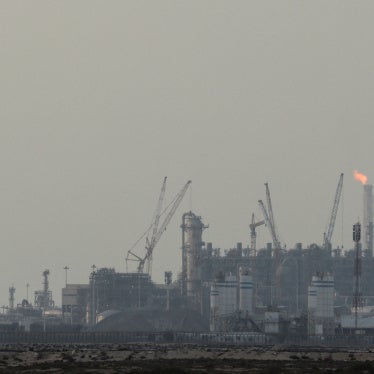
One-quarter of the world’s “seaborne oil trade” travels through the Strait of Hormuz. Since the conflict began, the price of crude oil has risen by 40 percent, according to the New York Times. The International Energy Agency has stated: “The war in the Middle East is creating the largest supply disruption in the history of the global oil market.”
On March 16, Brigadier General Ali Mohammad Naini, a spokesman for Iran’s Islamic Revolutionary Guard Corps (IRGC) who was reportedly killed in an Israeli strike on March 20, stated that Iranian forces had targeted all vessels owned by a US or Israeli entity, regardless of their flag country. He did not indicate whether he was referring to military or civilian vessels, or both. The Joint Maritime Information Center stated on March 11 that while some of the vessels that had been struck since March 1 had “potential Western commercial associations…multiple attacks have involved vessels with no confirmed affiliation to US or Israeli ownership.”
Lloyd’s List Intelligence, a maritime data and intelligence company, reported that some vessels have continued to pass through the strait between March 1 and 18 and noted: “Shadow fleet vessels [ships engaging in illegal operations for the purposes of circumventing sanctions] carrying Iranian oil and gas account for most transits through the Strait of Hormuz.”
Human Rights Watch wrote to Iranian authorities on March 18 seeking clarification about the attacks but did not receive a response.
Iranian authorities, in statements they made pertaining to the two ships they claimed to have targeted—the Safesea Vishnu and Mayuree Naree—did not state that the vessels were military objects, nor did they present any evidence to demonstrate that anything on board the ships could have constituted military objects.
Under international humanitarian law, it is forbidden in any circumstance to carry out direct attacks against civilians and civilian objects, and warring parties are obligated to take all feasible precautions to avoid harm to civilians and civilian objects. Civilian vessels with commercial ties to the United States or Israel remain civilian objects. Warring parties must take all necessary action to verify that targets are military objectives. A person who commits serious violations of the laws of war with criminal intent—that is, intentionally or recklessly—may be prosecuted for war crimes. Individuals may also be held criminally liable for assisting in, facilitating, aiding, or abetting a war crime.
The effects of global fossil fuel dependence, and its connections to concentrated corporate power and authoritarian governments, are increasingly evident, Human Rights watch said. A just transition to renewable energy is an environmental and geopolitical urgency now more than ever. This requires concomitant efforts to provide universal access to public services such as social security, education, and health care to guarantee everyone’s rights and accelerate the transition.
“Iranian forces’ attacks on civilian ships in the Strait of Hormuz will result in harm to some of the most socioeconomically disadvantaged people across the globe,” Jafarnia said. “Iranian forces should immediately end these attacks, rescue the remaining three crew members aboard the Mayuree Naree, and release any seafarers they have detained.”
For details of the documented attacks on two vessels, further details about the others, and IRGC statements, please see below.
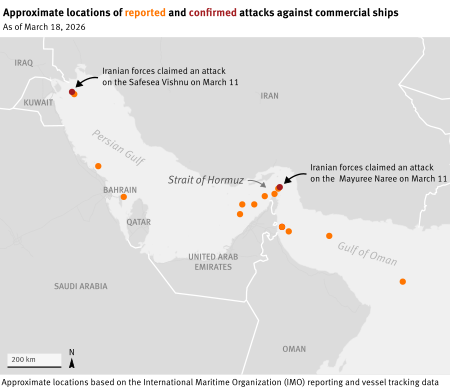
March 11 Iranian Attacks on Ships
On March 11, the Safesea Vishnu, an oil tanker, was “struck by an unknown projectile,” according to the UKMTO. The last signal sent from the ship was received by the vessel-tracking website Marine Traffic at 10:01 p.m. local time. On March 12, the Islamic Republic News Agency (IRNA), Iran’s official state news agency, published a statement from the IRGC that confirmed that the Safesea Vishnu “had been hit in the northern Persian Gulf after failing to comply with and ignoring the warnings of the IRGC Navy.”
One of the crew members was killed in the attack, the IMO said. It also reported that another oil tanker, the Zefyros, caught fire in the same incident. The two vessels were next to each other within Iraqi territorial waters approximately 50 nautical miles southeast of Basra, according to measurements taken from vessel-tracking websites.
Human Rights Watch analyzed three videos posted to X by different accounts on March 12, with the earliest posted at 12:32 a.m. One of the videos, filmed from a nearby vessel, shows two large explosions on the Safesea Vishnu, seconds apart. Those filming from the nearby vessel claim to be the IRGC Navy and say that they have destroyed a US ship in the Persian Gulf. The Safesea Vishnu is engulfed in flames. This video supports accounts by Reuters from the US owner and operator of the vessel that two explosive-laden, unmanned boats rammed the vessel.
Another video shows firefighters spraying the Safesea Vishnu with water from a nearby boat. The BBC published a video filmed in daylight that shows the vessel tilting to one side considerably damaged.
The New York Times reported that, according to Iraq’s oil export authority, “[t]he two vessels were used by Iraq for its own oil transport.” The news outlet added that “[s]enior Iraqi officials said that one of the vessels, flying the flag of the Marshall Islands, was owned by an American company.”
On the same day, three other vessels—One Majesty, a Japanese-flagged container vessel, and two bulk carriers, the Marshall Islands-flagged Star Gwyneth and the Thai-flagged Mayuree Naree—were attacked in the strait, the IMO said.
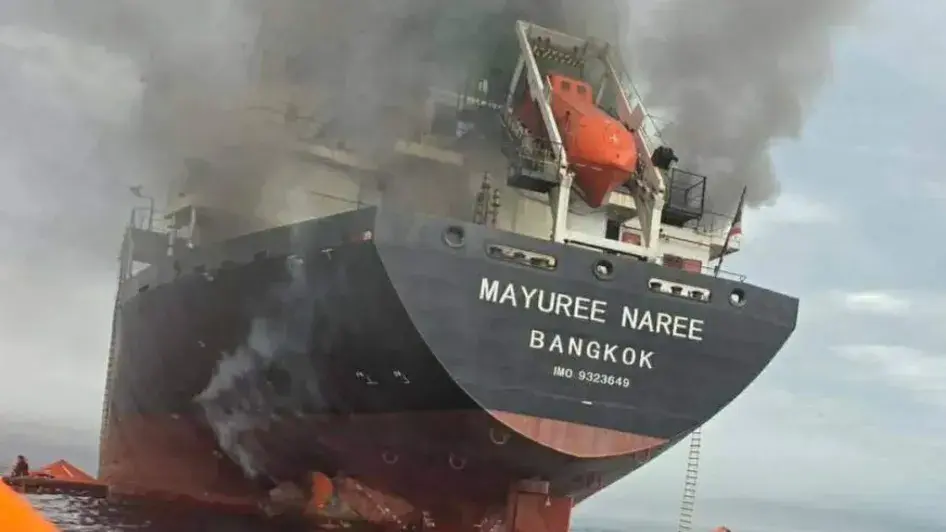
The Royal Thai Navy spokesperson said in a statement that the navy had received an initial report that “two projectiles of unknown origin” had struck the Mayuree Naree as it sailed into the Strait of Hormuz after departing from the UAE. The statement said that the Omani navy had rescued 20 of the vessel’s 23 crew members, which the Omani Maritime Security Center confirmed. On March 18, the Royal Thai Navy reported that the ship had moved from Omani to Iranian territorial waters. Three crew members reportedly remain on board the seriously damaged vessel.
Photographs taken by rescued crew members circulating online show the superstructure emitting large columns of black smoke. One photograph shows damage to the hull of the boat near the propeller that is consistent with an explosion.
The day the three ships were reportedly attacked, Tasnim News, affiliated with the IRGC, posted a statement on its Telegram channel at 3:36 p.m. stating that the Mayuree Naree was “shelled by Iranian fighters hours ago after ignoring the warnings of the IRGC Navy and illegally insisting on passing through the Strait of Hormuz.”
Alireza Tangsiri, commander of the IRGC naval forces, posted on X the same day at 3:50 p.m. local time that the crew of the Mayuree Naree had “ignored [Iranian authorities’] warnings and intended to pass through the strait but was caught.” He added that “[a]ny vessel intending to pass [the Strait of Hormuz] must obtain permission from #Iran.”
Both statements included claims that Iranian forces had also attacked another ship, the Express Rome, a ship not listed by the IMO as having been attacked. On March 19, Human Rights Watch received confirmation from Danaos Shipping, the owners of Express Rome, that the ship had not been hit or compromised in any way and that its crew is safe.
According to media reports from March 20, a Nepali Ministry of Foreign Affairs official stated that Iranian authorities had “taken one Nepali into custody from the Strait of Hormuz.”
Islamic Revolutionary Guard Corps Statements
Human Rights Watch was unable to confirm who was responsible for the other 14 attacks the IMO documented. However, Iranian authorities have made several statements in which they have demonstrated a clear intention to attack ships, including civilian ships, that attempt to pass through the strait.
On March 4, Mohammad Akbarzadeh, an IRGC navy official, announced that the Strait of Hormuz was “under the complete control of the Islamic Republic of Iran.” On March 16, Naini repeated the statement.
“If the US claims that the Iranian Navy has been destroyed, then why is the Strait of Hormuz still closed and not even a tanker is allowed to pass,” Akbarzadeh said. “If the Iranian Aerospace Force [the IRGC’s missile, air, and space force, separate from the Air Force] has been destroyed, why do our missiles and drones hit the intended targets at specific intervals?”
On March 12, what appears to be the new X account of the newly appointed supreme leader of Iran, Mojtaba Khamenei, posted: “the lever of blocking the Strait of Hormuz must definitely continue to be used.” Tangsiri reposted the statement, adding: “By maintaining the strategy of keeping the #Strait_of_Hormuz closed, we will deal the most severe blows to the aggressor enemy.”
Also on March 12, the IRGC Public Relations office said in the statement posted by IRNA on Telegram that ships “must act in accordance with the laws and regulations of passage in the Persian Gulf and the Strait of Hormuz…in order to remain safe from being hit by stray projectiles.”
The United States has also targeted and destroyed Iranian military vessels. US Central Command reported that they had damaged or destroyed 43 Iranian ships within the first seven days of the war. While military vessels constitute legitimate military targets, the attacks may pose long-term environmental threats to the region. The US navy’s attack on an Iranian military vessel near Sri Lanka on March 4 caused an oil spill stretching 20 kilometers, according to the Conflict and Environment Observatory.
Wim Zwijnenberg, an analyst at PAX, a Dutch nongovernmental organization, told Human Rights Watch that, as of March 13, the attacks by all parties to the conflict had caused “a lot of [environmental] impacts on many different locations, [including] oil spills near Basra, Bandar Abbas and Sri Lanka, but often short-term and limited impact” as a result of authorities’ quick cleanups. However, on March 18, Zwijnenberg said that a separate US strike on an Iranian drone carrier near Bandar Abbas in southern Iran had “resulted in a large 25km long oil slick that is posing a threat [to] the coastal and marine environment of the Hara Biosphere and Khuran Strait Wetlands.”
The continuation of attacks on vessels carrying large quantities of oil and gas has the potential to cause long-term and significant environmental harm. Despite cleanup efforts, offshore oil spills have long-lasting detrimental impacts on marine life and ecosystems. Customary international humanitarian law provides that warring parties need to respect the protection and preservation of the natural environment. All feasible steps should be taken to minimize environmental harm. Using methods or means of warfare that are intended or can be expected to cause widespread, long-term, and severe damage to the natural environment is prohibited.
The attacks on civilian ships in the Strait of Hormuz, as well as the threat of attack, and the targeting of energy infrastructure within the context of conflicts also appear to be contributing to significant global cost increases in energy, which may lead to increases in the costs of food and other critical sectors, to the detriment of the rights of populations.
In the same speech on March 11, Zofaghari said: “Get ready for the oil barrel to be at [US]$200, because the oil price depends on the regional stability which you have destabilized.”
Increases in oil and gas prices will have ripple effects on sectors such as food, transportation, and energyprices around the globe, which are critical to the enjoyment of human rights. Moreover, news outlets and think tanks have described the potential impact on the global food supply as a result of the collapse in fertilizer exports through the strait. The Financial Times has reported that, according to several experts, the “Middle East war is close to triggering a global food shock worse than that unleashed by Russia’s 2022 full-scale invasion of Ukraine” given that significant percentages of the raw materials for widely used fertilizers are transported through the strait.
World Food Programme Deputy Executive Director Carl Skau told reporters on March 17 that if the ongoing regional conflict continues, “an additional 45 million people could be pushed into acute hunger by price rises.”