US Expulsions of Third-Country Nationals to Countries in Africa
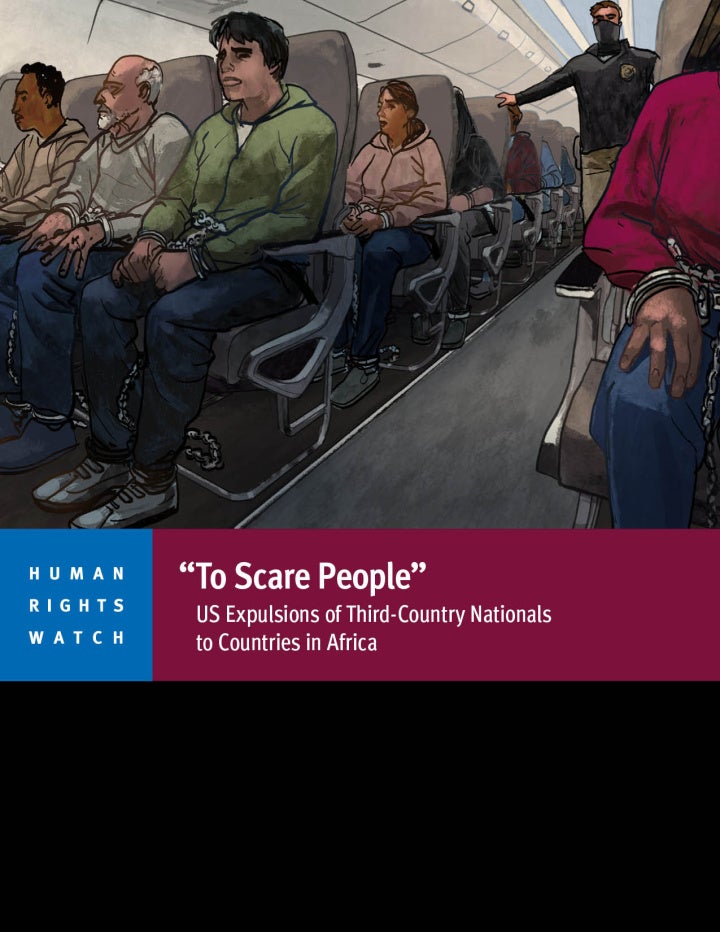
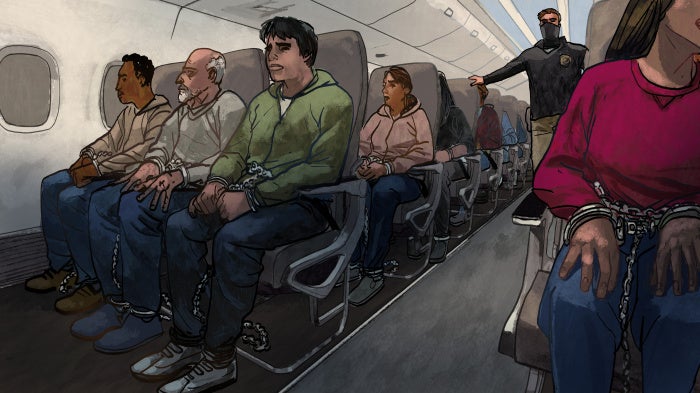
The 125-page report, “‘To Scare People’: US Expulsions of Third-Country Nationals to Countries in Africa,” documents that US authorities denied the more than 500 people transferred to third countries a meaningful chance to contest their removals or to articulate their fears of being removed to these countries. Some countries arbitrarily detained people they had accepted, and some have sent people onward to the risk of persecution or torture in their home countries, violating the international law principle of nonrefoulement.
Briefing Paper Prepared for the ICRC Experts Meeting on Cluster Munitions
This presentation is an introduction to the wide variety of cluster munitions currently available. The functional characteristics of these munitions as well as estimates of the numbers in current stockpiles are included in the presentation.
Brutality and Repression by Guinean Security Forces in Response to a Nationwide Strike
This 64-page report documents how Guinean security forces brutally repressed demonstrations across the country. It details how security forces abused, intimidated and arbitrarily arrested journalists and members of civil society. The report also shows how security forces were responsible for excessive use of force, as well as reckless and undisciplined fire.
In this 10-page briefing paper, Human Rights Watch articulates how the European Union should make respect for human rights an integral part of its new Central Asia strategy. The strategy, an initiative of the German EU Presidency, replaces years of an uncoordinated approach by the European Union to the five Central Asian countries, which were once part of the Soviet Union.
Neighboring States Stop Iraqis Fleeing War and Persecution
Iraq’s neighbors are refusing entry, imposing onerous new passport and visa requirements, and building barriers to keep refugees out. In certain cases, they are also expelling Iraqis back to Iraq.This briefing paper focuses on new restrictive measures taken by Jordan and Egypt to prevent more refugees from coming.
The Consequences of Insurgent Attacks in Afghanistan
This 116-page report describes how Afghan insurgent groups, primarily Taliban and Hezb-e Islami forces, sharply escalated bombing and other attacks in 2006 and early 2007. The report is based on dozens of interviews with civilian victims of attacks and their families and a lengthy review of available documents and records.
Human Rights Abuse and Threats to Free and Fair Elections in Nigeria
In 1999, Nigeria made a definitive break with a post-independence history dominated by three decades of abusive and unaccountable military rule. That year, the country returned to civilian government under the leadership of President Olusegun Obasanjo and since then has enjoyed its longest stretch of uninterrupted civilian rule since independence in 1960.
The Story of Seven Men Betrayed by Russia’s Diplomatic Assurances to the United States
This 43-page report reconstructs the experiences of the detainees after being returned to Russia in March 2004, based on interviews with three of the detainees, their family members, lawyers, and others. Access to the ex-detainees is limited because three of them are in prison and the rest have either managed to leave the country or are in hiding.
The United Arab Emirates (UAE) is currently considering revisions to its main labor law. Like other countries in the Gulf, the UAE is heavily reliant upon the labor of migrant workers, primarily from South Asia. According to figures from 2005, 95 percent of the UAE’s labor pool, some 2.7 million workers, are migrants, many of whom work in the construction and domestic service industries.
Enforced Disappearances in Thailand’s Southern Border Provinces
This 69-page report details 22 cases of unresolved “disappearances” in which the evidence strongly indicates that the Thai security forces were responsible. The report is based on interviews with dozens of witnesses, families of victims and Thai officials since February 2005.
Violations of the Rights of Children in Detention in Burundi
This 62-page report documents the many types of human rights violations that children experience in pre-trial detention, in the investigation and prosecution of cases, and while in prison.
The management of infectious disease in prisons is a human rights imperative as well as a matter of public health. Given the high level of HIV infections among those who enter prison, making condoms readily accessible to inmates is an effective and inexpensive measure that corrections officials should take to limit the spread of infection.
In this first year of its existence, the Council is understandably preoccupied with institution building. But human rights violations haven’t been suspended while the Council focused on these tasks; in fact they have worsened in many locations. The Council’s attention to institution building has created a growing backlog of work that deserves the HRC’s attention.
The North Korean government has hardened its policy towards its citizens it catches crossing the border into China without state permission, or whom China has forcibly repatriated.
This 115-page report documents how state officials arrest, detain and deport undocumented foreign migrants, particularly those from Zimbabwe and Mozambique, in ways that contravene South Africa’s immigration law. The report also details how commercial farmers ignore basic employment law protections even when they employ documented foreign migrants and South Africans.