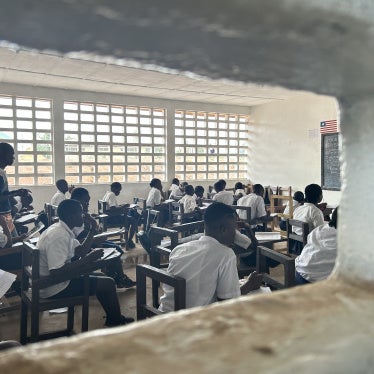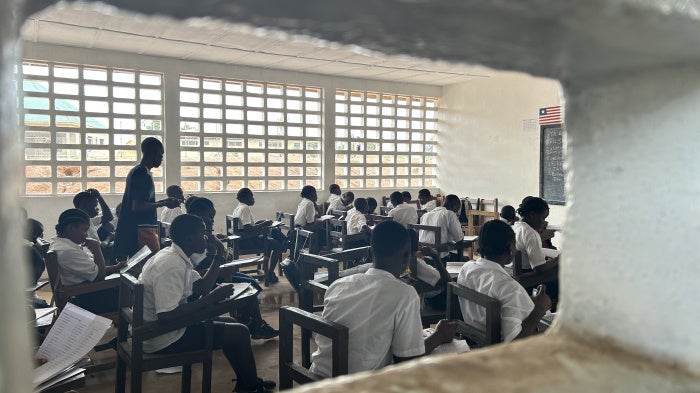
Summary
Peter lives near Monrovia, the capital of Liberia, with his mother and three younger sisters. He attended school through the ninth grade, but after his father died, his mother could no longer pay his school fees, forcing him to drop out at age 15. Now 17, Peter helps his mother sell goods and occasionally works at a carpentry shop. “I had no choice but to help her so that my little sisters could attend school,” he said. He hopes that his earnings will enable him to return to school and become an engineer. “If school were free, when my dad died, I would still be going to school. But because it’s expensive, I’m a school dropout.”
Peter’s experience reflects a broader reality. Liberia has one of the highest out-of-school rates in the world: Roughly one-third of all school-aged children (ages 3 to 17)—and half of rural children—have never attended school. Only 38 percent of children complete grade 6, and just 17 percent complete grade 9. On average, a child who enters school at age 4 will complete only 4.2 years of schooling by age 18.
By law, education in Liberia from grades 1 to 9 is compulsory and free, but in practice, children at all levels—from early childhood education (ECE) through senior secondary—must pay registration fees and other costs to attend public schools. For low-income and rural families, these costs frequently put schooling out of reach or impose severe hardship. As a result, many children start school years late, attend irregularly, engage in child labor, or drop out entirely. Many never attend at all.
Based on interviews conducted by Human Rights Watch between November 2025 and January 2026—including 118 parents, teachers, and school administrators, as well as peer-to-peer interviews with 61 children and youth—school fees and related costs emerged consistently as one of the most significant barriers to education.
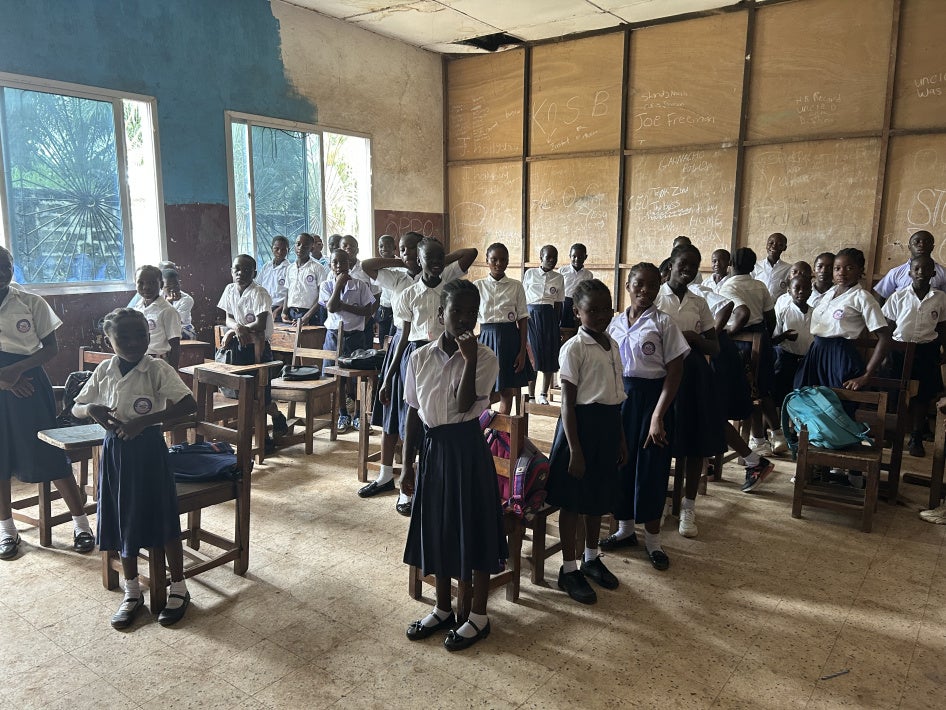
Many children in Liberia enter school late, often because their parents do not have enough money to pay school registration fees. At the early childhood education level—intended for children from ages 3 to 5—43 percent of children are overage by at least three years. A single mother of three children in Monrovia told Human Rights Watch that her daughter started grade 1 at 12 years old and her older son did not start school until he was 13. She said, “They started late because I had no money.”
As delays compound, the percentage of overage students grows; by junior and senior secondary school, more than 60 percent of students are four or more years older than the official age for their grade. Multiple studies have found that students who begin school late are more likely to repeat grades, drop out, and fail to complete their education.
Even after entering school, children miss weeks, months, or even years of education when their parents are unable to pay their fees. Many schools send children home if their parents have not paid their fees; once the fees are paid, the children are allowed to return.
Beatrice, 17, is a 10th grade student from a rural area of Nimba County and hopes to become a nurse. After completing grade 7, she was forced to leave school for a year-and-a-half because her parents could no longer pay her fees. “I felt bad,” she said. “I stayed home and cried when I saw my friends going to school.” Help from an uncle and a loan from a teacher allowed her to return to school, but she struggled to catch up academically.
Many children work before or after school to help pay their fees or drop out entirely to work. James, 14, left school in 2024 and helps his mother sell goods in the market. “Right now, I’m not in school because my parents can’t afford to send me,” he said. “I couldn’t keep up with the fees. Now, I help my mother sell to get money to send us to school. I really want to go back to school because I want to be educated.”
According to the most recent available data, nearly 50 percent of the Liberian population live in poverty, with 44 percent surviving on less than US$1.90 per day. With little income, parents described taking on debt, going without food, and making extreme sacrifices to keep their children in school. A single mother of four in Bong County said, “Even if I don’t eat, I find a way to pay the fees.” Another parent has borrowed money multiple times to help pay her children’s fees and estimated that she was at least US$300 in debt. “I don’t know if I can ever pay it back,” she said. “It’s difficult to feed my children. I give my children food but sometimes don’t have enough for myself.”
While Liberia’s Ministry of Education sets official registration fees, Human Rights Watch found that many schools charge significantly more. For example, some parents and children reported paying 3,000-4,000 Liberian dollars (LRD) (US$16-21) for primary school, rather than the 1,000 LRD (US$5) authorized.
Fees are highest at the early childhood level—more than three times those at primary—creating a major barrier to entry. Household surveys show that about 52 percent of parents in the poorest income quintile identify ECE fees as the main obstacle to enrollment. In some cases, children who cannot afford early childhood education are later excluded from primary school due to requirements for ECE transcripts.
The Ministry of Education has stated that, “All public schools are tuition-free. Once registered, students are not required to pay any additional fees.” However, the imposition of mandatory registration fees appears to violate the Education Reform Act of 2011, which stipulates that grades 1 through 9 are to be free and compulsory.
The barriers represented by fees are compounded by broader structural constraints. A shortage of public schools has fueled the private sector, with private, faith-based, and community-run schools accounting for more than 60 percent of Liberia’s schools, particularly at higher levels. At the senior secondary level, fewer than one in five schools is public, and access is heavily concentrated in Montserrado County, where the capital, Monrovia, is located.
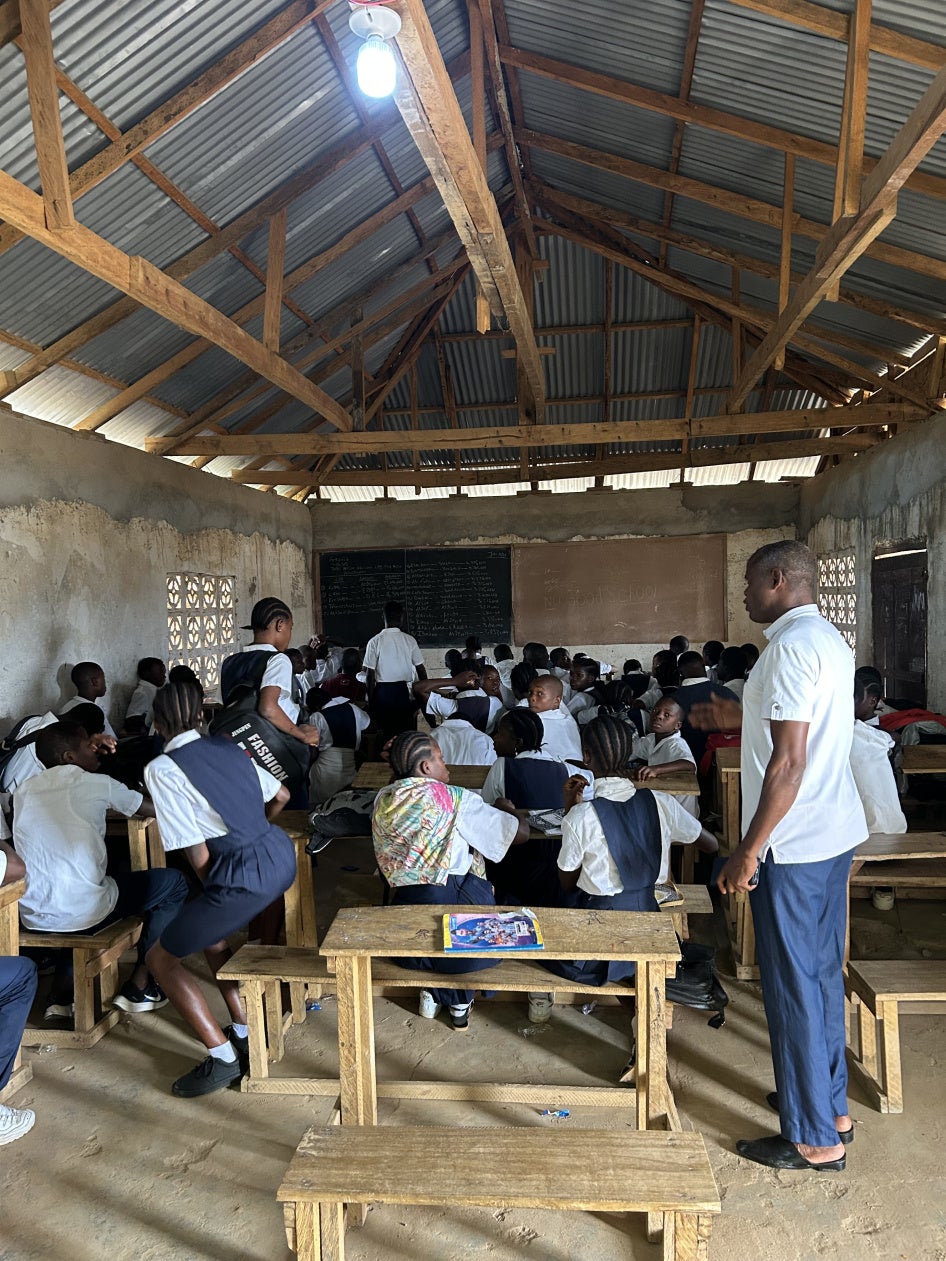
Public schools are often overcrowded, under-resourced, and reliant on low-paid or volunteer teachers. Classrooms with 80, 90, and even 100 students or more are not uncommon. Teachers lack adequate materials and infrastructure is poor. In some schools, volunteers—who hope to be offered paid positions—make up the majority of teachers. Some have taught for 10 years or more without a salary.
Liberia has faced significant challenges in developing its education sector. It endured two devastating civil wars between 1989 and 2003, an Ebola epidemic from 2014 to 2016, and like all countries, the Covid-19 pandemic from 2020 to 2023. Although Liberia’s economy has grown substantially since the end of the civil wars, gross domestic product (GDP) is approximately US$850 per capita, and according to the most recent official data, more than half of Liberians live below the national poverty line.
The education sector has been chronically underfunded, with education spending consistently falling below agreed international levels of 15-20 percent of public expenditures and 4-6 percent of GDP. Although the education allocation for fiscal year 2026 (US$136 million) increased by 14 percent in nominal terms over the previous year, it accounts for only 11 percent of the total national budget and only 2.73 percent of GDP, significantly below the global benchmark and the Economic Community of West African States (ECOWAS) average of 4 percent.
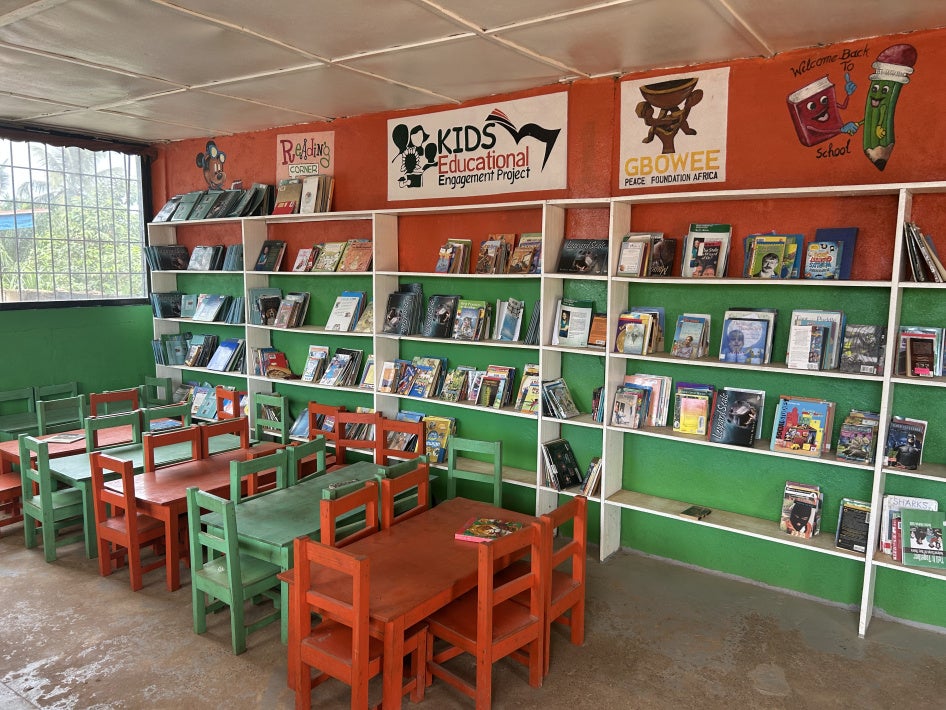
Moreover, less than 50 percent of Liberia’s 2026 national education budget is designated for ECE to grade 12 education, while roughly 43 percent (nearly US$60 million) is allocated to tertiary education—universities, colleges, and technical institutes – raising concerns about the equity implications of Liberia’s current education spending priorities. Extensive research shows that public spending on primary education tends to benefit lower-income households and promotes equal opportunity, while spending on tertiary education disproportionately benefits wealthier households.
Liberian President Joseph Nyuma Boakai, Sr. has identified education as a national priority and pledged to invest in schools, teachers, and students. Since assuming office in January 2024, he and his education minister, Dr. Jarso Maley Jallah, have implemented a range of new initiatives, including a digital learning platform and a “Back to the Classroom” campaign to return 250,000 out-of-school children to school. In 2025, the administration moved more than 2,000 volunteer teachers onto the government payroll and “topped up” salaries for nearly 70 percent of teachers—over 9,000 educators.
That same year, the government launched the Excellence in Learning in Liberia (EXCEL) Project, a five-year, US$88.7 million initiative financed by a US$60 million World Bank loan and a US$28.7 million grant from the Global Partnership for Education, with additional government support. The project aims to improve learning outcomes for 350,000 students, expand access to quality education, and strengthen the capacity of 12,000 teachers and school leaders.
Critically, EXCEL provides a pathway to reduce financial barriers to education. It includes US$18.5 million in school grants designed to reduce or eliminate fees, with a target of reaching 90 percent of ECE and primary schools by 2029. If fully implemented, these grants and the elimination of fees could help ensure that children enroll on time and remain in school, while reducing overage enrollment, dropout, and child labor, and improving learning and completion rates.
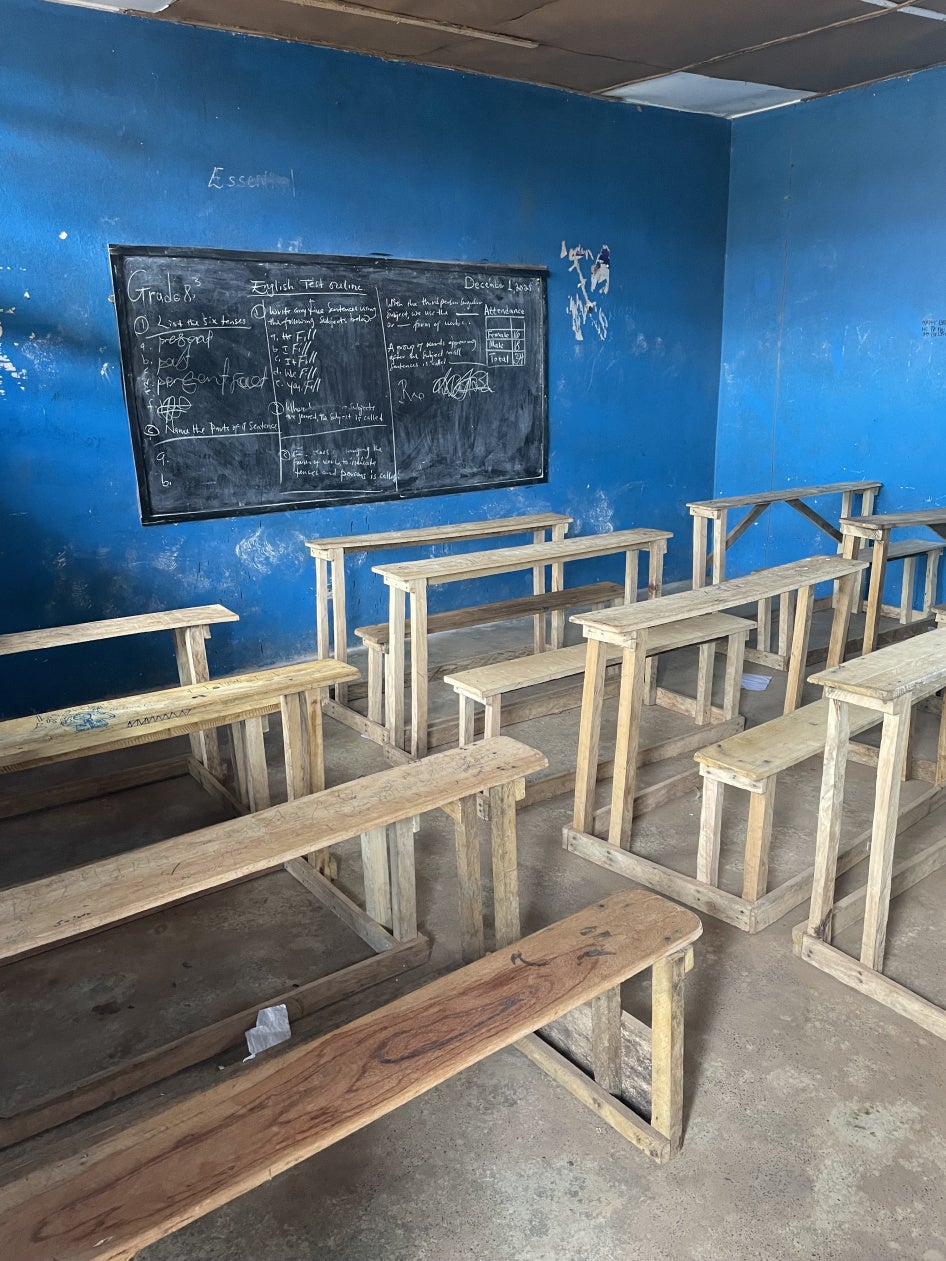
The Liberian government should build on this momentum by extending school grants beyond the initial five-year period, expanding them to junior and senior secondary education, and permanently abolishing school fees. This is both feasible and affordable: Human Rights Watch estimates that replacing registration fees with school grants for public schools—from ECE through senior secondary education—would increase the education budget by roughly 4 percent.
Experience from neighboring countries shows what is possible with sufficient political will. In Sierra Leone, eliminating senior secondary school and exam fees in 2018 led to enrollment rising from under two million to over three million students within three years; in 2023, 13 years of free education—from pre-primary through secondary—was guaranteed in law.
Education is not only a human right but one of the most effective investments a country can make. Over the past four decades, education has driven an estimated 50 percent of global economic growth and 40 percent of extreme poverty reduction. Over time, these investments yield substantial returns through higher incomes, increased tax revenues, and reduced public spending on social services. Investments in early childhood education are particularly impactful.
Ensuring that public education is adequately funded—and removing the financial barriers that keep children out of school—is essential to realizing children’s rights and advancing Liberia’s development. Expanding access to free, quality public education will reduce poverty and inequality, strengthen human capital, and broaden opportunity for millions of children.
Recommendations
To the Government of Liberia
With regard to school fees:
Eliminate registration fees immediately at public primary and junior secondary schools and as expeditiously as possible for early childhood education and senior secondary education—and provide these schools with financial transfers, such as capitation grants, to support their operation and maintenance.
Amend the Education Reform Act of 2011 to add early childhood education and senior secondary education to the levels of public education guaranteed to be free to all.
Establish strong oversight mechanisms to ensure that the planned EXCEL program school grants are used to eliminate school registration fees; plan for the continuation of the grants beyond the five-year project timeline and expand them to include junior and senior secondary schools.
Until registration fees are abolished, establish effective monitoring systems to ensure that all registration and Parent Teacher Association (PTA) fees comply with Ministry of Education guidelines.
With regard to funding for education:
Adopt measures so that Liberia undertakes to use its maximum available resources to progressively realize economic and social rights including for the right to education. This should include a plan to reach education spending equivalent to at least 4 to 6 percent of GDP and 15 to 20 percent of the national budget, in line with international benchmarks established in the 2015 Incheon Declaration and Framework for Action.
Consider ways to increase progressive and fair taxation, recognizing that international benchmarks call for a minimum 15 percent tax-to-GDP ratio.
Fully implement section 9.1.a of the 2011 Education Reform Act, which requires that concession agreements include dedicated revenue for education, including 60 percent of signature fees.
Prioritize education funding for early childhood to secondary public education, increasing its relative share of the education budget while limiting increases for tertiary education.
With regard to quality of education:
Continue to make efforts to improve the quality of public education, including by constructing and rehabilitating schools and classrooms and providing necessary materials and equipment, including restroom facilities, with priority to areas that are underserved.
Continue efforts to ensure sufficient and trained teaching staff, pay teachers according to the established salaries for their credentials, and place all volunteer teachers on the government payroll.
With regard to relevant international treaty negotiations:
Actively support consideration and negotiation of an Optional Protocol to the Convention on the Rights of the Child that aims to a) explicitly recognize that the right to education includes the right to early childhood care and education; b) guarantee free public pre-primary education (beginning with at least one year) for all children; and c) guarantee free public secondary education for all children.
Actively support ongoing negotiations for the United Nations Framework Convention on International Tax Cooperation, including provisions that will effectively address harmful tax competition, tax evasion and avoidance, and illicit financial flows, and help enable the realization of human rights, in particular economic, social, and cultural rights.
To High-Income Countries and Other Technical and Financial Partners
Meet the global target of dedicating 0.7 percent of gross national income to aid, including allocations for early childhood education through secondary education.
Provide technical assistance and development aid specifically to assist the government of Liberia in expanding free and quality public education.
Methodology
This report is based on research conducted in Liberia between November 2025 and January 2026, and visits to 21 schools with a combined enrollment of 18,510 students. Human Rights Watch interviewed 54 public school teachers; 27 administrators, including school principals, registrars, and county education officers; and 37 parents and other caregivers.
In addition, 10 child advocates conducted peer interviews with 61 children and young people, ages 9 to 18, including 26 males and 35 females. The child advocates were ages 16 and 17, and prior to conducting interviews, underwent a training workshop with Human Rights Watch on interview methodology. In total, 179 individuals were interviewed for the report. All interviews were conducted in English.
Interviews were conducted in 5 of Liberia’s 15 counties: Montserrado (northwestern), Margibi (north central), Grand Bassa (west central), Bong (north central), and Nimba (northeastern) counties. These counties were selected to represent diverse educational contexts. For example, Montserrado County has the highest school completion rates in Liberia, whereas Bong County has among the lowest.
Researchers informed all interviewees about the purpose and voluntary nature of the interviews, and the ways in which the information would be used. The interviewees received no financial or other compensation for the interviews.
The schools visited for our research were the following: In Montserrado, we visited William V.S. Tubman High School (grades 10-12); Paynesville Elementary and Junior High School (grades 1-9); and Gaye Town Elementary and Junior High School (grades 1-9); in Margibi, we visited KRTTI Demonstration School (grades 1-9), Lango Lippaye High School (grades 7-12), and E.J. Yancy Public High School (grades 10-12); in Grand Bassa, we visited Buchanan Elementary Demonstration School (grades 1-6); Lower Harlandsville Elementary School (ECE-grade 9); and Kpanay Town Public School (ECE-grade 12); in Bong, we visited Dorothy Cooper KG and Primary School (ECE-grade 6); Dorothy Cooper Elementary and Jr. High (grades 1-9); JR Clarke Elementary (ECE-grade 6); John Flomo Bakalu High School (grades 1-12); and in Nimba, we visited Zokeseh Community School (ECE-grade 6); Francis Nya Maweah Elementary School (ECE-grade 6); J.W. Pearson High School (grades 7-12); Dingamon Public School (ECE-grade 10); Zuluyee Public School (interior) (ECE-grade 8); Gbedin Public School (interior) (ECE-grade 9); Central High School of Sanniquellie (grades 7-12); and New Sanniquellie Elementary and Junior High School (ECE-grade 12).
Human Rights Watch conducted additional interviews with experts from nongovernmental organizations and reviewed secondary sources, including Liberian national laws, budgets, government policies, and reports; reports from UNICEF, UNESCO, the World Bank, and other United Nations entities and international groups; and academic and other sources.
Pseudonyms are used for all children in this report to protect their privacy.
The exchange rate at the time of the research was approximately US$1 = $180 Liberian dollars (LRD); this rate has been used for conversions in the text, which are often rounded off to the nearest US dollar.
Liberia’s Education System
Over the last four decades, Liberia’s education system has been severely impacted by two devastating civil wars, the Ebola outbreak, the Covid-19 pandemic, as well as economic and policy shocks.
During 14 years of civil war (1989-1997 and 1999-2003), thousands of schools were destroyed, looted, or occupied by armed groups. Many schools closed for years, and in some areas formal education stopped entirely. Many teachers were killed, injured or displaced, and teacher-training institutions shut down. Millions of children missed years of education. During the Ebola outbreak (2014-2016), schools were closed for months and many children lost a year of schooling. Schools were closed again for 37 weeks in 2020 and 2021 during the Covid-19 pandemic.[1]
Despite these challenges, the number of children enrolled in public and private schools increased from 300,000 in 1981 to 1.5 million in 2015. Between 2010 and 2018, the teaching force doubled in size, from 26,359 to 55,243.[2] More recently, Liberia has experienced a decline in student enrollment, from 1.4 million students in 2021-2022 to 1.3 million in 2024-2025.[3] The 2024-2025 Liberia Annual School Census states that this downturn may be linked to demographic shifts, migration, economic pressures on households, and improved reporting.[4]
Despite overall gains, the measured educational outcomes in Liberia are extremely poor. Roughly one-third of all school-aged children (3 to 17) and half of rural children have never attended school.[5] Only 38 percent of children complete primary school, and only 17 percent complete grade 9.[6] According to a 2021 World Bank report, a child who starts school at age 4, on average, will complete only 4.2 years of schooling by their 18th birthday.[7]
Liberia has 6,394 schools nationwide. Only 39 percent of these schools are government-funded and managed. The remainder are classified as private (33 percent), faith-based (24 percent), and community schools (4 percent). The proportion of private schools is larger at higher levels: 81 percent of senior secondary schools are private.[8] Montserrado, the most populous county and home to Liberia’s capital, accounts for more than half of all junior and senior secondary schools, both public and private.[9]
Education comprises four phases: early childhood education (also known as preschool or pre-primary), consisting of three years—nursery (also known as “ABC”), kindergarten 1, and kindergarten 2; primary education, consisting of grades 1-6; junior secondary, consisting of grades 7-9; and senior secondary, consisting of grades 10-12.
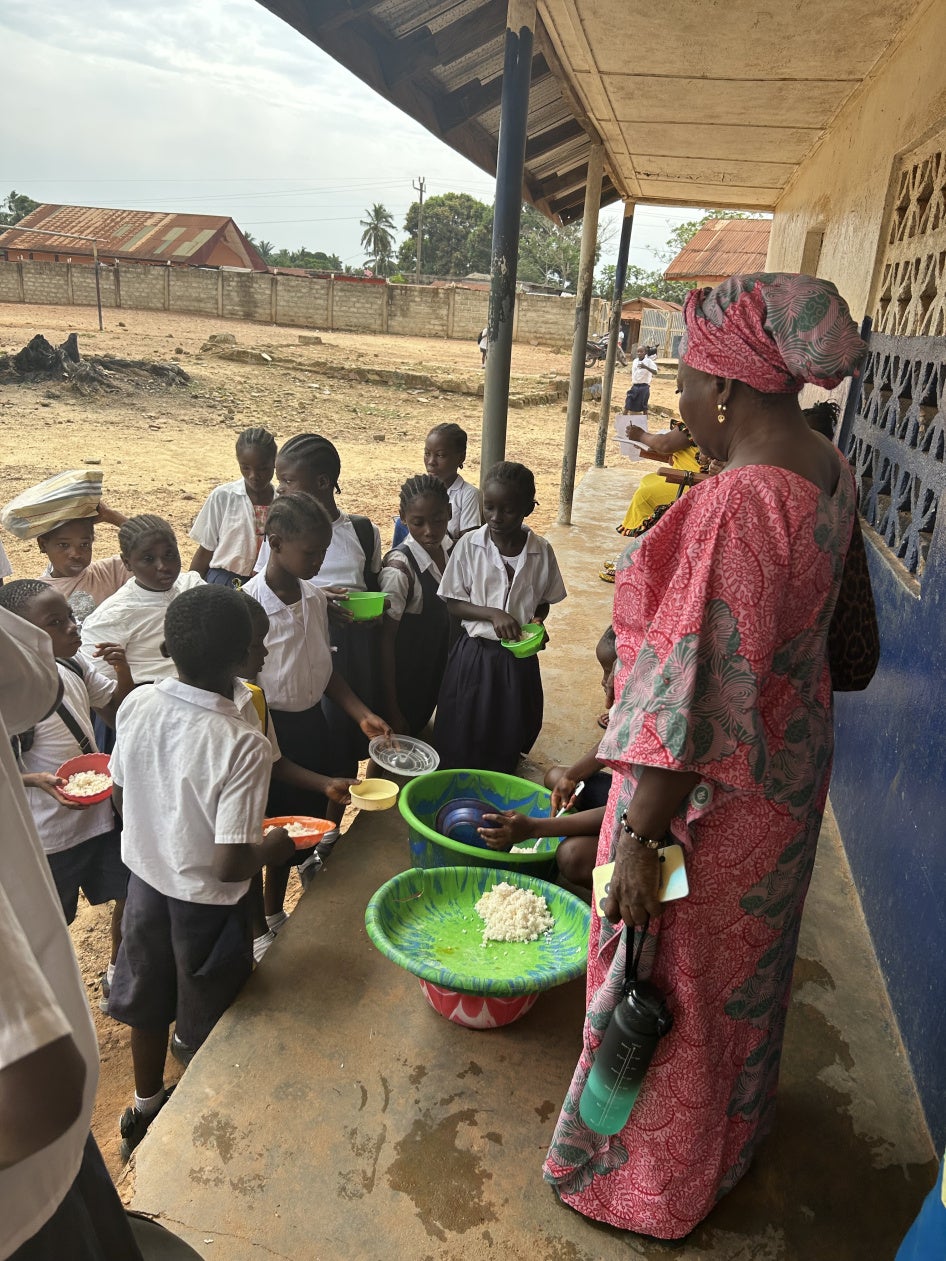
With some exceptions, the Ministry of Education provides no direct funds to run and maintain public schools despite its legal obligation to provide free education. Its budget pays primarily for teacher salaries. The ministry provides some stationery to individual public schools, but schools are expected to pay their operating costs, including maintenance, supplies, and capital improvements from the registration fees and Parent Teacher Association (PTA) fees collected from individual students and their families.
Liberia’s president, Joseph Nyuma Boakai, Sr., has repeatedly stressed education as a national priority and pledged to invest in schools, teachers, and students. Since assuming office in January 2024, he and his minister of education, Dr. Jarso Maley Jallah, have taken steps to “top up” teacher salaries, lower registration fees, and place over 2,000 volunteer teachers onto the government payroll.[10] The approved 2026 fiscal year budget (FY2026) includes new allocations of US$2.8 million to renovate and rehabilitate public schools, and US$1.7 million to expand school feeding programs across all 15 counties.[11]
The ministry has initiated a national digital learning platform, equipped over 150 schools with computer laboratories, and procured hundreds of school chairs as part of its “One Child, One Chair” initiative. With support from UNICEF, Liberia has also launched a “Back to the Classroom” initiative, designed to reintegrate 250,000 out-of-school children into schools over a three-year period (2024-2027) by addressing the root causes of non-attendance, and provide learning supplies, birth certificates, waivers for registration fees, and other support.[12]
In July 2025, the administration launched the Excellence in Learning in Liberia (EXCEL) Project, an ambitious, five-year US$88.7 million initiative financed by the World Bank and the Global Partnership for Education. The initiative is intended to improve learning outcomes, expand access to quality basic education, and strengthen the national education system in Liberia. It will support the construction, repairing, or rehabilitation of 400 to 1,000 school classrooms, construct additional washrooms, improve foundational learning for an estimated 350,000 ECE and primary students, and provide training and capacity-building for 12,000 teachers and school principals.[13]
The EXCEL Project allocates US$18.5 million for school grants. This component will provide annual capitation grants to ECE and primary schools based on school size to reduce or eliminate the need for schools to charge fees to households. The grants will be administered by school management committees (SMCs) and help schools cover their operational expenses and essential supplies; they also require schools to spend 10 percent of the funds on climate resilience enhancements.[14] The project estimates that by September 2029, 90 percent of all ECE and primary schools will receive school grants.[15]
If fully implemented, the school grants could significantly reduce the financial burden for schooling currently borne by individual households. Previous school grants programs have been shown to foster community involvement and enable schools to address locally identified issues.[16] The government should make it a priority to extend these school grants beyond the initial five-year period, abolish registration fees, and expand the program to include junior secondary and senior secondary education.
Cost of Public Schooling in Liberia
By law, Liberia guarantees nine years of free and compulsory primary and junior secondary education starting at age 6.[17] This obligation is reinforced by international treaties, including the International Covenant on Economic, Social and Cultural Rights and the Convention on the Rights of the Child, which both require free and compulsory primary education, as well as article 11 of the African Children’s Charter, which requires states parties to take all appropriate measures to ensure free and compulsory basic education.
In practice, however, fees are charged at all levels of education. Two teachers at the primary and junior secondary level independently told Human Rights Watch that the “government says education is free, but it’s not free.”[18]
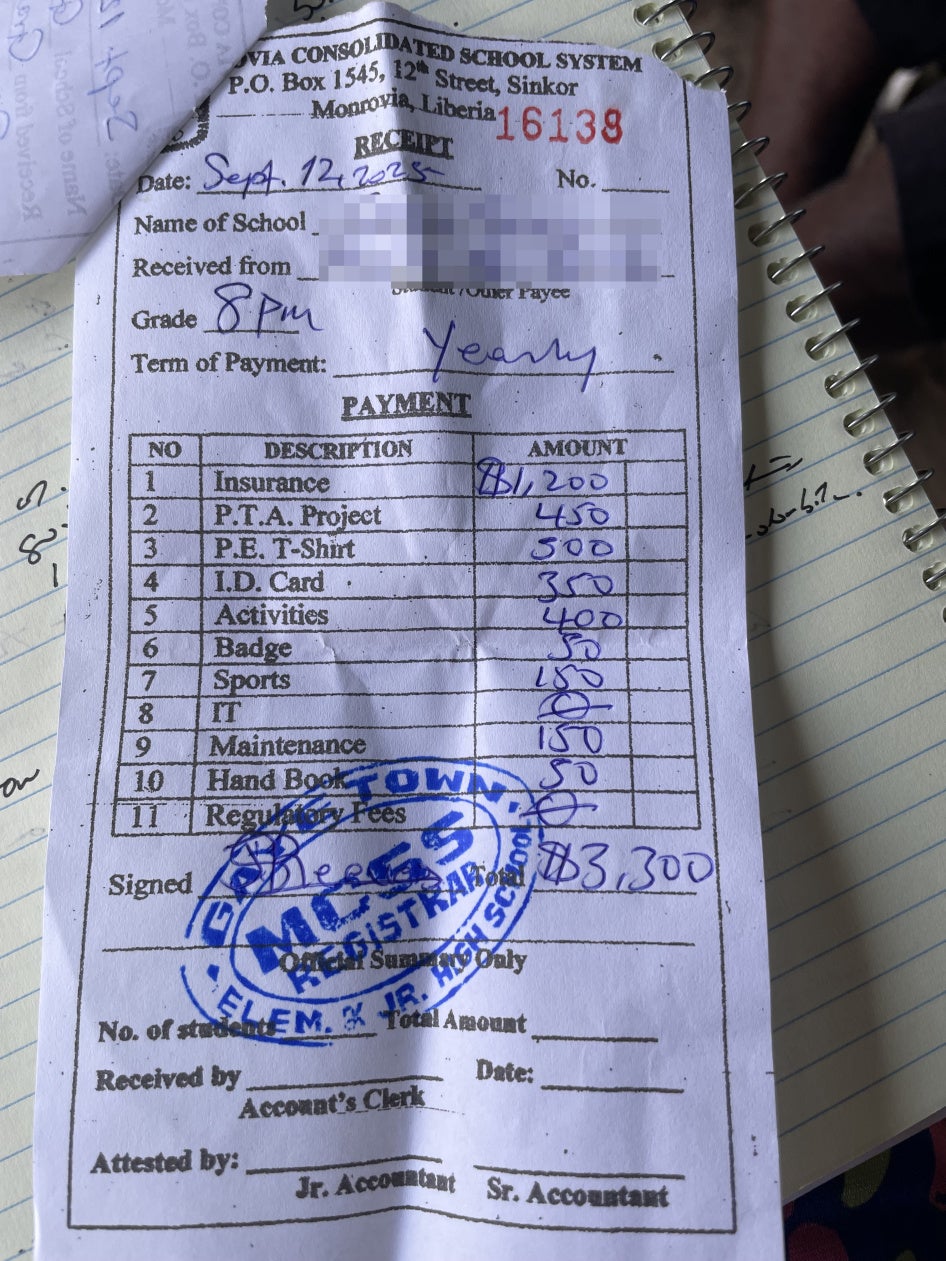
Required fees for children in Liberia’s public schools include registration fees, exam fees, and graduation fees. In addition, Parent Teacher Association (PTAs) are allowed to collect additional fees, and students and their families bear the cost of uniforms, textbooks, copybooks, food, and transportation.
The most recent Liberian household survey found that families on average spent 8,843 LRD (US$48) per child each year on education expenses. School fees were by far the most significant cost, averaging 5,796 LRD (US$31) per child per year. The remainder was spent on uniforms, transportation, books, and other materials.[19]
According to the most recent available data, nearly 50 percent of the Liberian population live in poverty, with 44 percent surviving on less than US$1.90 per day.[20] Eighty percent of Liberian workers work in the informal sector, which is often low-paid, irregular, and precarious. Even in the formal sector, where incomes are generally higher, 40 percent of female wage earners made below 6,000 LRD (US$33) per month.[21] On average, Liberian households spend two-thirds of their income on food.[22] In this context, education costs often exacerbate family hardship or are simply out of reach.
Registration Fees
The Ministry of Education publishes authorized registration fees that schools are allowed to collect for each student. For the 2025-2026 school year, these were as follows:
Early Childhood Education (nursery, kindergarten 1, and kindergarten 2): 3,500 LRD (US$19) per year
Lower basic (primary school, grades 1-6): 1,000 LRD (US$5) per year
Junior Secondary (grades 7-9): 2,000 LRD (US$11) per year
Senior Secondary (grades 10-12): 3,000 LRD (US$16) per year[23]
In seven counties, these fees are waived for children entering school for the first time or returning to school after an absence of at least two years as part of the first phase of the “Back to the Classroom” initiative.[24]
Human Rights Watch found that some schools charge fees far above authorized levels. About half of the parents interviewed reported paying registration fees that exceeded the Ministry of Education’s approved amounts; in some cases, the fees were more than three times the authorized level. For example, one parent said they paid 9,000 LRD (US$48) for their child in grade 12, 7,000 LRD (US$38) for their child in grade 9, and 5,000 LRD ($US27) each for children in grades 6 and 7, for a total of 26,000 LRD (US$140)— far exceeding the education ministry’s guidelines of 8,000 LRD (US$43) for the four children. Two primary school children in Grand Bassa reported that they paid 4,000 LRD (US$21) for their registration fees, four times the amount authorized by the Ministry of Education.[25]
Even at the authorized levels, registration fees create a significant barrier to education, as described later in this report.
Exam Fees
Children in grades 3, 6, 9, and 12 are expected to take West African Examinations Council (WAEC) exams. At grade 6, 9, and 12, these exams are required for primary, junior secondary, and senior secondary certificates. At grade 3, the fee is 1,000 LRD (US$5), at grade 6, 2,000 LRD (US$11), and at grade 9, 5,000 LRD (US$48). The grade 12 West African Senior School Certificate Examination (WASSCE) is free. Schools are also allowed to charge up to 150 LRD (US$0.80) as a processing fee for each of the exams.[26]
As with registration fees, some parents and children said schools charged more than the authorized amounts for the exams. The parent of a 6th grader said she had been charged 4,500 LRD (US$24) for the WAEC exam, rather than the set amount. Another parent said she was charged 5,600 LRD (US$30) for her daughter’s 6th grade WAEC fee; because she didn’t have the money, she said that her daughter was not allowed to take the test and was sitting at home. Another parent said her 6th grade daughter’s school charged 4,500 LRD (US$24) for the WAEC exam, more than twice the amount allowed. A grade 12 student said she was charged 500 LRD (nearly US$3) for her grade 12 exam processing fee; it should have been no more than 150 LRD (US$0.80).
Graduation Fees
Public schools are authorized to charge up to 2,500 LRD (US$13) for kindergarten (ECE) graduation; 3,500 LRD (US$19) for grade 6 and grade 9 graduation; and 5,000 LRD (US$27) for grade 12 graduation.[27] These fees are necessary for students to receive their diplomas. Human Rights Watch did not collect information on whether schools adhere to these limits.
Parent Teacher Association (PTA) Fees
Parent Teacher Associations (PTAs) are authorized to charge between 200-500 LRD (US$1-2.68) per parent in rural schools, and 250-350 LRD (US$1.34-1.87) per student in urban areas.[28] PTA fees often cover school maintenance, capital improvements, fuel, and cooks for school feeding programs, and in some cases, uniforms or supplies for children. In practice, Human Rights Watch found that some schools collect up to 2,300 LRD (US$12.33) in PTA fees.[29] Some parents reported that schools combine the registration and PTA fees with the total well in excess of Education Ministry guidelines. For example, a parent in Montserrado said she was charged 3,050 LRD (US$16.36) for registration and PTA fees for her daughter in 1st grade; ministry guidelines would limit the combined payment to 1,350 LRD (US$7.24).[30] Another mother in Montserrado said the school charged 5,900 LRD (US$31.64) for registration and PTA fees for her 7th grade son; ministry guidelines would limit the combined payment to 2,350 LRD (US$12.60).[31]
Uniforms, Textbooks, and Transportation
Public schools generally require students to wear uniforms to attend. Parents and children told us that the cost for uniforms is typically US$10-20. Parents can buy uniforms at the market for lower amounts, but some schools require parents to purchase the uniforms from the school, at a higher cost. Families must also purchase textbooks and copy books for children. Parents and children reported that the combined costs for uniforms, textbooks, and copy books ranged from 1,000 to 4,000 LRD (US$5-$21) per year. In addition, children who do not live within walking distance of their schools often pay 50 to 150 LRD (US$0.26-$0.80) for transportation each day.
Negative Impacts of School Fees on Children and Families
Fee-based schooling undermines children’s right to education, deepens inequalities, and significantly limits children’s future opportunities. Liberia is obligated to ensure free and accessible education to children under both international and regional human rights law, including the African Charter on Human and Peoples’ Rights and the African Charter on the Rights and Welfare of the Child. (See the International Law and Standards section, below.) Registration and other fees exacerbate over-age enrollment, negatively affect children’s educational achievement, and contribute to school dropout and child labor. For low-income families in particular, fees can create significant hardship or put education out of reach entirely.
Family Hardship and Debt
Among the parents interviewed by Human Rights Watch were farmers, teachers, masons, nurses’ aides, electricians, factory and port workers, bakers, and market sellers. Nearly all said that it was a challenge to pay the fees required for their children to attend school.
A single mother of five children in Montserrado has three grown children and two still in school. She works as a kindergarten teacher, making about 26,000 LRD (US$139) per month. She said that she had to pull her children out of school more than five times until she had enough money to pay their registration fees. “There are so many times I have had to borrow money,” she said. She relies on friends and her older children for help and estimates that she is currently at least US$300 in debt. “I don’t know if I can ever pay it back. It’s difficult to feed my children. I give my children food but sometimes don’t have enough for myself.”[32]
Another mother in the same community has three children, ages 4, 7, and 10. Her husband works at the port in Montserrado, loading and unloading ships, but his work is irregular. “If my husband has work, we can pay the fees,” she said, “but if he doesn’t work, we can’t. If we don’t have the money, the younger children stay home until we can pay. Sometimes they stay home for two weeks. Their school doesn’t provide food, so sometimes they don’t eat because we have to pay their fees.”[33]
A single mother with four children in Gbarnga, Bong County, said that two of her children are in school and two are still too young to attend. She sells biscuits from her home but said she makes little profit and that her income isn’t enough to support her children. She borrows money from an uncle, and said that “even if I don’t eat, I find a way to pay the fees.” She had no education after grade 5 and said, “I don’t want my children to be like me, because I missed a lot of opportunity. Education is important to become somebody.”[34]
A mother of two children in Gbarnga, Bong County, sells plantains and her husband works transporting passengers and goods by motorcycle. “If the plantain is not ripe, I’m not able to get money,” she said. “It’s a burden on all parents to pay for their children. Parents want children to learn, but if they have no money, the children sit at home.”[35]
Children also reported hardships due to school fees. Blessing, 13, said, “I experience a lot of challenges, I miss school because of lack of money for fees and transportation. Sometimes I don’t have enough textbooks.”[36] Janet, a 14-year-old girl from Montserrado, has eight siblings but said only some of them are in school. “Having money for my school has been a challenge.” She said the costs made her parents “stranded”—stuck without enough money to pay.[37]
Joshua, 12, lives with his grandmother in Montserrado. His parents sell goods in the market, but he said that when they don’t have customers, they are not able to pay his school fees. “If they can’t keep up,” he said, “me and my mom beg the administration for more time to pay.”[38] Joyce, a girl in 8th grade in Margibi County, said, “Sometimes we sleep with hunger. When my parents can’t keep up with the fees, I feel bad about it. Sometimes my friend makes fun of me.”[39]
Many of the parents interviewed said they had borrowed money to help pay their children’s fees. Some borrow from relatives, friends, their local church, or BRAC, an international organization that provides microloans.[40] Some contribute to a “susu” (community or women’s savings club) and borrow money back from the fund.
The sums parents borrow often come with heavy interest fees. A single mother of two children who sells goods in Grand Bassa said she has borrowed money twice from BRAC. She said she borrowed 25,000 LRD (US$134) the first time, and 40,000 LRD (US$215) the second. She is still paying back the second loan and said that with interest, the total amount for the 40,000 LRD loan will be nearly 50,000 LRD (US$268).[41] Another mother from Grand Bassa borrowed 50,000 LRD (US$268) from BRAC, and paid an additional 25,000 LRD (US$134) in interest.[42] A mother with three children in public school said she once borrowed 8,000 LRD (US$43) from BRAC, but was unable to pay back the 10,000 LRD (US$56) in principal and interest, so said she can’t borrow again.[43]
A mason with six children in Margibi County said, “My income is not enough to pay all the fees. I talk to family and friends to get more money. Sometimes I get a loan from the savings club. If I borrow 1,000, I have to pay back 1,250.”[44]
Beatrice, 17, said that when she reached senior secondary school and her registration fees increased to 3,000 LRD per year (US$16), she asked a teacher for help. He agreed to pay the fees if she would pay him back. Her mother gave her 1,000 LRD (US$5) to help repay the loan, but she still owes the teacher more than 2,000 LRD (US$11). She wants to continue her education and said, “Education is important. Without education, you are disadvantaged.”[45]
Teachers and principals affirmed that registration fees are a burden for many parents. A senior secondary school teacher in Monrovia said, “A lot of families struggle to pay the registration fees. It’s a stretch for most families.”[46]
A vice-principal at a primary school in Bong County said that most parents do not pay their children’s fees in full. “Most of the parents owe money,” she said.[47] The principal at a primary and junior secondary school in Montserrado, said that at least 300 of the 2,760 students at her school had not paid their fees three months after the beginning of the school year.[48] The principal of an elementary school in Grand Bassa estimates that about 75 percent of parents pay the fees for children at his school. “If they can’t pay, we give them consideration,” he said.[49]
Some teachers and administrators pay fees for students whose families are unable to do so. A principal in Kakata, Marbigi, said, “I help three to four students with their fees. I didn’t want them to be left behind, so I paid the fees myself.”[50] A high school chemistry teacher in Margibi has been paying the fees for a student at his school for three years. He said, “The student’s family is in dire economic straits. His father had trouble getting decent employment and his mother was selling in the local market. They have eight children, and the big ones are not learning.”[51]
A junior high school literature teacher in Bong County spent 10 years as a volunteer before being put on the government payroll in 2021. He still makes only US$95 a month, but nonetheless, said he is paying the school fees for four junior high school students who can’t afford them. “Their parents don’t have money, so they came to ask my help.”[52] Another teacher in Bong County said that he has helped two junior high students at his school pay their fees. He said, “Here, you have to pay in full to go to class. The students came to me and had half their fee, so I provided the rest. I have been supporting them for two years now. Other students have asked, but I didn’t have the means to help them.”[53]
A biology teacher in Bong County said, “Many days, children come to me to ask for help because their parents can’t pay.” He struggles to support his own family but has worked with other teachers to secure scholarships for three children at the school whose parents were unable to meet the fees. He said, “Some are still out and need help. It is so sorrowful.”[54]
Late and Overage Enrollment
Some parents delay enrollment for some or all of their children for weeks or months at the beginning of the school year. A mother in Monrovia who makes a living baking and selling bread said she finds it difficult to pay the school fees for her three children, ages 7, 9, and 17. “I try to save money,” she said, “but I can’t pay for all of them, so some go and then the others go when I have the funds. If school starts in September, some of the children won’t start until October. If they miss a month of school, it is challenging.”[55] Blessing, 13, said, “My parents sometimes don’t have money to pay everything at once. Sometimes we delay going to school at the start of the semester.”[56]
A high proportion of children in Liberia enter school a year or more late, often because their parents don’t have enough money to pay school registration fees or schooling is not easily accessible. When children are older than the expected age for their grade, this is known as “overage” enrollment.
Typically, a child should enter grade 1 at age 6, but Human Rights Watch interviewed parents who did not send their children to school until age 7, 8, or even 13 because they did not have the money to cover the child’s fees. According to the most recent Liberian school census, fewer than half of primary-school age children are enrolled in the correct grade for their age.[57]
A mother of seven in Montserrado earns income from selling charcoal. Her four oldest children are attending public school, but her 7-year-old has not yet begun school. She said, “I don’t send her to school now, because I don’t have the money. If there was no registration fee, I would send her now.”[58] A mother of four, who earns a living making and selling concrete blocks, said her youngest child, also 7, is not yet in school. “When I get the money, I will send him,” she said. “For now, he stays at home.”[59]
A baker with three children said that her daughter didn’t start grade 1 until she was 9, because she didn’t have the money for fees.[60] A single mother of three who supports her family by selling water, said her daughter began grade 1 at age 12 and her older son did not start school until he was 13. “They started late because I had no money,” she said.”[61]
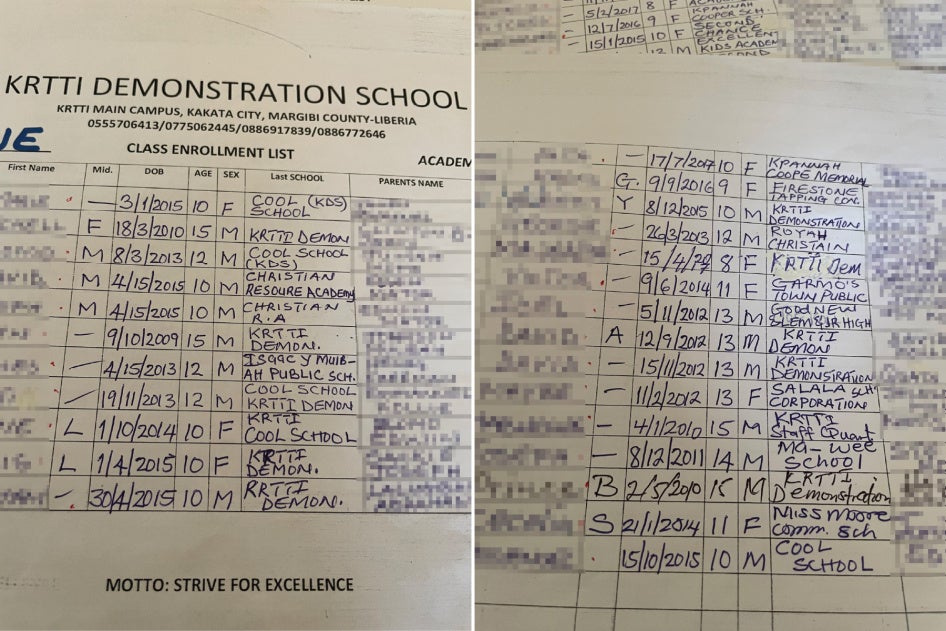
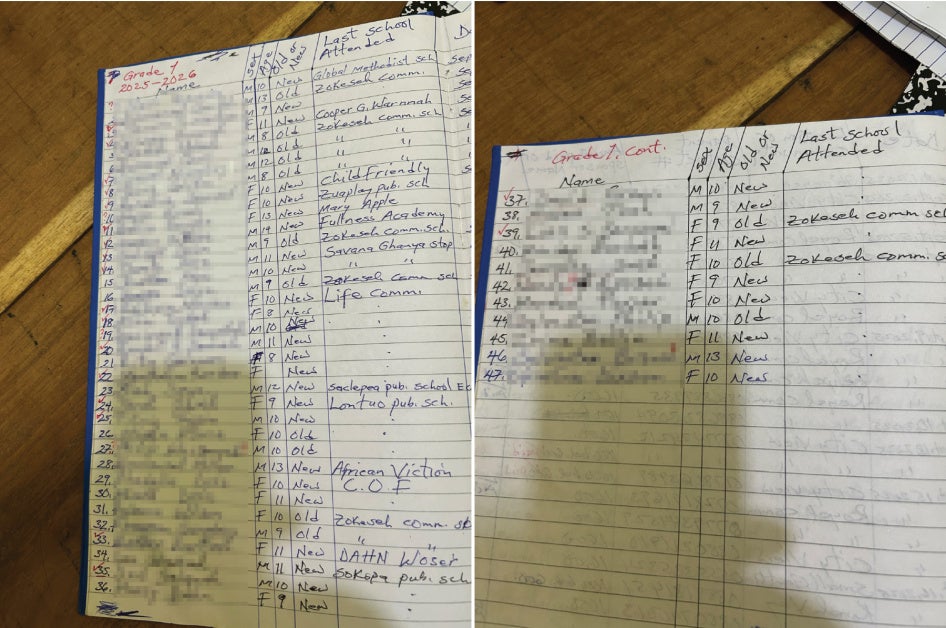
The principal of an elementary and junior high in Kakata, Margibi, showed Human Rights Watch the roster for grade 1 at his school. Only 2 of the 26 students enrolled were under the age of 10. The oldest was 15. Similarly, a grade 1 teacher in Montserrado estimated that 75 percent of her students were overage, with the oldest being 15.
Overage enrollment is particularly acute in junior and senior secondary school. The 2024-2025 Annual School Census found that 66 percent of students in junior secondary and 61 percent in senior secondary were overage. The census report said the “extremely high” rates indicated an “urgent need” for targeted interventions by the Ministry of Education, including accelerated learning, age-appropriate placement, and community sensitization.[62] Other sources cite even higher rates of overage learners: 95 percent in junior high and 84 percent in senior high.[63]
Every teacher interviewed said they had students over the appropriate age for their grade. A language arts teacher in Montserrado, for example, said that some of the students in her 4th grade class were 18 or 19; and that in her 6th grade class, some students were 22 or 23.
In some cases, children start school late because their families live in rural areas without a government school nearby. Parents understandably wait until the children are older to send them to an urban area to live with extended family members and attend school. A caregiver in Margibi said, “If parents are in rural places farming, they don’t want to send their young children long distances, so the child might be 10-years-old before they start school.”[64] Clara, for example, is 13 but only in the 1st grade. Her parents are farmers and sent her to Gbarnga in Bong County to live with her grandmother. Her parents send money once in a while; otherwise, she is dependent on her grandmother and aunt for her school fees and other support.[65]
Overage enrollment has negative consequences for both children and for Liberia’s education system. Multiple studies have found that students who are overage when beginning school have higher repetition and dropout rates, and lower completion rates than their peers who enter school at the appropriate age.[66] Between 2006 and 2011, 80 percent of Liberian students who dropped out of primary school were at least three years older than the intended completion age.[67] Overage students may feel embarrassment and stigma from being older than other children in their class, while teachers struggle to teach effectively and maintain class discipline due to differences in students’ maturity and educational level.
Missed and Interrupted Education
Many schools send children home when their parents have not paid required fees. As a result, students miss days or even weeks of instruction, undermining their academic progress. A science teacher in Kakata, Margibi, explained that at his school, “Lots of children are sent home. Some come back after a week, but if they don’t have the money, they don’t come.”[68]
Isaac, a 17-year-old in 11th grade in Montserrado, said, “Sometimes my father delays my fees because he is a farmer and depends on crops. If my parents can’t pay fees, the school sends me home until the balance is paid.”[69] Children also described feelings of shame and stigma after being sent home. Mary, 18, said, “It used to be shameful walking out of class, while your friends are staying in class.”[70] Michael, a grade 10 student in Montserrado, said that at his school, the registrar would humiliate children when sending them home.[71] Musu, 16, from Kakata, Margibi, said she was sent home repeatedly for non-payment of school fees, which left her feeling discouraged and unable to focus in class. She later dropped out of school.[72]
One parent in Gbarnga, Bong County, said that her children had been sent home from school on at least seven occasions because she was unable to pay their fees. “Sometimes they sit home for a week and then have a hard time catching up with their lessons. I talk with the administration to ask for more time. Sometimes they allow it, sometimes they don’t.”[73] A single parent of five children in Montserrado said that her children had stayed home from school at least five times because she had not been able to pay their fees. “They are wasting the children’s time,” she said. “The child stays home, wasting time, and doesn’t graduate on time.”[74]
Some parents reported that their children missed months or even years of schooling due to lack of funds. A mother of four in Monrovia, who holds a university degree in forestry, said she could not find work in her field and now earns a living making and selling concrete blocks. She explained that two of her children, ages 7 and 11, were not attending school because she could not pay their fees. “My youngest daughter attended one semester this year but then had to stop because of financial constraints.” The 7-year-old had never attended school.
A mother of six said that two of her children each stayed home from school for a year because she could not pay their school fees.[75] A farmer in Grand Bassa said that two of his children, ages 12 and 15, had dropped out of school because he didn’t have enough money for their fees. He said, “Now they do nothing. I want them to go back. If God gives us the opportunity, I will get the money and send them back next year.”[76]
A single mother of three boys in Montserrado said that her two youngest sons, 9 and 11, have not attended school for three years. She washes dishes to earn enough money for food but said she doesn’t have enough money for her sons’ school fees. She said that education is important and wants them to return to school. If there were no fees, she said she would send them back immediately. “I’m not feeling fine that they are not in school,” she said.[77]
Dropping Out
In Liberia, only 38 percent of children complete primary school (grade 6), and only 17 percent complete junior high school (grade 9).[78] Many of the principals and teachers Human Rights Watch interviewed identified school fees as a significant driver behind children dropping out.
A first-grade teacher in Montserrado said that she started the 2024 school year with 150 students but ended up with only 90. She said, “Some parents don’t have money.”[79] A principal of a public school in Grand Bassa offering ECE through grade 12 estimated that 10 to 20 percent of the children in his school drop out every year, primarily due to financial reasons.[80] A junior high school agriculture teacher in Margibi said that “plenty” of students at his school drop out because of the fees. “The registration fee is a challenge for families,” he said. “Most parents cannot afford [it].”[81]
James, 14, left school in 2024. He said, “Right now I’m not in school because my parents can’t afford to send me. I couldn’t keep up with the fees. Now, I help my mother sell to get money to send us to school. I really want to go back to school because I want to be educated.”[82]
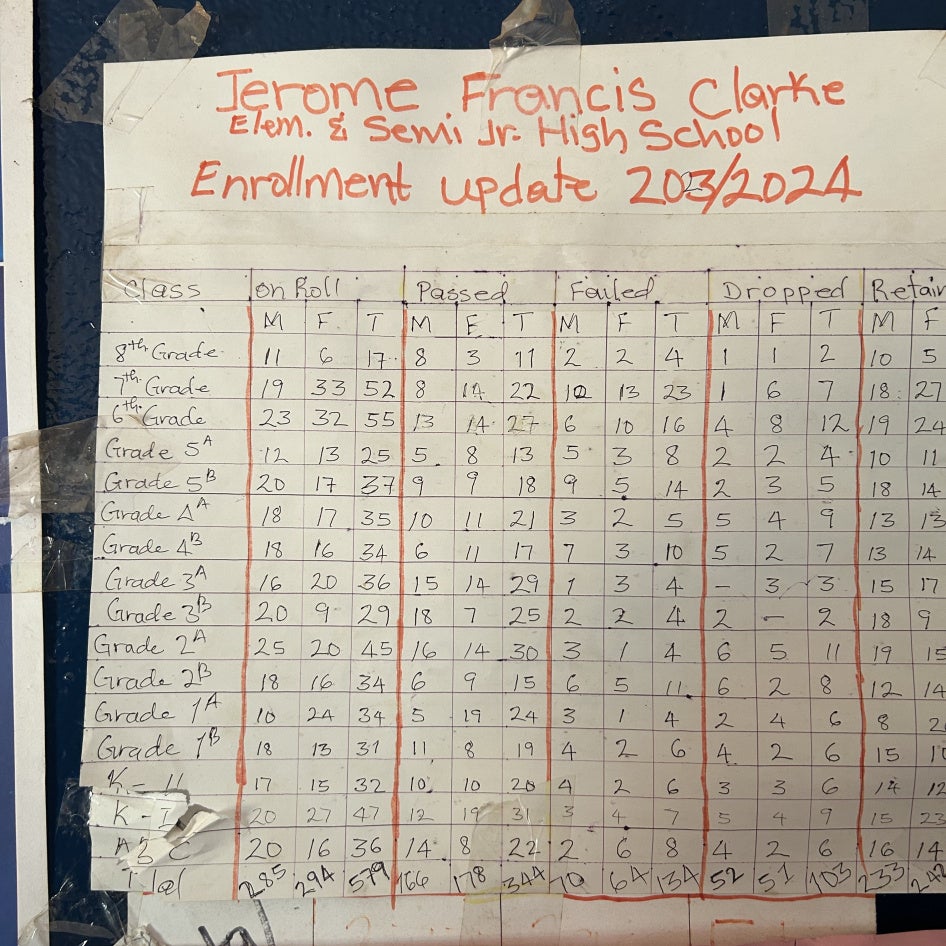
Princess, 17, said she stopped going to school after 8th grade because her parents didn’t have the funds to pay the fees. She has nine siblings and said that not all of them attended secondary school because of the school fees. “I want to go back to school to start from where I stopped,” she said.[83]
Several of the children interviewed said that they dropped out of school after the death of a parent. Peter, 17, dropped out of school after grade 9. He said, “I left school because my dad passed away, and my mom cannot afford to send me and my siblings to school.” He now helps his mother sell goods and works part-time in a carpentry shop to earn money to keep his younger sisters in school. He wants to go back to school to become an engineer and said, “Schooling should be free so that children will not drop out from school like my case. If school were free, when my dad died, I would still be going to school. But because it’s expensive, I am a school dropout.”[84]
Mary, 9, is from Bong County and was in the first grade when her father died. She said her mother couldn’t pay her school fees, so she was forced to drop out. She is working with her mother to sell goods and hopes to return to school. She said, “If you are educated, you can be respected in the society, you can work and earn your own money and live the life you want.”[85] Musu, 16, left school in Margibi County in 2023. Her father died and her mother was not able to keep up with her school fees. She is now working in a hairdressing shop. “I would like to go back to school,” she said. “School encourages personal growth, self-discipline, and a better future. But because of the poverty rate in Liberia, many families are not able to pay for their child’s fees.”[86]
Fees are not the only reason that children leave school. Particularly at the junior and senior high level, pregnancy is a significant driver of dropout for girls. Approximately one-third of 15 to 19-year-old females in Liberia are pregnant or have already given birth.[87] Most of the schools Human Rights Watch visited said they encourage girls to continue their education while pregnant (though many encourage them to transfer to night-time “adult” schools once their pregnancy is visible) and to return after giving birth. If new mothers do not have support for childcare, however, many do not return. A high school principal in Nimba County estimated that 20 to 30 of the school’s students were pregnant at the time of Human Rights Watch’s visit. “Some come back after giving birth, but if they don’t have help with care, they don’t come back,” he said.[88] Child marriage rates have dropped from 50 percent to 25 percent in Liberia since 1995, but also prompt girls to drop out.[89]
Some students drop out to avoid repeating a grade. A junior high school civics teacher in Nimba County said, “Some students drop out if they can’t progress. They prefer to drop out than to repeat.”[90] The registrar at a primary school in Nimba showed Human Rights Watch a large stack of report cards, and said, “Often if children believe they will fail, they will drop out or try to move to another school. I have a lot of report cards on my desk, but they have never come to collect them because they know they have failed.”[91]
Child Work and Child Labor
Under Liberian labor law, children can work full-time beginning at age 15, and are permitted to perform “light work” from age 13, provided such work is not for more than two hours per day or 14 hours per week and does not “prejudice the child’s attendance at school or their capacity to benefit from instruction.”[92] Liberia’s Child Law states that every child shall have the right to be protected from work and other practices that may threaten his or her health, educational, spiritual, physical, and moral development.[93] Both international and regional human rights law similarly protect children from economic exploitation. For example, the African Children’s Charter requires states to protect children from work that interferes with their education or harms their development.[94]
Nearly 3 in 10 children ages 5 to 17 in Liberia are engaged in child labor, either through outside economic activities or domestic chores.[95] Liberia’s most recent demographic and health survey found that 38 percent of children ages 12 to 14 were working outside the home, with 11 percent working more than 14 hours per week. Of children ages 15 to 17, 57 percent worked outside the home; 2 percent worked 43 hours or more per week.[96]
Children often work to help pay their school fees. According to teachers and children alike, children’s work outside of school may negatively affect their school performance or cause them to interrupt their education for periods of time. John, a 16-year-old boy in 9th grade in Montserrado, said that his school fees and additional costs for uniforms and textbooks cost about 4,500 LRD (US$24) per year. “My family is not working, so we sell sometimes to be able to afford the fees,” he said. “Now, I’m going to school but after school I go sell in the community to earn money. I want the government to help my parents so I can stop selling. School is good and can help you make a good life. If I learn today, my children will not sell like me.”[97]
Teachers and school administrators say that girls often work selling food or goods on the street or in markets, while boys often work transporting passengers or goods by motorbike. A science teacher in Gbarnga, Bong County, said, “Students will speak to me and say their parents are not working or that their parents are not making enough to take care of their responsibilities. Some are working to pay their fees and extend their education. Some work for a while and then come back to school.”[98]
Children from rural communities often do not have junior or senior secondary schools in their area and may move to urban areas for school. Some stay with extended family members or other guardians, but others live on their own and work to cover their living expenses and school fees. The UN special rapporteur on trafficking in persons, especially women and children, visited Liberia in December 2024 and expressed concern that in such situations, informal kinship-based and foster care can lead to trafficking in children for domestic servitude, and that many children who have been relocated from rural areas to Monrovia have ended up in street vending, begging, and domestic servitude.[99]
A senior secondary school math teacher in Grand Bassa estimated that up to 60 percent of students at his school were “self-sustaining” and living on their own.[100] A biology teacher in Margibi said, “Many of my students are self-supporting. They leave their families in the villages to come into the city to acquire an education. Feeding and lodging is difficult for them, so some sell in the street to make money, or ride a motorbike. Some ask teachers for assistance. Every day they are asking us for help.”[101]
Ellen, 13, left her parents in a rural village to live with a woman in Montserrado so that she could attend school. “I sell potatoes and greens in the market for the lady I live with,” she said. “The costs for school create difficulties for my family. If they don’t have the money, my guardian will credit the money, and I have to pay it back from what I sell.” She often sells in the market before school and said that the time working interferes with her studies.[102]
Some children from rural areas return to their village on weekends to farm. A junior secondary school civics teacher in Nimba said, “If I don’t see a student for two or three days, I will ask them, and they say they went to farm. Most are self-supporting, so they sometimes have to get food.”[103]
Their time working often leaves children with little time or energy to study. Samuel, a 10th grade student in Margibi, said, “I was unable to study because I was having to sell for my parents for them to get money to sustain us.”[104] A grade 3 teacher in Bong County said, “Some children have to sell before coming to school, sometimes they sell after school, so they don’t have time to study.”[105]
UNESCO has found that combining work and schooling increases absenteeism and reduces educational performance, often leading to dropout.[106]
The High Cost of Early Childhood Education
The financial barriers to children’s schooling in Liberia are highest for early childhood education (ECE). This period of education, also known as pre-primary education, preschool, or kindergarten, typically takes place from ages 3 to 5, before entering primary school. While the Liberian government authorizes 1,000 LRD (US$5) in fees for primary school, authorized fees for early childhood education are more than three times as high: 3,500 LRD (US$19) per year for each child.
Early childhood education has profound long-term benefits for children’s cognitive and social development, their health, future educational attainment, and employment and other opportunities later in life. The pace of brain development is at its highest in the first years of life, so this period represents a critical opportunity to make a positive difference in children’s lives.[107] Emerging evidence finds the benefits of pre-primary education are not only life-long but cross-generational.[108] Liberia’s 2022/23–2026/27 Education Sector Plan identifies ECE as an “indispensable intervention for the development of a young child.”[109]
Multiple studies have found that access to early childhood education can mitigate inequalities among children from families of different incomes.[110] Universal access to quality pre-primary education narrows early achievement gaps for children from disadvantaged households and places them on a more equal footing with their well-off peers.[111] According to the International Monetary Fund, increasing pre-primary enrollment can yield “large positive returns over an individual’s entire lifetime, particularly for the most disadvantaged.”[112] The African Committee of Experts on the Rights and Welfare of the Child has emphasized that states need to progressively expand access to early childhood education as part of fulfilling the right to education under the African Children’s Charter.[113]
According to Liberia’s most recent household survey, more than half of children ages 3 to 5 have never attended ECE and only about two in five are currently attending.[114] Teachers, administrators, parents, and children all identified the cost of ECE as a significant barrier to children’s education. In Liberia’s last available household survey, 52 percent of parents in the lowest income quintile cited ECE school fees as the main barrier to entry.[115]
Liberia’s current Education Sector Plan notes that households bear 46 percent of the total cost of ECE, with the government covering only 54 percent. In contrast, households cover less than 35 percent of the total costs of primary, junior, and senior secondary education, and only 3 percent of tertiary (university) education.[116] The plan states: “[P]arents support a disproportionate level of cost for the ECE, contributing to the difficulty of parents to send their children to ECE schools, despite the importance of the ECE in building a strong and long-lasting foundation.”[117]
An “ABC” nursery teacher in Nimba said, “Parents struggle to pay for ABC. Some of the parents pay, but sometimes children drop out to work on the farm. I had 130 children at the beginning of the school year, but now only have 70. Sometime the parents find the money and the children return, but most go to become farmers.”[118]
A school registrar in Nimba showed Human Rights Watch the school’s student roster, which indicated that the majority of parents had paid only part of the required fees. For the school’s ABC class, only 10 out of 50 children had their fees paid in full.[119]
Human Rights Watch visited two rural schools in the interior of Nimba, where most families rely on farming for income. Both schools had chosen to reduce the required fee for early childhood education. A principal of one of the schools said, “We are in the interior where it is very difficult for parents to afford the fees. Most of the parents are farming, mostly sugarcane. Often, they don’t make enough to sustain themselves.” In 2019, the school decided to reduce the ECE fee from 3,500 LRD (US$19) to 1,750 LRD (US$9). He said, “Even with the reduced fee, parents still have trouble.”[120]
At another rural school in Nimba, the principal said that because of parents’ financial constraints, the school reduced ECE fees to 2,600 LRD (US$14), but that “some parents still can’t pay.”[121]
Although ECE is not compulsory under Liberian law, many primary schools require ECE transcripts for entry into grade 1.[122] In such cases, a child whose parents cannot pay ECE fees may receive no education at all. A principal in Bong County said simply, “If parents can’t afford ECE, the child won’t go to school.”[123] A kindergarten teacher in Nimba said that children whose parents have not paid their fees are allowed to attend ECE, but that the child would not be promoted to grade 1 until their fees are paid.[124]
Other children may be admitted to primary school without ECE or with only a year or two of ECE but often struggle to catch up to their peers. A grade 1 teacher in Montserrado said she had 35 children in her class but estimates that only 10 of them benefited from ECE. “I see a big difference in their writing and reading,” she said, “It’s difficult because I’m alone in the class and can’t do it all. I have to spend extra time with them [children who did not have ECE]. Twice a week I offer extra classes to help the children catch up.”[125]
A principal of an elementary school in Margibi said that some children enter grade 1 without ECE. “They don’t know their ABCs, don’t know how to write. Reading and writing is a serious problem.”[126] A first grade teacher in Montserrado said, “I can see a difference. Those who went to kindergarten can read and write. But the others can’t do nothing.”[127]
Children described the challenges they faced in primary school as a result of not attending ECE. Grace, now 18, said her parents could not afford ECE because they were not working at the time. “I faced many challenges when I first joined primary school because I did not attend preschool,” she said. “I found it difficult to recognize letters and numbers, while some of my classmates already knew how to read small words and write their names.”[128] Janet, a 14-year-old girl in second grade, said, “My parents didn’t take me to preschool because things were hard on them. Primary school is challenging. It’s difficult for me to read, write, and understand the teacher.”[129]
Rebecca attends grade 11 in Montserrado and said, “I didn’t attend preschool. My parents said they never had money at the time, so they couldn’t afford paying my fee. In primary school, I struggled with writing and reading at first and stayed behind for a year because my foundation was not built from the first stage.”[130]
Some teachers and administrators said that parents try to enroll their children directly into grade 1 because of the prohibitive cost of ECE. A first grade teacher in Bong County said, “Children are not in the right class because of lack of money. Parents don’t want to send the children to private school for ECE, so they send them to grade 1. It’s a big problem.”[131] An early childhood education teacher in Bong County said, “Parents don’t want to pay the ECE fees, so they want their children to sit in the older classes. I tell them they are not helping their child, and their child will learn nothing.” She said she had several children who entered grade 1 but then were sent back to ECE because they were not prepared. She said, “ECE is a foundation. If it’s not built, you will struggle.”[132]
Several parents told us that they did not enroll their child in ECE because there was no public ECE available in their area. Of the 10 elementary schools that Human Rights Watch visited, only four offered ECE. Several school administrators, when asked about government-funded ECE in their geographic area, said they were not aware of any. The vice-principal of instruction at an elementary school in Montserrado that does not have ECE said, “Very few government schools have ECE. Sometimes children go to grade 1 without ECE, and teachers have to give extra class time after school to help them catch up.”[133] An administrator at a senior secondary school in Karkata, Margibi’s largest city, said that the city had six public primary and junior secondary schools, but no public kindergarten.[134]
A mother of three children in Montserrado said that none of her children had attended preschool. She said, “There’s no government preschool nearby, and the private preschool charges 25,000 LRD (US$134) per year.”[135]
When Private School is the Only Option
Only 39 percent of Liberia’s schools are operated by the government; 33 percent are classified as private, and 24 percent are faith-based institutions (also effectively private), and 4 percent are community-run schools.[136] At the junior and senior secondary levels, public schools are particularly scarce. Only one in five senior secondary schools is public, just 216 schools nationwide.[137]
Private school fees in Liberia often range from about US$400 to over US$800 per year, with some lower-cost schools charging US$200–$400 annually, and international schools charging much more.[138] Parents interviewed for this report who sent their children to private school reported paying between 6,000 and 30,000 LRD (US$32—$161) per year. Uniforms, transportation, books, and other materials typically add to the cost.
Approximately 44 percent of Liberia’s private schools operate without government authorization.[139] Moreover, there is no government oversight of the fees private schools charge or regulations requiring private schools to provide subsidies for low-income children, even when no public option is available nearby.
For many families, particularly in rural areas, schools are not available within a reasonable distance. More than half of rural children must walk more than 20 minutes to reach a primary school, and one in five must walk more than an hour.[140] Several of the parents interviewed for this report said they send their children to private schools because there is no public school in their area. Blessing, a 13-year-old girl in Montserrado, said that she attended private preschool for three years because the government school in her area did not offer preschool.[141] The mother of five children in Margibi sends her youngest child to a private preschool, which charges 18,000 LRD per year (US$97). She said, “The government kindergarten is very far from here. If it were closer, I would send my child there.” She makes only 8,000 LRD (US$43) per month as a nurse’s aide and struggles to pay her children’s school fees, but said, “Education is important because when you learn, you will do something to sustain your life.”[142]
Some low-income parents feel they have no choice but to pay the higher costs of private school because private schools typically have more flexible payment policies than many public schools. While some public schools that Human Rights Watch visited allowed children to attend even if their parents had not paid their fees, others have strict policies requiring the payment of registration fees upfront, at the beginning of the school year. Parents who don’t have enough money to pay these upfront fees sometimes end up sending their children to private schools, where they can pay the fees in smaller installments over time. One single mother of nine children said she couldn’t pay the fees for public school all at once as required, so sent eight of her children to private school. She said, “Private school is more flexible, and they let you pay bit by bit.” She said her brother and sister both helped with the fees. “When they send me 1,500 LRD (US$8), I divide the money in two—half for school, the rest to eat.”[143]
Finally, in some cases, local public schools have capped their registration, and children are forced into private school because no space is available in the public schools. One woman who is caring for three children from rural areas in Margibi said she struggles to pay for private school for one of the children, “We don’t have money for private school, but if public schools don’t have room, we are forced to go to private school.”[144] The nurse’s aide in Margibi said that when she went to enroll her 13-year-old daughter at a local public school, she was told that the school wouldn’t accept the girl because it was over capacity and registration was over. “So we had to go private,” she said. The private school charges 12,000 LRD (US$64) per year, which represents her salary for a month and a half. “When I’m able, I pay small, small amounts. Each time when you get some small money you go pay.”[145]
States have an obligation to provide free, quality public education, which is not diminished nor replaced by the existence of private schools. International law protects the rights of parents or guardians to send their children to private school,[146] but even where private schools operate, the state remains the primary duty-bearer and must both provide public education and regulate private providers to ensure access and equality.
Other Barriers to Quality Education
During Human Rights Watch’s interviews, teachers and school principals cited additional challenges that impact the quality of education in Liberia. Those most commonly raised included overcrowding and poor infrastructure, low salaries for teachers, and unpaid teachers called “volunteers.”
It is beyond the scope of this report to examine these issues in depth. However, issues of access to education cannot be separated from issues of quality. Access and quality are deeply interconnected, mutually reinforcing dimensions of the right to education that should be addressed in tandem.
As noted above, the Liberian government is making efforts to increase the number of schools and classrooms across the country, improve infrastructure, and address inadequate and irregular teaching salaries. The following sections, reflecting concerns raised in Human Rights Watch’s interviews, illuminate some of these challenges.
Overcrowding and Poor Infrastructure
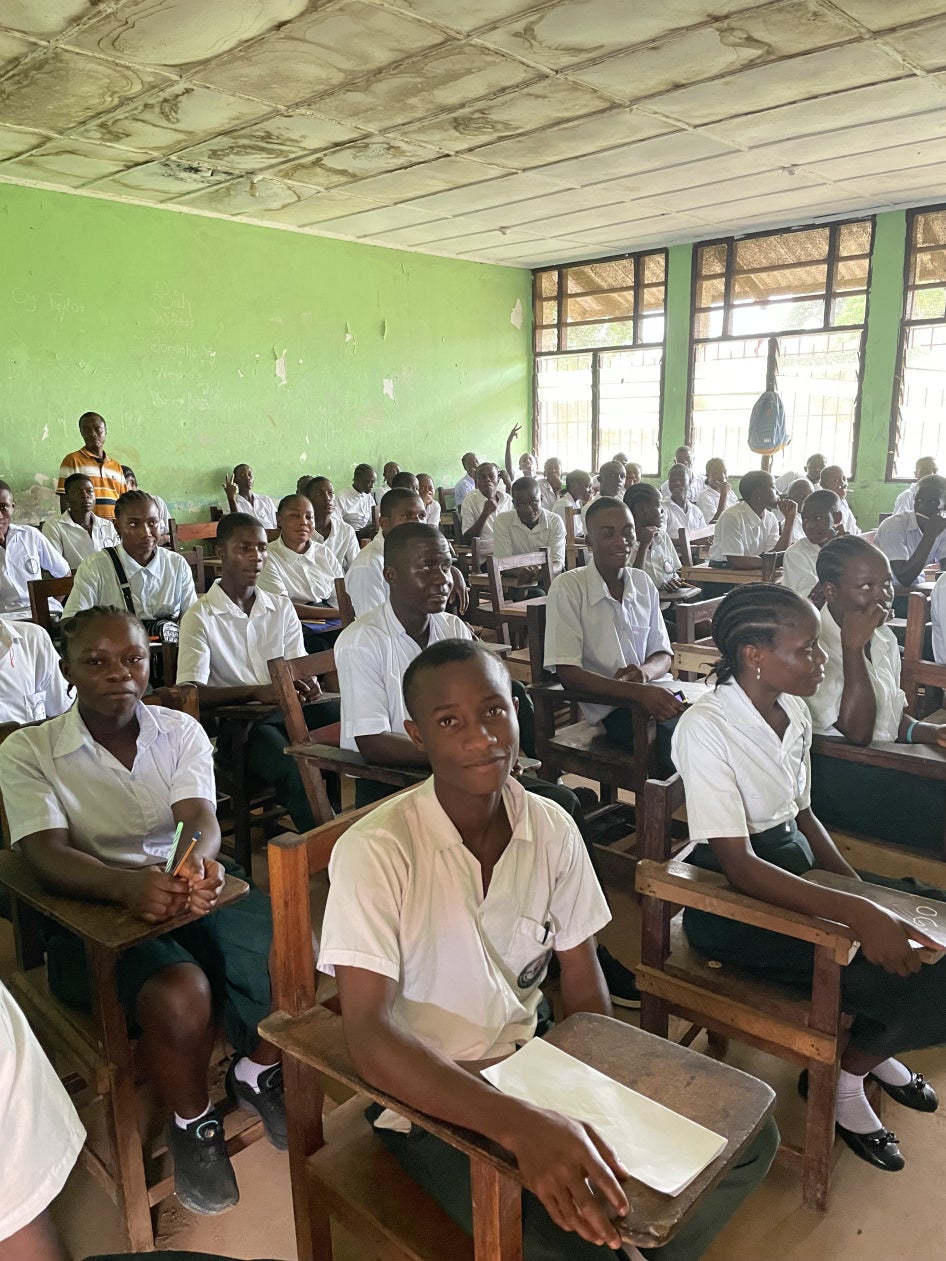
Many teachers complained about overcrowded classes. Some said they teach over 80 students in a class, while others reported classes of over 150. Liberia’s Ministry of Education recommends no more than 45 students per classroom.[147] An English teacher in Paynesville, Montserrado said that he had 130 students in one of his classes. “It’s not easy to monitor the class,” he said. “Two children will share a chair; two to five children will sit around one desk.”[148] A senior secondary school literature teacher in Margibi has 80 or 85 students in some of his classes. He said, “The classes are jam-packed. Teachers don’t have space to teach. The environment is not conducive for learning. There’s no proper evaluation.”[149]
Teachers said that with large classes, it is difficult to keep the students’ attention. An English teacher in Bong County said he had over 100 students in his 5th grade reading class. “Many students will not listen or focus. Some of the children are standing because there’s no seating capacity.”[150]
Teachers also report a lack of chairs and desks. A senior secondary school physics teacher in Monrovia said he had 90 students in his class. “Two students will share a chair. Some students have been expelled for fighting over chairs,” he said.[151] Several teachers reported that students have fainted in their classes, due to heat and the overcrowded conditions.
Two schools in Kakata in Margibi County have capped registration to reduce overcrowding. The principal of an elementary and junior secondary school said that before capping, some classes had as many as 200 students. He said, “When the class is that congested, the teacher doesn’t control the class anymore.”[152] Now, the school limits enrollment to 65 per class on a first-come, first-serve basis, with priority given to continuing students. A Kakata senior secondary school has also capped enrollment, limiting each class to 50 students.
While capping enrollment produces smaller classes with a better learning environment, it leaves some families with few options if their child is refused entry once classes are full. In Kakata, Margibi, there are only two government senior secondary schools. An administrator at the capped senior secondary school acknowledged that “lots of students want to go to school, but we don’t have enough space to accommodate.”[153] The elementary/junior secondary school principal mentioned above admits that, “If children can’t go elsewhere, they will sit at home because their parents don’t have money for private school.”[154]
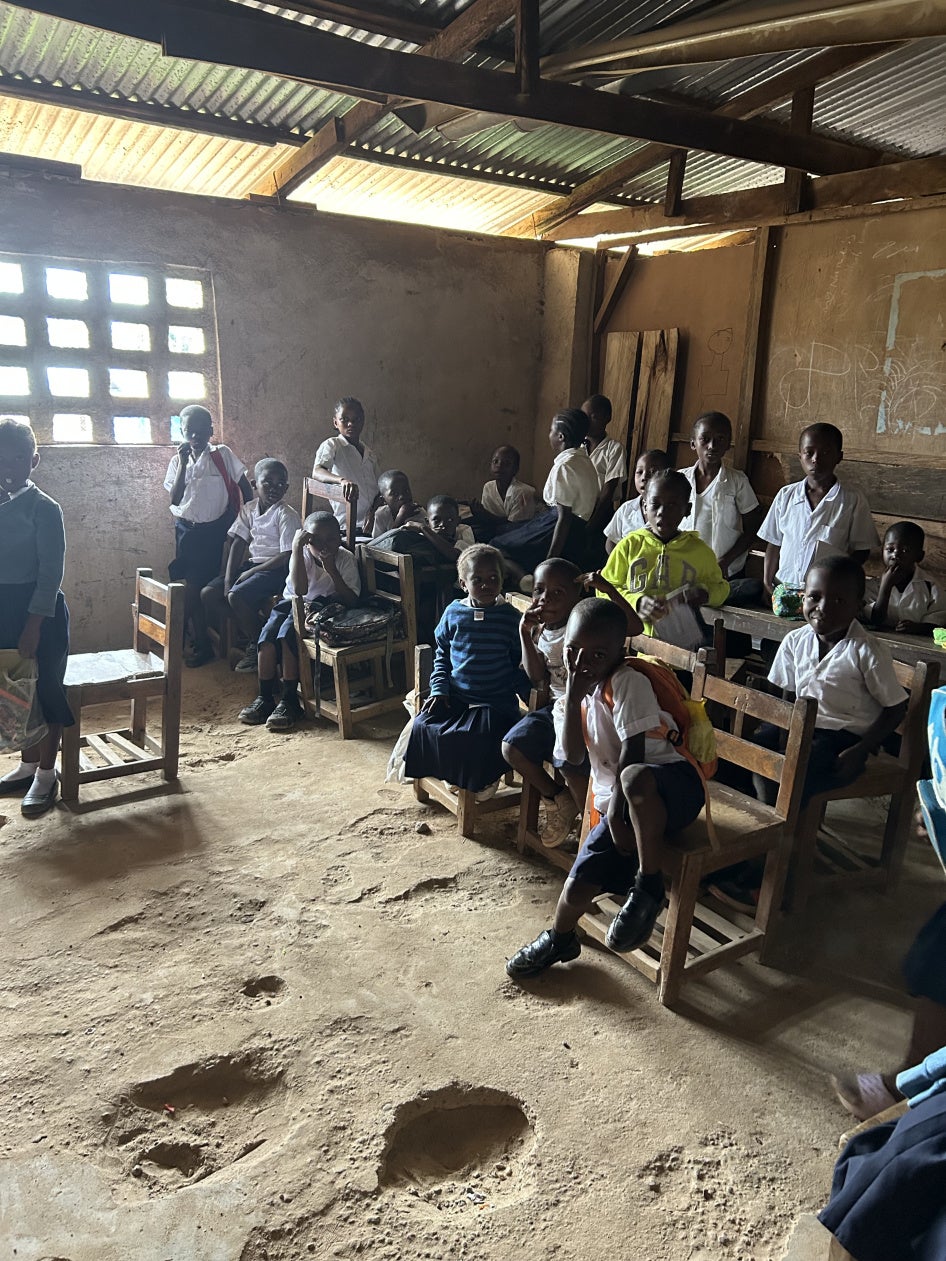
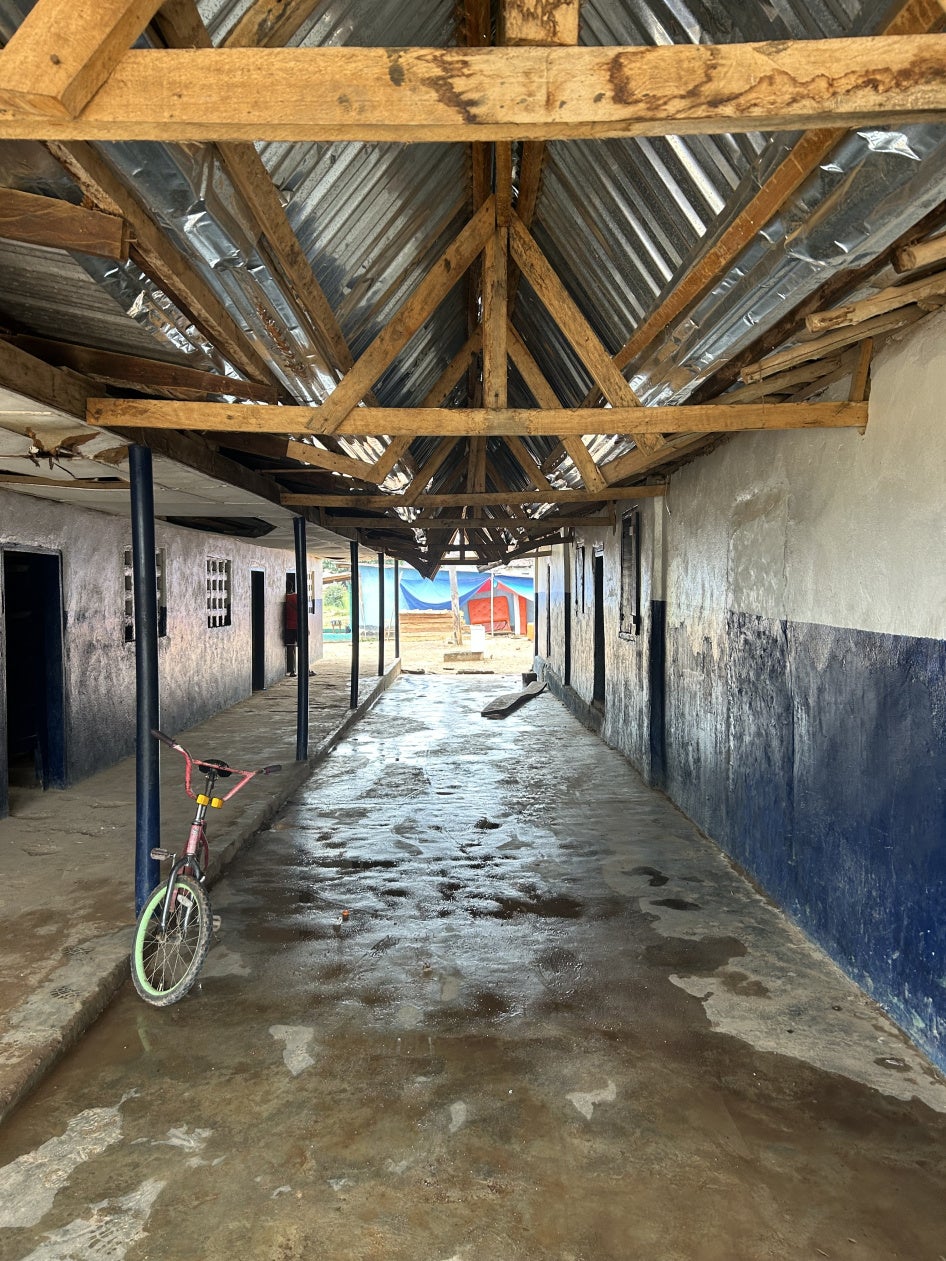
At some schools visited, Human Rights Watch observed leaky roofs, broken chairs, and pocked floors. Some principals and teachers said that their school lacked adequate bathrooms and sanitation. According to the 2024-2025 annual school census, 48 percent of public schools (1,184) do not have toilets and 76 percent (1,882 schools) do not have handwashing facilities.[155]
Low Teacher Salaries
School principals and teachers consistently cited low salaries as one of their most significant challenges. Under the Ministry of Education’s 2025 salary structure, teachers holding a C-certificate—qualified to teach early childhood education and primary school—are to receive US$185 per month, while those with a Bachelor’s degree in science or education (BSc or BSE)—qualified to teach at the junior and senior secondary school levels—are to receive US$400 per month.[156] In 2026, an average monthly salary for wage workers in Liberia was roughly 35,000–40,000 LRD (US$175–200).[157]
Since assuming office in 2024, Minister of Education Dr. Jarso Maley Jallah has pursued human resource reforms, including salary “top-ups” for teachers. By early 2025, she reported that of 13,400 teachers, the government had provided salary top-ups for 9,271 educators.[158]
Despite these efforts, many teachers continue to earn substantially less than the amounts specified in the salary structure or are not paid in accordance with their qualifications. An agriculture teacher at a junior secondary school in Margibi, for example, has taught for 20 years and makes only US$130 per month. He said, “I have four children, all young. It’s very challenging to support my family. Even as a teacher, I can’t eat breakfast, the money is not enough.” He said that he walks one hour each way to get to school to save money on transportation costs. He does agricultural work to supplement his salary, but still regularly borrows money from creditors to help pay his expenses.[159]
A literature teacher at a junior secondary school in Bong County said he has an associate’s degree (two years of college or university), but receives only US$95 per month. He said, “The salary is not easy. I live far from the school and half of my salary just goes for transportation.”[160] A primary school teacher in Montserrado with a C-certificate, said her salary is less than US$100 per month. She said that because she lives far from her school, she pays 500 LRD (US$2.68) per day for her transportation. “I am just working for the drivers,” she said.[161]
A school administrator in Bong County said she has a BSE but is paid at less than a C-certificate level. “US$100 makes it hard for me to cater to my children. It’s not easy for us.”[162] An economics teacher is making US$275 at a senior secondary school in Monrovia. He began teaching with a C-certificate and earned his BSE after one year but said that his salary still lags behind the BSE rate. To supplement his income, he also works part-time at a private school.[163] A school principal in Grand Bassa said, “Teachers are not paid according to their qualifications. Sometimes teachers with a C-certificate make as much or more as teachers with a BSE.”[164]
Volunteer Teachers
Thousands of trained teachers in Liberia teach without a salary as volunteers. Nearly all began teaching with the hope of being placed on the government payroll but often end up teaching unpaid for years. Human Rights Watch interviewed several teachers who had worked without a formal salary for 10 years or more.
In 2025, the Ministry of Education placed 2,148 volunteer teachers on the government payroll and removed 1,053 “ghost” names—names that were receiving salaries although no active teacher could be identified.[165] At many of the schools Human Rights Watch visited, teachers and principals reported that some of their volunteer teachers had recently been put on payroll. But many continue to teach with no government salary. The County Education Officer for Nimba, for example, said that 227 volunteer teachers in Nimba were put on payroll in 2025, but that 1,249 volunteer teachers in the county remained unpaid.[166]
The vice-principal for administration at a senior secondary school in Margibi reported that more than half of the teachers at the school were volunteers. At the school, volunteers teach mathematics, English, government, chemistry, physics, biology, economics, agriculture, and geography. She said that the school’s longest serving volunteer was teaching for the 11th year.[167] Other school principals said that up to one-third of their teachers were volunteers.[168]
A science teacher at an elementary and junior secondary school in Margibi said he had taught as a volunteer for more than six years. He said, “The government says the only way to be employed is to start as a volunteer, but there are no promises of how long it will take.” He has his C-certificate and is working towards a BSE degree. For income, he also works part-time at a private school for 6,000 LRD per month (US$32).[169]
Without a government salary, volunteer teachers rely on family or friends for financial help, or earn additional income from farming or other jobs, including teaching at private schools. Some schools or Parent Teacher Associations have also provided small stipends to volunteer teachers.
A language arts teacher in Montserrado has a BSE and 15 years of experience teaching, including in private schools. She has been teaching for two years as a volunteer and said, “It is very difficult to live with no salary, but I have a passion for teaching.” She said she planned to teach for another two years, but if she was still not on payroll after that time, would “need to reassess.”[170]
An elementary English teacher in Bong County has taught as a volunteer for seven years. He has two children and said that he walks more than an hour to his school to avoid paying for transportation. He also teaches at a private school, earning 8,000 LRD per month (US$43).[171] A first grade teacher in Grand Bassa has taught as a volunteer for 10 years. After her husband died, she had to support their five children on her own. She sells food at the market to make a little income but said that if she is not placed on payroll by the end of the year, she will need to go work at a private school.[172]
Despite low government salaries, public school teachers still make significantly more than private school teachers. Those teaching at private schools reported salaries of 8,000-18,000 LRD per month (US$43-$97). Teachers on the government payroll also have greater job security than private school teachers, who often need to reapply each year, and are eligible for government pensions. These factors lead many volunteers to continue teaching in public schools, hoping that eventually they will be placed on the government payroll.
Teacher Absenteeism
Administrators, teachers, and parents reported that teacher absenteeism is frequently a problem, often linked to teachers’ low or lack of pay. A senior secondary school principal in Margibi said, “It’s hard for administrators to exert authority over the teachers because they are volunteers.”[173] A principal in Grand Bassa said, “Teachers come to the school anytime they want to come, do what they want to do. Their salaries are not in our control. On a typical day, two, three, or four teachers may not attend.”[174] His school only has 12 teachers, so the absence of four teachers constitutes a 33 percent absenteeism rate. A registrar at another school in Grand Bassa said, “Every day, maybe 20 teachers come and four don’t.” She said that the school had replaced two teachers because of absenteeism.[175]
Absenteeism occurs among both volunteer and salaried teachers. A parent in Bong County said, “Some teachers are on the payroll, but they don’t teach. They sit home and take their salary.”[176] A teacher in Margibi said, “Volunteer teachers are constrained to come to work every day. If you don’t, it counts against you. While some of the payroll teachers don’t show up.”[177] A teacher in Nimba who had spent seven years working as a volunteer teacher, noted that volunteers often moonlight at private schools to earn income, affecting their attendance. “Sometimes they teach in two or three schools, so often are not coming. The government has no hold over them, so they do what they want to do.”[178]
Money for Grades
Principals, teachers, parents, and children alike reported that individual teachers sometimes demand sums of money from students for exams, assignments, or to influence their final grades. Anti-corruption assessments have also documented the practice in Liberia.[179] In the cases reported to Human Rights Watch, teachers demanded amounts ranging from 100 LRD (US$0.56) to 1,500 LRD (US$8).
A parent in Grand Bassa said, “Teachers give assignments to students and expect 1,400, 1,500 LRD (US$7.50-$8). If we don’t pay, they won’t accept the assignment. Anytime they take the assignment, they take money. If we don’t pay, the child will fail.” She said that just a few weeks before our interview, a teacher had asked for 1,500 LRD (US$8) from her daughter for an assignment.[180]
Another parent in Grand Bassa said that teachers asked her 15-year-old daughter, attending 6th grade, for amounts ranging from 300 to 500 LRD (US$1.60-$2.68) for exams and assignments.[181] The daughter independently confirmed that as many as six of the teachers in her school asked students for money, and said they did it openly in class. Both the mother and her daughter believed that if they reported it, no action would be taken.
Several children reported being forced to pay these bribes to their teachers. Faith, a 14-year-old, 5th grade student in Montserrado, said, “If you miss a test or quiz, the teachers demand you pay money. It’s something I’ve experienced many times.”[182] None of the children interviewed said that they had reported the practice. Several said they were afraid that if they did, their teacher would fail them.
Junior, a student who attended senior secondary school in Margibi, said that he did not pay for grades, but he believed that it happened at his school:
When I’m going to school, I am studying and making an effort, and my grade would be low, while other people who didn’t study got grades that were higher. I felt bad about it. We are in class. We know who is putting time into their studies and who doesn’t. When those students get better grades, we know that something went wrong somewhere.[183]
Teachers, principals, and parents alike link the practice to the large number of volunteer and low-paid teachers in the education sector. An economics teacher in Margibi said, “If volunteers work for 8 to 10 years with no salary, it’s an incentive to take money from students. It’s an incentive to manipulate the system.”[184] Another teacher in Margibi said, “It’s obvious, where there are not sufficient funds, the teacher will get fees from students.”[185] One of the parents mentioned above said that the government should pay teachers an adequate salary: “If they don’t pay teachers, they will ask children for money, because it’s the only way they can survive.”[186]
The County Education Officer in Nimba County said that he gets reports of money for grades on a regular basis. He has dismissed some teachers and issued warnings to others.[187] Several principals said that when teachers were found to be demanding bribes, the teachers were reassigned to less desirable schools or areas.
The County Education Officer in Grand Bassa said that his office makes announcements in meetings and on the radio, urging whistleblowers to come forward, but that many cases are never reported. “If there’s no evidence, there’s nothing I can do,” he said.[188] A senior secondary school principal in Margibi said, “It is happening, it’s a problem we’re facing. If we find out, the teachers get a warning letter. The problem is that there’s no way to get evidence. Students won’t tell because they are afraid of the teacher.”[189]
Although Human Rights Watch did not receive direct reports of students being coerced into sexual relationships with teachers or administrators in exchange for grades, academic advancement, or to avoid academic penalties (i.e. “sex for grades”), multiple academic studies and media accounts indicate that this is a continuing and prevalent problem in Liberia.[190]
Education as Investment
Education is not only a human right and a powerful catalyst for improving children’s lives, but also one of the best investments for sustainable and inclusive development. A 2023 analysis of data from 155 countries between 1980 and 2021 found that public expenditure on education accounted for 50 percent of global economic growth, 70 percent of income gains among the world’s poorest 20 percent of individuals, 40 percent of extreme poverty reduction, and over 50 percent of improvement in the share of labor income accruing to women over this period.[191]
Over the long term, education investments pay for themselves many times over in the form of increased tax revenues, contribution to Gross Domestic Product (GDP), and value to employers over the life of the eventual employee, as well as reduced public service expenditures in law enforcement, medical care, the justice system, and child welfare.[192]
Pre-primary education investments in particular have powerful results. A 2021 World Bank cost-benefit analysis using studies from low- and middle-income countries estimated benefit-to-cost ratios for pre-primary education ranging between 1.7 and 14.2. In other words, low- and middle-income countries can expect up to US$14 in benefits for every $1 invested in pre-primary education.[193] The International Monetary Fund (IMF) has concluded that “[i]nvesting in early childhood education and care has been shown to yield some of the largest returns.”[194]
Research from sub-Saharan Africa suggests that investments in early childhood care and education would be offset by up to 87 percent as a result of higher efficiency within primary education alone.[195] For example, education data from some countries shows that more than half of children who do not attend pre-primary school end up repeating grades.[196] According to UNICEF, such excessive repetition can result in 1.2 extra years of education per child and an estimated 5-10 percent of the education budget wasted.[197]
Financing for Education
Liberian government spending on education has consistently fallen below established international benchmarks of 15 to 20 percent of total public expenditure and/or 4 to 6 percent of GDP.[198] Between 2015 and 2020, education expenditure ranged from 11 to 15.3 percent of Liberia’s national expenditure.[199] In 2021, Liberia pledged to increase its education spending to 20 percent of its national budget by 2025.[200] Its education expenditure did not substantially change, however. Between 2020 and 2025, education sector spending remained between 11.2 to 14.5 percent of national expenditures.[201]
Liberia’s approved FY2026 national budget totals US$1.25 billion, representing a 42 percent increase over FY2025.[202] Although the education sector allocation (US$136 million) increased by 14 percent in nominal terms over the previous year, it accounts for only 11 percent of total government spending, and only 2.73 percent of GDP, significantly below the global benchmark and the Economic Community of West African States (ECOWAS) average of 4 percent.[203]
A number of factors, discussed below, undercuts Liberia’s capacity to direct more funding to its education sector. Government revenues, which are highly dependent on taxes, are low, in part due to tax exemptions, profit shifting, and tax abuse. The extractive sector contributes more than 50 percent of Liberia’s GDP, but accounts for only 16 percent of Liberia’s domestic revenues.[204] Budgets also allocate only a small share of funding to education, and this is disproportionately spent on university-level education, while neglecting early childhood, primary, and secondary education. As noted below, the government is also not fully implementing a law requiring that 60 percent of “signature fees” for concession agreements go toward education.[205]
In addition, traditional donor countries have eliminated or decreased their development funding. Debt to domestic and international creditors, including the World Bank, is forcing Liberia to spend nearly as much on debt servicing as it does on education and health combined.[206]
The global tax system contributes to many of these problems. Nevertheless, as discussed below, Liberia has numerous options to increase domestic revenue to better fund education and other public services.
Tax Reform
For most countries, domestic financing (primarily tax revenues) is by far the largest source of education funding. There are various policy options for governments to secure resources for education in a progressive manner. These include increases in progressive taxes—that is, those with greater income or wealth contribute a larger share of their resources in taxes than those with less, reconsidering costly tax exemptions, stemming tax abuses, and improving governance and accountability (including reducing corruption and tax evasion). The political obstacles to achieving adequate tax revenues for necessary domestic programs such as education are exacerbated by a global tax system that makes it challenging for many governments, especially in the Global South, to effectively tax the wealthy and multinational corporations.
Both the World Bank and the IMF have found that tax revenues above 15 percent of GDP are key for economic growth, poverty reduction, and reducing inequality.[207] This is a low threshold from a human rights perspective, as prevailing international benchmarks call for governments to spend 5 percent of GDP on health and/or 4 to 6 percent on education alone.
Liberia’s tax-to-GDP ratio in 2023 was about 11.7 percent, significantly lower than the average for African countries (16.1 percent). ActionAid has argued that a five percentage-point increase in tax-to-GDP ratios across African Union countries could generate an additional US$146 billion annually.[208] For Liberia, a five percentage point increase in its tax-to-GDP ratio could generate an additional US$240 million in annual revenue, more than the combined allocations for education and health in the approved FY2026 budget.
The overall tax framework should be progressive and measures to improve revenues should be informed by that principle, for example by favoring measures to eliminate corporate tax exemptions or increase taxes on the highest incomes and wealth. Heavy reliance on consumption taxes, particularly on goods and services critical for necessities such as food and fuel, have been shown to disproportionately harm people with lower incomes.
The Atlas of Offshore Wealth, a project of the European Union Tax Observatory, finds that Liberia’s effective tax rate on companies and capital, which most affects the wealthiest, has decreased dramatically over time, whereas tax on labor has increased.[209]
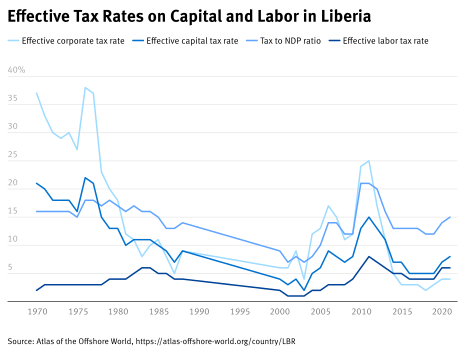
The global tax system contributes to these trends by, for example, enabling multinational companies to shift profits to tax havens and making it difficult for governments to stem tax-related illicit financial flows. According to the Tax Justice Network, Liberia loses at least US$200 million per year to global tax abuse, including through tax havens—equivalent to 240 percent of annual education spending.[210] The threat of profit shifting, as well as tax competition, also fuels a “race to the bottom,” leading many governments to cut rates or grant broad tax exemptions, even though decades of research indicate they are rarely effective at attracting investment and their cost often outweighs their benefit.[211] In 2023, tax exemptions cost the Liberian government US$270 million in foregone revenue, equivalent to 6.7 percent of GDP.[212]
In July 2025, 36 Liberian civil society organizations issued a joint communiqué, calling on Liberia to transform its domestic resource mobilization strategy to better finance public services and to center people, rights, and accountability. Their recommendations included progressive tax reforms to increase revenue through wealth and property taxation, revising capital gains and top-income tax rates, and ensuring robust enforcement against corporate tax evasion and avoidance.[213]
The civil society organizations’ communiqué also recommended that the Liberian government take action to eliminate illicit financial flows, to cooperate with other countries to pursue comprehensive debt cancellation, to reject austerity conditions from the IMF and other international financial institutions, and to reform extractive sector taxation and governance.[214]
In addition to national level reforms, all governments should support reforms at the international level. In 2024, the Africa Group at the United Nations initiated a resolution at the UN General Assembly for a convention on international tax cooperation to address precisely the challenges that Liberia is facing. Negotiations on the treaty are ongoing, and a draft will be submitted for a General Assembly vote in 2027. Potential reforms at the center of the debate could eventually be transformative for Liberia.[215] For example, the treaty could end the current system’s privileging of taxing rights of governments where companies are incorporated or headquartered (so-called “residence countries”) over countries where the economic activity takes place (“source countries”). It could also effectively tackle profit shifting, such as by adopting an approach that treats companies and their subsidiaries as a single entity, and improve how governments work together to combat harmful tax practices and stem illicit financial flows.[216]
Concession Fees and Education Funding
Liberia’s Education Reform Act of 2011 establishes a notable requirement that certain concession agreements—contracts between the government and a private company granting the right to earn revenue from managing and running a public asset or service—include dedicated revenue for education. Section 9.1.a of the law states:
All concession agreements for investment in the extractive mineral sector and other non-renewable resource sector, as well as in the agriculture sector and in major privatization contracts shall require that 60 percent of any signature fees realized shall be allocated to the education budget, and the terms and conditions of all such agreements and contracts shall include a negotiated fixed annual amount as social responsibility fee for education which, when paid, shall be made available as transfer and/or subsidy to the annual cost of education in Liberia. [Emphasis added.][217]
A signature fee is a one-time payment made by an investor at the signing of a concession agreement. Such payments do not generate predictable year-to-year revenue like taxes or royalties, but can be substantial. For example, in January 2026, the Liberian legislature approved an agreement between the government and the mining company ArcelorMittal, which entails a US$200 million signature fee.[218] Under the education law, US$120 million of this fee should be allocated to education.
The Liberian government has, however, failed to fully implement the law, thereby denying significant funding to the education sector. In its approved FY2026 budget, the government stated that the entirety of the US$200 million ArcelorMittal signature fee was allocated to the Public Sector Investment Plan (PSIP). Of the funds designated under the PSIP, only $15.7 million was allocated to education—just 13 percent of the US$120 million required by law.[219]
Reordering Budget Priorities
Less than 50 percent of Liberia’s 2026 national education budget is designated for early childhood education (ECE) to grade 12 education.[220] Roughly 43 percent of the education budget (nearly US$60 million) is allocated to tertiary education, including the University of Liberia and more than a dozen other public and private universities and community colleges, raising concerns about the equity implications of Liberia’s current education spending priorities.[221] Extensive research shows that public spending on primary education tends to benefit lower-income households and promotes equal opportunity, while spending on tertiary education disproportionately benefits wealthier households.[222] The 2022 Education Sector Analysis notes that Liberia’s spending for tertiary education was five times higher than for basic and secondary education, and found that while household spending for education increased with ascending levels of education, it drops at tertiary level.[223] In its most recent review of Liberia’s compliance with the Convention on the Rights of the Child, the UN Committee on the Rights of the Child raised concerns about Liberia’s overall budget being “highly skewed towards tertiary education, thus limiting opportunities for all children to achieve universal primary and second cycle education.”[224]
International Assistance and Cooperation
International assistance plays a central role in financing Liberia’s education sector, with major support from multilateral, bilateral, and philanthropic donors. The World Bank is the largest single financier, providing a US$60 million credit in 2025 for the five-year Excellence in Learning in Liberia (EXCEL) Project, building on earlier support of approximately $47 million.[225] The Global Partnership for Education has contributed an additional $28.7 million to the same project, alongside smaller system transformation grants.[226] Together, these commitments amount to nearly $90 million for a single nationwide initiative to improve foundational learning.
UNICEF serves as a key implementing partner for education, supporting early childhood education, learning materials, and system strengthening, often financed through pooled donor funds.[227] The European Union has also provided substantial support, including tens of millions of euros in broader budget assistance that supports the education sector.[228] Additional contributions from bilateral donors and philanthropic actors further supplement financing, particularly for teacher training and early grade learning programs.
While the EXCEL Project is the largest education-related project ever financed by the World Bank in Liberia, other donors have cut their support. For example, in 2025, USAID was providing US$261 million in support over five years to education projects; this support was suspended in early 2025 with US$128 million not yet dispersed.[229] In addition to the sharp reduction in US assistance, several other major donors—including the United Kingdom, Germany, Sweden, and France—have reduced development aid in recent years, contributing to a broader decline in funding for social sectors such as education in low-income countries like Liberia.[230]
Although international assistance will continue to be an important source of funding for Liberia’s education sector, recent trends underline the importance of domestic resource mobilization to achieve universal quality public education.
Regional Examples of Free Education
Several countries in West Africa illustrate the benefits and feasibility of expanding access to free education through law and policy.
In 2018, Liberia’s neighbor Sierra Leone introduced a free education policy that eliminated school and examination fees. Over the following three years, student enrollment rose from fewer than two million to more than three million.[231] In 2023, Sierra Leone further strengthened this commitment by enshrining the policy in national law, guaranteeing 13 years of free education, from one year of pre-primary through secondary school.[232]
Liberia and Sierra Leone share broadly similar contexts, including histories of civil conflict and the Ebola outbreak, as well as comparable economic profiles. In 2024, Sierra Leone’s per capita GDP stood at approximately US$807, slightly below Liberia’s US$851.[233] Within these shared constraints, Sierra Leone allocated 5.6 percent of its GDP to education in 2021, compared with Liberia’s 2.3 percent.[234]
As early as 2001, the Gambia began rolling out fee-free public schooling for girls in grades 7-12 on a nearly national scale, increasing the number of girls taking the high school exit exam by 55 percent.[235] Between 2004 and 2023, it increased its funding for education from 5 percent of the national budget to 17.5 percent.[236]
Ghana has provided two years of free and compulsory pre-primary education since 2007[237] and introduced free upper secondary education in 2017, covering all fees, meals, textbooks, and other charges. In 2011 and 2012, it allocated more than 30 percent of its national budget to education.[238] Following the implementation of the free upper secondary education policy, senior secondary school enrollment rose from 813,448 in the 2016/17 academic year to 1.3 million in 2022/23.[239] By 2025, the program had benefited over 2.5 million students.[240]
The implementation of free education policies such as these presents significant challenges. In some contexts, the removal of school fees has led to sharp increases in enrollment that have strained education systems and, in some cases, contributed to declines in quality.[241] Ensuring that fee abolition expands access without undermining learning outcomes requires commensurate investments in teachers, infrastructure, and learning materials.
The Path to Eliminate School Fees
As Liberia seeks to expand access to quality education, eliminating school fees would yield significant benefits. As this report shows, registration fees remain a major barrier for many families. Removing these fees would help ensure that children enroll on time and remain in school, while reducing overage enrollment, out-of-school rates, dropout, and reliance on child labor. It would also improve learning outcomes and completion rates.
Eliminating school fees would also reduce inequities. Currently, low-income households bear a disproportionate share of education costs. Liberia’s current Education Sector Plan (2022/23–2026/27) acknowledges that education financing is regressive, with households—particularly at lower levels of education—contributing a disproportionate share of total spending.[242]
The five-year EXCEL Program, launched in 2025, offers a concrete pathway to address these challenges. It recognizes that current financing patterns—characterized by limited government support for school operating costs and the absence of an equitable funding formula—have led schools to rely on fees that “represent a binding constraint to increasing access to formal education.”[243]
To address this, the EXCEL Program allocates US$18.5 million for annual school grants, distributed based on school size, with the explicit objective of reducing or eliminating the need for schools to charge fees.[244] By September 2029, it aims for 90 percent of primary schools to receive these grants, administered through school management committees.[245]
To ensure impact, the Ministry of Education should establish strong oversight mechanisms so that schools eliminate fees rather than use grants to supplement existing fee income. The program’s five-year implementation period also provides time for the government to increase education financing, institutionalize the grant system, expand it to junior and senior secondary education, and secure the permanent abolition of school fees.
Abolishing school fees is both feasible and affordable. Human Rights Watch estimates that eliminating registration fees for students currently attending public schools and replacing this revenue with public funding would increase the education budget by less than 4 percent.[246]
International Law and Standards
Education is a human right enshrined in a range of international and regional treaties, including the International Covenant on Economic, Social and Cultural Rights (ICESCR); the Convention on the Rights of the Child; the African Charter on Human and Peoples’ Rights; and the African Charter on the Rights and Welfare of the Child. Liberia is a party to all four conventions.[247] These instruments establish that all children have a right to free, compulsory, primary education, free from discrimination. States parties should also ensure that different forms of secondary education are available and accessible to every child, and make it free through the progressive introduction of free education.[248]
Currently, a United Nations intergovernmental working group, chaired by Sierra Leone, was considering a possible optional protocol to the Convention on the Rights of the Child to strengthen the right to free education by guaranteeing free public pre-primary education (beginning with at least one year) and free public secondary education for all children.[249] As of early 2026, 60 UN member states had expressed public support for the initiative.[250]
The right to education is guaranteed for all, and states have an obligation, under the ICESCR and other treaties, to take steps, “to the maximum of [their] available resources” towards its realization, similar to other economic, social and cultural rights. The Committee on Economic, Social and Cultural Rights, in its 1990 General Comment No. 3 on the nature of states parties’ obligations, said that states must “move as expeditiously and effectively as possible” towards the full realization of rights.[251] In its most recent review of Liberia’s compliance with the Convention on the Rights of the Child, the UN Committee on the Rights of the Child urged Liberia to “ensure that primary education is completely free of charge, including for textbooks and school materials in all regions.”[252]
In considering whether a budget aligns well with a state’s human rights obligations, other considerations may come into play. For example, the “4S” framework developed by advocates of the right to education considers the following to determine whether a budget aligns with human rights: the size of the budget relative to GDP; the share of spending relative to overall government expenditures; the sensitivity of the budget to educational inequalities; and scrutiny over the budget to ensure money is appropriately allocated and spent.[253]
The right to education must be free from discrimination of any kind.[254] Governments are obligated to take positive steps to include children who are often excluded from education systems and who experience multiple and often intersecting forms of discrimination, including girls, children with disabilities, refugee and immigrant children, lesbian, gay, bisexual and transgender (LGBT) children, children living in rural areas, children living in poverty, and children affected by armed conflict.[255]
According to the UN Committee on the Rights of the Child, “Every child has the right to receive an education of good quality which in turn requires a focus on the quality of the learning environment, of teaching and learning processes and materials, and of learning outputs.”[256]
The African Charter on the Rights and Welfare of the Child, like the Convention on the Rights of the Child, states that “every child shall have the right to education.”[257] Among its provisions, states must take all appropriate measures to provide free and compulsory basic education, to progressively make secondary education free and accessible to all, and to encourage regular attendance at schools and the reduction of dropout rate.[258]
In its 2025 General Comment No. 9 on the right to education, the African Committee of Experts on the Rights and Welfare of the Child stated that the obligation to provide free and compulsory basic education is immediate and should include the elimination of collateral costs. These costs include direct and indirect fees such as tuition, exam fees, and activity fees; levies; donations and additional payments to teachers; hidden costs that prevent access to education, such as uniforms, school supplies, and transportation; denial of examinations results due to nonpayment of fees; and expulsion or suspension due to inability to pay fees.[259] It also clarified that “basic education” includes at least one year of free “quality pre-primary education” and that African states should ensure that public schools offer early childhood development “as part of basic education.”[260]
The African Charter on Human and Peoples’ Rights in article 17 also recognizes the right to education and obligates states to promote and protect it. The African Commission on Human and Peoples’ Rights has clarified that states must take positive measures to realize socio-economic rights, including through adequate funding and policy measures. In Social and Economic Rights Action Center (SERAC) v. Nigeria, the African Commission affirmed that governments have obligations to respect, protect, promote, and fulfill socio-economic rights.[261] These obligations apply equally to the right to education.
Indirect education costs constitute disincentives to the enjoyment of the right to education and may jeopardize its realization. The UN Committee on Economic, Social and Cultural Rights has said that therefore governments have to take measures to eliminate financial barriers to ensure education is “free of charge.”[262]
Under the Convention against Discrimination in Education, which Liberia ratified in 1960, states must “ensure that the standards of education are equivalent in all public educational institutions of the same level, and that the conditions relating to the quality of the education provided are also equivalent.”[263]
As part of the 2030 Agenda for Sustainable Development, all UN member states have committed to ensure that by 2030, all girls and boys complete free, equitable, and quality secondary education and have access to quality early childhood development, care, and pre-primary education.[264] The “Framework for Action” adopted by UNESCO member states in 2015 encourages states to achieve this last target by providing “at least one year of free and compulsory pre-primary education of good quality.”[265]
Governments have also made a commitment at the 2015 World Education Forum in Incheon, South Korea to allocate 4 to 6 percent of GDP to education and/or to allocate at least 15 to 20 percent of public expenditures to education.[266] The 2021 Paris Declaration on Education Financing reaffirmed these international benchmarks.[267]
Education, an economic, social, and cultural right, entails both immediate and progressive state obligations. This set of rights is subject to progressive realization, in recognition of the fact that states require sufficient resources and time to respect, protect, and fulfill these rights. The OHCHR further provides:
The treaties impose an immediate obligation to take appropriate steps towards the full realization of economic, social and cultural rights. A lack of resources, or periods of economic crisis, cannot justify inaction, retrogression in implementation or indefinite postponement of measures to implement these rights. States must demonstrate that they are making every effort to improve the enjoyment of economic, social and cultural rights, even when resources are scarce.[268]
The “Abidjan Principles on the human rights obligations of states to provide public education and to regulate private involvement in education” were adopted in 2019 in Côte d’Ivoire by a group of experts on the right to education and have been cited by all major UN and regional human rights bodies. The Abidjan Principles provide a summary of states’ existing legal obligations regarding the delivery of education including authoritative interpretations provided by human rights bodies. They outline states’ duties to provide free, public education of the highest attainable quality to everyone as effectively and expeditiously as possible, to the maximum of their available resources.[269] They apply to all levels of education including pre-primary, and they lay out the obligation to realize the right to education including by prioritizing the provision of free, quality, public pre-primary education.[270]
Where private actors are involved in the provision of education, states need to regularly monitor compliance of private institutions with the right to education and ensure all public policies and practices related to this right comply with human rights principles.[271] The Abidjan Principles provide that “international assistance ... must prioritise free, quality, public pre-primary, primary, and secondary education for all, especially vulnerable, disadvantaged, and marginalised groups, and move as effectively and expeditiously as possible towards free, quality education in public educational institutions at other levels.”[272]
The African Union’s “Agenda 2063,” a blueprint for inclusive and sustainable socio-economic development, adopted in September 2015, calls for “sustained investments based on universal early childhood development and basic education, and sustained investments in higher education, science, technology, research and innovation, and the elimination of gender disparities at all levels of education.”[273] The complementary Continental Education Strategy for Africa, 2026-2035, states that “[e]ducation should be free until the completion of secondary school.”[274]
Taken together, these international and regional standards obligate the Liberian government to ensure that all children are able to access free and compulsory basic education without discrimination. This includes taking steps to eliminate financial barriers that prevent children from attending school and advancing toward the adequate funding of public education systems.
Where school registration fees and other mandatory costs effectively prevent children from accessing education, the government has an obligation to review and reform these policies. Measures such as school grants, increased public funding for education, and the progressive elimination of school fees can help ensure that Liberia fulfills its obligations under regional and international human rights law.
Ensuring universal access to free and quality public education is not only a policy choice but a legal obligation under human rights treaties that Liberia has ratified. Removing financial barriers to schooling would therefore represent an important step toward realizing children’s right to education and advancing broader goals of equality, social development, and human dignity.
Acknowledgments
This report was researched and written by Jo Becker, children’s rights advocacy director for Human Rights Watch. Research assistance was provided by Roberto Cooper Jr. and Fanell Dewee. The following child advocates conducted peer-to-peer interviews with children for the report: Sadayah I. Davis, Fanell Dewee, Paulstina Gbalazeh, Mayamu S. Kamara, John T. Munyeneh, Cyrus O. Reeves, Endurance Times, Myer F. Tweh, Mai Wiakanty, and Ellen M. Vah.
The report was edited by Bede Sheppard, deputy director of the Children’s Rights Division of Human Rights Watch. Holly Cartner, deputy program director, provided program review. James Ross, legal and policy director, and Chris Albin-Lackey, senior legal advisor, provided legal review. Expert reviews were provided by Allan Ngari, advocacy director for the Africa Division of Human Rights Watch; Sylvain Aubry, deputy director in the Economic Justice and Rights Division of Human Rights Watch; and Sarah Saadoun, senior advisor on poverty and inequality at Human Rights Watch.
Katherine La Puente, Children’s Rights Division senior coordinator; Travis Carr, publications manager; Fitzroy Hepkins, senior administrative manager, and José Martínez, administrative officer, produced the report.
Human Rights Watch appreciates the support, collaboration, time, and insights offered by many organizations and experts for this project. Most importantly, Human Rights Watch is deeply grateful to the children, parents, teachers, principals and other education officials who shared their experiences and insights with us.