(Beirut) – The Israeli government on August 18, 2026, opened a new tender for the construction of 1,234 housing units in the illegal E1 settlement project in the occupied West Bank, about a third of the 3,401 housing units approved for construction, Human Rights Watch said today. The government set a deadline for bids just days before Israel’s October 27 elections.
The E1 settlement would deliberately fragment the occupied West Bank by severing its northern part from its southern part, forcibly displace over 18 Bedouin communities, and further entrench apartheid. Businesses submitting a bid risk complicity in human rights abuses, war crimes, and crimes against humanity and open themselves to legal and reputational consequences.
“Behind housing units in E1 are Palestinian families facing displacement. Companies bidding to build those houses are bidding on complicity in a war crime,” said Sarah Sanbar, acting Israel and Palestine researcher at Human Rights Watch. “Other countries have a duty to prevent companies under their jurisdiction from profiting off illegal settlement construction.”
The E1 Project includes housing, roads, and industrial and commercial zones in the E1 area of the occupied West Bank, east of Jerusalem. The project intends to create demographic, territorial, and transportational contiguity between Jewish settlements in East Jerusalem and other parts of the West Bank.
The project was challenged in court by Israeli organizations PeaceNow, Bimkom, and Ir Amim together with Bedouin Palestinian residents. The groups said that in July, the State Attorney’s Office informed the petitioners the tender would not be published for two months, and they would be notified in advance if the government decided to proceed. The groups said no such notice was given.
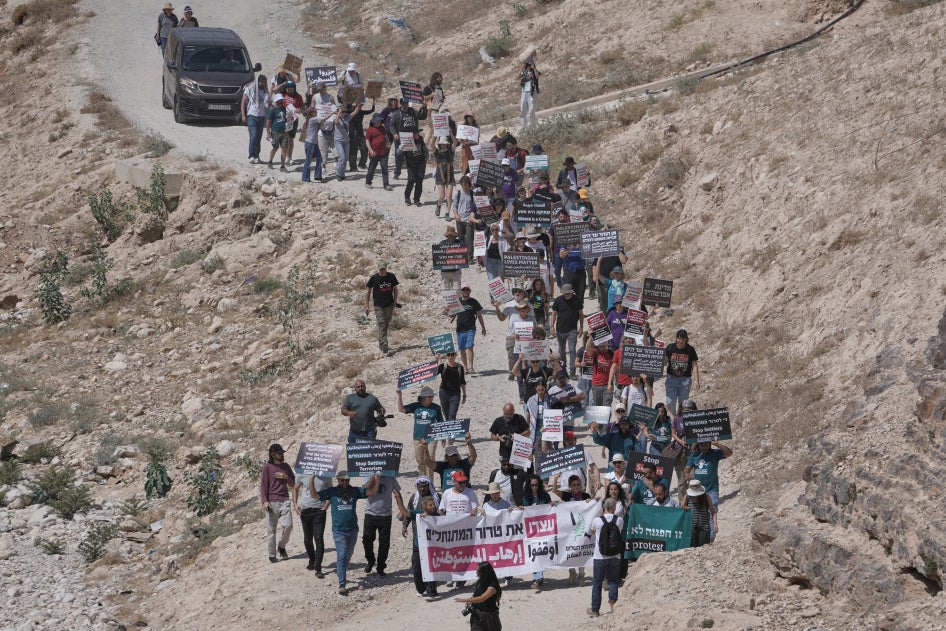
The groups said immediate issuance and opening of a separate tender, and the pre-election deadline, is an attempt to create “irreversible facts on the ground, fundamentally altering the character of the area.” The groups are planning to file an interim injunction halting the tender pending a decision on the petition.
Human Rights Watch, other rights organizations, and the United Nations have documented the acceleration of illegal settlement expansion since the current Israeli government took office in December 2022, alongside a sharp increase in state-backed settler violence against Palestinians.
On December 9, 2025, the Israeli Construction and Housing Ministry published a call for tenders for the construction of the 3,401 housing units to begin implementation of the project. The tender was initially scheduled to open on December 29 but was postponed three times. An additional tender for an employment and commercial zone in E1 was published in March 2026.
The E1 project puts communities in the area at imminent risk of forcible transfer, Human Rights Watch said. Khan al-Ahmar, a Bedouin community of 250 people, has faced repeated threats of forced eviction since the project was first advanced in the 1990s. According to the Israeli organization B’Tselem, from 2006 through 2018, Israeli authorities demolished 28 homes in the area, leaving 132 people without shelter.
In May, Israeli Finance Minister Bezalel Smotrich directed the Israeli Civil Administration in the West Bank to evict the Khan al-Ahmar community “as soon as possible” following media reports of a possible arrest warrant against him by the International Criminal Court.
Khan al-Ahmar would join at least 117 herding and Bedouin communities forcibly displaced from the West Bank since 2023, according to Amnesty International. Human Rights Watch has previously found that Israeli authorities have intentionally caused the massive, deliberate, and long-term forced displacement and ethnic cleansing of Palestinian civilians in both Gaza and the West Bank, amounting to war crimes and crimes against humanity.
The E1 area falls within a corridor critical for the West Bank’s territorial continuity. Israel’s construction of settlements and Israeli-only roads in the area would effectively sever the West Bank into two zones and isolate the southern governorates of Bethlehem and Hebron from northern population centers such as Ramallah and Nablus.
Israeli officials have stated that one of the E1 project’s goals is to erase any possibility of a future Palestinian state. Smotrich, in August 2025, boasted that the project will “bury the idea of a Palestinian state,” because “there will be nothing to recognize and no one to recognize.” At a signing ceremony for the project in September 2025, Prime Minister Benjamin Netanyahu declared: “There will be no Palestinian state! This place is ours.”
Other countries have long voiced opposition to the E1 project and called for Israeli authorities to halt its implementation. The latest wave of condemnations included a joint statement by 14 countries in December 2025, condemnations by the European External Action Service, and a joint statement by the United Kingdom, France, Italy, and Germany in May. The four countries warned that “businesses should not bid for construction tenders for E1 or other settlement developments,” reminding them of legal and reputational consequences, “including the risk of involving themselves in serious breaches of international law.”
French Foreign Minister Jean-Noël Barrot said in an interview with France Inter radio on May 29, 2026, that “any company that responds to the call to bid on the project will expose itself to international sanctions.” In July, civil society organizations filed a legal challenge before France’s highest administrative court seeking to bar French companies from commercial activities that sustain the occupation.
In July 2004, the International Court of Justice (ICJ) concluded that Israeli settlements violate the Fourth Geneva Convention and are unlawful. In 2024, the court reaffirmed this and affirmed the illegality of the Israeli occupation of the Palestinian territory. It found Israeli land policies do not conform with articles of the Hague Regulations that prohibit an occupying power from confiscating private property, limit requisitions to its army’s needs, and require it to administer public land for the benefit of the local population rather than settlers.
The court affirmed Israel’s obligation to halt settlement expansion, evacuate existing settlements, and provide reparations to Palestinians. Other countries are also obliged not to assist in the maintenance of the unlawful situation in the occupied Palestinian territory.
The forced displacement of the Khan al-Ahmar community would also violate the prohibition of forcible transfer under article 49 of the Fourth Geneva Convention. Article 49 also prohibits the occupying power from transferring its own civilian population into the territory it occupies. Both could constitute a war crime under the Rome Statute of the International Criminal Court and could also be a crime against humanity.
Other countries should publicly call for the immediate cancellation of the E1 tender process and impose concrete measures to end the unlawful situation, including by imposing targeted sanctions on those implicated in ongoing grave abuses, suspendingarms transfers to Israel, banning trade with illegal settlements, and considering suspending preferential trade agreements with Israel.
Other countries should ensure that corporations comply with the rule of law by imposing sanctions on businesses involved in the construction of the E1 settlement project and those that facilitate human rights abuses in the Occupied Palestinian Territory. They should also strengthen domestic human rights due diligence laws by establishing effective enforcement mechanisms to address corporations’ violations.
Human Rights Watch has previously documented cases of businesses contributing to transferring civilians into occupied territory, including by building or servicing settlements.
Corporations or their executives responsible for such crimes could be held liable for aiding or facilitating the commission of war crimes. Corporations have a responsibility under the United Nations Guiding Principles on Business and Human Rights to avoid causing or contributing to human rights abuses. The risk of complicity in human rights abuses linked to settlements is so great that companies should halt all business activities in those areas.
“The E1 project isn’t just housing; it’s erasure of Palestinians, their homes, and their livelihoods,” Sanbar said. “Israel cannot be allowed to alter ‘facts on the ground’ and entrench apartheid with impunity.”