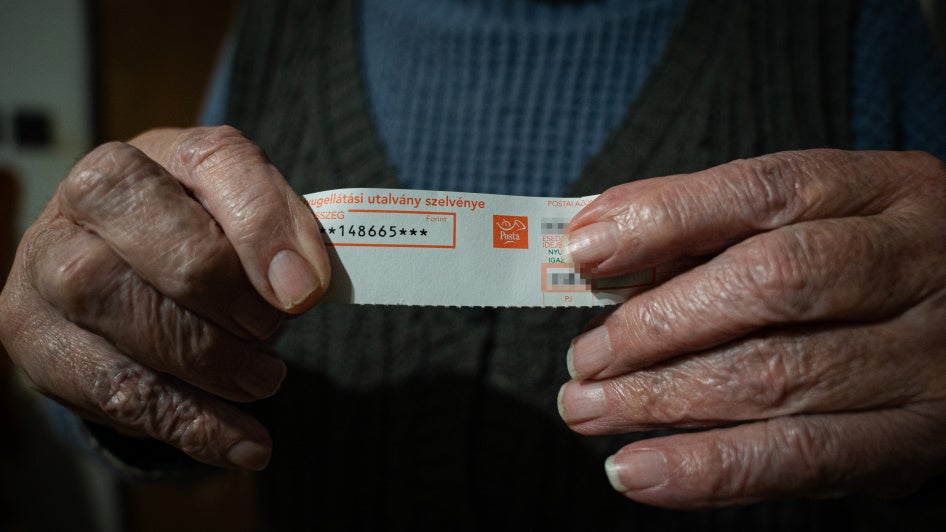
Prime Minister Péter Magyar is moving swiftly with policy measures and legislative reform that will hopefully have positive impacts on people’s lives and rights. On May 25, he announced in an interview that the 1.3 million older people on the lowest pension incomes would receive additional money on prepaid “SZÉP” cards by the end of the year to spend on expenses including food and domestic travel.
This is a promising first step. But deeper pension reform is needed to tackle the poverty, inequality, and related rights problems that many older people in Hungary face. Hungary’s failings in its legal obligations on the rights to social security and to an adequate standard of living, particularly of older people, are a key issue awaiting action by the new government.
Last winter, as part of our research on Hungary’s pension system, I spoke with 45 older people about life on low pensions, insufficient to pay for food, heating, or medical supplies. Among them, two older women, 85 and 90, shared their stories with me at a center for older people. They remembered the Second World War, the arrival of Soviet troops in their town in the Great Hungarian Plain, collectivization, and the end of the Kádár era, as if they were yesterday.
They expressed frustration about their years of hard work on farms and in factories, as well as at home raising children, and their struggle to make ends meet now because their pensions provided incomes well below the nationally established poverty line.
Our analysis of the Hungarian Central Statistical Office’s (KSH) 2024 data indicated that 23 percent of pensioners received monthly pension incomes below the official at-risk-of-poverty threshold (173,990 HUF, or €440, in 2024) and almost two-thirds of all older people received less than the gross monthly minimum wage (266,800 HUF, or €675, in 2024).
Our analysis of KSH data also showed that poverty among people age 65 and older more than doubled between 2018 and 2023, while poverty rates for others have stayed the same or even fallen.
The former Fidesz government rejected our findings, despite the fact that our analysis was based on official KSH data. It is heartening to see the new Tisza government announce steps to address pensioner poverty in its first weeks. Péter Magyar’s commitment to add funds to the SZÉP card of all older people with monthly pensions up to 500,000 HUF (€1,416), prioritizing those with pensions below 250,000 HUF (€708), by the end of the year is a good first step, and will undoubtedly make a difference to older people. But the Tisza government should not delay tackling other longstanding, structural problems with the Hungarian pensions system.
They include low pensions due to underreported wages and irregular employment, significant gender gaps, a change to how annual pension increases are calculated, and a shockingly low minimum pension of 28,500 HUF (€81) per month. It is reassuring that Tisza’s election manifesto, and subsequent statements, indicate that the new government intends to increase this minimum monthly pension to 120,000 HUF (€340), although that would still be under the at-risk-of-poverty threshold.
During the post-Communist transition, successive governments tolerated widespread underreporting of wages and irregular employment arrangements, including false freelance contracts, without proper social security contributions. Such practices have left people with low pensions when they retired. Women in Hungary, as in almost every other EU country, live longer than men, and earn less than men during their working lives, and are more likely to receive low pensions and face poverty as they grow older, the government data show.
Those problems were exacerbated during the years of Fidesz rule. Fidesz touted its 2009-2011 nationalization of the private pension system as an opportunity to strengthen the public pension system. But the rushed manner in which those changes became law, the failure to fully consult those affected, and the subsequent failure to reinvest the funds into public pensions meant that the government fell short of its human rights obligations.
Hungary’s pensioners’ associations have focused particular criticism on Fidesz’s 2009 decision to stop using the so-called “Swiss indexation” method (based in part on wages) to increase pensions, and instead only use inflation-indexing. They point out that it has led to growing economic inequality between long-term pensioners on low, fixed incomes, and current earners and recent retirees, who have significantly higher wages.
Recent reports in HVG show staggering pension income inequality. In February, Hungary’s National Coordinating Council of Pensioners’ Organizations (NYUSZET) and the pensioner section of the Trade Union Confederation (MASZSZ) set out the case for a 23 percent increase to median pensions, after calculating what the values of pensions should be if the Swiss indexation method were correctly applied.
How the precise indexing system is redesigned and legislated for is a matter for the new Hungarian government, with the meaningful participation of civil society and people receiving pensions, and ensuring compliance with its international human rights obligations. What is clear, though, is that fixing the problem requires more than a boost of cash on a SZÉP card. It requires a re-evaluation of pension levels to ensure that Hungary’s government complies with its legal duty to ensure the rights to social security and to an adequate standard of living for older people.
Ildikó, 69, a retired hairdresser, explained to me in her Budapest flat that her 77,000 HUF (€218) monthly pension falls well short of her monthly costs for food, housing maintenance, utilities, and payments for medical supplies necessary to manage her diabetes. “I don’t feel respected, and I don’t think the state is taking care of me,” she told me. “I have no hope for the future and will live like this until the end of my life.
Addressing Ildikó’s needs and the poverty facing other older people like her requires a careful, rights-aligned revaluation of pension levels to fulfill the rights of older people and to ensure that they can live in dignity.
This text is the original English version, which was subsequently published in Hungarian translation with minor edits.
The article uses two distinct Euro-Hungarian Forint conversion figures. For data relating to 2024, the conversion figure is €1 = 395.44 HUF, based on the European Central Bank’s average exchange rate during the year. For current data, the figure is €1 = €353.20, based on the exchange rate at publication. Euro figures are rounded.