Dear Mr. Secretary-General,
We are writing ahead of your June 16 visit to Haiti. As criminal groups tighten their grip on the country, its security, human rights and humanitarian crises continue to deepen. We urge you to use this visit to call for a comprehensive response that protects the population and helps address the factors that fuel the violence and widespread human rights abuses.
In April 2026, criminal groups expanded into Haiti’s South-East department and are now present in five of the country’s ten departments. They continue to commit widespread abuses, including massacres and sexual violence. Children, many driven by hunger, coercion, or threats, are estimated to constitute up to half of their membership. Recent clashes have displaced thousands of people in the capital within days, pushing the number of internally displaced Haitians to nearly 1.5 million.
Even when fully staffed and resourced, security measures alone will not suffice to address this situation. Any meaningful strategy should include effective protection for victims of violence, credible pathways for disengagement from criminal groups, accountability for abuses, and a coordinated humanitarian response to help restore access to basic goods and services. Critically, it should also include robust human rights safeguards to ensure that Gang Suppression Force (GSF) members and the Haitian police protect and respect the rights of Haitians.
The number of people killed during security operations, some in summary killings by police personnel, has steadily increased since 2025 and rose to 69% of total documented killings in the first quarter of 2026, according to the United Nations Integrated Office in Haiti (BINUH). Apparently unlawful lethal drone strikes involving security forces and private contractors have killed and injured at least 1,243 people, including 17 children.
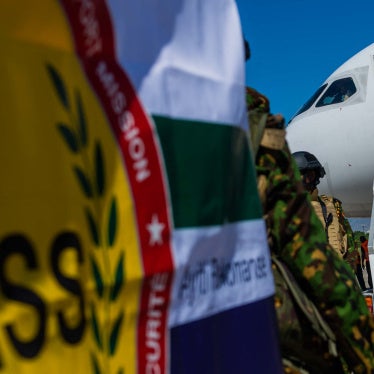
Four allegations of sexual violence involving Multinational Security Support (MSS) mission personnel remain inadequately investigated. Ensuring that its successor, the GSF, operates with robust safeguards, effective oversight, and meaningful accountability mechanisms will be critical to preventing further harm. The GSF will need sustained support from the UN for human rights monitoring, reporting, and, where needed, investigations.
Ultimately, we believe that the best solution for Haiti would be the eventual merger of all UN operations and the GSF into a full-fledged UN mission in the country.
In the near term, we respectfully urge you to seize your visit to Haiti to:
- Work with BINUH and publicly urge Haitian authorities, the GSF, and other international partners to ensure that security plans are embedded in a broader, concrete response that includes prevention, protection of the population, credible pathways for disengagement from criminal groups, reintegration support, and access to justice;
- Publicly call on relevant local and international actors, including the GSF, to participate meaningfully in the design and implementation of the disarmament, demobilization, and reintegration (DDR) framework led by BINUH and the national DDR commission (CNDDR), while prioritizing concrete pathways for children to safely exit criminal groups before security operations are undertaken;
- Publicly urge the GSF and Haitian security forces to ensure that operational language, planning assumptions, and decisions governing the use of force reflect an international human rights law framework, rather than terminology and concepts derived from armed conflict that risk lowering the threshold for the use of lethal force;
- Publicly urge the GSF to strengthen its human rights safeguards to prevent and address abuses, including monitoring capacity, the effectiveness of complaints mechanisms, public reporting, independent investigations, and accessible pathways to remedy for victims;
- Ensure that UN agencies, in coordination with Haitian authorities and international partners, provide resources to scale up existing services for survivors of sexual violence and for children affected by violence, including healthcare and psychosocial support, education, and reintegration programs for children formerly associated with criminal groups;
- Publicly urge Haitian authorities to ensure that security operations comply with international human rights law, investigate and bring to justice alleged abuses by police and security personnel, including those involving drones strikes, and support the ongoing operationalization of the specialized judicial units responsible for prosecuting mass crimes and corruption;
- Ensure seamless coordination between the UN and GSF.
The international community’s support for Haiti should be guided not only by the urgent need to improve security, but also by the imperative of protecting the population and laying the foundations for long-lasting reductions in violence.
We remain at your disposal to discuss our findings regarding conditions on the ground in Haiti and our recommendations.
Sincerely,
Juanita Goebertus Estrada
Director
Americas Division
Human Rights Watch
Louis Charbonneau
United Nations Director
Advocacy Division
Human Rights Watch