Summary
The Trump administration has deepened its security cooperation with Ecuador in an effort to respond to surging violence in the country and organized crime groups operating across the region. The United States has arguably become Ecuador’s main partner in its security response to these challenges, providing equipment, training, intelligence, and most recently, direct military support.
From a human rights perspective, this partnership is a perilous one. The two countries’ security relationship is deepening at a moment when both governments have engaged in serious human rights violations fueled by their insistence on framing their confrontations with organized crime groups as a kind of war. Ecuador and the United States have not disclosed many details about the nature of their security cooperation, nor whether there are appropriate safeguards in place to prevent human rights violations.
This report–based on 62 interviews with victims, lawyers, witnesses and others, and analysis of satellite imagery, vessel monitoring and fire detection data, judicial documents, medical records, and more than 100 photographs and videos—documents three incidents that saw ordinary people subjected to abuses, including drone strikes, torture, and arbitrary detention. In a fourth case, a fishing boat and most of its crew went missing amid signs of another attack. Each of these incidents either implicates the US-Ecuador security partnership or surfaces questions about responsibility that neither government has adequately addressed.
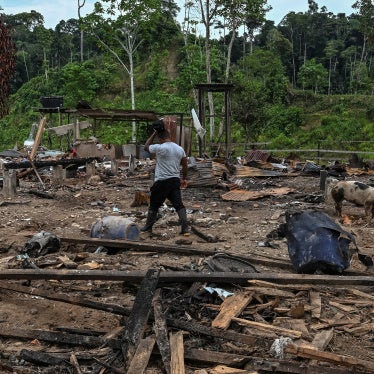
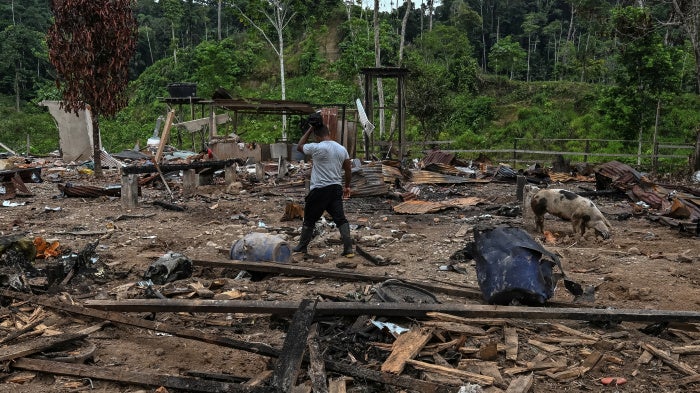
The first incident involves a military operation in San Martín, on the border with Colombia, between March 1 and 6, 2026, which US officials have described as partnered. While neither the United States nor Ecuador has described the specific role of each country’s forces in the operation, Human Rights Watch found that Ecuadorian forces arbitrarily detained and tortured four Colombian farm workers, burned three properties that appear to have no connection to organized crime groups, and later struck two of those properties with air-dropped munitions.
The remaining three incidents involve the disappearance in January of the Ecuadorian fishing vessel the Fiorella and a large part of its crew, and armed drone attacks against the fishing vessels La Negra Francisca Duarte II and the Don Maca in March, all off the coast of the Galápagos Islands. The US Department of Defense and Coast Guard have denied any involvement in these incidents, and Ecuadorian authorities have not confirmed that they even took place. Thirteen survivors interviewed by Human Rights Watch said that after the attacks, they were detained on board a ship by people they identified as armed US nationals wearing military-style uniforms.
US-Ecuador Military Operation on Land
When Ecuadorian soldiers arrived at a farm in San Martín, the workers had no reason to suspect what was coming. What followed were beatings, electric shocks, and mock executions. Their accounts, and those of another worker and community members, expose torture and wanton destruction carried out by Ecuadorian forces operating jointly with the US.
“They poured water on me and then shocked me,” a worker said. He and another victim described how Ecuadorian soldiers threatened to cut off their fingers or pull out their fingernails to make them confess where the drugs or arms were. “They pointed a gun at me, racked it, and pulled the trigger, but it wasn’t loaded,” one of them said.
Hours later, the men were released, without charges, by a nearby hospital. Photographs, medical records, and an analysis by an expert from the Independent Forensic Expert Group (IFEG) of the International Rehabilitation Council for Torture Victims (IRCT) indicate they were beaten. The Ecuadorian government said a prosecutor refused to charge the men “out of fear,” but the prosecutor said soldiers failed to provide sufficient information or evidence to charge the men who, Human Rights Watch found, had no criminal records.
Three days later, the Ecuadorian Army struck the farm where they worked, destroying its facilities. The Ecuadorian government said the site was a “a camp area belonging to the narco-criminal group the Border Commands” (Comandos de la Frontera), an armed group that operates on the Colombia-Ecuador border, but Human Rights Watch found evidence indicating that it was a dairy farm–including satellite imagery, witness testimonies, and photographs of receipts for the products purchased and the cheese sold by the farm’s owner.
In a hearing before the US Senate Committee on Armed Services, the Commander of US Southern Command, General Francis L. Donovan, described the operation as a “success” and said that Ecuadorian forces acted “professionally.” While the Trump administration described the operation in San Martín as “partnered” and said that its forces were “present,” it has not disclosed the role of US military in the strikes against the properties, let alone the arrest and torture of the Colombian men.
Drone Attacks and a Missing Vessel near the Galápagos Islands
Between January and March 2026, three Ecuadorian fishing vessels—the Fiorella, La Negra Francisca Duarte II, and the Don Maca—disappeared or came under attack while operating in the Eastern Pacific. On January 20, the Fiorella disappeared with most of its crew. On March 17 and 26, crew members of La Negra Francisca Duarte II and the Don Maca, respectively, said they were attacked by armed drones. After the attacks, survivors of La Negra Francisca Duarte II and the Don Maca said that they boarded a nearby blue-and-white vessel, where armed US nationals wearing military-style uniforms bearing US flag insignias detained them and later transferred them to the Salvadoran Coast Guard.
“I was in the hold, icing fish, when I felt the first explosion,” a crew member of the Don Maca, a boat fishing off the coast of Ecuador recalled. He and other crew members described how drones attacked their fishing vessel in late March 2026, leaving many injured.
They said a boat with a US flag approached them. “How many are you? How many dead? How many injured?” a man asked them, they said. The survivors said they boarded a vessel that carried a US flag while officers pointed “long guns” at them.
Once aboard, men they described as US armed personnel handcuffed them, hooded them, and pushed them to a deck, where some were ordered to sit and others to kneel. The personnel asked for their names and held them for approximately 8 hours on a hot metal deck. Some said they heard or saw officers destroy their vessel and its accompanying boats. The officers transferred them to the Salvadoran Coast Guard, which took them to El Salvador. They returned to Ecuador 10 days later, in early April.
Meanwhile, eight crew members of another fishing vessel, the Fiorella, remain missing since January 20 along with their ship. Two crew members who were fishing away from the vessel when it disappeared said they lost contact with the Fiorella’s captain around midday and later saw what appeared to be a column of smoke in the distance. Hours later, they returned to the vessel’s last known location but found no trace of the Fiorella or its crew.
The crew members of the three vessels came from the coastal communities of San Mateo, Jaramijó, and Manta, where small-scale fishing remains a principal livelihood. Human Rights Watch’s review of Ecuadorian criminal record certificates showed that only four of the 46 men had criminal records; none for violent or potentially violent crimes, or drug trafficking-related offenses.
The US military and Coast Guard have denied any involvement in or knowledge of these incidents.
There are, however, indicators of some type of possible US government involvement in or knowledge of the attacks, especially in the survivors’ consistent accounts of the moments before and after the drone attacks. The Fiorella’s surviving crew members said they saw a gray patrol vessel near the fishing vessel in the days before it disappeared. They said it was flying a US flag.
One La Negra Francisca Duarte II crew member said he saw a US flag insignia on the arm of one of the personnel who detained him and the rest of his crew. Crew members from the Don Maca said the personnel who detained them wore khaki camouflage uniforms, and one of them said he saw US flags on the sleeves of some personnel, as well as the acronym “USA.”
Crew from both La Negra Francisca Duarte II and the Don Maca said they were later transferred to Salvadoran coast guard vessels. In both cases, they said Salvadoran personnel told them that “US officials” had handed them over as “shipwrecked persons.”
Around the same time as the vessels were attacked, Ecuadorian officials publicly described joint or coordinated maritime security operations with the United States, including US support to Ecuador in identifying drug-trafficking routes in the Pacific.
Despite Human Rights Watch’s comprehensive verification efforts, and multiple inquires to the Ecuadorian and US authorities, there remain many unanswered questions about these incidents. First and foremost, it is unclear what happened to the Fiorella and its crew. While the vessel’s captain reported that a “US patrol boat” had been following the ship before it disappeared, the ship lost contact with the shore beyond that point. Human Rights Watch was unable to ascertain who carried out the drone strikes against La Negra Francisca Duarte II and the Don Maca. Nor were we able to identify the blue-and-white ship that took the survivors aboard, or the armed US nationals wearing military-style uniforms with US flag insignias whom the survivors said had detained them on board.
All of these unexplained details warrant a serious, transparent response from both the US and Ecuadorian governments. This is especially true considering the larger context of their deep security partnership. So far, neither government has been forthcoming.
***
The US government and President Daniel Noboa’s administration in Ecuador should take immediate steps to disclose their role in the incidents described in this report, and essential details about the nature of the partnership, the role of US forces, and what human rights safeguards have been built into their joint operations.
Noboa’s government should also reassess its determination that there is an “armed conflict” in the country and focus its efforts on strengthening justice sector capabilities to fight organized crime.
The US Congress should demand that the Trump administration provides clear answers to the many questions surrounding its security cooperation with Ecuador. It should also examine whether security cooperation with Ecuador is bound by appropriate safeguards given the growing number of human rights violations under the Noboa administration.
“They need to clarify this case, so it doesn’t happen again,” a community member of San Martín, where the strikes on land happened, said. “Or who knows who could be next.”

Methodology
Human Rights Watch documented the military operations and attacks described in this report through interviews with victims, relatives, lawyers, government officials, journalists, and other people with direct knowledge of the incidents. Researchers reviewed and analyzed medical records, judicial documents, Ecuadorian and US government statements, photographs and videos shared by lawyers and interviewees or published online on social media, satellite imagery, vessel monitoring data and fire detection data, and other materials to corroborate witness accounts, assess the circumstances of each case, and reconstruct the timeline of events.
To document the military operation in San Martín, in Ecuador’s Sucumbíos province, Human Rights Watch interviewed 13 people by phone, including two workers who said they were detained and tortured, the owners of two properties that were attacked, members of the community who witnessed the arrests, and journalists and human rights defenders from the Alliance for Human Rights, a coalition of human rights groups, who visited the area after the strikes. Interviewees requested anonymity. Researchers also reviewed medical records and photographs of the injuries of the men detained and consulted with the Independent Forensic Expert Group (IFEG) of the International Rehabilitation Council for Torture Victims (IRCT).
Human Rights Watch also analyzed more than 80 photographs of damaged properties and of munitions found on the Colombian side of the border taken by members of the community, human rights organizations, and journalists who visited the site. In addition, we verified 12 witness-recorded videos showing the arrests of the four men, and aerial footage capturing the bombing of one property and the surveillance of another presented by Ecuadorian and US authorities during television interviews or on social media.
Human Rights Watch analyzed satellite imagery at different spatial resolutions to corroborate the timeline of events related to the destruction of property and subsequent attacks, and to analyze possible links with criminal groups.
To document the attacks on fishing boats near the Galápagos Islands, Human Rights Watch visited Manta, a port city in Ecuador’s Manabí province, and San Mateo, a nearby coastal fishing community, in early May 2026. Human Rights Watch interviewed a total of 49 people. Some interviews were carried out in person during the visit and others by phone, after the visit. Those interviewed included owners of the fishing vessels that were attacked; their lawyers; crew members, some of whom were severely injured in the incidents, arbitrarily detained, and transferred to El Salvador before returning to Ecuador; and two fishermen on the Fiorella vessel. Human Rights Watch also interviewed prosecutors from Ecuador’s Attorney General’s Office, officials with Ecuador’s Ministry of Foreign Affairs and Human Mobility and the Ecuadorian national police, former members of the US and Ecuadorian armed forces, and officials in the Manta Port Captaincy, the Galápagos Port Captaincy, and the Undersecretariat of Fisheries Resources in Manta, all of whom requested anonymity; local and international journalists who covered the incidents; security experts; and members of the Permanent Committee for the Defense of Human Rights who analyzed the incident.
Human Rights Watch also reviewed a wide range of documents and materials, including medical reports on the fishermen issued by Salvadoran authorities, X-rays, photographs and videos of the injured crew members, and their criminal records. Researchers also verified 12 photographs and videos of the vessels before the attacks, and, for one case, four photographs taken from a nearby support vessel showing one of the alleged attacked fishing vessels burning at sea, analyzed judicial documents from Ecuador, and consulted forensic experts from the IRCT.
Human Rights Watch analyzed and reviewed Vessel Monitoring System (VMS) data provided by the National Directorate of Aquatic Spaces of the Ecuadorian Navy and consulted through the publicly available Global Fishing Watch platform, to identify the tracks and the last known positions of the three fishing vessels that transmitted signals.[1] Unless otherwise noted, all times related to the incidents involving the vessels are given in the local time of the area where the events occurred. Data transmitted through the Automatic Identification System (AIS) collected via satellites and terrestrial receivers, included on the Global Fishing Watch platform and reviewed by Human Rights Watch, were used to identify vessel types, locations and routes near the attacked fishing vessels.[2]
In addition, Human Rights Watch reviewed fire detection data from NASA’s Fire Information for Resource Management System to identify the potential location where one of the fishing boats, La Negra Francisca Duarte II, could have been attacked.[3]
Human Rights Watch also conducted open-source research to identify the vessel where several interviewees said they were detained, and to assess its possible ownership and operations. Human Rights Watch sent information requests to two private companies that may operate vessels matching the characteristics described by some crew members. At time of writing, none had replied.
Human Rights Watch sent information requests to Ecuadorian authorities between April and June, including the Ministry of Defense, the Ministry of Interior, the Attorney General’s Office, and the Ombudsperson’s Office. At time of writing, only the Ombudsperson’s Office and the Attorney General’s Office had replied.
Human Rights Watch also sought comment from El Salvador’s Ministry of Defense, the US Department of Defense and US Southern Command in June. At time of writing, none had replied.
I. Background
Ecuador’s Security Crisis, the Government’s Response, and US Cooperation
Ecuador’s transformation from one of Latin America’s safest countries to one of its most violent represents one of the most dramatic security collapses in the region in decades.[4] The government’s response has failed to reduce violence and has led to increased reports of human rights violations.
The United States has become one of Ecuador’s main partners in its security response, providing equipment, training, intelligence, and, most recently, direct military support. While previous administrations in Washington have supported Ecuador’s security policy, the bilateral relationship deepened following the inauguration of President Donald Trump in January 2025.[5]
Violence and Organized Crime
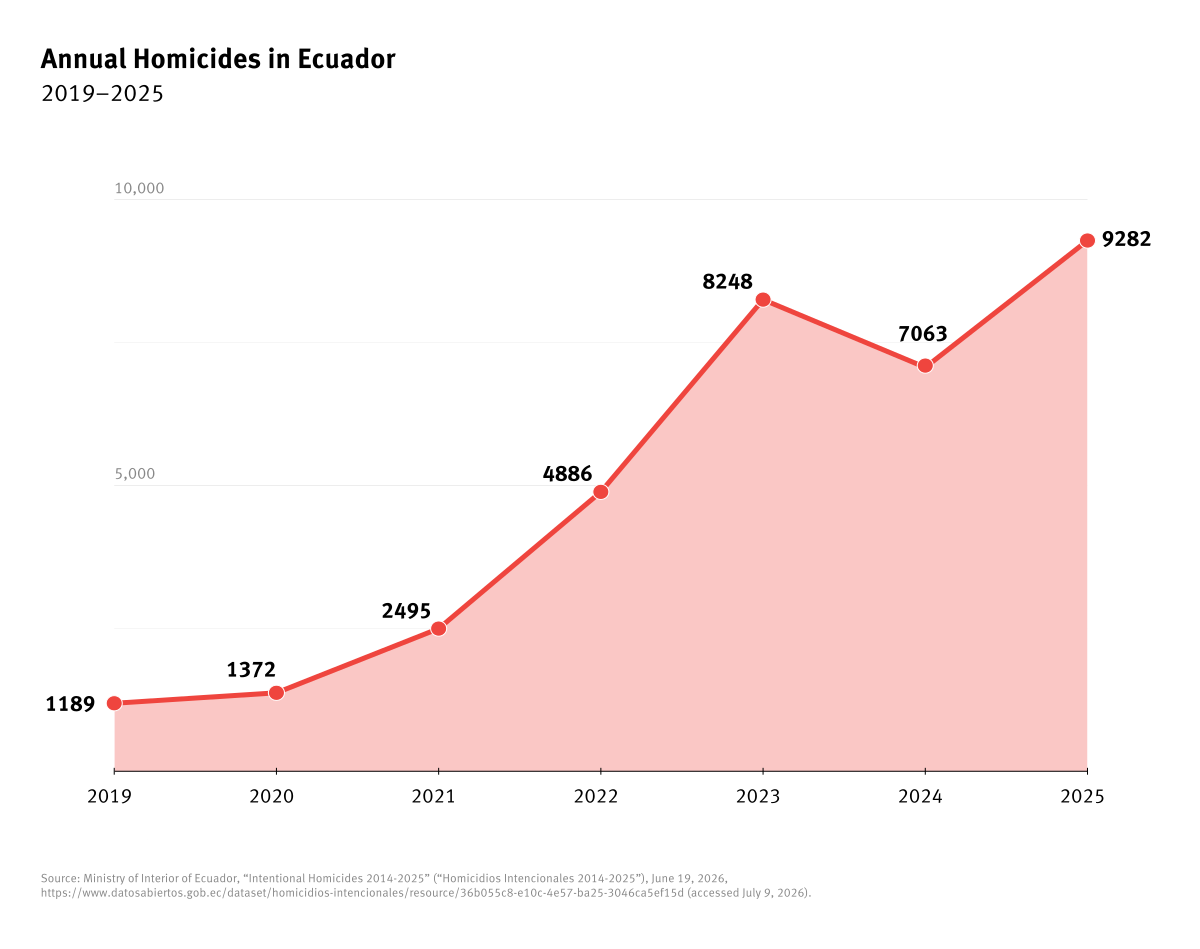
For most of the 2010s, Ecuador had one of the lowest homicide rates in Latin America—at times it was three or four times lower than the regional average.[6] Since 2019, however, the country has experienced a dramatic increase in homicides and other crimes, driven by a surge in activity by organized crime groups.
In 2019, Ecuador recorded 1,189 homicides, a rate of 6.8 per 100,000 inhabitants. By 2025, that figure increased nearly eight times to over 9,200 homicides, a rate of 50.9 per 100,000, the second highest in the Western Hemisphere after Haiti.[7]
According to data from the Attorney General’s Office, between 2019 and 2024, extortion complaints surged from 1,616 to 23,083—a fourteenfold increase—and kidnapping for ransom reports increased from 224 to 1,900. Both crime indicators declined in 2025 but remained two to three times higher than in 2022.[8]
Based on events reported to and recorded by the conflict-monitoring group Armed Conflict Location and Event Data (ACLED), to more than 12 million Ecuadorians—roughly 71 percent of the population—lived within 5 kilometers of a battle, explosion, or attack on civilians in 2025, a higher proportion than any other country in Latin America.[9]
During recent years, civil society organizations, authorities, and media outlets have documented acts of extreme violence previously uncommon in Ecuador, including decapitations, dismemberments, and car bombings.[10] Judges, prosecutors, journalists, and politicians have also been targeted and killed.[11] On August 9, 2023, for example, a gunman shot and killed Fernando Villavicencio, a presidential candidate and former journalist who had reported on corruption and organized crime networks, as he was leaving a campaign rally in Quito.[12]
Situated between Colombia and Peru—the world’s two largest cocaine producers—Ecuador has become a critical transit and logistics hub for drugs destined for North America and Europe.[13] Mexican cartels, Albanian crime networks, the Italian mafia, and Colombian armed groups, including the Border Commands (Comandos de la Frontera), are reportedly present in the country.[14]
Organized crime has come to be dominated by two main groups: Los Choneros, reportedly linked to the Sinaloa Cartel, and Los Lobos, linked to the Jalisco New Generation Cartel.[15] Once partners, the two split following the assassination of a Los Choneros leader in December 2020, triggering power struggles and disputes for control of major illicit markets and prisons that drove a wave of prison massacres killing around 500 detainees between 2021 and 2024, according to the Ecuadorian Conflict Observatory.[16]
Organized crime groups have expanded their criminal operations beyond drug trafficking into extortion, kidnapping for ransom, and illegal mining, which has provided them a steady stream of revenue that has made them resilient to state pressure.[17]
The Government’s Response and Human Rights Abuses
President Daniel Noboa took office in November 2023 after winning an early election triggered by the dissolution of the previous legislature under then-President Guillermo Lasso.[18] His predecessor had already declared localized states of emergency, suspended constitutional rights, and deployed the military in streets and prisons, without reducing violence.[19] Noboa deepened that approach, with consequences for both public security and human rights.
Several of the most far-reaching policies were introduced in response to events that took place between January 7 and 9, 2024. Members of criminal groups took over the state-owned TV channel TC Television, and José Adolfo Macías Villamar, alias “Fito,” who led the criminal group Los Choneros, escaped from prison.[20]
On January 8, Noboa declared a nationwide state of emergency due to “serious internal unrest” and the following day, declared an “internal armed conflict” and designated 22 organized crime groups as “terrorist groups.”[21] Those organizations included Los Choneros, Los Lobos, Los Tiguerones, Los Chone Killers, Ak47, Latin Kings, and others. He ordered the armed forces to conduct “military operations,” and the military was subsequently deployed to patrol cities and neighborhoods and assumed control of prisons nationwide.[22]
The legal basis for the “internal armed conflict” has been repeatedly contested.[23] Under international law, the existence of a non-international armed conflict requires that non-state armed groups have a sufficient level of organization and that hostilities reach a minimum threshold of intensity.[24] Ecuador’s Constitutional Court found, in multiple rulings, that the government had not provided sufficient information to justify its claims that the situation reached that threshold.[25] However, the court has not addressed the specific question of whether there is an internal armed conflict between the government and the Border Commands, the armed group allegedly targeted in the military operation in San Martín, Sucumbíos province, that this report describes in detail.
President Noboa issued 28 executive decrees declaring, renewing or modifying states of emergency between January 2024 and June 2026, which, among others, loosened human rights constraints on the government’s fight against crime.[26] On June 18, 2026, Noboa passed a new decree indicating that there is an “internal armed conflict,” and authorized the armed forces and National Police to “neutralize” all “structures threatening national sovereignty and public order.” The decree also assured police, military and civilians that they would receive pardons, sentence reductions, and/or amnesties for any crimes committed during the “armed conflict.”[27]
After declaring the existence of an armed conflict, Noboa’s government touted a security plan called “Plan Fénix” as a solution to organized crime. He deployed the armed forces and police jointly in the streets.[28] However, details about the nature and scope of the plan were lacking and have still not been made public.[29]
Prosecutors and security experts told Human Rights Watch they did not see it as a workable and concrete strategy. Some prosecutors said that they were not aware of the contents of “Plan Fénix” or whether it changes the way they investigate organized crime.[30] The government has since changed the name of the strategy and replaced high ranking officials in the security forces, but experts’ concerns about the lack of a coherent long-term strategy have persisted.[31]
The ministries of defense and interior have launched continuous security operations reporting arrests, the capture of several gang leaders, drug seizures, and destruction of illegal mining sites.[32] Yet the operations have failed to reduce violence and have led to increased reports of human rights violations.
Shortly after the government declared an “internal armed conflict” for the first time in January 2024, Human Rights Watch documented multiple abuses committed by security forces, including extrajudicial killings, several cases of arbitrary arrests, and ill-treatment of detainees that in some cases may have amounted to torture.[33] Complaints filed with the Attorney General’s Office alleging extrajudicial killings and excessive use of force by security forces more than doubled in 2024, rising to 293—the highest figure in at least a decade—and remained high at 249 in 2025, compared to an annual average of roughly 106 complaints between 2015 and 2023.[34]
As of March 2026, the UN Committee on Enforced Disappearances had received 51 reports of enforced disappearance, including of children, allegedly committed by law enforcement agencies during security operations between 2024 and 2025.[35] A particularly notorious case involved four children from the Las Malvinas neighborhood in Guayaquil, who went missing on December 8, 2024. Security camera footage showed a military patrol detaining them and forcing them into a pickup truck. Their burned remains were found on Christmas Eve near the Taura Air Base.[36] In December 2025, a court sentenced 16 soldiers for their role in these enforced disappearances.[37]
The government has also advanced laws that endanger rights.[38] In June 2025, the National Assembly approved the National Solidarity Law, which granted the president sweeping powers to declare an “internal armed conflict” and authorize the use of lethal force in situations in which international human rights law and Ecuadorian law would otherwise prohibit it.[39] The Constitutional Court subsequently struck that law down on September 26, 2025.[40] The National Assembly also adopted a new Intelligence Law in June 2025 that authorizes intelligence gathering without adequate safeguards.[41]
The government has also taken steps to undermine the independence of the Constitutional Court, which has struck down some of the government’s security policies after finding that they violate the Ecuadorian Constitution. The government has organized demonstrations against the Constitutional Court magistrates, and senior officials have called them “enemies of the people” and blamed them for violence in the country.[42] In November, Ecuadorians voted against a proposal to overhaul the Constitution, which appeared designed in part to undermine the independence of the court.[43]
The government has also been increasingly hostile toward human rights defenders and organizations that have criticized its security strategy. Senior officials have branded critics as “unpatriotic” or as defenders of criminals.[44]
Noboa has not strengthened the country’s justice system, which remains weak.[45] The Attorney General’s Office estimated a shortfall of 631 prosecutors within an overall shortfall of nearly 1,900 staff in 2025.[46] Similarly, the Judiciary Council estimated in June 2025 that it lacked 753 judges nationwide, with 38 percent of the courts understaffed, with excessive caseloads and significant risks from organized crime.[47]
Judges and prosecutors often lack basic tools and security to investigate organized crime groups. Some provinces do not have enough personnel to remove bodies from crime scenes or conduct ballistics analyses, even in large cities like Guayaquil. Many prosecutors and judges, including those at risk, lack basic security, such as bulletproof vehicles.[48] The Observatory of Rights and Justice, a human rights group, recorded 46 attacks against judicial officials between January 2020 and June 2026, resulting in 28 deaths.[49]
US–Ecuador Security and Military Cooperation
The United States has become one of Ecuador’s main partners in its security response, providing equipment, training, intelligence, and, most recently, direct military support.
Bilateral Agreements and Security Assistance
The current bilateral security relationship rests on a series of agreements negotiated or ratified under both the Lasso and Noboa administrations.[50]
The first agreement, on Aerial Interception Assistance, grants the Ecuadorian Air Force access to intelligence and radar information from the United States, as well as funding, technology, and training, to intercept aircraft suspected of drug trafficking.[51] The second, a Status of Forces Agreement (SOFA), grants privileges, exemptions, and immunities to US civilian and military personnel, as well as free movement throughout Ecuadorian territory for aircraft, vessels, and vehicles operated by the US Department of Defense, for purposes including port visits, training, exercises, humanitarian activities, and cooperation activities to address shared security challenges such as illicit drug trafficking, international terrorism, and other threats.[52] The third, an Agreement Concerning Counter Illicit Transnational Maritime Activity Operations, authorizes joint operations against suspect vessels to prevent, identify, combat, impede and interdict illicit transnational maritime activities, including drug trafficking, migrant smuggling, trafficking of weapons of mass destruction, and illegal fishing.[53]
By July 2024, the US Department of State reported providing counternarcotics and counter-transnational organized crime assistance to Ecuador totaling US$81 million since 2018.[54] In September 2024, Ecuador and the United States signed a $25 million bilateral security cooperation agreement.[55]
Since the beginning of President Trump’s administration and Noboa’s re-election in 2025, both countries have taken steps to further align their foreign policy and security strategies. US Secretary of State Marco Rubio called Noboa shortly after his re-election to “advance US national security and mutual priorities,” including by “countering narcoterrorists, transnational criminal organizations, illegal immigration, drugs and malign foreign influence.”[56] Secretary Rubio, then-US Secretary of Homeland Security Kristi Noem, current and former US Southern Command commanders General Francis L. Donovan and Admiral Alvin Holsey, and other officials traveled to Ecuador on multiple occasions during 2025 and 2026, with their visits focused on security cooperation.[57]
In July 2025, the United States and Ecuador reached an agreement to station an Ecuadorian police liaison at US Customs and Border Protection’s National Targeting Center in Virginia to facilitate information sharing and threat tracking.[58] In September 2025, US Southern Command signed a Communications and Information Security Memorandum of Agreement with Ecuador’s Chief of Defense.[59]
In March 2026, the US Federal Bureau of Investigation (FBI) announced the establishment of its first permanent office in Ecuador, tasked with supporting joint investigations with Ecuador’s National Police targeting drug trafficking, weapons smuggling, money laundering, and terrorism financing.[60]
In April 2026, the US Department of Homeland Security’s Homeland Security Investigations and Ecuador’s Ministry of Interior signed a Memorandum of Understanding to deepen cooperation through information and intelligence sharing, technical assistance, and specialized training to strengthen operational, investigative, and intelligence capabilities against criminal organizations.[61]
Extraditions, Designations, and Rewards
In July 2025, Los Choneros leader José Adolfo Macías Villamar, alias “Fito,” was extradited from Ecuador to the United States, after being recaptured in June, to face charges including international cocaine distribution conspiracy, use of firearms in furtherance of drug trafficking, and smuggling firearms.[62]
In September of that year, during Secretary Rubio’s visit to Quito, the United States designated Los Choneros and Los Lobos as Foreign Terrorist Organizations (FTOs) and Specially Designated Global Terrorists (SDGTs).[63] In December, the US State Department announced a reward of up to $5 million under the Narcotics Rewards Program for information leading to the arrest or conviction of Francisco Manuel Bermúdez Cagua, alias “Churrón,” a leader of Los Choneros.[64]
Equipment and Training
Equipment transfers have been a central element of the partnership between the United States and Ecuador. In September 2025, Secretary Rubio announced nearly $20 million in security assistance, including $6 million in unmanned aerial systems to improve maritime and aerial surveillance.[65] Later that month, the US Southern Command announced it had donated a radar system to bolster Ecuador’s capacity to combat transnational criminal organizations.[66]
In November 2025, the US transferred a coast guard vessel to the Ecuadorian Navy, and in May 2026, the US Embassy announced giving the first three of a package of 12 interceptor vessels to Ecuador, valued at approximately $5 million, to strengthen maritime interdiction efforts on the high seas.[67]
Training has accompanied these transfers. For instance, in July 2025, US and Ecuadorian Marines conducted joint infantry training at a Naval Base in Jaramijó.[68] In April 2026, the US Navy and Ecuador’s Navy conducted bilateral maritime training in the Pacific Ocean as part of the Southern Seas 2026 deployment, and US service members from the aircraft carrier USS Nimitz (CVN 68) trained Ecuador’s Marine Infantry in tactical search and seizure techniques in Guayaquil.[69]
US Military Deployment and Joint Operations
The bilateral relationship also includes US military deployment and direct military cooperation.
In December 2025, US Air Force personnel were deployed for a temporary operation with the Ecuadorian Air Force in Manta. The US Embassy described the operation as aimed at strengthening intelligence gathering and counternarcotics capabilities.[70]
Reported joint counternarcotics operations have yielded drug seizures. For example, on December 3, 2025, “combined efforts” resulted in the seizure of 1.4 tons of cocaine valued at approximately $98 million.[71] Similarly, on March 3, 2026, US, Europol, and Ecuadorian authorities conducted a joint operation that allegedly dismantled the Hernán Ruilova Barzola transnational drug trafficking organization linked to Los Lobos.[72] On March 11, 2026, authorities reported a seizure of 1.6 tons of drugs by Ecuadorian partners with support from Joint Interagency Task Force South and the US Coast Guard.[73] On March 24, 2026, US and Ecuadorian authorities announced the seizure of 592 kilos of cocaine during a coordinated operation in international waters southwest of Ecuador.[74]
On March 2, 2026, President Noboa announced joint operations with the United States and regional allies against narcoterrorism and illegal mining throughout March.[75] The following night, US Southern Command confirmed that “Ecuadorian and US military forces launched operations against Designated Terrorist Organizations in Ecuador.” Sean Parnell, US assistant to the secretary of defense, described the effort as part of a broader US commitment to dismantling such organizations across the Western Hemisphere.[76]
The US Southern Command described Ecuadorian-US operations against Designated Terrorist Organizations in Ecuador as “essential to ensuring security and stability in the Western Hemisphere and protecting the homeland.”[77]
The Shield of the Americas and Broader Regional Framework
On March 5, 2026, Ecuador joined 16 nations in signing the Americas Counter Cartel Conference Joint Security Declaration in Doral, Florida.[78] On March 7 and 8, 2026, President Noboa participated in the Shield of the Americas summit hosted by President Trump in Miami, alongside leaders from Argentina, Bolivia, Chile, Costa Rica, the Dominican Republic, El Salvador, Honduras, Panama, Paraguay, and Trinidad and Tobago.[79]
The summit formally launched the Americas Counter Cartel Coalition, presented by the Trump administration as a mechanism to “operationalize hard power to defeat threats to our security and civilization” through coordinated action to deprive criminal organizations of territorial control and access to financing, and through US training and mobilization of partner nation militaries.[80]
Human Rights Concerns Regarding US Assistance
Human rights organizations, international cooperation officials, and members of the US Congress have expressed concern that US security assistance has been provided without adequate safeguards or monitoring to prevent it from fueling human rights violations, and have also raised questions about whether adequate human rights safeguards are in place around the military partnership.[81]
Ecuador’s Constitution prohibits the establishment of foreign military bases in the country—a prohibition that Noboa sought to modify through a November 2025 referendum that voters rejected with a 61 percent majority.[82] In June 2026, Noboa passed a decree authorizing “international cooperation” from “allied states” to “neutralize” threats against security. In a video statement, he said that foreign military personnel would be deployed in the provinces most affected by violence. He said the decision was a result of months of work, especially a recent meeting at the Pentagon.[83]
The United States has provided training, equipment, and direct operational support to Ecuadorian security forces that have been credibly accused of enforced disappearances, extrajudicial executions, torture, and arbitrary detention. US law, commonly referred to as the “Leahy Law,” generally prohibits the Department of Defense and the Department of State from providing assistance to foreign security units if the government has credible information that they have carried out gross violations of human rights.[84]
US Weakening of Human Rights Safeguards on Use of Force
The deepening US-Ecuadorian partnership comes amid broader changes within the US defense establishment that have weakened safeguards intended to constrain the use of force and uphold compliance with international humanitarian and human rights law.
The Trump administration has taken steps to remove or sideline officials and offices associated with legal oversight and civilian protection, while publicly embracing a more permissive approach to military operations.[85] In February 2025, US Secretary of Defense Pete Hegseth removed the top judge advocates general of three military services.[86] Hegseth later described these senior military lawyers as “roadblocks to orders” from the commander-in-chief.[87] At the same time, Hegseth pursued changes affecting inspector general processes and oversight systems, which former military lawyers and officers warned could weaken independent legal review and dissuade internal dissent.[88]
The US Department of Defense has also substantially weakened structures created in recent years to reduce civilian harm and institutionalize lessons from past conflicts. The Civilian Harm Mitigation and Response Action Plan, developed in 2022, and the Civilian Protection Center of Excellence, established in 2023, were milestone initiatives designed to improve targeting practices, investigate civilian harm allegations, integrate protection into military planning, and support operational commanders.
However, both initiatives have faced sharp reductions in staffing, budget, and authority.[89] Former officials and military personnel involved in these efforts have reported that many of their functions now exist only on paper, and have raised serious concerns about what the changes mean for the protection of civilian lives.[90]
Human Rights Watch also has concerns about the US command environment, which has traditionally played a key role in shaping how military personnel interpret, apply, and enforce legal and operational constraints. Secretary Hegseth declared that US forces would fight without “stupid rules of engagement” and with “maximum lethality,” rhetoric that, when combined with institutional rollbacks, raises concern that civilian harm mitigation is not being taken seriously as a legal obligation.[91]
At the US State Department, significant cuts to the Bureau of Democracy, Human Rights, and Labor have raised concerns about diminished ability to rigorously screen foreign security force units implicated in gross human rights violations in order to appropriately restrict assistance, including under the Leahy Law.[92] The Trump administration also rescinded the prior Conventional Arms Transfer Policy, removing strengthened human rights standards that had required heightened scrutiny of transfers at risk of facilitating abuses.[93] The Civilian Harm Incident Response Guidance process, which had provided a mechanism within the US State Department for assessing and responding to reports of civilian harm linked to US-origin defense articles or assistance, has been discontinued.[94]
The removal or weakening of these guardrails reshapes the policy and operation environments in which decisions about the use of force and security partnerships are made. These changes raise significant concerns when considered alongside US security partnerships with foreign forces facing credible allegations of torture, arbitrary detention, and other serious abuses, as well as the direct actions of US military personnel themselves, including the over 200 extrajudicial killings carried out through deliberately lethal strikes on boats in the Caribbean and Pacific oceans conducted without any credible legal basis.[95]
II. Joint Military Operations in San Martín Community, Sucumbíos, March 1–6
Between March 1 and 6, 2026, Ecuadorian military forces conducted a series of partnered operations with the United States in and around the San Martín community, a rural settlement of 27 families in Sucumbíos province on the Colombia-Ecuador border whose livelihood depends on agricultural activities.[96] The community has historically been neglected by the Ecuadorian government, which has mainly been present only though the military. Children have to cross into Colombia for schooling and members of the community have limited access to basic services. They have also endured forced displacement and cross-border armed violence linked to the Colombian armed conflict and coca eradication policies.[97]
Over the course of six days, Ecuadorian soldiers arbitrarily detained and tortured four Colombian men, burned three properties that appear to have had no connection with organized crime groups, and later struck two of the properties with air-dropped munitions.
Both the Ecuadorian and US authorities said it was a partnered operation. Ecuadorian authorities said the operation targeted facilities of the Border Commands (Comandos de la Frontera), an armed group that has for years operated on both sides of the border.[98]
Torture and Arbitrary Detention
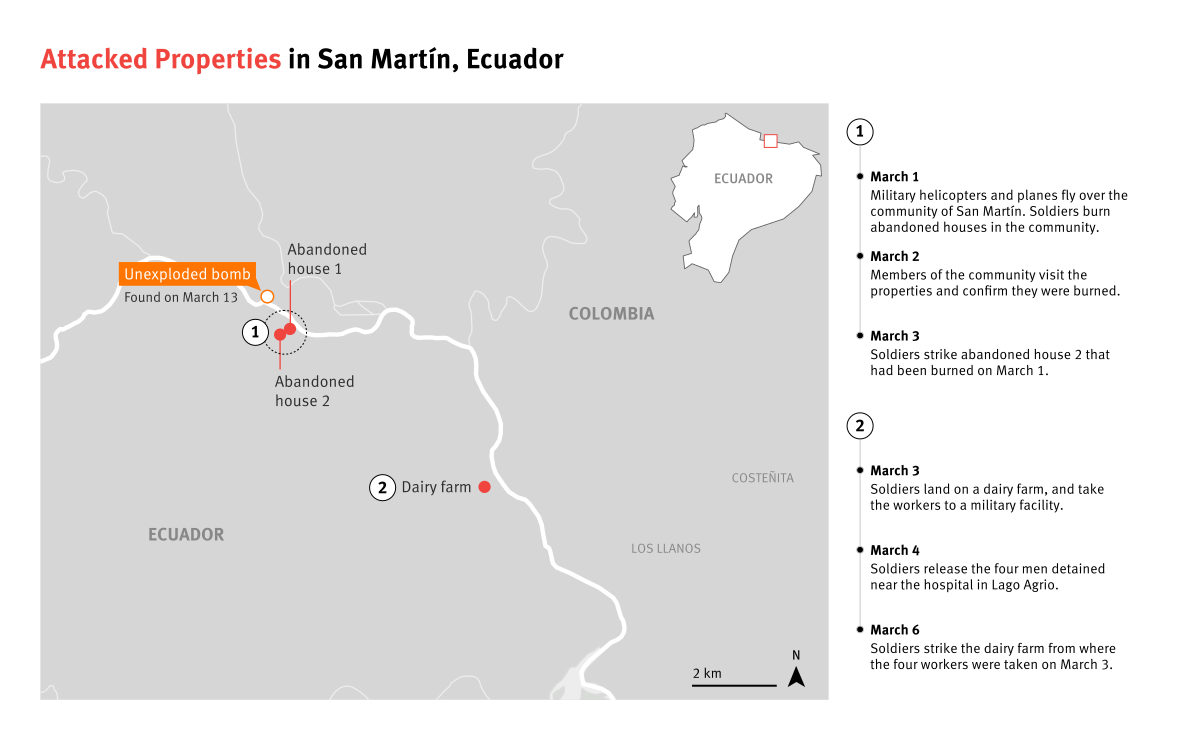
On the afternoon of March 3, 2026, around 3:30 p.m., an Ecuadorian military helicopter landed near a dairy farm in the San Martín community, on the Ecuadorian side of the border. According to two of the men detained that day and the property owner, four Colombian men were resting in a wooden house on the farm after a morning spent planting grass.[99] A fifth worker, who had been elsewhere working on the property, arrived after the Ecuadorian soldiers.[100]
Ecuadorian soldiers ordered the four men out of the house, forced them face-down on the ground, and covered their heads with their own shirts, the two workers said. They were not shown any arrest warrant or told that they were being detained.[101] Soldiers then separated the four men across different parts of the property and interrogated them individually about alleged ties to the Border Commands and the location of drug-storage sites in the area. The two workers told Human Rights Watch that the beatings and insults “intensified” after the soldiers learned that they and the other two men being detained were Colombian nationals.[102]
The two men described how Ecuadorian soldiers kicked and beat them for over an hour, struck them with rifle butts and the flat side of a machete, and suffocated them with their shirts and a cord. One of the men said he was subjected to waterboarding in a water tank in the laundry room of the main house on the farm.[103] The fifth worker, who arrived later, told Human Rights Watch that he saw men lying on the ground with their hands bound behind their backs. He said a soldier punched him in the chest, ordered him to remove his boots, and inspected the contents of his cell phone before allowing him to leave.[104]
The three workers and the property owner told Human Rights Watch that soldiers used gasoline to set the property on fire.[105]
At approximately 5 p.m., according to the workers and some community members, soldiers transported the four men to the riverbank.[106] A group of community members approached the riverbank, some of them said, to ask about the workers. They said soldiers shot towards them, and they fled.[107] Human Rights Watch verified a video recorded by a community member showing a group of at least eight men and women walking on the riverbank towards a small group of people. A total of nine gunshots, including several 2-round bursts consistent with a military-style rifle, can be heard in the same scene.[108] This video is consistent with the allegations of the community members and workers Human Rights Watch interviewed.
Minutes later, an Ecuadorian Army helicopter transported the four men away from the riverbank, two of the workers and several witnesses said.[109] Human Rights Watch verified three further videos corroborating their testimonies. These show a helicopter bearing Ecuadorian Army insignia on its tail boom departing from the area.[110] A photograph broadcast on Ecuadorian television during an interview with the minister of defense shows at least 10 soldiers wearing balaclavas and helmets escorting the four men—three of them with shirts pulled over their heads—from a military helicopter.[111]
The workers told Human Rights Watch that they were taken to a military facility. They were not informed of the facility’s name or location, but a report from the Ecuadorian police that Human Rights Watch gained access to, as well as information provided to researchers by the Attorney General’s Office, confirm that they were taken to Jungle Battalion 56 (Batallón de Selva 56), a military facility located about 32 kilometers south in the Santa Cecilia parish of Lago Agrio, Sucumbíos province.[112]
At the military facility, the two workers said, Ecuadorian soldiers doused them with water and applied electric shocks to their ribs with what they believed was a taser.[113] “They tortured me with electricity, with a taser,” one of the men told Human Rights Watch. “They poured water on me and then shocked me, and I passed out. I lost consciousness at least twice.”[114]
Two of the men said soldiers threatened to cut off their fingers or pull out their fingernails. Both said soldiers pointed firearms at them and threatened to kill them to make them confess where the drugs or arms were.[115] “They pointed a gun at me, racked it, and pulled the trigger, but it wasn’t loaded,” one of the men said.[116]
The workers told Human Rights Watch that soldiers released the four of them between 2 a.m. and 3 a.m. on March 4, near a hospital in Lago Agrio. As they were released, soldiers told them they would be killed if they did not leave Ecuador or if they saw them again.[117]
Human Rights Watch reviewed medical records of two of the men based on exams conducted, in one case, the day after the events and, in the other, a month later. Both sets of records describe “traumatic injuries” and bruises.[118] An expert with the Independent Forensic Expert Group (IFEG) of the International Rehabilitation Council for Torture Victims (IRCT) who reviewed the records concluded that, in both cases, the physical examinations and recorded diagnoses, including bruising, lacerations, trauma to the chest area, and pain in the back and abdominal areas, are consistent with the individuals’ allegations of beatings.[119]
Human Rights Watch also reviewed five photographs of one of the men taken in mid- and late March that show injuries on his wrists and neck.[120] The IFEG expert reviewed the photographs and concluded that the wounds observed on the wrists and neck are consistent with the workers’ allegations of restraint and suffocation by cords, and that the apparent age of the lesions were consistent with the timeline of the reported events.[121]
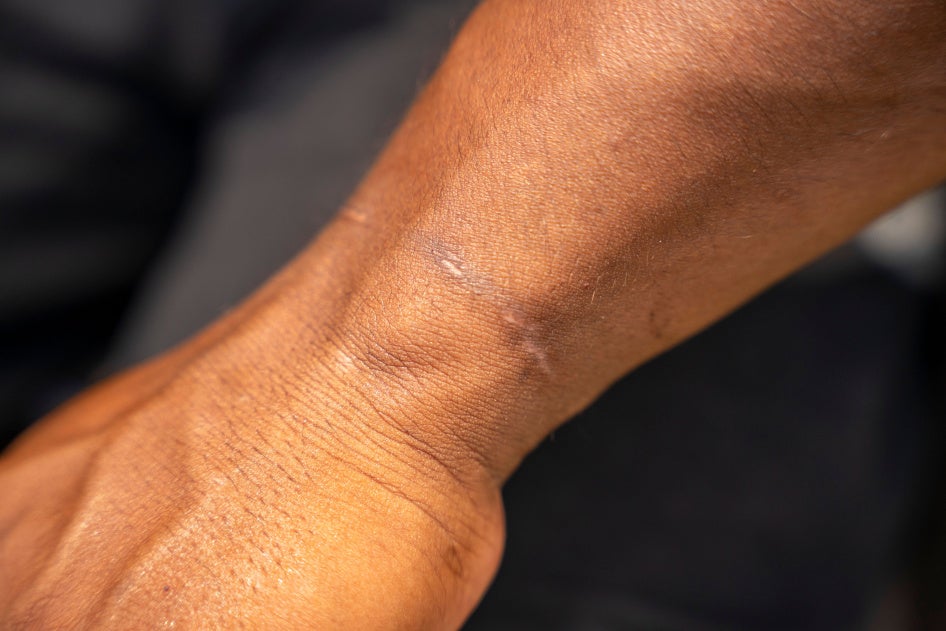
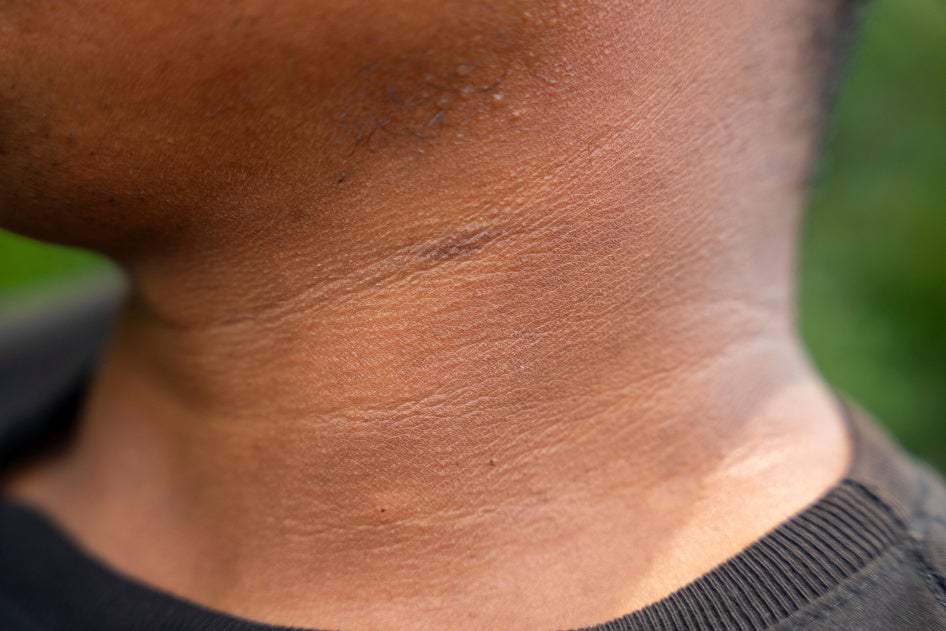
Scars left by injuries sustained by a farm worker during his torture on March 3, 2026.
© 2026 Veronica LombeibaEcuadorian Authorities’ Account
A May 18 report by the Army’s Fourth “Amazonas” Division reviewed by Human Rights Watch provides the army’s version of the events on March 3. It says that during an “operation” to an “area identified and individualized as a military objective,” officers found four foreign nationals who were identified as “members of the first security ring of a high-value target.” The report says that soldiers “immediately” handed over the men to the prosecutor’s office and the police who “ordered their release” despite objections from the military.[122] The report also claims that there is no evidence that the men were tortured or subject to any abuse.
In a statement published on its X account on March 25, the Ecuadorian Ministry of Defense said that the detention of the four men was carried out “for investigative purposes.”[123] During a media interview, the minister said that the four men had been brought before a prosecutor who declined to file charges “out of fear.”[124] He did not explain what they allegedly feared.
The Attorney General’s Office provided a different account to Human Rights Watch. According to that office, the prosecutor was “materially and legally” precluded from proceeding with charges because soldiers failed to provide sufficient information or evidence of criminal activity, including basic details needed to identify the workers and the circumstances of their arrest, arguing that the information was “classified.”[125] Two workers told Human Rights Watch that they never saw or spoke to the prosecutor.[126]
Human Rights Watch also reviewed a police report dated April 14 regarding the operation. It indicates that police officers visited Jungle Battalion 56 on March 3 at around 10:30 p.m. and spoke with Commander Jorge Delgado Jijón, who informed them that military personnel had carried out “raids and interventions” and that “military personnel proceeded to transfer 4 citizens who were not carrying identification documents, on the presumption that they could belong to an armed group operating in the area known as [the Border Commands].”[127]
Both the May 18 military report and the statement by the Ministry of Defense said that during the operation they found evidence of illicit activities, including a semi-automatic rifle and ammunition.[128] The police report contradicts the Ministry of Defense’s allegation that the soldiers found arms and states that the men detained had no weapons nor any other evidence linking them to an offense.[129]
Human Rights Watch reviewed Ecuadorian judicial databases and found no record of pending investigations or prosecutions against the four men. The police report confirms they did not have “registered pending issues with judicial authorities.”[130]
The Attorney General’s Office and the Ombudsperson’s Office told Human Rights Watch that they opened investigations into allegations of torture committed by members of the armed forces against residents of San Martín.[131]
Destruction of Property
Between March 1 and 6, soldiers burned and bombed three properties in the San Martín community and conducted repeated overflights with helicopters and small aircraft, which caused fear among residents.[132] “We are scared. Scared that at any moment they can come back and burn more properties or take more people from the community. They keep saying we are all ‘guerrilla members,’” a member of the community told Human Rights Watch.[133]
Human Rights Watch found no credible evidence that the three destroyed properties had any connection with criminal armed groups. One of the properties burned and later struck appeared to be a dairy farm, according to a review of photographs, videos, satellite imagery, property records, and commercial receipts, and interviews with the property owner, nearby residents, and the detained workers. According to New York Times reporting and testimonies, the two other destroyed properties had been abandoned for some years.[134]
According to the May 18 military report, the operation had three different phases that were carried out on March 1, 3 and 6. The report says properties near the river were previously identified as “storage areas,” “rest points,” and “coordination centers” for the Border Commands and soldiers carried out “neutralization actions” and “controlled destruction.”[135] The report does not specify how many properties or facilities were destroyed.
During an interview broadcast on television, the Ecuadorian minister of defense presented photographs and videos which he claimed showed the presence of the group’s leader “Mono Tole” and other Border Commands members on a property he said the military had struck.[136] The broadcast also presented a framed photograph of a man, a woman and a child and the minister hinted that the man was “Mono Tole.” Human Rights Watch researchers could not establish the identity of the people in the photograph.
Dairy Farm Burned and Struck on March 3 and 6
Around 5 p.m. on March 3, 2026, soldiers also set fire to the house in which the workers had been resting, as well as to a nearby kitchen and storage area, and burned personal belongings of the workers and property owner who were inside the main house, interviewees told Human Rights Watch.[137] Human Rights Watch verified photographs and videos recorded by community members near the riverbank of the property, showing parts of the farm in flames or showing plumes of smoke.[138] Through a video call with the property owner on April 24, Human Rights Watch confirmed that the parts of the farm seen burning in the video and the structures that the workers described as having been burned in their testimonies are the same structures researchers observed as damaged during the video call.[139]
On March 6, 2026, at approximately 10:30 a.m., the Ecuadorian Army struck the same property with three air-dropped munitions according to testimonies and three videos, two of which were posted on social media by Ecuadorian and US authorities.[140]
Human Rights Watch verified photographs showing blast debris consistent with munitions that detonated as airbursts.[141] The damage matches ground footage shared in a video posted to US Assistant Secretary of Defense Sean Parnell’s X account on March 6.[142] US Secretary of Defense Pete Hegseth reposted the footage and wrote: “we are bombing Narco Terrorists on land as well.”[143]
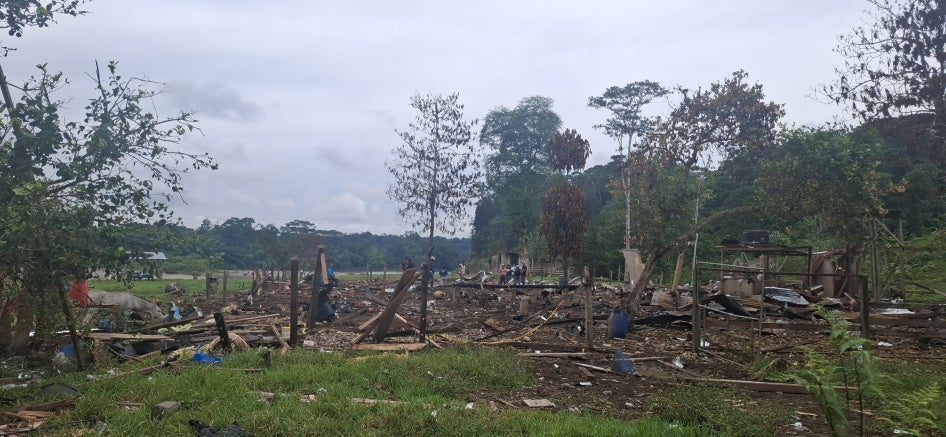
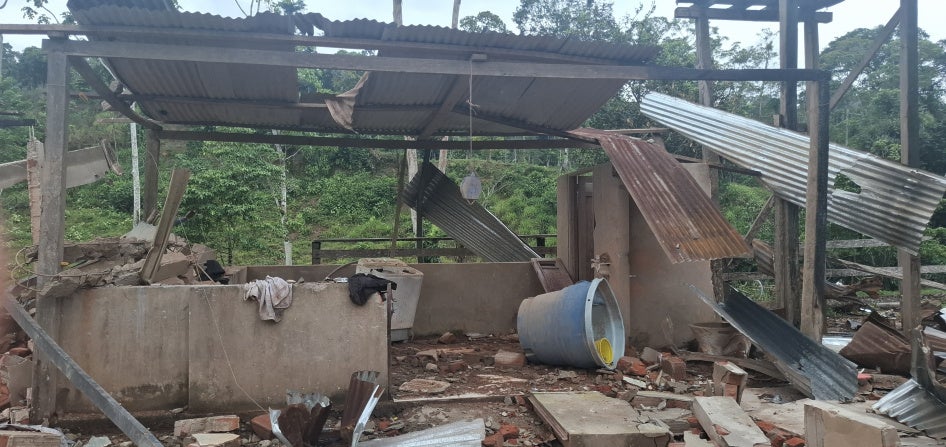
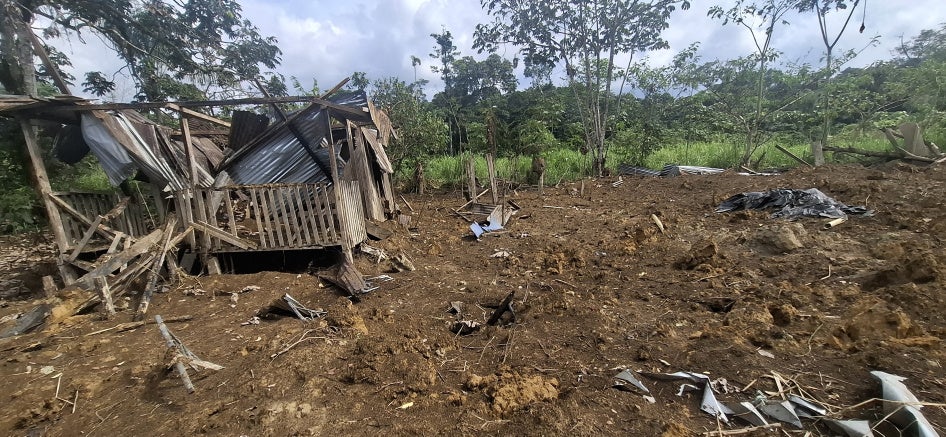
Two photographs of the damage caused to the property burned on March 3, 2026, and bombed on March 6, 2026.
© 2026 Alliance for Human RightsEcuadorian authorities described the operation as targeting “a camp used by the narco-criminal group the Border Commands,” which they characterized as a “training site” capable of accommodating “approximately 50 narcotraffickers.”[144] However, the two interviewed detained workers, the property owner, other community members, and journalists and members of human rights organizations who visited the area described the property struck on March 6 as a working dairy farm.[145]
On April 24, 2026, the owner of the property conducted a video call with a Human Rights Watch researcher in which he showed the infrastructure and equipment used for livestock and cheese production. Human Rights Watch researchers reviewed the deeds of the property, which confirm the property’s ownership and boundaries.[146] During the video call, Human Rights Watch researchers identified the following:
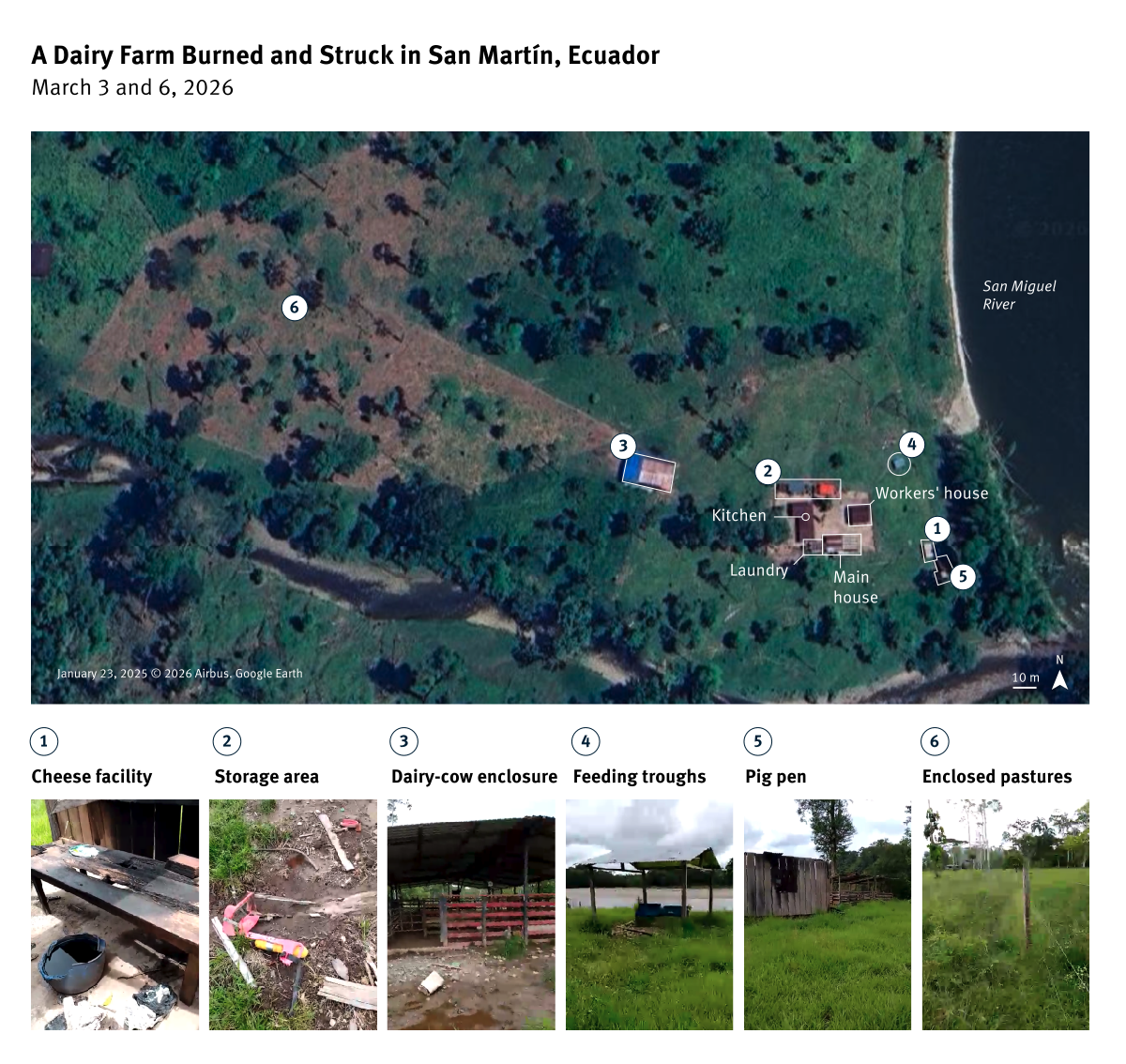
During the call, researchers saw rennet containers inside the burned cheese facility, damaged agricultural equipment, such as chainsaws and brush cutters near the storage area, and a few cattle and horses in the pastures. According to the property owner, he had to sell or move some of the cattle to Colombia after the attack.[147] Satellite imagery recorded a few months prior to the attack, on October 25, 2025, shows at least four head of cattle in a field near the dairy cow enclosure.
As shown in the video call and aerial photographs analyzed by Human Rights Watch, all the structures and buildings within the owner’s property were damaged by fire or destroyed by the air-dropped munition, with the exception of the dairy cow enclosure and a wooden house approximately 300 meters away from the damaged area of the property.
Human Rights Watch separately showed satellite imagery of the property to the property owner during an interview with researchers. He described and labeled the various buildings and facilities visible in the imagery, providing identifications consistent with the April video call and the descriptions provided by the detained workers and other community members.[148]
The May 18 report by the military claims that the Border Commands often uses agricultural property as a “front” to provide “cover” for its operations.[149] However, the report does not include any specific evidence that the farm struck on March 3 served as a “training camp,” as the military claims.
Researchers also reviewed sales receipts dated January and February 2026, shared with Human Rights Watch by the property owner, recording sales of pressed cheeses. The type of cheese sold requires rennet for its production, which is consistent with the facilities and rennet containers observed during the video call. Other invoices dated between June 2020 and June 2025 reviewed by researchers show that, prior to the military operation, the property owner acquired various farm-related items from a hardware store, including chainsaws and related equipment.[150] Human Rights Watch confirmed that the hardware store from which the items were purchased operates in San Miguel, Putumayo, Colombia.
Abandoned Wooden Houses Burned and Struck on March 1 and 3
On March 1, at approximately 11 a.m., soldiers set fire to two properties about 300 meters apart in San Martín, according to community members and the owner of one of the houses.[151] Human Rights Watch verified photographs taken by members of the Alliance for Human Rights, a coalition of human rights groups in Ecuador, approximately 10 days after the event, which show blast and fire damage to wooden houses in both locations.[152]
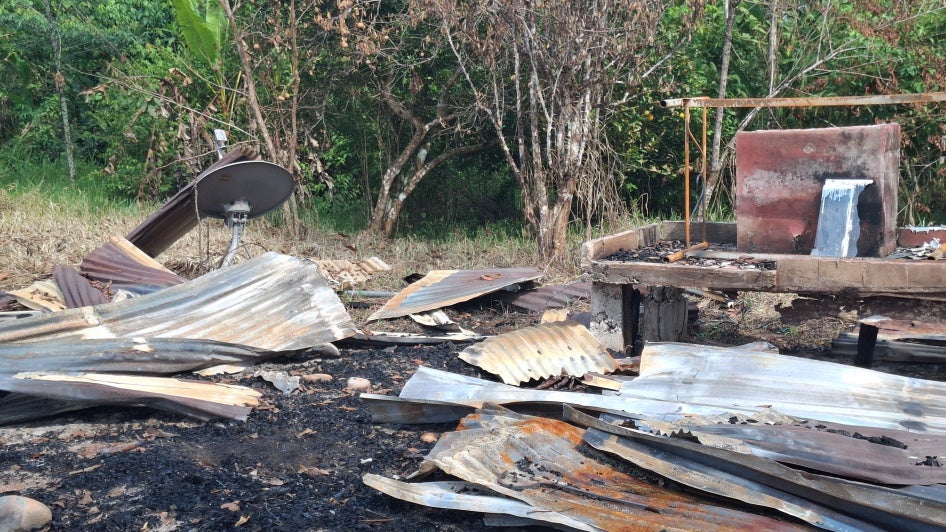
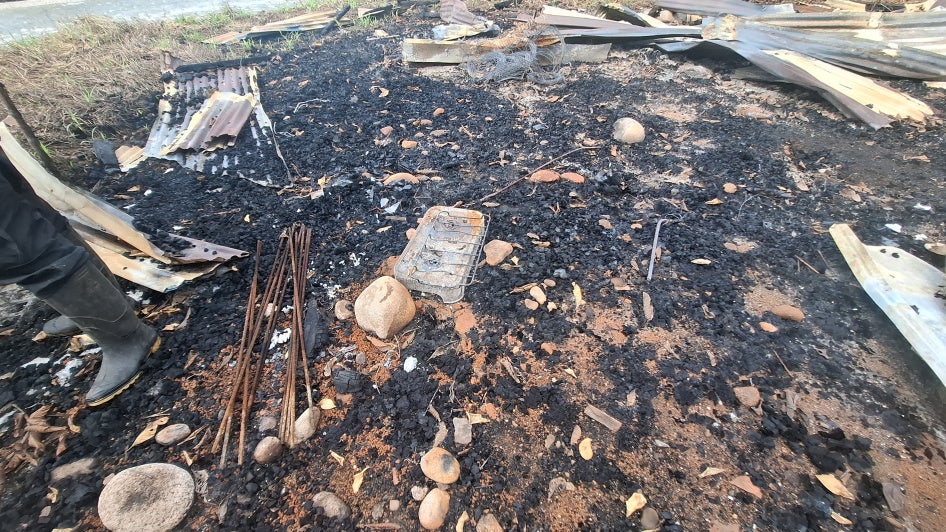
Two photographs of the damage caused to one of the properties burned on March 1, 2026.
© 2026 Alliance for Human RightsLow-resolution satellite imagery captured on March 1 at 10:36 a.m. shows both properties still intact. An image collected 24 hours later, on March 2, shows burn scars in and around one of the properties and potential damage to the other.
A caretaker responsible for one of the properties told Human Rights Watch that the owner had left approximately four years ago. He said he would occasionally return to the property to clean it, and that it had a few pieces of furniture in it.[153] A man, who identified himself as the owner of the other house closer to the river, said he left it approximately two years ago for work-related reasons, but that he visited every 8 to 15 days to clear vegetation and sweep.[154] Human rights defenders and journalists who visited the area after the attacks told Human Rights Watch the houses appeared to have been abandoned.[155] They said the vegetation was dense and there were limited accessible pathways to reach the properties.[156]
Consistently, satellite imagery recorded a few months before the attack, on October 25, 2025 shows no defined paths connecting or providing access to the houses. A comparison between imagery from 2020 and 2025 shows no additional structures or buildings constructed on the properties.
On March 3, a military aircraft struck one of these properties, interviewees said.[157] Human Rights Watch reviewed four photographs and two videos, including some taken by members of the Alliance for Human Rights approximately 10 days later, showing a large crater and debris.[158] The blast and thermal damage is consistent with an air-dropped MK-82 bomb, such as the one described in the following section, that detonated upon impact.
Low-resolution satellite imagery captured on March 16 and analyzed by Human Rights Watch shows further damage to the property, consistent with the photographs taken at the site.
On the night of March 3, US Southern Command announced on its X account that Ecuadorian and US military forces had “launched operations against Designated Terrorist Organizations in Ecuador.”[159]
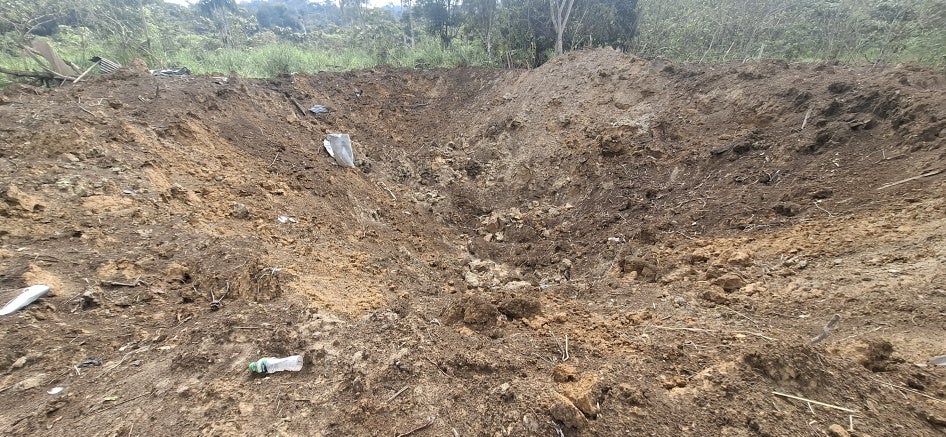
Two photographs of the damage caused to the property burned on March 1, 2026, and bombed on March 3, 2026.
© 2026 Alliance for Human RightsCross-Border Bomb Incident
On March 13, 2026, a family, on the Colombian side of the river that divides the two countries, approximately 900 meters from one of the affected properties, reported finding an unexploded air-dropped MK-82 bomb on their property.[160] One photograph and two videos captured by community members and reviewed by Human Rights Watch show the tail of the bomb confirming it is a 500-pound bomb consistent with a MK-82 commonly used by aircraft to attack targets on the ground.
According to community members and media reports, witnesses saw planes flying over the area on March 3.[161]
The discovery sparked a diplomatic incident between Colombia and Ecuador, with Colombian President Gustavo Petro publicly suggesting that Ecuador dropped the bomb in Colombian territory and Ecuadorian President Daniel Noboa responding via social media that the claim was false.[162]
On March 23, Colombia’s Ministry of Defense said the bomb impacted first in Ecuador and “bounced” approximately 210 meters into Colombian territory before coming to rest unexploded.[163] According to Human Rights Watch weapons experts, the bomb could indeed bounce if the fuze or fuzes failed to function.
US Involvement in the Events
Both Ecuadorian and US authorities have publicly characterized the events of March 1-6, 2026, as a joint or partnered operation.
On March 2, President Noboa announced on the social media platform X a new “phase” of government efforts against narcoterrorism and illegal mining, stating that joint operations with regional allies, including the United States, would be conducted throughout March.[164]
On the night of March 3, 2026, US Southern Command posted footage of Ecuadorian Army helicopters taking off from what Human Rights Watch identified as Jungle Battalion 56.[165] On March 6, US Assistant Secretary of Defense Sean Parnell cast the operation as part of a broader US commitment “to detect, disrupt, and destroy designated terrorist organizations” across the Western Hemisphere alongside regional partners.[166]
On March 7, Ecuador’s Ministry of Defense confirmed that the aerial bombings were part of an operation called “Total Extermination,” carried out “with the support” and as part of “bilateral cooperation mechanisms” with the United States.[167] President Noboa confirmed in an interview with Univision the next day that Ecuador had engaged in joint operations with the United States and said both Ecuadorian and US equipment, including aerial bombing capabilities and ground-to-ground munitions, had been used.[168]
On March 9, President Trump reported to Congress that “military action” had been taken “at the invitation of, with the consent of, and in partnership with the Government of the Republic of Ecuador.” He stated that both countries’ armed forces had partnered to strike, on March 6, 2026, “the facilities of narco-terrorists affiliated with a designated terrorist organization.” He noted that while US forces were “present,” they “did not come into contact with hostile forces.”[169] The head of US Southern Command, General Francis L. Donovan, told the US Senate Committee on Armed Services that he “took part” and “observed” the operation. He said that US “special operations forces, including both ground forces and air forces quickly plan[ed] with the Ecuadorians to ensure that any use of force fell within our requirements” and that the operation was “professionally executed.”[170]
The May 18 report by the Ecuadorian military says that the operations received “international support,” but says that the identification of the national and foreign units involved, as well as the “cooperating states and organizations,” are “sensitive” and “restricted” information.[171]
Human Rights Watch sent written requests to the Ecuadorian Ministry of Defense, the US Department of Defense and US Southern Command seeking information about the operation, the properties struck, and evidence that any of the targets were part of a “training site” for the Border Commands. At time of writing, neither had replied.
Despite public statements from both governments characterizing the operations as joint, neither the US Department of Defense nor Ecuador’s Ministry of Defense has disclosed the specific roles played by US personnel in the planning, surveillance, targeting, or execution of the strikes; the legal framework governing their participation; the chain of command connecting US and Ecuadorian forces; the number of sites struck; the evidence on which they concluded each of the sites was a legitimate military target; or the measures taken to avoid harm to ordinary people living, working or otherwise present in the area.
III. Drone Strikes and a Missing Vessel near the Galápagos Islands, January–March
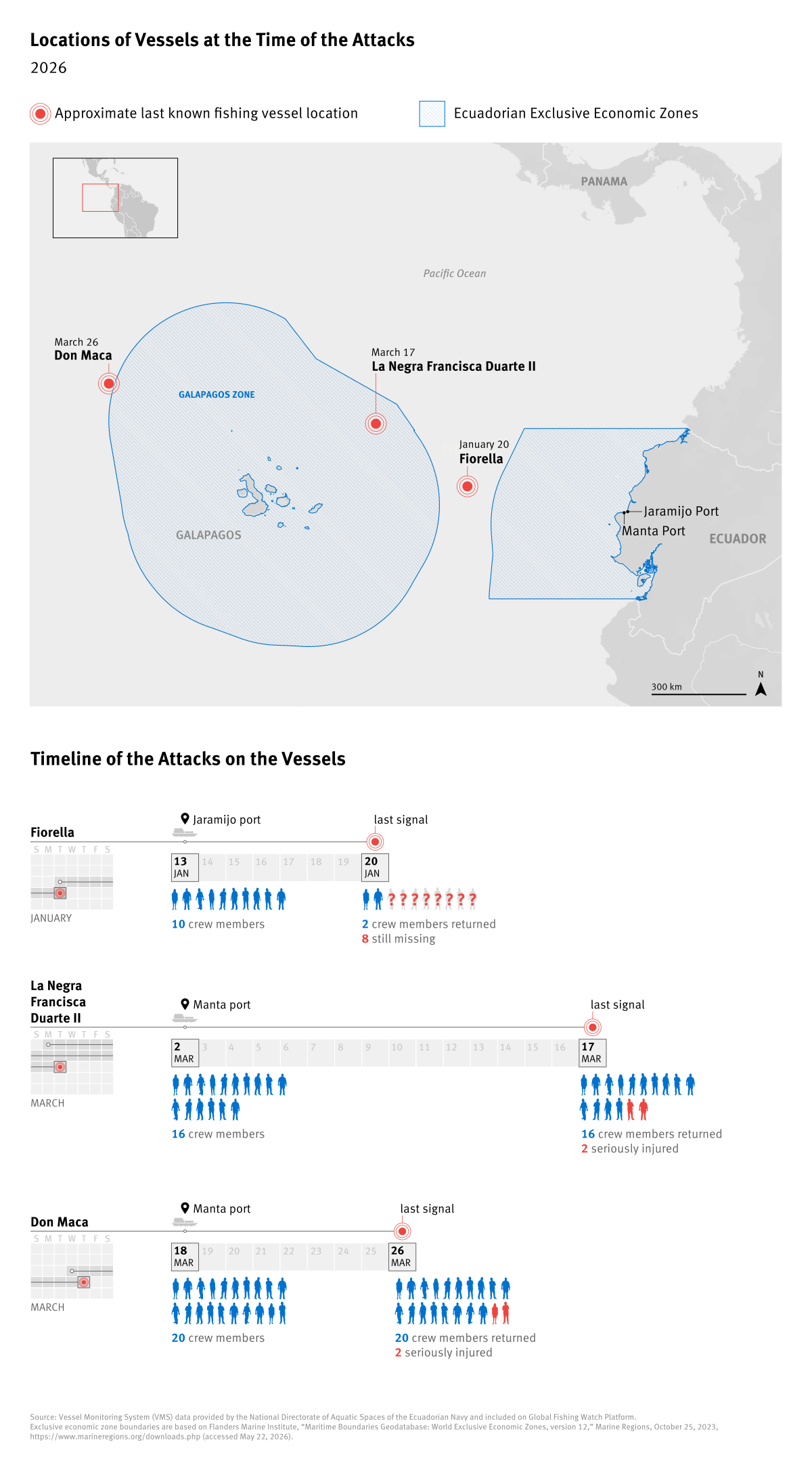
Between January 13 and March 18, 2026, three Ecuadorian fishing vessels—the Fiorella, La Negra Francisca Duarte II, and the Don Maca—left the ports of Manta and Jaramijó, on Ecuador’s central Pacific coast, on fishing trips toward waters north of the Galápagos Islands. None returned intact. Eight of the ten crew members of the Fiorella remain missing, after the vessel lost contact with shore on January 20, 2026.
Survivors from La Negra Francisca Duarte II and the Don Maca told Human Rights Watch that drones armed with explosives struck their vessels on March 17 and March 26, respectively, as described in more detail below. They also said that what they believed to be US armed personnel wearing military-style uniforms bearing US flag insignias took them aboard a nearby blue-and-white vessel, detained them, and transferred them to Salvadoran coast guard vessels. At least four crew members on those vessels suffered serious injuries.
During this period, Ecuadorian and US authorities carried out maritime operations that the government of Ecuador and the press have characterized as joint or coordinated activity.[172] In an April 8 interview with Bloomberg en Español, Ecuadorian President Daniel Noboa said the United States had provided significant support in identifying drug-trafficking routes in the Pacific, and that Ecuador was carrying out “joint work” with the US government as part of international cooperation.[173] On April 9, 2026, Ecuador’s then-Foreign Minister Gabriela Sommerfeld said that Ecuador and the United States were “working cooperatively on joint activities,” without providing details.[174]
However, US Southern Command said in response to media inquiries that it had no information to provide regarding the attacks on the three vessels.[175] The US Department of Defense said “the US did not board the Don Maca and conducted no kinetic strikes against it.” It also said it was “unaware of any strikes against” the Fiorella and La Negra Francisca Duarte II and “did not conduct strikes against any vessel” on the dates when contact with those vessels was last reported.[176] The US Coast Guard also told journalists that it had no knowledge of, and no involvement in, the reported attacks on Ecuadorian fishermen. The US Coast Guard said it conducted a search-and-rescue operation on March 18 (that is, the day after La Negra Francisca Duarte II was attacked), after receiving reports of a vessel on fire in the Eastern Pacific. But, the Coast Guard said, the search yielded no survivors and was subsequently suspended.[177]
The crew members of the three vessels came from the coastal communities of San Mateo, Jaramijó, and Manta, where small-scale fishing remains a principal livelihood despite the severe impact of organized crime and drug trafficking on the region’s economy.[178] All three vessels had been cleared to depart by the Manta Port Captaincy (Capitanía de Puerto de Manta), the maritime authority responsible for authorizing departures and overseeing maritime safety and control.[179]
Human Rights Watch reviewed criminal record certificates issued by Ecuador’s Ministry of Interior, as well as records in Ecuador’s Automated Judicial Proceedings System (Sistema Automático de Trámite Judicial Ecuatoriano), for all crew members of the three vessels.[180] Only four of the 46 crew members had criminal records: one for fishing in a protected area and for the illegal storage, transport, packaging, sale, or distribution of hydrocarbons; and three for failure to pay child support. None of the men on the boats had previously been convicted of a drug trafficking-related offense or a violent or potentially violent offense.
Human Rights Watch analyzed and reviewed data from the Vessel Monitoring System (VMS), provided by the National Directorate of Aquatic Spaces of the Ecuadorian Navy and accessed through the publicly available Global Fishing Watch platform.[181] This data identified the routes and the last known positions of the three fishing vessels that transmitted signals.
The Fiorella
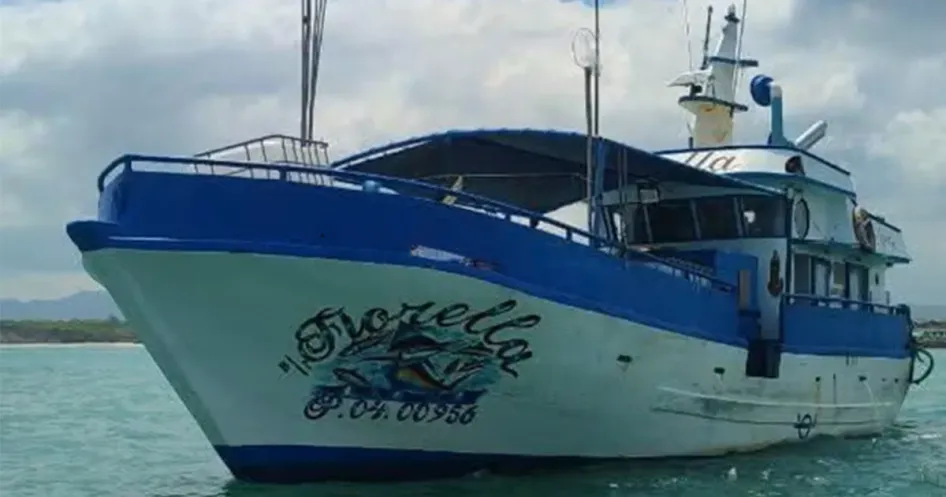
After obtaining authorization to depart from the Manta Port Captaincy, the Fiorella left Jaramijó Port on January 13, 2026, under the command of 36-year-old captain Juan Carlos Valencia, on a trip to conduct long-line fishing in waters between the Ecuadorian coast and the Galápagos Islands.[182] The vessel carried four support boats for fishing operations, as recorded in the departure authorization document reviewed by Human Rights Watch.[183] People on shore lost contact with the vessel on January 20, 2026.[184]
Most of the crew members were from the fishing community of Jaramijó. Eight had worked for years on the same vessel, and some of them were family.[185] The crew planned to fish for marlin, tuna, and dorado, and expected to remain at sea for 20 to 25 days, according to the vessel owner’s lawyer.[186]
Two of the 10 crew members returned to shore in late January. Eight crew members remain missing. Human Rights Watch interviewed the surviving crew members, who said that the Fiorella sailed for about four days into deeper waters before the crew began fishing.[187] They also said that on January 18 and 19, they saw two gray airplanes and what they believe were two surveillance drones flying near the vessel at dusk. They said the drones were black with four propellers and a red light. They also said that on January 19, they saw a gray patrol vessel flying a US flag approach the Fiorella and then move away.[188] Both survivors said they thought they were going to be inspected.[189]
“The captain stopped the vessel, we had a snack, and we waited to see whether the people from the patrol vessel would board ours, but they did not,” one of them said. “Since they did not board our vessel, we continued on.”[190]
On January 20, the captain ordered two of the small support boats to leave the Fiorella to set fishing lines, while the other boats remained tied to the vessel, according to the interviewees.
The two surviving crew members departed in one of the support boats, while two others took the second; the remaining six crew members stayed on the Fiorella. The survivors who spoke with Human Rights Watch said their boat traveled several miles east of the Fiorella to set the longline, while the other small boat headed north. At about 8 a.m., the captain radioed to say that they should begin collecting the line at 4 p.m. and that the Fiorella would pick them up where they had separated from the vessel later that night.[191]
They said they spent the morning fishing and, at around noon, lay down to rest. At about 1 p.m., they woke up after hearing one of the crew members in the other small boat trying to reach the Fiorella by radio. “He was saying, ‘Captain, captain,’” one of the surviving crew members said.[192] “And then we did not hear any response from the Fiorella, and the radio did not sound again.”[193] They said he then tried to contact the captain and the other small boat, but no one answered.
From a distance, they saw what looked like a “column of smoke,” they said, but did not know what it was or what had happened. At about 4 p.m., the pair began collecting the longline. They finished at about 7 p.m. and tried again to reach the Fiorella and the other support boat by radio, but no one responded.[194]
The interviewees told Human Rights Watch that they then went to the point where the Fiorella was supposed to pick them up. They waited there until about 11 p.m., turned off their lights, and continued trying to reach the vessel and the other small boat by radio, but no one answered. By then, they said, they could no longer see smoke plumes or any sign of the Fiorella. They then went to the area where the second small boat should have been fishing. They did not find the boat or its crew members, but they did find the longline they had set.
The interviewees said they remained in that area until about 8 a.m. on January 21. Because they had little fuel left, they decided to throw the fish overboard and head back towards the coast. The interviewees recorded two videos, shared with Human Rights Watch by the vessel owner’s lawyer, in which they filmed themselves in the small boat, saying they had lost contact with the Fiorella, and explaining that they needed to discard the catch because they could not find the vessel.[195] The interviewees said they then traveled all day and through the night, until another vessel, Dios es mi Guía, rescued them at about 6 a.m. on January 22.
Data from the VMS, as displayed on the Global Fishing Watch platform and reviewed by Human Rights Watch, indicates the presence of a vessel identified as Dios es mi Guia approximately 95 nautical miles east of the Fiorella on January 22.
The Fiorella’s owner told Human Rights Watch that he last spoke with the captain on January 19.[196] The captain told him that “a US patrol vessel was following them and drones were flying over them,” the owner said.[197] “But I told him to stay calm, that nothing was going to happen because we were operating legally and everything was in order.”[198] He said relatives of the crew later told him that they had also last communicated with their loved ones that day, while a few had last heard from them on the morning of January 20. Some relatives told the owner that crew members had expressed concern about drone surveillance, aircraft flying near the vessel, and the presence of a nearby patrol vessel, which they identified as a US patrol because it was flying a US flag, the owner said.[199]
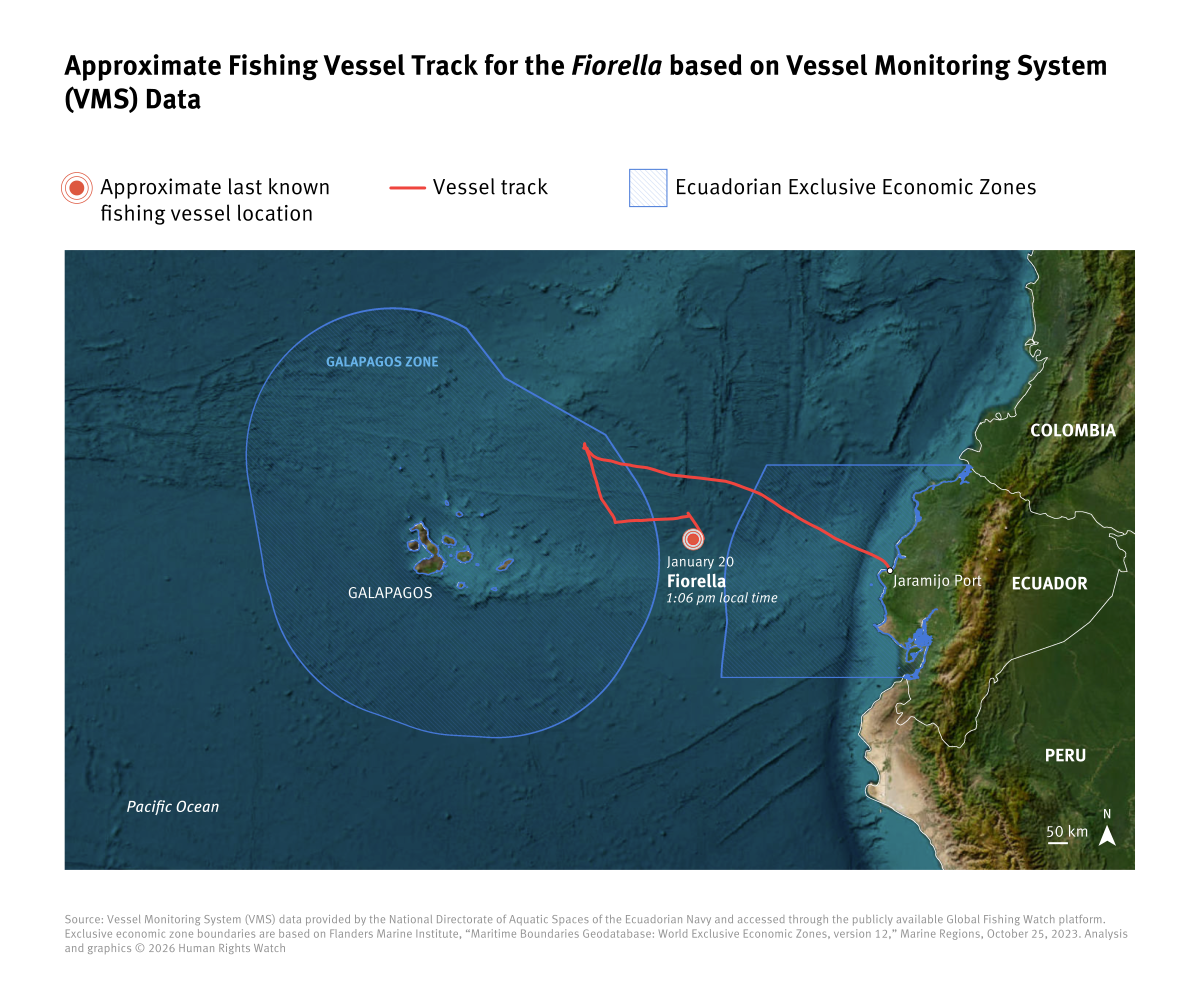
The vessel owner’s lawyer told Human Rights Watch that the Fiorella lost its satellite tracking signal around 1 p.m. on January 20.[200] According to information provided to the lawyer by the company that provided satellite tracking for the vessel and reviewed by Human Rights Watch, the Fiorella’s last recorded position was at coordinates 0°12'51.0"S 85°05'53.0"W.[201]
According to VMS data reviewed by Human Rights Watch, the last signal transmitted on January 20 at 1:06 p.m. by the Fiorella was at approximately the same coordinates, 0°12'51.0"S 85°05'54.0"W. After this time, no further signals were recorded.
Human Rights Watch cross-checked those coordinates against the World Exclusive Economic Zones (maritime boundaries) dataset and confirmed that the location lies in international waters between the Ecuadorian Exclusive Economic Zone bordering the Ecuadorian mainland and the Ecuadorian exclusive economic zone surrounding the Galápagos Islands.[202]
The lawyer representing the Fiorella’s owner also told Human Rights Watch that he reported the vessel’s disappearance to the Manta Port Captaincy on January 22 and filed a complaint with Ecuador’s Attorney General’s Office on January 23 to demand the activation of a search-and-rescue plan. The lawyer said he had not received any information about search efforts.[203]
In early May, Human Rights Watch interviewed Gloria Alexandra Bravo Cedeño, the prosecutor who was then handling the investigation into the Fiorella’s disappearance in Manta. She said the Attorney General’s Office had opened an investigation under Ecuador’s protocol for disappearance cases, which requires prosecutors to work with the National Directorate for the Investigation of Crimes Against Life, Violent Deaths, Disappearances, Kidnapping and Extortion (DINASED). She said, however, that neither prosecutors nor DINASED have the authority or logistical capacity to carry out investigative actions at sea. She said the National Directorate for Aquatic Spaces is responsible for search-and-rescue protocols. Her office had requested information from relevant authorities, including the Manta Port Captaincy, but had not received any official response.[204]
On June 14, 2026, unidentified attackers shot and killed Bravo in Manta. Authorities had recently transferred her to Montecristi, a municipality in Manabí province near Manta.[205] The following day, Human Rights Watch interviewed the prosecutor who replaced her and took over the investigations. He said his office had not yet received responses from the authorities to which it had sent formal information requests and that authorities had yet to identify the motive behind Bravo’s killing.[206]
The Permanent Committee for the Defense of Human Rights, an Ecuadorian human rights organization, told Human Rights Watch that it had submitted information about the missing crew members to the United Nations Committee on Enforced Disappearances. On April 13, the committee called on Ecuador to take urgent measures to protect the lives of the missing persons and issued a series of recommendations.[207]
On May 15, Ecuador responded to the committee, outlining steps taken by several state institutions. Ecuador said the Navy activated its search-and-rescue plan on January 23, 2026, and carried out maritime search protocols for about five weeks, using naval and aerial-maritime assets and covering about 250 square nautical miles. The government said authorities moved the case to a “passive phase” on February 27, after failing to find the vessel or any of the eight missing crew members. Ecuador also said prosecutors had opened a criminal investigation into the disappearance of the eight crew members. However, the Attorney General’s Office identified critical obstacles, including the lack of direct operational support from the National Police in maritime territory and the absence of effective and sustained coordination with the armed forces and the Port Authority, which it said had limited investigative capacity.[208]
La Negra Francisca Duarte II
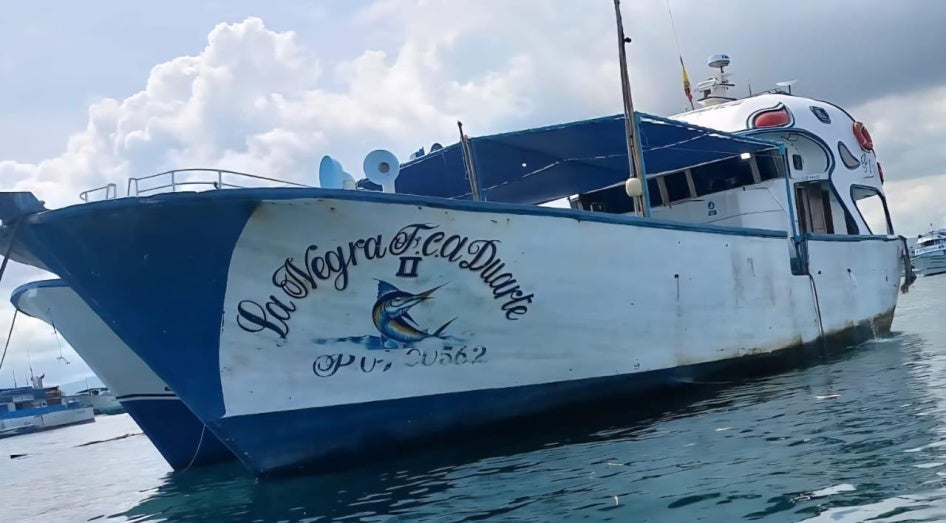
La Negra Francisca Duarte II left Manta Port on March 2, 2026, with six support boats and a crew of 16, on a fishing trip to waters north of the Galápagos Islands.[209] Most of the crew were from San Mateo, a coastal community near Manta where small-scale fishing is the main source of income for residents.[210] The captain told Human Rights Watch that most crew members had worked as fishermen for years with the same vessel.[211]
At approximately 5 a.m. on March 17, 2026, Ecuadorian coast guard officials, with the patrol vessel identified as “Isla San Cristobal,” carried out a routine inspection of the vessel and found no evidence of illicit activity, according to the vessel owner’s lawyer, its captain, and five crew members interviewed by Human Rights Watch.[212] “The only issue they found was that not all crew members matched the list submitted for departure,” the captain said. “Some of the fishermen whose information we had provided did not show up, so after departure from Manta but before heading for the fishing grounds, we had to find replacements,” he explained.[213]
Human Rights Watch also reviewed data transmitted through Automatic Identification Systems (AIS) collected via satellites and terrestrial receivers, included on the Global Fishing Watch platform, to identify vessel types, locations and routes near the attacked fishing vessels. This review identified the location of the Ecuadorian patrol vessel “Isla San Cristobal” on March 17 at approximately 11:31 am, a few hours after the inspection, about 11 nautical miles south of the position of La Negra Francisca Duarte II.
Later that same day, a crew member said that after finishing his fishing work around midday, he saw a blue vessel, “like a fragata,” in the distance.[214] An hour later, while he was in his bunk trying to sleep, he heard drones and some of his crewmates shouting, “The drones, captain, the drones!” He said he initially remained calm: “I thought it was probably a surveillance drone and that they would inspect us,” he said. “But because we were not carrying anything illegal and were only fishing, I was not worried.”[215]
At approximately 1 p.m., two drones approached the vessel when it was located approximately 170 nautical miles north of the Galápagos Islands, according to interviewees.[216] “I saw two drones. One came from the bow [front of the boat] and the other from the stern [the rear],” a crew member who was on deck said.[217] “They were white. The one coming from the stern had two small silver tubes attached under the propellers. I could not see the other one clearly.”[218]
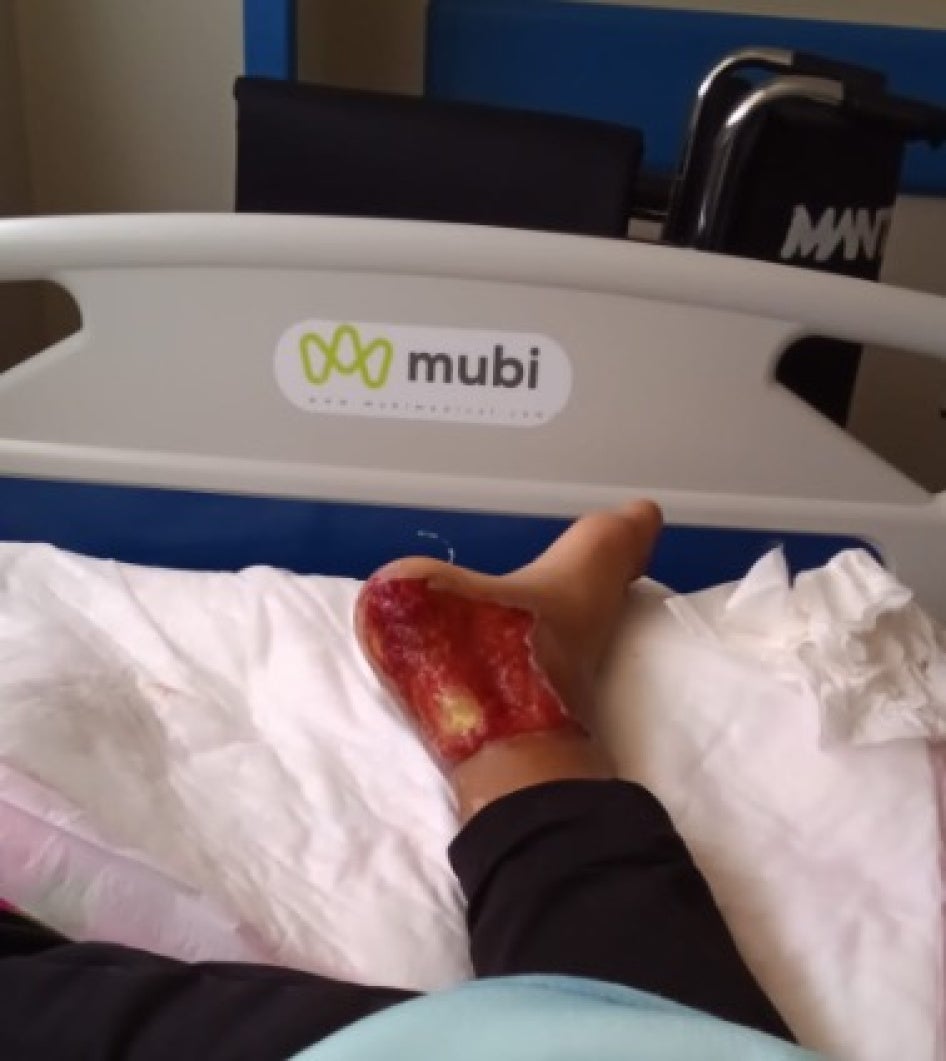
The captain, who was steering the vessel at the time, said that after crew members shouted warnings about the drones, something struck the boat, causing an explosion near the cabin, close to the antennas and the crew’s sleeping quarters, where two crew members were sleeping. He said: “One of them was screaming in pain, saying, ‘my foot, my foot.’ When I saw his foot, it was cut and bleeding. The entire cabin began to catch fire.”[219]
The injured crew member said: “I was lying on my back, I remember ... The drone first passed right over the back of my left leg, by the calf, and cut me. Then I felt the cut on my left foot, and then a horrible pain in my right foot. It was a blade that cut my right foot, around the ankle and heel, as if it had sliced the skin off, leaving it raw, and then I felt the burning.”[220]
The injured crew member said a second explosion happened in the cabin minutes later, apparently close to a gas cylinder, causing part of the cabin roof and wooden debris to fall on him. He said he dragged himself out of the bunk area toward the edge of the boat, near the section where the crew placed the longline, and other crew members, including his father, came to his aid.[221]
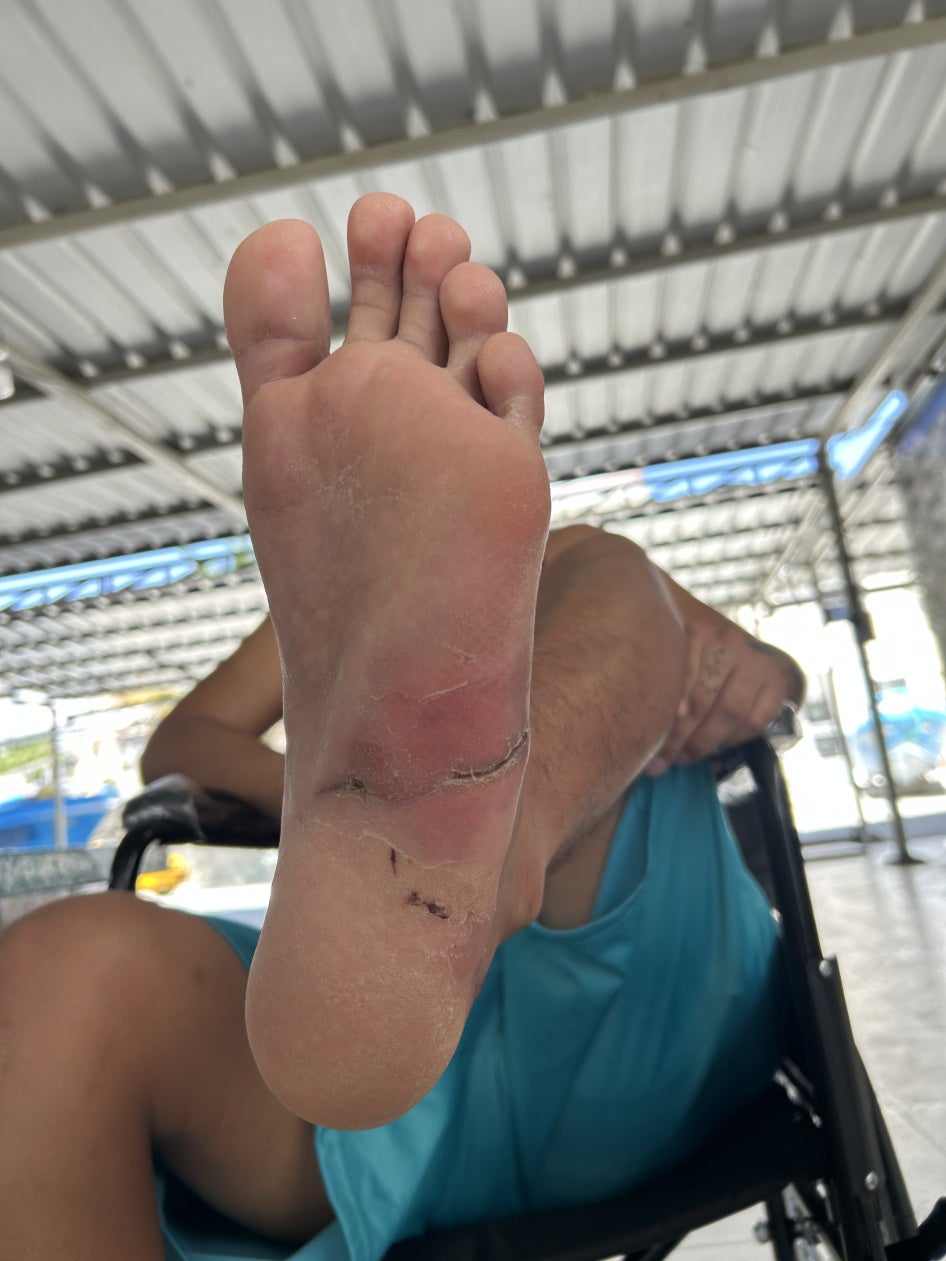
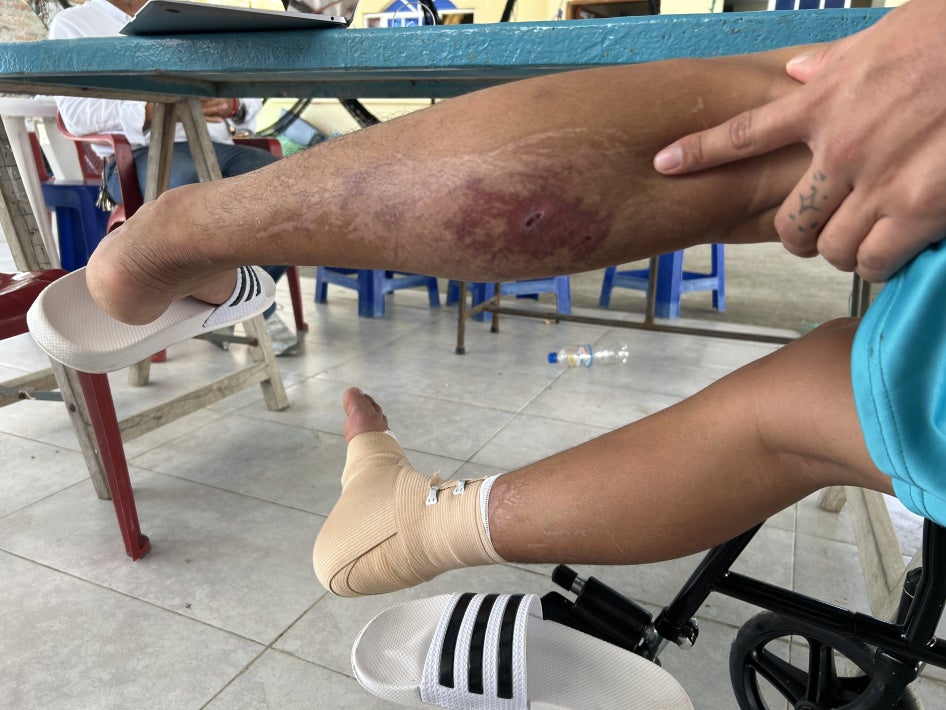
Injuries sustained by a crew member while aboard La Negra Francisca Duarte II during the March 17, 2026 attack. Photographs taken by a Human Rights Watch researcher on May 8, 2026.
© 2026 Human Rights WatchMeanwhile, the fire was spreading quickly, the captain told Human Rights Watch. He moved back onto the deck, where he said he saw “a white drone with four propellers, partly destroyed, that had what looked like a small tube that had exploded and was blackened.”[222]

The second blast also struck another crew member who was attempting to release one of the support boats so that the crew could evacuate. According to the captain, debris and flames burned the crew member’s back and arm.[223]
Human Rights Watch reviewed photographs, provided by the vessel owner’s lawyer, of the injuries suffered by crew members of La Negra Francisca Duarte II, as well as a medical record of one of the injured crew members. Human Rights Watch took photographs of additional injuries sustained by one of the interviewed crew members.[224]
Dr. Rohini Haar, a member of the Independent Forensic Expert Group (IFEG) of the International Rehabilitation Council for Torture Victims (IRCT), who reviewed the photographs of injuries and medical records of the crew member whose leg and foot wounds are described above, concluded that his account of being directly struck by a moving drone propeller was “plausible and consistent with the observed injury pattern.”[225]
Haar also said that the back injury suffered by the other crew member was consistent with the crew member’s description of how the burn occurred.[226]
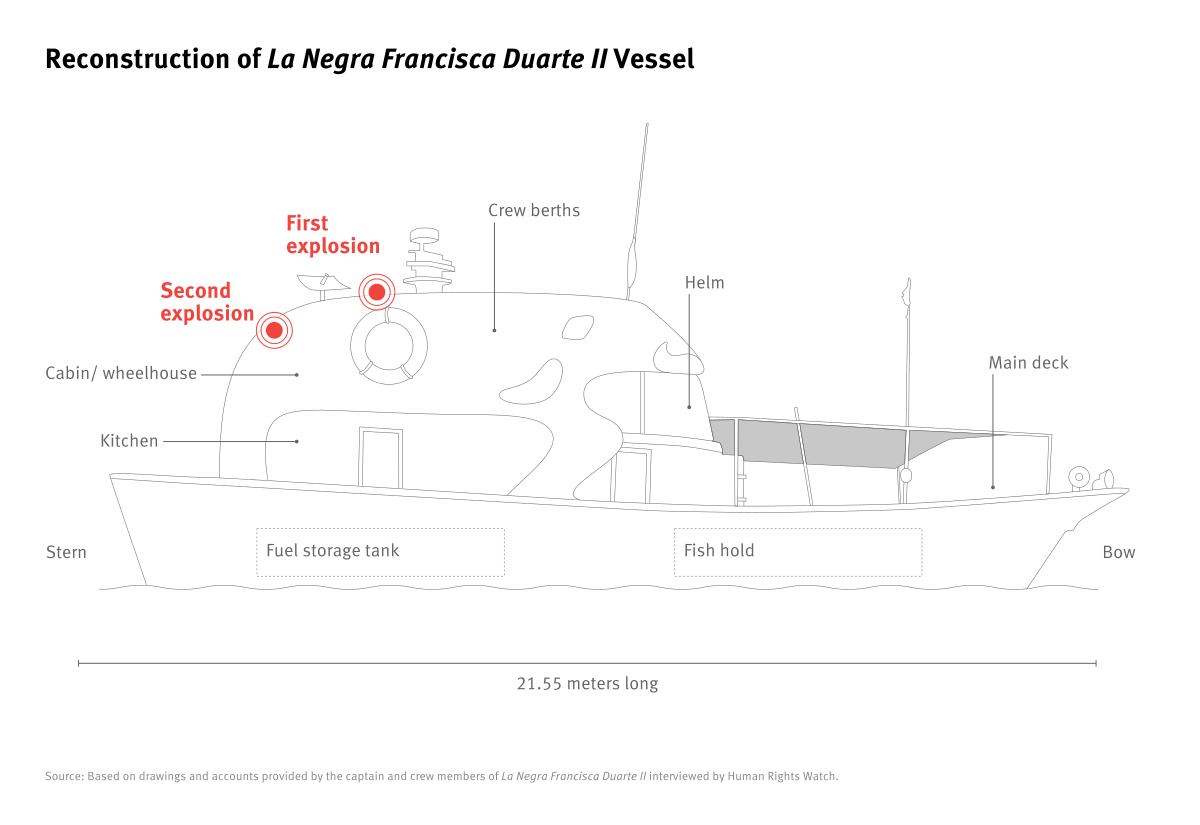
The captain said that after the two strikes, all 16 crew members evacuated in two support boats and navigated toward a larger blue vessel visible in the distance, which he described as resembling a “fragata.”[227] Two crew members told Human Rights Watch that the “fragata” they saw was a medium-sized blue vessel, with a white cabin and a large open deck at the back where at least a couple of beige containers were visible. Both said the vessel had the words “Atlantic” and “Oceanic” written in white letters on the forward section of the blue hull, below the white cabin.[228] They also said that a small aircraft flew overhead during their approach.[229]
The captain of La Negra Francisca Duarte II and the five crew members interviewed by Human Rights Watch said that armed individuals they described as “military personnel” received them on the blue vessel.[230] The interviewees said the personnel wore khaki camouflage-style uniforms and vests, and carried “machine guns.”[231] One member of the crew, the engineer of La Negra Francisca Duarte II, said he saw a US flag on the sleeve of one of the personnel.[232]
The interviewees said that the armed personnel used a translator to ask whether anyone had been injured or killed, and then ordered the crew members to come on board.[233]
Once on deck, the interviewees said, the armed personnel placed hoods over their heads, restrained their wrists with plastic ties behind their backs, and ordered some to sit and others to kneel on a metal floor which, as the captain put it, “burned in the heat” of the sun. The personnel did not explain to the crew why they were being detained. They did not provide food or water during the period of detention.[234]
One of the crew members interviewed by Human Rights Watch said they received little to no medical care after the explosions. “We had all been affected and hit by the explosions,” he said.[235] “Many of us had headaches or ear pain. Some of us, including me, could not even hear. We were stunned.”[236]
The same crew member said that during the second explosion he hit his hands hard against a water tank on the deck, but the armed personnel kept him handcuffed behind his back for several hours. “The handcuffs were tight,” he said. “I could not take it anymore and shouted that I was in a lot of pain.” He said the translator informed one of the armed personnel, who removed the handcuffs from behind his back but then handcuffed him again with his hands in front.[237]
Only one severely injured crew member, who had suffered the injuries to his foot and leg, received first aid; the other, who had suffered burns to his back, did not, the captain said.[238]
The crew member with injuries on his foot and leg said armed personnel took him to what looked like a container, gave him an intravenous drip, and injected him with an unknown substance. “When they gave it to me, I fell asleep,” he said.[239] “It was an injection, but I don’t know what it was.” When he woke up, he said, they had stitched his left leg, cleaned the wound on his right foot, and then they gave him milk and cookies.[240]
He said he later asked the translator why they had attacked the vessel when Ecuadorian authorities had inspected it that morning. The translator, he said, appeared shocked, spoke in English with other armed personnel, and then told him, “We are going to hand you over to El Salvador.”[241]
Approximately 18 hours later, the armed personnel transferred the crew to a Salvadoran coast guard vessel, a unit of the Salvadoran Navy.[242] Two crew members interviewed by Human Rights Watch said the vessel had “PM-13” written on its hull.[243] Human Rights Watch found reports online identifying PM-13 as a Salvadoran Navy maritime patrol boat that entered service in 2016 and has supported counternarcotics, maritime interdiction, and operations against transnational organized crime.[244]
The captain of the Salvadoran vessel told the crew of La Negra Francisca Duarte II that “US officials” had handed them over as “shipwrecked persons,” the captain of La Negra Francisca Duarte II told Human Rights Watch.[245] Security experts consulted by Human Rights Watch said this could indicate that the armed personnel were attempting to follow a rescue procedure for which security forces are trained.[246] Salvadoran coast guard personnel then provided the crew with food, water, clothing, a place to sleep, and basic medical care for the injured during the seven-day voyage to El Salvador. When the captain asked to call his family, the Salvadoran coast guard captain said that the crew could do so once they reached land.[247]
Survivors said the Salvadoran coast guard arrived at La Unión Port in El Salvador on March 24, 2026, and handed the crew over to Salvadoran police. After questioning the crew, Salvadoran authorities transferred them to migration officials, who placed them in a migrant reception center in San Salvador. There, on March 25, the crew members were finally able to contact their relatives in Ecuador.[248]
“They [Salvadoran officials] thought we had been detained in Salvadoran waters,” the captain told Human Rights Watch. “No one understood that we had been near the Galápagos and that we had been attacked there.”[249]
On March 24, 2026, El Salvador’s armed forces posted on its X account that its Navy had carried out a humanitarian operation to transfer 16 Ecuadorian “shipwrecked persons” rescued at sea, two of whom were injured—one with foot injuries and the other with burns on his back.[250] The descriptions are consistent with the captain’s descriptions and with the photographs of the injuries of the crew members reviewed by Human Rights Watch.
According to interviewees, Ecuadorian consular officials in El Salvador issued travel documents to the crew on March 27, 2026.[251] The vessel owner’s lawyer told Human Rights Watch that the families of the crew members paid for their return flights to Ecuador. The two seriously injured crew members returned in late March, and the rest of La Negra Francisca Duarte II crew returned in groups between April 3 and April 10, 2026.[252]
According to VMS data reviewed by Human Rights Watch, the last signal transmitted by La Negra Francisca Duarte II fishing vessel on March 17, the day of the reported strikes, was at 12:41 p.m. at these approximate coordinates: 1°34'51.0"N 87°41'40.0"W. After this time, no further signals were recorded.
Human Rights Watch cross-checked the coordinates of the last known location of the vessel against the World Exclusive Economic Zones (maritime boundaries) dataset and confirmed that this location lies within the Ecuadorian exclusive economic zone of the Galápagos Islands.
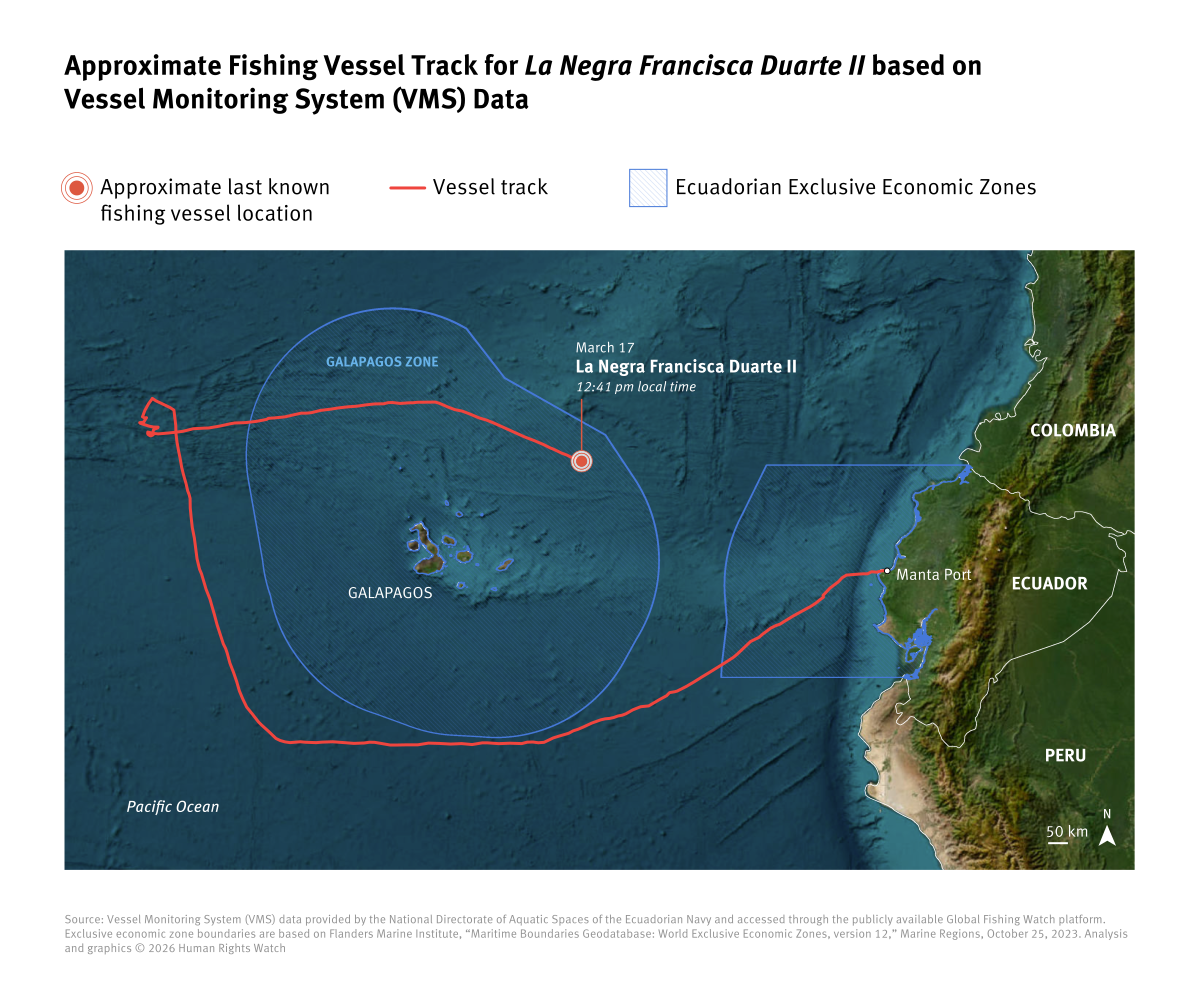
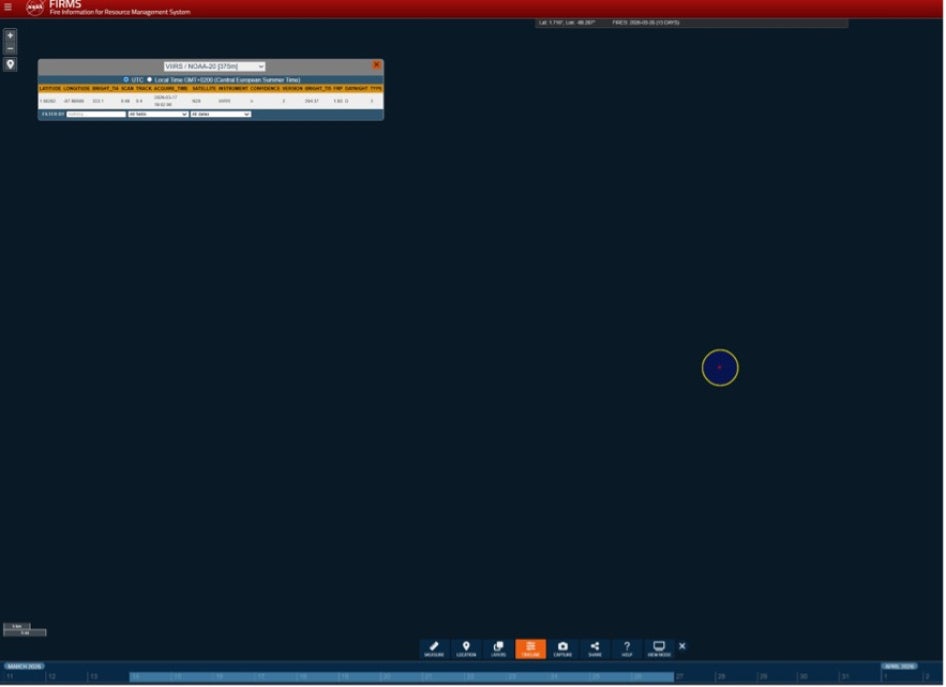
Human Rights Watch also reviewed thermal anomaly data from NASA’s Fire Information for Resource Management System (FIRMS) and identified a fire detection at the coordinates closely matching the vessel’s last recorded location, further corroborating the occurrence of the fire approximately at the same coordinates as the vessel’s last recorded location.[253] This thermal anomaly, recorded by an environmental satellite sensor, indicates the presence of fire on March 17, 2026, at 1:02 p.m. local time.[254]
On March 18, the day after the vessel’s owner lost contact with the crew, his lawyer filed a complaint with Ecuador’s Attorney General’s Office.[255] The complaint listed the vessel’s approximate coordinates at 1°35'50.0"N 87°44'50.0"W, which according to the lawyer, came from the GPS system of one of the support boats of another Ecuadorian vessel, the Solavil, which was near La Negra Francisca Duarte II when it was struck, and whose crew members reportedly witnessed the vessel on fire.[256]
Human Rights Watch compared those coordinates with those estimated from the VMS for the Solavil fishing vessel on March 17 at 8:32 p.m. local time. At that time, the Solavil vessel appears to have been stationary (0.00 knots) three nautical miles west of La Negra Francisca Duarte II vessel.
The Solavil’s captain and one member of its crew said they were returning to Manta Port on March 17 with some of its support boats traveling ahead when they saw to the east a column of black smoke at around 2 p.m. on the day of the attacks, then moved closer, and saw La Negra Francisca Duarte II on fire at night.[257]
“Around 2 p.m., a young crew member told me, ‘Captain, there is a lot of smoke,’” the captain said.[258] “I looked up and there was a column of smoke in the distance. It was east of where we were. We decided to keep sailing, but we were scared.”[259]
Around 5:30 p.m., the captain said, one of his crew members, who was on one of the support boats ahead of the Solavil, radioed him to say that La Negra Francisca Duarte II had “exploded.”[260] The crew member also said that he had seen “a large boat, kind of blue, with a white tip on the cabin” in the distance. The Solavil’s captain said he asked whether that was the source of the column of smoke they had seen earlier, and the crew member said it was.[261]
The captain said that around 6 p.m. he sent three of the Solavil’s support boats to search the area, and he traveled in another support boat directly toward the smoke. He said he reached La Negra Francisca Duarte II between about 7 and 8 p.m. “It was very close, about half a mile away,” he said.[262] By then, he said, the vessel was burning heavily and it was too dark to read its name.
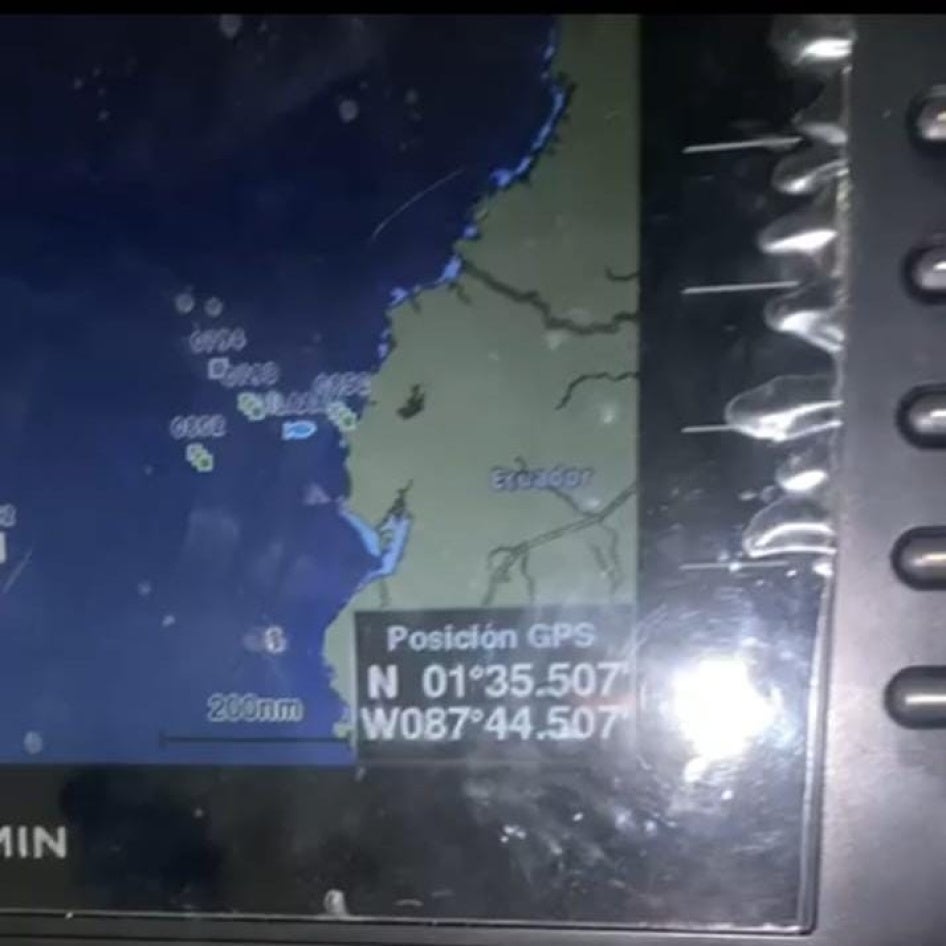
Human Rights Watch reviewed photographs which the captain of the Solavil said he took. The photographs show a vessel on fire at night, and a GPS showing coordinates which coincide with the place where La Negra Francisca Duarte II was attacked. However, Human Rights Watch was unable to review the photographs’ metadata because the captain claimed he lost his phone.[263]
The same day, Captain Diego Criollo Chamba of the Manta Port Captaincy told the media that he had activated a search-and-rescue plan and that La Negra Francisca Duarte II was in international waters, 385 miles from Manta and 225 miles from San Cristóbal Island in the Galápagos.[264]
He also said he had received a notification from an Ecuadorian coast guard vessel in the area reporting that it had seen a vessel on fire, confirmed that the Solavil was near La Negra Francisca Duarte II, and said authorities were treating the incident as a fire.[265]
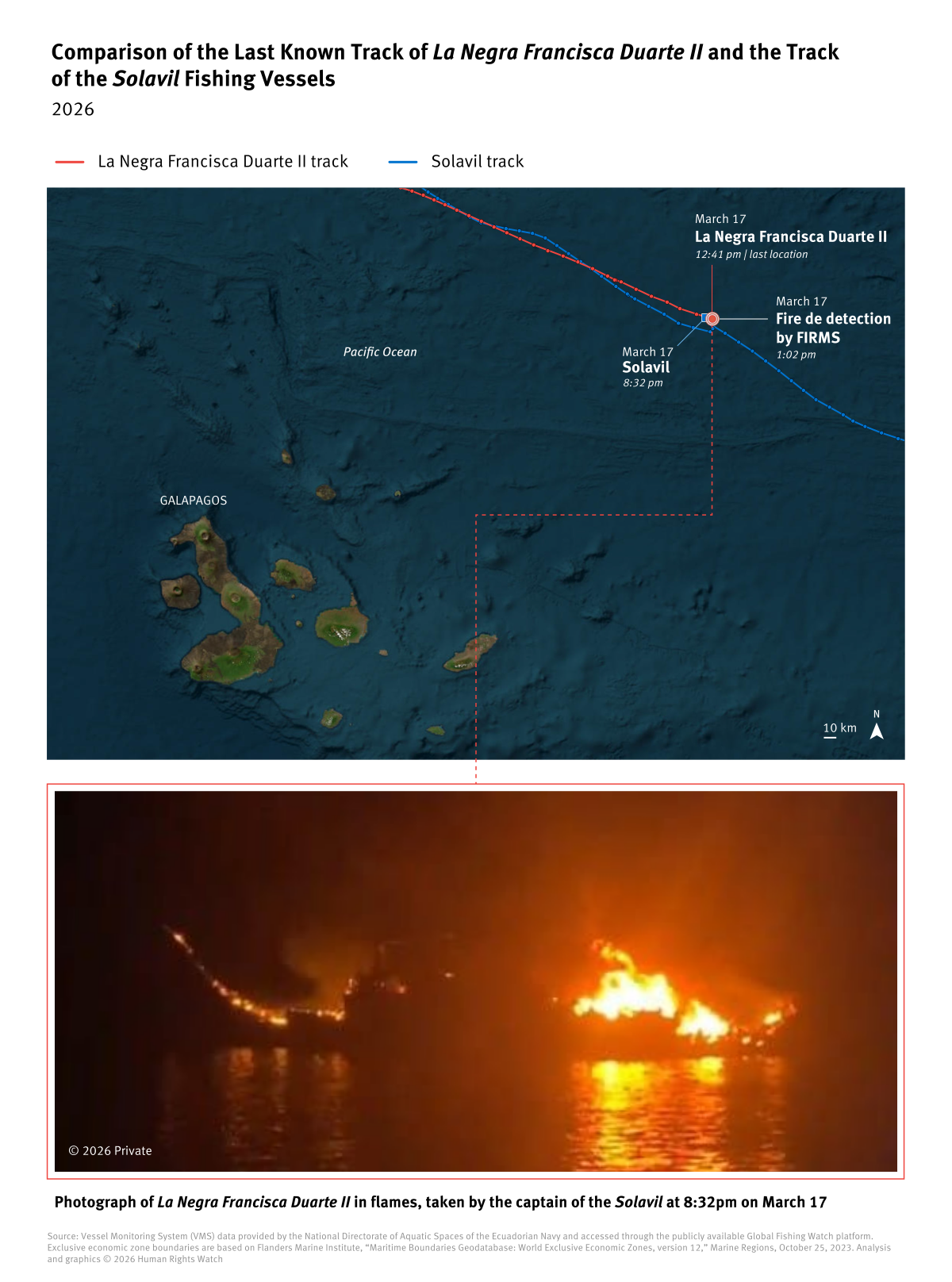
In an interview with local media on March 20, Criollo also confirmed that one of the vessels had been boarded by coast guard officials in the early morning hours and that officials had “found nothing.”[266]
Human Rights Watch interviewed the prosecutor investigating the attacks on La Negra Francisca Duarte II in Manta in early May. He said his office was investigating the case as arson because, based on the facts described in the owner’s complaint, no other criminal offense appeared to fit the allegations.[267]
The prosecutor also said the information his office had gathered indicated that the attacks may have occurred in the Exclusive Economic Zone of the Galápagos Islands, which would be consistent with Human Rights Watch’s analysis of La Negra Francisca Duarte II’s last transmitted signal, the reported vessel fire location cross-checked against the World Exclusive Economic Zones dataset, and thermal anomaly data indicating that there was a fire. [268] However, at the time of the interview, no government agency had responded to the prosecutor’s requests for information about the location of the attack. The prosecutor said he was waiting for the Port Captaincy to confirm the coordinates to decide whether he would transfer the case to prosecutors in the Galápagos Islands.[269]
“Neither the Port Captaincy nor any other authority has given us answers,” the captain of La Negra Francisca Duarte II said. “Instead, the narrative is that we must have been doing something illegal, when all we were doing was fishing so we could bring food to our families.”[270]
The Don Maca
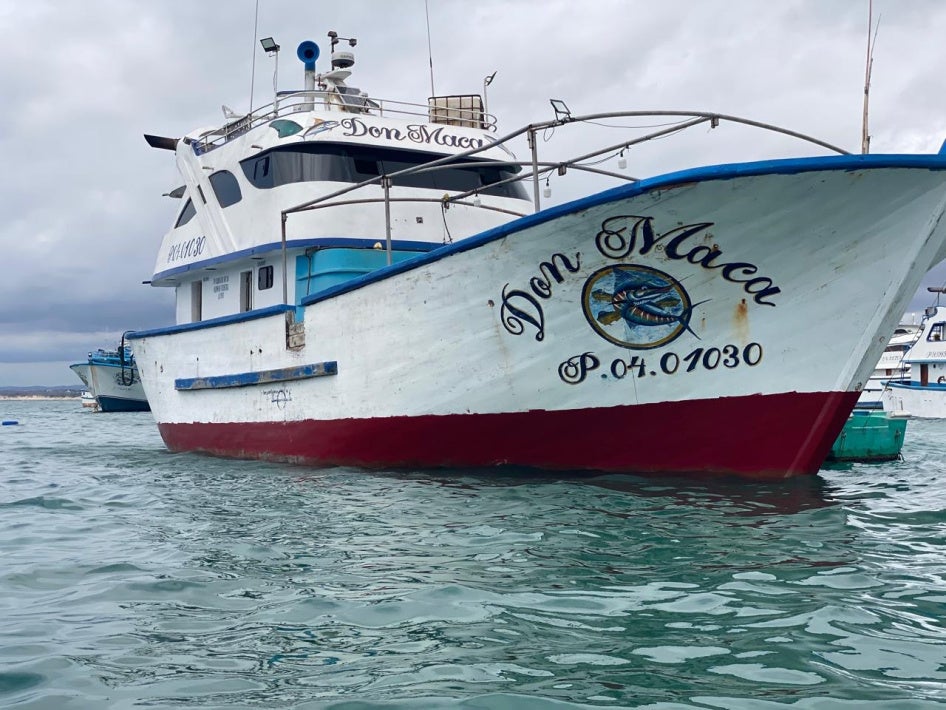
The Don Maca vessel left Manta Port on March 18, 2026, with a crew of 20 for a fishing expedition, its owner told Human Rights Watch.[271] Most crew members were from San Mateo and had worked on the vessel for several years using a fishing method known locally as palanquero.[272] During the first days at sea, the crew caught squid to use as bait to fish for larger species farther offshore, including albacore, swordfish, and marlin.[273]
The boat’s owner told Human Rights Watch that he last spoke with the captain on the morning of March 26, 2026. The vessel’s last recorded satellite tracking signal was at approximately 4:30 p.m. that afternoon, the owner said, the time at which survivors later said the explosions began.[274]
According to VMS data reviewed by Human Rights Watch, the last signal transmitted by the Don Maca was on March 26 at 4:50 p.m., approximately at 2°42'05.0"N 95°19'43.0"W. After this time, no further signals were recorded.
Human Rights Watch crossed-checked those coordinates against the World Exclusive Economic Zones (maritime boundaries) dataset and confirmed that the location lies in international waters, approximately 8.5 nautical miles west of the Ecuadorian exclusive economic zone of the Galápagos Islands.
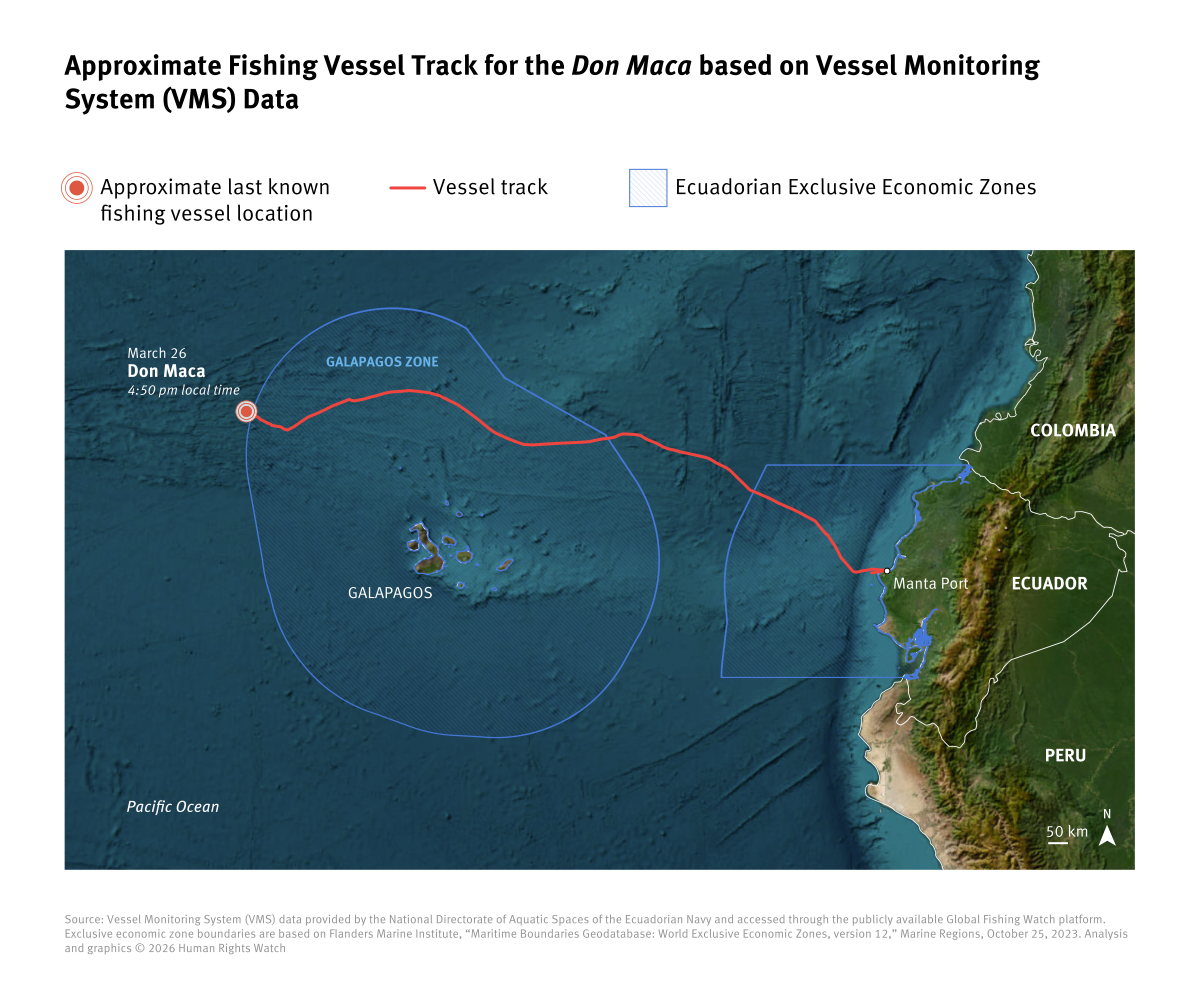
In the days preceding the attack, crew members reported several sightings of drone and aircraft surveillance of the vessel, the owner told Human Rights Watch. The drone passes intensified on March 25, 2026, and included low-altitude passes directly over the vessel.[275]
Human Rights Watch interviewed five crew members who survived the attacks. One of them, a crew member responsible for icing the fish on board, said he first saw drones on the night of March 24. “There were two drones,” he said.[276] “I identified them by their small red lights. They were black and had four propellers.”[277]
The same crew member said that, at around 1 a.m. on March 25, while he was on watch, he saw what appeared to be a patrol vessel. “I told the captain, ‘A patrol vessel,’” he said.[278] “Because we weren’t doing anything wrong, we stayed where we were and waited to see if they would board us.”[279] After the crew waited for some time, he said, the patrol vessel did not approach or contact them by radio, so they continued on their route.
Later that day, at around 3 or 4 p.m., the crew member said he saw a gray aircraft fly over the vessel twice.[280] Another crew member, the mechanic of the vessel, also said he had seen an aircraft flying over the vessel days before the attack, but described it as white.[281]
According to interviewees, at approximately 4:30 p.m. on March 26, 2026, a first drone detonated near the vessel’s cabin, which housed the bridge, the crew’s sleeping quarters, and the satellite and radio communications antennas. A second attack followed minutes later, hitting the stern area near the hydraulic gear and disabling the vessel.
“I was in the hold, icing fish, when I felt the first explosion,” the crew member said.[282] “I felt it above me, near the cabin. The explosion threw me against the fish, and just as I was recovering, I felt the second one. That one sounded like it came from the stern, the back of the boat. It was very strong and shook me from top to bottom. It made me fly up, hit the ceiling, and then fall face down on the floor.”[283]
The mechanic told Human Rights Watch he was cleaning the deck at around the same time when he heard an explosion. “I thought the engine had exploded and blown upward through the exhaust,” he said.[284] “I looked up and saw all the glass shattered, the boat’s lights broken, everything had come loose, the bunks, everything.”[285]
He said that after about three minutes, while he was still stunned, other crew members began shouting, “The drone, the drone!” He then saw a white drone nearby, approaching from behind the stern with something like a ball in the middle. “That is when it released it, and that was the second explosion. It fell near the hydraulic gear, where the diesel tank was.”[286]
The mechanic and a third crew member both described the drones as white, with four propellers, “like a little butterfly,” and about 40 to 50 centimeters wide. According to another crew member, the launch operator, the first drone had “two small silver tubes” under the propellers. The mechanic said the second drone had what looked like a black grenade in the center.[287] The features described by interviewees are consistent with a quadcopter drone.
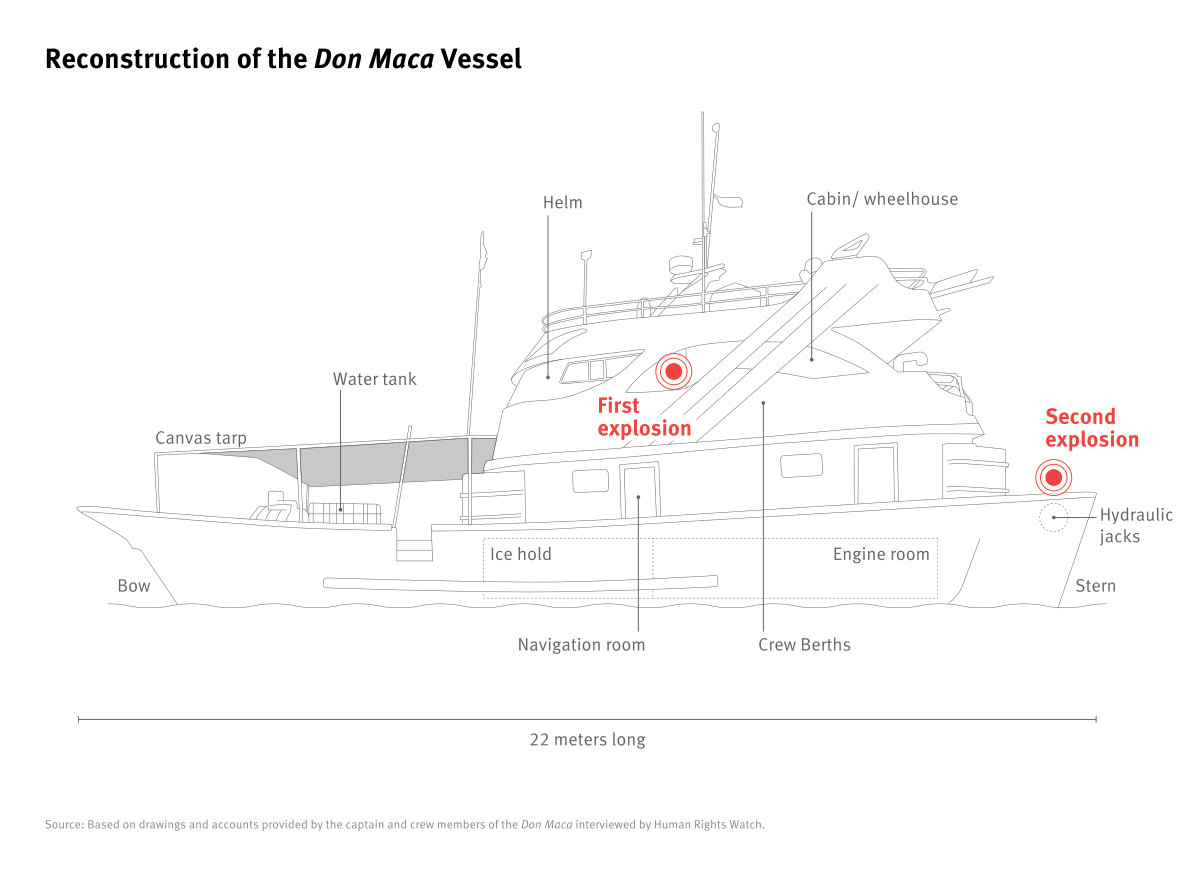
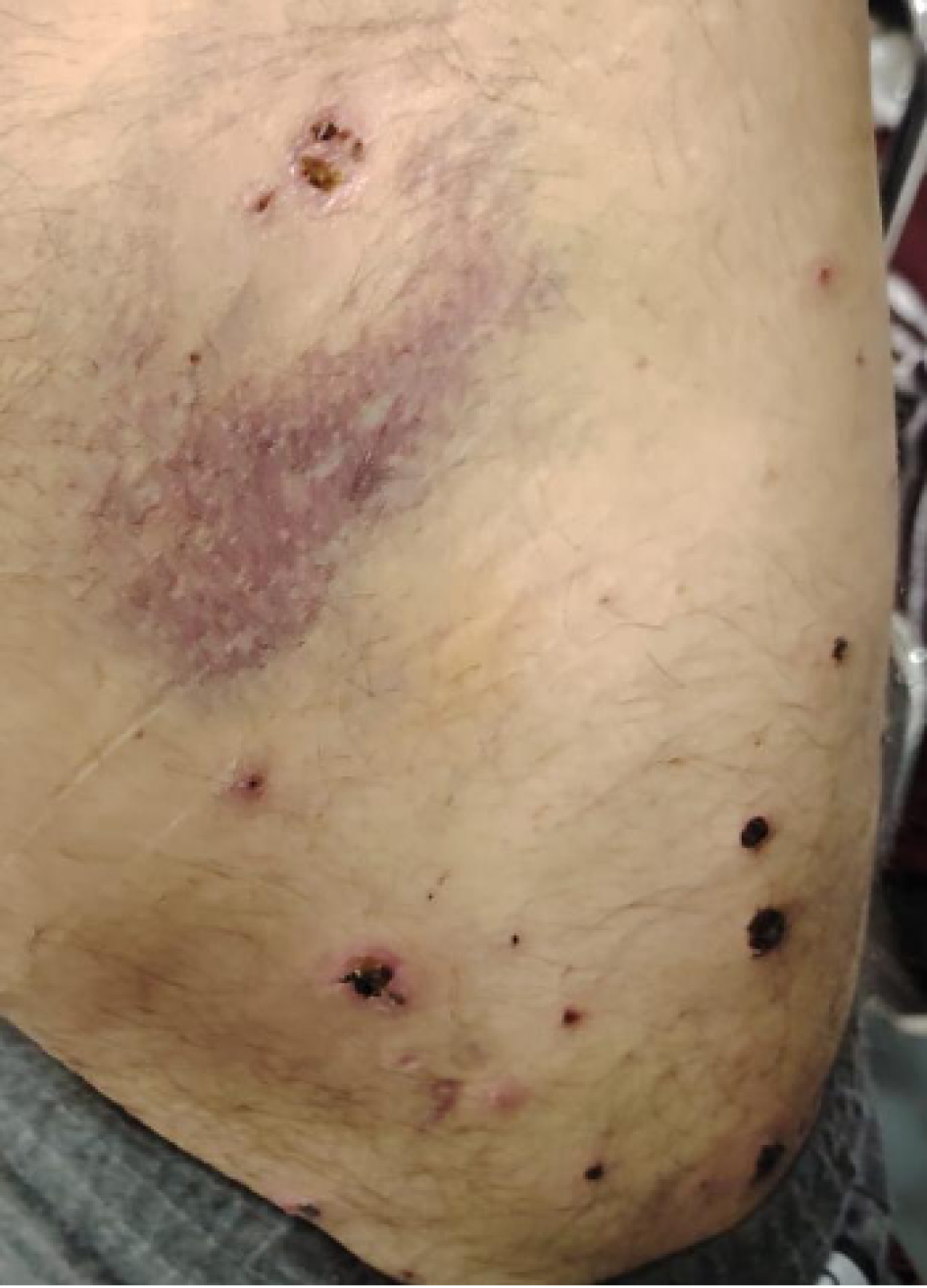
At least two crew members were seriously injured in the attacks and required medical care.[288] One of them, a crew member responsible for fishing from the support boats, told Human Rights Watch that he was hanging wet clothes to dry in the corridor next to the bunks in the cabin when he saw a drone release “two small tubes.”[289] The first explosion then threw him against the cabin wall.[290]
“My left eye hurt,” he said. “I could only see a black spot, as if my eye had burst. It hurt a lot. My ears also hurt, and I began to feel something on the right side of my body, on my torso, like stings, as if something was cutting my skin. Then I saw pieces of glass embedded in my right thigh, arm, cheek, and torso, all on the right side.”[291]
Minutes later, he said, a second explosion threw him onto the deck. “That is when I felt like my ears had burst, and I could not hear anything anymore, only a ringing,” he said.[292]
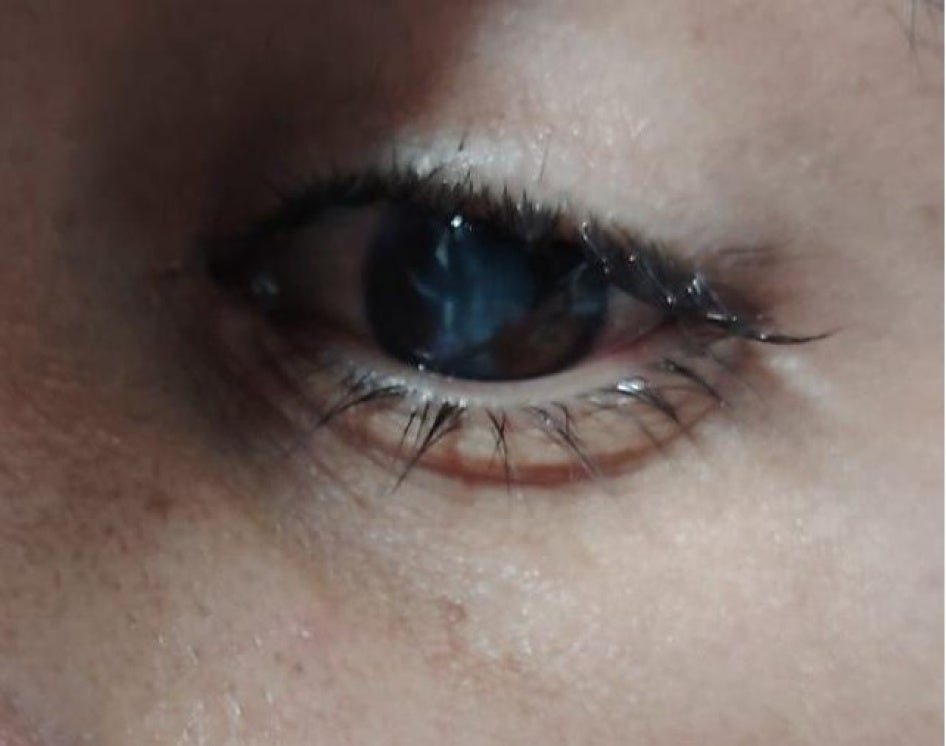
The fisherman said doctors who treated him after he returned to Ecuador told him that his left eardrum had been perforated and that his right eardrum had been destroyed. He said doctors also told him he had lost 90 percent of the vision in his left eye.[293]
The Don Maca’s mechanic told Human Rights Watch that, during the second explosion, the blast wave threw him against a water tank on the vessel’s deck, causing a severe blow that dislocated his right shoulder blade. “My shoulder is dislocated now, and my shoulder blade is sticking out,” he said. “I cannot even lift my hand.”[294]
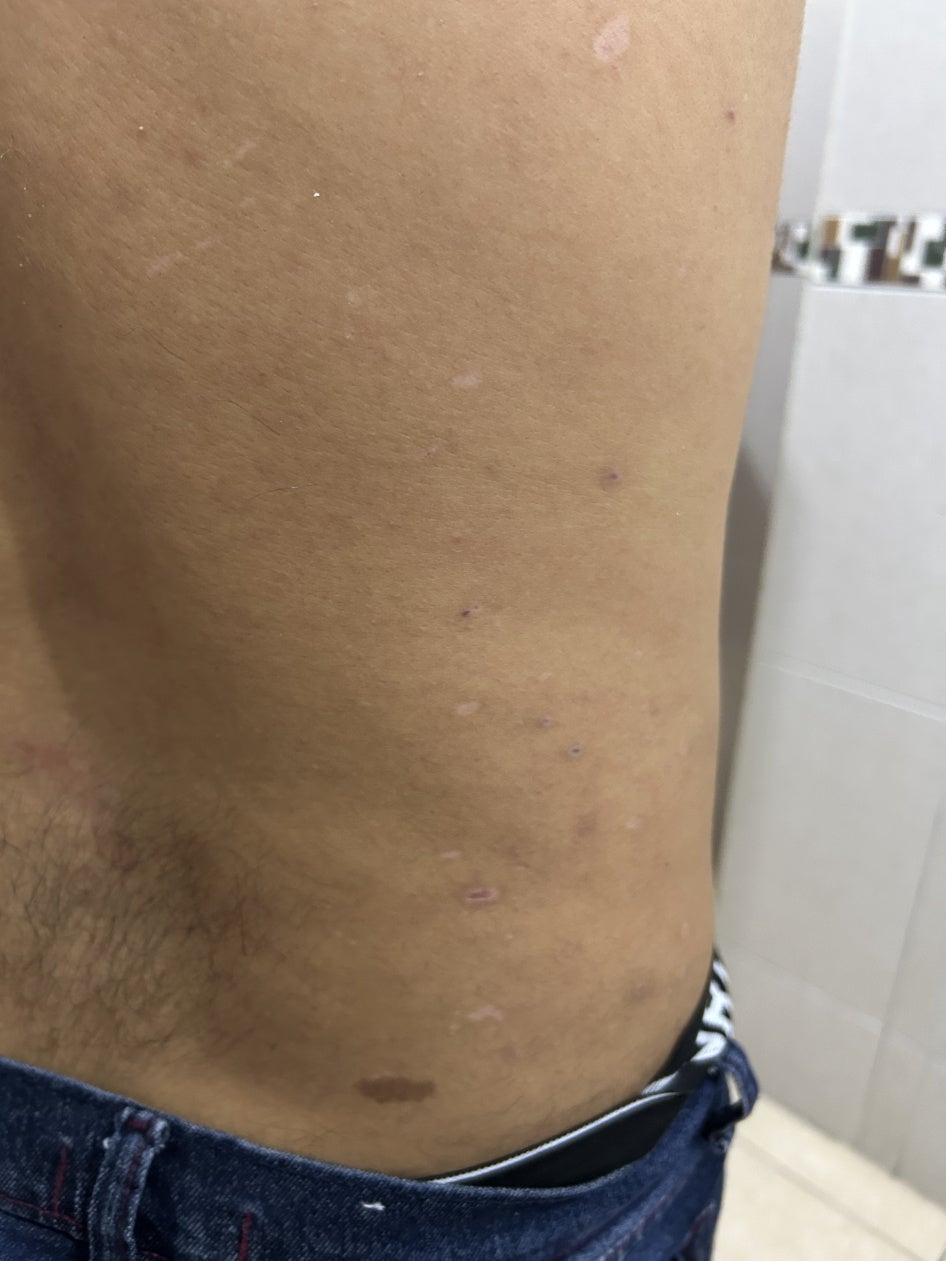
He said he also hit his right hand hard, fracturing several bones, and that the explosions left him partially deaf. “Pieces of glass were also embedded in my feet,” he said.[295]
Human Rights Watch reviewed photographs provided by the vessel owner’s lawyer of the injuries to two of the crew members of the Don Maca, as well as videos provided by the crew members. Human Rights Watch also photographed additional injuries sustained by both of them.[296]
Dr. Rohini Haar, an expert with the IFEG who reviewed the photographs and videos, said that the two crew members’ injuries were “consistent with the alleged mechanisms” they described. She also said the injuries were “consistent with exposure to explosive weapons.”[297]
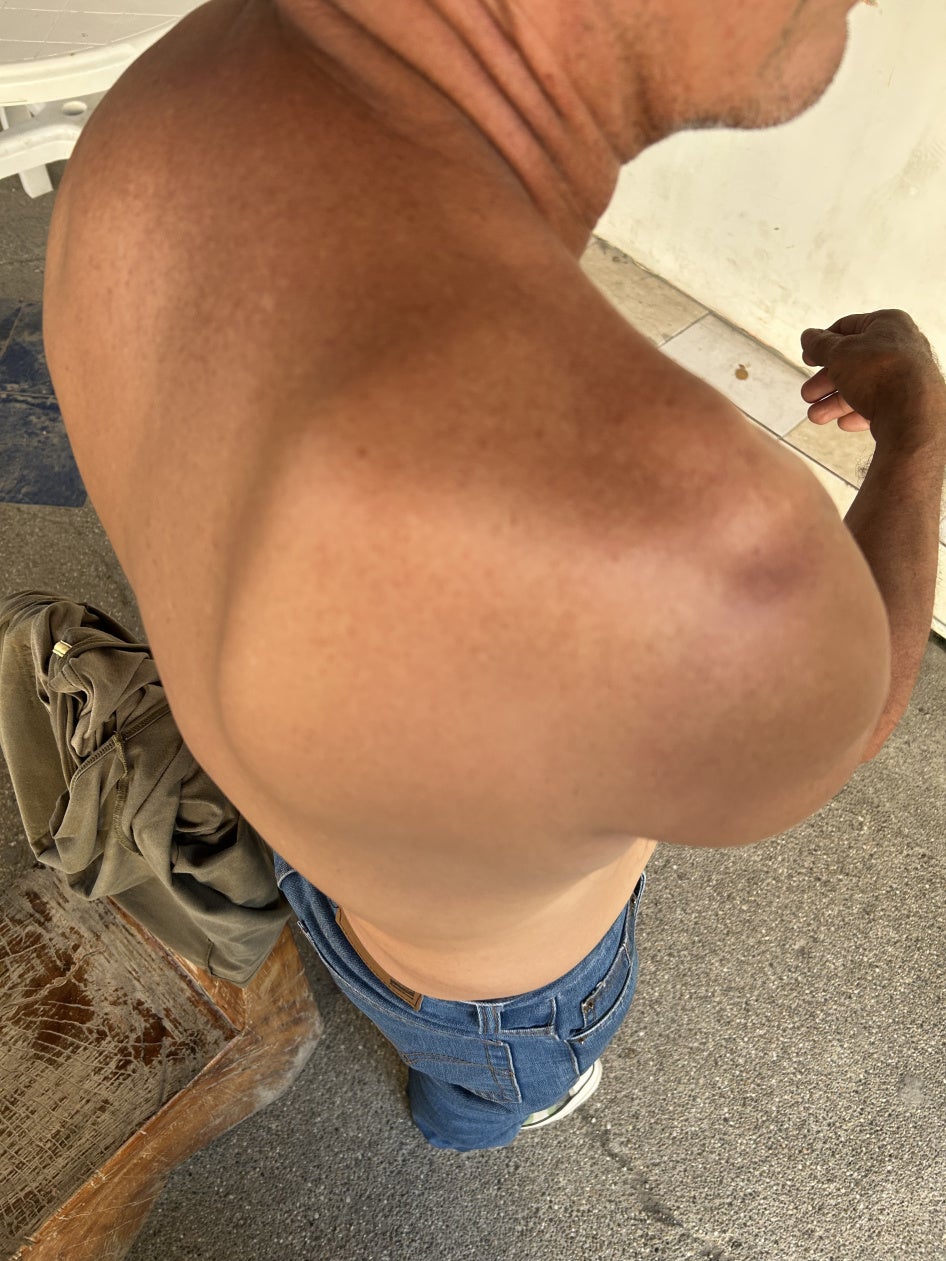
(Left): Scapular subluxation injury sustained by a crew member of the Don Maca after the March 26, 2026 attack. Photograph taken by a Human Rights Watch researcher on May 8, 2026. © 2026 Human Rights Watch (Right): X-ray provided by a survivor showing a scapular subluxation injury after the March 26 attack on the Don Maca. © 2026 Private
(Left): Distal ulna fracture sustained by a crew member of the Don Maca after the March 26, 2026 attack. Photograph taken by a Human Rights Watch researcher on May 8, 2026. © 2026 Human Rights Watch. X-ray provided by a survivor showing a distal ulna fracture in his hand after the March 26, 2026 attack on the Don Maca. © 2026 Private
As the crew evacuated in a support boat, they approached a nearby large blue vessel with a white cabin at the front, which survivors interviewed by Human Rights Watch thought was a US vessel based on the flag, the use of English by the vessel’s personnel, and the personnel’s khaki camouflage uniforms.[298] One crew member said he saw US flags on the sleeves of some personnel with the word “USA.”[299] Like La Negra Francisca Duarte II survivors, two of the Don Maca crew members said the vessel had the words “Atlantic” and “Oceanic” written in white letters on the blue part of the bow, below the white cabin and near the front of the vessel.[300]
The crew member responsible for icing fish said that once they arrived near the vessel, a blue “fragata” displaying a US flag, a man in plain clothes who spoke Spanish and seemed to be translating for the others on the “fragata,” asked them, “How many are you? How many dead? How many injured?”[301]
“There were other Americans next to him,” he said.[302] He said the armed personnel standing nearby wore khaki camouflage uniforms, with the word “USA” and a US flag on one arm. He estimated that about 15 people in camouflage uniforms, all armed, were present.[303]
The survivors said they boarded the US vessel while armed personnel pointed “long guns” at them. Once on deck, they said, the personnel handcuffed them behind their backs with plastic ties, hooded them, and pushed them one by one to an area of the deck where some were ordered to sit and others to kneel. They said the personnel asked for their names and held them for approximately eight hours on a hot metal deck, exposed to seawater and sun, without food or water.[304]
The mechanic, who was injured, said he told the translator that his shoulder hurt badly, but was told to be quiet.[305] Only the crew member who had injuries to his eye and body said he received medical attention while hooded and handcuffed.[306]
“One of the Americans came with the translator and told me they were going to clean my wounds,” he said. “They took me to another area of the “fragata,” like a container, and began wiping the blood with a small cloth. They put a bandage on my thigh and part of my leg.”[307]
He said he asked the Americans to examine his eye and ears, but they did not. “They did not give me that care,” he said. “They did not give me any pain medication either. They only gave me an IV.”[308]
According to the Don Maca’s owner, many crew members told him after returning to Ecuador that US military personnel beat some of them with fists and kicks to make them move across the bow, and shouted orders in English that the crew did not understand.[309] “When they moved us from one place to another, they pushed us and forced us to the floor. It was mistreatment,” the mechanic of the Don Maca said.[310]
Two interviewees told Human Rights Watch that while they were on board the US vessel, they saw through their hoods that armed personnel leave the vessel and later return carrying beers. “We saw them come back with beers, and those were the same beers we had loaded onto our vessel. That means they went down to inspect our vessel,” the crew member responsible for icing fish said.[311]
One to two hours after the Don Maca crew boarded the US vessel, they heard another explosion. Through their cloth hoods that they said allowed some visibility and let some light through, they were able to see that the Don Maca and its support boats had been destroyed.[312]
The mechanic said that when he asked to urinate, US armed personnel took him near the edge of the vessel.[313] Through his hood, he said, he saw armed personnel heading toward the Don Maca in a boat. Later, he heard “about six explosions” in the distance. “That is when they destroyed the boat,” he said. When he stood up again, he said he saw “the flames and thick smoke.”[314]
The crew member responsible for icing fish confirmed that account. He said that, when he heard the blasts, he stood up, but an armed American with a rifle grabbed him from behind and tried to force him back down.[315] “I shouted, ‘I’m choking, I’m choking!’ so they would remove the hood and I could see,” he said. “They lifted the hood for a moment, and I was able to see the boat completely in flames.”[316]
US personnel transferred the Don Maca crew to a Salvadoran coast guard vessel on March 27, 2026, after approximately eight hours in detention, the survivors and the owner of the Don Maca told Human Rights Watch. Two crew members interviewed by Human Rights Watch said the vessel had “PM-7” written on its hull. Human Rights Watch found reports online identifying PM-7 as a Salvadoran Navy maritime patrol boat used in maritime interdiction operations.[317] In recent X posts, El Salvador’s government acknowledged the use of this vessel in maritime interdiction operations in the Pacific, while US Southern Command described the operation as a coalition effort to combat “cartels and narcoterrorists.”[318]
The Salvadoran captain told the Don Maca’s crew that “US officials” had handed them over as “shipwrecked persons.”[319] The crew arrived at La Unión Port in El Salvador on or around April 2, 2026.[320]
The crew said Salvadoran authorities, both at sea and on land, treated them well and provided basic services, including food and water. After questioning the crew, Salvadoran authorities transferred them to a migrant reception center in San Salvador, where they were allowed to call their relatives. Ecuadorian consular officials visited the crew on April 4, 2026, and issued travel documents, according to the owner’s vessel. The crew returned to Ecuador on commercial flights on April 6 and 7, 2026, without government support.[321]
The vessel’s owner told Human Rights Watch that he filed a complaint with the Manta Port Captaincy on March 28 reporting the disappearance of the Don Maca.[322] He said the complaint listed the vessel’s last known position as near San Cristóbal Island in the Galápagos.[323]
On March 31, the captain of the Manta Port Captaincy told media that the vessel was “almost at the limit of our jurisdiction as the Ecuadorian state, which is latitude 0 9 5 ... at 306 miles from the outermost point of Isabela Island.”[324] He also said the vessel was carrying seven more people than were listed in the departure permit issued by the Port Captaincy.[325] On April 1, he said authorities had notified the maritime community, deployed a Navy unit to activate the search-and-rescue plan for the vessel, and carried out the necessary international coordination.[326]
In early May, the prosecutor Gloria Alexandra Bravo Cedeño who oversaw the missing persons unit in Manta told Human Rights Watch that her office had opened an investigation into the disappearance of the Don Maca and its crew. But because the crew had returned alive, she said, she planned to close the case without further investigations. She also said on May 8 that the Manta Port Captaincy had not officially responded to her request for information about the incident.[327] On June 15, Human Rights Watch interviewed the prosecutor who replaced her and took over the investigation. He said his office had not yet received responses from the authorities to which it had sent formal information requests.[328]
An official from the Puerto Baquerizo Moreno Port Captaincy (Capitanía de Puerto Baquerizo Moreno), located on San Cristóbal Island in the Galápagos, told Human Rights Watch that his office was conducting an administrative investigation to determine whether the Don Maca had complied with the requirements for navigating in the Exclusive Economic Zone of the Galápagos Islands.[329] He did not provide further details.
Recommendations
To the US Government:
End the current practice of framing organized crime groups in other countries as parties to an armed conflict as a pretext to use lethal force where it is not justifiable.
Focus security cooperation with Latin America on strengthening judicial capacities to ensure effective prosecution of organized crime groups.
Work with Ecuadorian authorities to conduct a joint, prompt, thorough, impartial, and effective investigation into the attacks against the San Martín community, the reported attacks against La Negra Francisca Duarte II and the Don Maca vessels, and the disappearance of the Fiorella crew members, including any involvement of US personnel or other US nationals, assets, intelligence, or operations in each attack. Ensure accountability for any US personnel or agencies found responsible for unlawful conduct.
- Conduct and publicly report on human rights risk assessments related to joint land and maritime security operations with Ecuador.
Establish with Ecuadorian authorities clear protocols governing the use of force, the identification of fishing vessels, and the protection of fishers during any joint maritime operations.
Ensure effective mechanisms for victims of human rights violations linked to bilateral security operations, and family members, to obtain information and access effective remedies.
Publicly disclose the framework governing all current US-Ecuador security cooperation, including the role of any US military and law enforcement personnel operating in or near Ecuadorian waters.
To the US Congress:
Through appropriations legislation and the National Defense Authorization Act, require the State Department and Department of Defense to submit regular reporting to Congress on human rights conditions attached to US security assistance to Ecuador and on the outcomes of joint operations.
- Investigate the incidents documented in this report and require that the State Department and Department of Defense report to Congress whether any US personnel, assets, intelligence, or operational support were involved in operations in the San Martín community and in or near the areas where the Fiorella crew members went missing and where La Negra Francisca Duarte II and the Don Maca were attacked.
Condition a significant portion of Foreign Military Financing (FMF) and International Narcotics Control and Law Enforcement (INCLE) funding to Ecuador on specific human rights benchmarks requiring credible efforts to prevent human rights violations and impartial and independent investigation into alleged human rights violations, including the incidents documented in this report.
Hold oversight hearings on US security cooperation with Ecuador, including maritime operations, intelligence sharing, human rights safeguards, and accountability for civilian harm.
To the Government of Ecuador:
End the unjustifiable use of states of emergency and characterization of organized crime groups as parties to an armed conflict. Instead, develop a comprehensive, effective, and human rights-compliant security and justice policy, rather than focusing on military operations that have failed to reduce violence sustainably.
Strengthen investigative and forensic capacities within law enforcement and judicial institutions, and develop strategic prosecution plans targeting organized crime groups. This includes investing in specialized training, modern forensic tools, and interagency coordination to ensure that investigations are thorough and evidence-based.
Publish rules of engagement, as well as timely reporting of incidents involving use of force.
- Ensure prompt and impartial investigations into the events in the San Martín community, attacks against La Negra Francisca Duarte II and the Don Maca, and the reported disappearance of the Fiorella crew members, including any involvement of US security forces; and require that state institutions provide investigators with full access to relevant information.
- Preserve and make available to prosecutors all relevant evidence, including radar records, vessel-tracking data, radio communications, inspection reports, operational logs, photographs, videos, and satellite imagery.
Disclose the legal framework, rules of engagement, and operational safeguards governing any joint maritime operations with US forces or agencies.
- Establish clear protocols governing the use of force, identification of fishing vessels, and protection of fishers during joint US maritime security operations.
Ensure that competent authorities, including the Attorney General’s Office, the Navy, the Port Captaincies, and search-and-rescue authorities, develop and adopt a specialized protocol for the search, investigation, and identification of persons missing at sea. The protocol should establish clear duties of immediate search, interagency coordination, evidence preservation, access to maritime records, coordination with foreign authorities where relevant, and regular communication with families. It also should be consistent with international standards on the search for disappeared persons and adapted to maritime cases.
To the Office of the UN High Commissioner for Human Rights:
Monitor and report on the human rights impact of maritime security and counternarcotics operations conducted in or near Ecuador, including operations carried out with US support.
To the UN Special Rapporteurs on Extrajudicial Executions and Counter-terrorism and Human Rights:
Request permission from the government of Ecuador to conduct visits to the country to document any extrajudicial executions and other human rights violations occurring in the context of alleged counterterrorism and counternarcotics operations, and to assess the legal frameworks and justifications being invoked to authorize the use of lethal and military force in law enforcement operations, including whether such frameworks comply with international human rights law.
Investigate human rights violations documented in this report and bring them to the attention of the UN Human Rights Council.
To the UN Committee on Enforced Disappearances:
Continue monitoring Ecuador’s response to the urgent actions issued by the committee related to the missing crew members of the Fiorella, and urge meaningful progress in the search and investigation.
Request permission from the government of Ecuador to conduct visits to the country to document cases, assess the State’s compliance with its obligations to investigate and clarify the fate and whereabouts of disappeared persons, and engage with victims’ families and civil society organizations.
To the UN Working Group on Enforced or Involuntary Disappearances:
Request information from the Ecuadorian government regarding the measures taken to determine the fate and whereabouts of the missing crew members of the Fiorella, and urge authorities to preserve evidence, and ensure thorough, prompt, and impartial investigations, including through international cooperation of the Port Captaincy and security forces.
Request information from the governments of Ecuador and the United States regarding any possible involvement of US personnel, assets, intelligence, or joint maritime operations in the incidents.
Urge Ecuador to adopt specialized protocols for the search of persons missing at sea and for the investigation of alleged abuses committed during maritime security operations.
Request permission from the government of Ecuador to conduct visits to the country to document cases of enforced disappearances both in the context of the Fiorella case as well as in other cases, and assess the structural conditions enabling enforced disappearance.
To the Inter-American Commission on Human Rights:
Request permission from the government of Ecuador to conduct an on-site visit to the country, including to document the violations documented in this report, attacks on judicial independence, and other human rights violations.
Consider the information included in this report as the commission assesses a request filed by the Alliance for Human Rights requesting precautionary measures for all members of the San Martín community, in Sucumbíos province.
Monitor the human rights impact of maritime security and counternarcotics operations conducted by Ecuador, including operations carried out with US support, and encourage both governments to ensure transparency, accountability, and effective civilian protection safeguards.
To Other Governments, including Members of the Organization of American States (OAS) and European Countries:
Publicly and privately urge the governments of Ecuador and the United States to ensure prompt, thorough, impartial, and independent investigations into the reported attacks against the San Martín community and La Negra Francisca Duarte II and the Don Maca, and the reported disappearance of the crew members of the Fiorella.
- Ensure that bilateral assistance programs—including training, equipment transfers, and intelligence sharing—with Ecuador include clear, measurable human rights benchmarks, and systematically request information from the Ecuadorian government on how that assistance is being used and whether it has contributed to any reported human rights violations through ex-ante, ongoing and ex-post human rights risk assessments.
Acknowledgments
This report was written by researchers in the Americas Division at Human Rights Watch.
The report is based on research conducted by a team of Human Rights Watch research staff members, including Gabi Ivens, head of Open-Source Research, Carolina Jordá Álvarez, senior advisor in the Digital Investigations Lab in the Technology, Rights and Investigations Division, Etienne Maynier, Security Technologist, and Americas Division researchers.
The report was reviewed by the following Human Rights Watch staff: Joseph Saunders, deputy program director; Chris Albin-Lackey, senior legal advisor; Juanita Goebertus, Americas director; Sam Dubberley, Technology, Rights and Investigations director; Ida Sawyer, Crisis, Conflict and Arms director; Mark Hiznay, Crisis, Conflict and Arms associate director; Reagan Williams, Crisis, Conflict and Arms researcher; Robin Taylor, Crisis, Conflict and Arms senior research assistant; Tanya Greene, US Program director; Lucy McKernan, UN Human Rights Council director; Friederike Mager, European Union advocacy coordinator; Nicole Widdersheim, interim Washington director.
The charts and visuals in the report were designed and prepared by Travis Carr, publications manager, and Victória Sacagami, information designer.
Delphine Starr, Americas editorial officer, Valentina Gómez, Americas associate, and Nelson González Sánchez, Americas research assistant, contributed to the production of the report. The report was prepared for publication by Travis Carr; Fitzroy Hepkins, senior administrative manager; and José Martínez, administrative officer.
Forensic analysis was provided by experts of the Independent Forensic Expert Group (IFEG) of the International Rehabilitation Council for Torture Victims (IRCT).
Human Rights Watch would like to thank the Alliance for Human Rights and the Permanent Committee for the Defense of Human Rights, as well as the victims’ lawyers, for the information shared.
Above all, we would like to thank the victims, lawyers, and communities affected for sharing their testimonies with us despite the difficult circumstances.