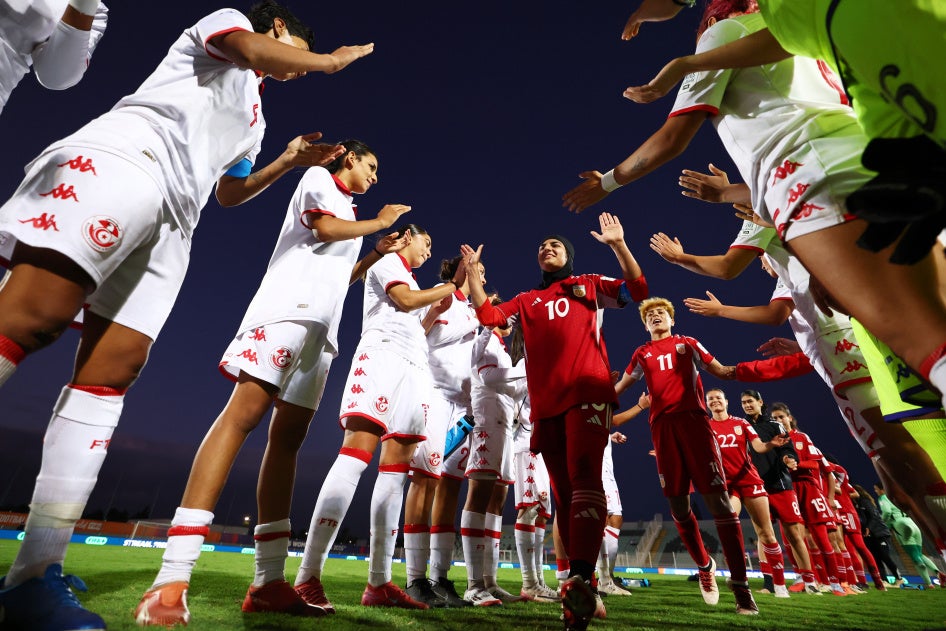
(Vancouver) – The FIFA Council’s decision to approve amendments to its Governance Regulations provides a landmark opportunity to ensure gender equity and human rights in sport, the Sport & Rights Alliance (SRA) said today. These changes allow for the official recognition of the Afghanistan Women’s National Team in exile, ensuring that the players can once again represent their country in official FIFA competitions.
“For five years, we were told the Afghanistan Women’s National Team could never compete again because the men who took our country would not allow it,” said Khalida Popal, founder and director of Girl Power, and former captain and cofounder of the Afghanistan Women’s National Team. “I am extremely proud of this decision by FIFA and glad that our collective advocacy has not only changed the future for Afghan women, but also ensured that no other national team has to sacrifice what our players did. This is the rebirth of hope and a strong message to those who try to erase women from society: you will not succeed. Women belong on the pitch, in public life, and everywhere decisions are made.”
The decision, approved on April 29, 2026, at the FIFA Council, grants FIFA the authority, in consultation with the relevant confederation, to register national teams for official competitions when their home member association is “unable to do so.”
“This FIFA decision is critical to ensuring every Member Association upholds their responsibilities toward gender equity and human rights,” said Andrea Florence, executive director of the Sport & Rights Alliance. “This is about more than just football: it’s about sending a message that no government should have the power to erase women from public life. We are thrilled that FIFA has listened to Afghan women and addressed this gap in their statutes. We look forward to cheering them on for years to come.”
After the Taliban took over Afghanistan in August 2021 and subsequently banned all women and girls from sport, the Afghanistan Women’s National Team has lived and trained in exile, scattered among Albania, Australia, Portugal, the United Kingdom, and the United States. Despite their demonstrated resilience, the team members were blocked from official competitions because FIFA rules required the approval of the Taliban-controlled Afghanistan Football Federation. The new amendment effectively ends this requirement.
“FIFA has finally done the right thing by closing the loophole that allowed the Taliban’s discriminatory policies to be enforced on the global stage,” said Minky Worden, director of global initiatives at Human Rights Watch. “FIFA’s action should serve as a model for how international sports bodies should respond when athletes are systemically excluded because of their gender, ethnicity, or beliefs.”
In a pivotal report published in March 2025, “It's Not Just a Game: It's Part of Who I Am,” the Sport & Rights Alliance outlined the Afghanistan Women’s National Team’s case for recognition, noting that the continued exclusion of the team represented a breach of FIFA’s nondiscrimination and gender equity mandates. FIFA’s subsequent formation of the Afghan Women United refugee team provided a partial solution, but the decision opens the pathway to grant the players full status and participation as a national squad.
“Afghan women have been punished twice: once by the Taliban who drove them from their homes, and again by global sports bodies that let them fall through the cracks,” said Steve Cockburn, head of economic and social justice at Amnesty International. “Official recognition of the women’s football team will represent a step toward justice for all Afghan women, and proof of what can be achieved when the international community refuses to look away.”
The Sport & Rights Alliance extends its deepest gratitude to all the players, fans, coaches, and activists worldwide whose tireless advocacy made this day possible. This victory belongs to the players, but its impact will be felt far beyond the pitch, setting a definitive precedent that women and girls belong in sport, and everywhere they choose to be.
Quotes from Players:
“For the last few years, we have played under many names—as refugees, as ‘Afghan Women United,’ and as guests of other clubs—but in our hearts, we were always the National Team. To hopefully be able to wear our flag again officially is a feeling I cannot describe.”
–Nazia Ali, Afghan Women United, Australia
“This achievement today honours the long and painful journey we have taken as Afghan women footballers, fighting discrimination, abuse, and harassment simply for the right to play the sport we love. Many of us have made enormous sacrifices, losing our homes, our country, our careers, and precious years of our footballing lives in the struggle for dignity and freedom. Yet we refused to give up. Today is not only about recognition; it is about securing our future. This team will no longer be a temporary or symbolic project: it will be permanent. Through our resilience and the sacrifices of so many players, we are sending a clear message to the world: Afghan women are here to stay.”
–Sevin Azimi, Afghan Women United, United Kingdom
“Today, the Taliban’s power no longer extends to the world of international football. It is not the end of gender apartheid in our country, but it is a sign that the fight is not over. When we take the pitch again as the Afghanistan Women’s National Team, we are sending a message to our sisters that we are with them, and that nothing is impossible.”
–Maryam Karimyar, Afghan Women United, Portugal