- A decade into President Xi Jinping’s “Sinicization” of religion campaign, Catholic communities across China face tightened ideological control, strict surveillance, and travel restrictions.
- The 2018 Holy See-China agreement on bishops has helped the Chinese government to pressure underground Catholic communities to join the official church.
- The Holy See and other governments should press Beijing to end the persecution of Catholic communities and respect the rights to freedom of religion for all Catholics and other religious beliefs.
(New York) – Chinese authorities are increasing pressure on underground Catholic communities to join the state-controlled official church, Human Rights Watch said today. In recent years, the Chinese government has tightened ideological control, surveillance, and travel restrictions on the country’s estimated 12 million Catholics.
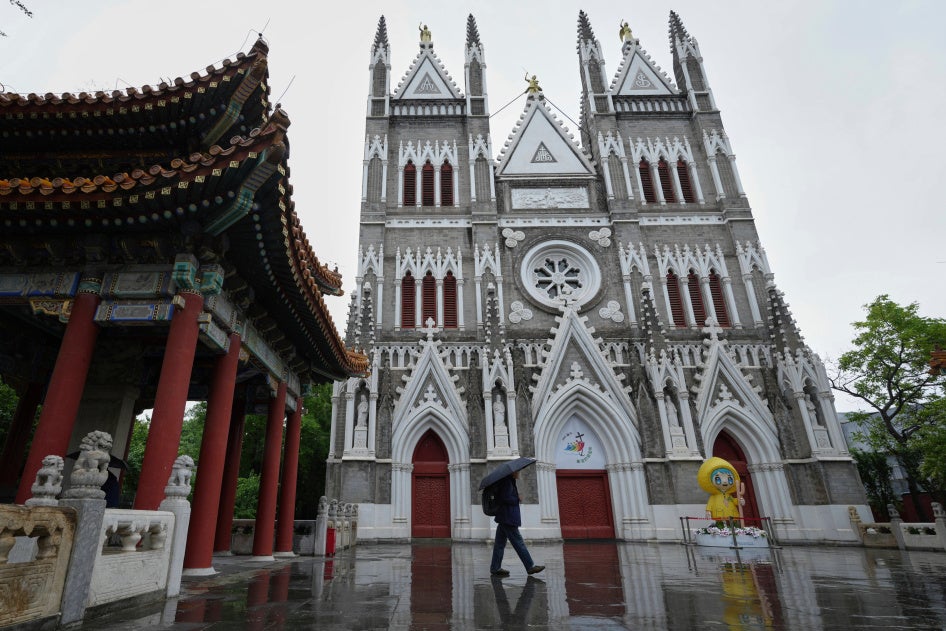
Under President Xi Jinping’s “Sinicization” of religion campaign, which began a decade ago in April 2016, places of worship and religious teachings are expected to reflect Han-centric Chinese culture and Chinese Communist Party ideology. The 2018 Provisional Agreement Regarding the Appointment of Bishops between the Holy See and China, which ended a decades-long dispute over the appointment of bishops in China, has facilitated repression of Catholics in China.
“A decade into Xi Jinping’s Sinicization campaign and nearly eight years since the 2018 Holy See-China agreement, Catholics in China face escalating repression that violates their religious freedoms,” said Yalkun Uluyol, China researcher at Human Rights Watch. “Pope Leo XIV should urgently review the agreement and press Beijing to end the persecution and intimidation of underground churches, clergy, and worshipers.”
The Chinese government does not allow independent researchers into China and punishes people for speaking to foreign media or rights groups. Human Rights Watch spoke with nine people outside the country who had firsthand knowledge of Catholic life in China, as well as experts on religious freedom and Catholicism in China. Human Rights Watch also reviewed government documents and articles in the Chinese government press.
On April 7, 2026, Human Rights Watch sent a summary of its findings seeking comment from the Chinese government and the Holy See. Neither has responded.
The Chinese government has long restricted the religious freedom of the country’s Catholics, who are permitted to worship only in official churches under the government-run Chinese Catholic Patriotic Association. Most affected are the underground Catholic communities, which refuse to pledge allegiance to the Chinese Communist Party. While religious persecution in China is longstanding, the environment has become increasingly repressive since President Xi took power in November 2012.
Under the 2018 Holy See-China agreement, Beijing proposes candidates for bishop that the pope can then veto, though the agreement’s full text has never been made public. The agreement has been renewed three times and is now valid through October 2028, but no pope has exercised his veto, even after the Chinese government violated its terms by unilaterally appointing bishops. Pope Leo XIV, in office since May 2025, has also approved Beijing’s five appointments.
Since the 2018 agreement, Chinese authorities have pressured underground Catholic communities to join the Patriotic Association by arbitrarily detaining, forcibly disappearing, torturing, and subjecting underground Catholic bishops and priests to house arrest, based on reporting by the media and research organizations.
People interviewed said that the 2018 agreement provided an overarching structure for the authorities to pressure underground Catholics. It left them with “no other choice but to join the official church,” said a person whose church was demolished, its cross removed, and its members threatened and arrested. Another person said the agreement has proven to be an “intelligent weapon to legally destroy underground churches,” as senior underground bishops, under persecution for years, have died or been replaced by officially appointed bishops.
Some underground Catholics said they felt betrayed by the Vatican. While “members of those communities are used to persecution from the [Chinese] government,” said one expert who has interviewed dozens of Catholics in China, since 2018 “they feel like the Vatican is also coming after them.”
A priest living abroad said that “many underground bishops are old, and they [Vatican and Beijing] are not appointing new underground bishops. Those communities may survive with their priests for a while but in the long run, underground Catholics [in China] will be gone.”
In recent years, the Chinese government has also intensified ideological control, surveillance, restrictions on religious activities, and foreign ties in official churches, Human Rights Watch said.
The authorities have subjected clergy to intense political or ideological trainings, as frequent as twice a week in some locations. In addition to existing state control over religious materials, priests’ teachings are now subjected to approval from relevant authorities. The authorities have also restricted religious activities in official church premises by, for example, implementing registration requirements for church services and barring children from entering churches. There are also credible reports that authorities have prohibited religious education for children at home and religion-oriented charitable activities across the country.
In December 2025, the Chinese Catholic Patriotic Association and the Chinese Catholic Bishops’ Conference formally adopted “Provisional Regulations on the Standardized Management of Exit-and-Entry Travel Documents for Catholic Clergy,” which requires all Catholic clergy to submit their travel documents to relevant departments, subjecting their trips outside the mainland, including for personal reasons, to state approval. The authorities also restrict foreigners from carrying out religious activities in China.
The Chinese government’s rights violations against Catholics contravene the United Nations Universal Declaration of Human Rights and violate the rights to freedoms of religion and belief, expression, association, and movement, among other rights, Human Rights Watch said.
“The Holy See and concerned governments should press Beijing to respect the religious freedom of all Catholics and other religions in China,” Uluyol said. “The Chinese government should stop persecuting and intimidating worshipers for upholding their faith and spirituality independent of Communist Party control.”
For accounts of repression against Catholics, please see below.
Chinese Government Control Over Religion
The Chinese government allows only five officially recognized religions—Buddhism, Taoism, Catholicism, Protestantism, and Islam—and maintains tight control over their operations and activities, including personnel appointments, finances, and seminary applications. The National Religious Affairs Administration (formerly the State Administration for Religious Affairs), which was absorbed into the United Front Work Department in 2018, manages the country’s religious affairs.
The Chinese government has issued a series of regulations in recent years to tighten control over religion. These include the Regulations of Religious Affairs (revised in 2018), Measures for the Administration of Religious Groups (2020), Measures for the Administration of Religious Personnel (2021), Measures for the Administration of Internet Religious Information Services (2022), and Measures for the Administration of Religious Activity Sites (2023).
“Sinicization” of Catholicism in China
At the April 2016 National Conference on Religious Work, President Xi said he would “Sinicize” religions. Since that time, Protestants and Catholics in China have been subjected to increased persecution and tight ideological control. The authorities have demolished hundreds of church buildings or the crosses atop them throughout the country, prevented adherents from gathering in unofficial churches, cracked down on underground Protestant and Catholic churches, restricted access to the Bible, confiscated religious materials not authorized by the government, and banned Bible and other religious apps.
The Sinicization of religion has also meant severe repression of Tibetan Buddhism and Islam. Much of the government’s “Strike Hard Campaign against Violent Terrorism” in the Xinjiang Uyghur Autonomous Region since late 2016—resulting in crimes against humanity against Uyghurs and other Muslims—has punished people for peaceful religious activity, including mere possession of digital recitations of the Quran.
Crackdown on the Underground Catholic Church
While Vatican officials in 2018 described “Sinicization” as potentially compatible with inculturation of Christianity—the process of embodying the religion in local culture—interviewees and other experts who closely follow Vatican-Beijing relations and the religious policies of Xi Jinping said that for the Chinese government it is about imposing Chinese Communist Party ideology on religious belief.
A member of an underground church community, who left China in 2024, said in January 2026:
The [2018] agreement was used by the Chinese Communist Party as the most intelligent weapon to legally destroy underground churches. In practice, they arrested priests and bishops from the underground churches and told them: “The Vatican has ordered you to join the Patriotic Association.” The current reality has forced many priests into what they see as a double bind: join the Patriotic Association and betray their faith or refuse to join and lose their livelihood and face arrest.
Two persecuted underground bishops, Joseph Zhang Weizhu and Melchoir Shi Hongzhen, are now recognized by Beijing. Two others, Augustine Cui Tai and Thaddeus Ma Daqin, have been detained, held under house arrest, and restricted in their ministerial duties by government-appointed bishops. James Su Zhimin, 94, and Xin Wenzhi, 63, remain forcibly disappeared, and Vincent Guo Xijin and Peter Shao Zhumin remain under house arrest.
Catholic clergy released from detention continue to face harassment. One person said in January that a priest he knew was barred from having bank accounts, sim cards, and a passport, and thus has “no means of survival and can barely make ends meet for even a day or two.”
Intensifying Ideological Control
Although Chinese authorities have conducted political or ideological training of clergy for decades, the Chinese government appears to have intensified such requirements since President Xi called for “Sinicization” in 2016.
People interviewed said that in recent years authorities have mandated training as often as twice a week in some locations. An academic who interviewed dozens of church members in China said in November 2025 that such training is part of “targeted efforts of the government to … decrease the energy of religious figures.”
Catholic priests are now required to submit their teachings for review and approval by relevant authorities, in addition to longstanding state control over religious publications, said two experts on the situation of Catholics in China.
The tightening of ideological control is also evident in religious regulations and official documents issued since 2018. In December 2023, the Patriotic Association published a five-year plan to promote further Sinicization of Catholicism, calling for church doctrines, governance, rituals, and even church art to develop Chinese characteristics “compatible with socialist society.” The plan makes no reference to the Holy See or the 2018 agreement and instead urges adherence to Xi’s guidance with Sinicization, a term mentioned 73 times in the plan.
In September 2025, the Chinese authorities issued an Online Code of Conduct for Religious Professionals, banning the online circulation of unauthorized religious content and effectively limiting public access to religious teachings outside government control.
In December 2025, the National Religious Affairs Administration initiated a nationwide campaign—“Study the Regulations, Observe Discipline, Cultivate Virtue, and Build a Good Image” (学法规、守戒律、重修为、 树形象)—which the Patriotic Association’s vice-chairman, Bishop Meng Qinglu, said aimed to promote the Sinicization of Catholicism and patriotism by making the study of laws and Xi’s discourse compulsory.
Increasing Surveillance and Restrictions on Religious Activities
In recent years, the Chinese government has also increased surveillance over official Catholic churches. The authorities have installed cameras inside some churches to monitor activities.
A member of the underground community in Shaanxi said in January 2026 that after the congregation became an official church under the Holy See-China agreement, authorities in their township rescheduled some church services to inconvenient hours, which reduced attendance. Another underground Catholic in exile from Inner Mongolia said people started to arrange fake wedding gatherings “just to be able to come together and pray” and “to avoid controls and heavy surveillance at official church premises.”
The US-based religious freedom organization China Aid reported that some official churches in Henan province in 2023 started to require pre-registration applications under which individuals must seek approval to attend church services, with requests filtered by the authorities. Other churches have been subject to such regulations only for religious feasts, such as a requirement that people must pre-register to attend church services during Christmas.
A Catholic who left China in 2023 described what happened after their congregation was forced to join the official church:
After forcibly joining the official church, our church was in a state of panic, and some priests were forced to leave the county. We felt the Chinese government became more heavy-handed after the agreement. We started praying like we were thieves, gatherings for major holidays disappeared. We used to have mass in hours that everyone could join, which changed to unreasonable hours, so people cannot join.
The authorities also cancelled our choir singing and shuttered windows of the church so that prayers are not visible from outside. Children growing up now have no memory of church prayers or ceremonies. The church premises are strictly regulated, and we cannot bring children since bishops and priests are very much afraid of the government. At one point, before escaping China in 2023, I stopped going to the church to avoid government surveillance.
The authorities have increasingly restricted children’s access to Catholic churches throughout the country, especially since the promulgation of revised Regulations on Religious Affairs in 2018, which prohibit religious activities in ordinary schools and restrict the establishment of religious schools to national or provincial-level religious organizations, subject to state approval. The government’s restrictions on children from religious activities violates its obligations under the Convention on the Rights of the Child, to which China is a party, which guarantees children’s freedom of religion and thought and the right to participate in cultural life.
Although the regulations do not forbid children from participating in religious activities, local authorities appear to interpret the regulations to ban children from religious premises. A Chinese academic who has interviewed dozens of Catholics said that, in the past, local governments “did not check a lot” whether children were attending church services.
However, the authorities now have started to strictly implement such bans, which a Catholic with firsthand knowledge of conditions in Shaanxi said in January 2026 “is aimed at cutting generational ties within the Catholic community.” The authorities closed a church in Xuchang city in Henan province in December 2025 because it “violated relevant regulations by allowing minors to enter the church to play music instruments,” China Aid reported.
A September 2025 internal document attributed to the Central United Front Leading Group, a high-level government body responsible for leading United Front work, which Human Rights Watch reviewed, says that parents in China “must not organize … home-based religious education to instill religious ideas to their children.” The document also tells schools to “guide students to proactively report” any such instances to the relevant authorities.
Human Rights Watch could not independently verify the classified document and wrote to the Chinese government about the document but received no reply. A former United Front official, now living in exile, said that prohibiting religious education of children at home began around 2018. In Xinjiang, such regulations were implemented as early as 2005.
There are also credible reports that Chinese authorities in recent years have shut down orphanages across the country, especially since the 2018 revised Regulations on Religious Affairs restricted the ability of individuals or organizations to engage in religiously oriented charitable activities. One person who closely monitors the situation of Catholics in China said in March 2026 that “over the last decade, [the Chinese] authorities removed the legal status of almost all social welfare facilities [owned by Catholics], including orphanages and centers for children with disabilities.”
The UN Committee on the Rights of Persons with Disabilities adopted guidelines on deinstitutionalization in 2022 that call on governments to “abolish all forms of institutionalization,” including for children with disabilities. However, these closures in China appear to be motivated by discrimination against their Catholic identity, as children from closed institutions were reportedly transferred to state institutions.
Restrictions on Clergy Travel, Foreign Ties
The Chinese authorities strictly regulate clergy’s engagement with those abroad, including their travels to or collaboration with foreign churches, according to recent government regulations.
In December 2025, the government issued the Provisional Regulations on the Standardized Management of Exit-and-Entry Travel Documents for Catholic Clergy, which ordered all Catholic clergy, including bishops, priests, deacons, and nuns, to submit their travel documents to supervising departments. Clergy can only get their travel documents back after applying to relevant departments for approval, a requirement even for personal travel. In recent years, the Chinese government has increasingly imposed arbitrary restrictions on people’s internationally protected right to leave their country.
While authorities have long restricted foreigners from conducting religious activities in China, the 2025 regulations on the Administration of Foreigners’ Religious Activities in the Mainland have formalized these restrictions: “Foreigners in China must not … preach, give sermons, or hold group religious activities without authorization” or “produce or sell religious items such as books, audiovisual materials, or electronic publications, and disseminate religious promotional materials.”
An expert on Beijing-Vatican relations said there has been growing sensitivity about foreign links: “Now groups must not have any relations with foreign churches or entities because that is seen as a national security issue. The Holy See, and [therefore,] the Catholic Church [as a foreign entity] represents a target [of persecution.]”
Relevant International Human Rights Law
The Chinese government’s repression of Catholics contravenes or violates international human rights standards and law. These include article 18 of the Universal Declaration of Human Rights, which is broadly recognized as customary human rights law, and article 18 of the International Covenant on Civil and Political Rights (ICCPR), which China has signed but not ratified. The ICCPR states: “Everyone shall have the right to freedom of thought, conscience and religion. This right shall include freedom to have or to adopt a religion or belief of his choice, and freedom, either individually or in community with others and in public or private, to manifest his religion or belief in worship, observance, practice and teaching.”
Articles 28 and 29 of the Convention on the Rights of the Child and article 13 of the International Covenant on Economic, Social and Cultural Rights, both of which China is a party to, recognize that the right to education does not allow for interference with the liberty of individuals and bodies to establish and direct educational institutions, subject to the requirement that the education in such institutions shall conform to such minimum standards as may be laid down by the state.