

Impact

By investigating and exposing human rights abuses, we work to create a world where everyone is treated fairly and equitably, no matter their race, religion, or beliefs. We call for action so that people who disagree with their government can speak their opinions freely, so that children are protected, and refugees cared for. All of us, regardless of who we are, who we love, or the color of our skin, should be able to enjoy fully our human rights.

BROWSE ALL IMPACT ›

Change is sometimes immediate, sometimes incremental. We work on issues for years and know from experience how to transform deep-rooted problems. Here are examples of some of the recent impact we have made, together with our partners, in advancing human rights around the world.

How do we bring about change?

Investigate
Our researchers investigate human rights abuses, first by speaking with victims or witnesses. We corroborate their stories using a variety of sources, including government records, weapons’ fragments, satellite imagery, and the statements of accused perpetrators – be they members of governments, armed groups, or companies. We often do this work together with partner activists.

Expose
We share this information widely, in multiple languages, to help shape public debate. Our reports, videos, and social media posts show up hundreds of times daily in news media around the world, bringing both global and local attention to our rigorously fact-checked findings.

Change
Often in coalition with local groups, we bring our findings to officials who have the power to change things. For every issue we work on, we make specific, concrete policy recommendations that will bring people justice, prevent future abuses, and protect human rights.

Our work has been instrumental in some foundational victories for human rights, including our work on banning landmines worldwide, for which we and our partners received the 1997 Nobel Peace Prize. Below are some examples of our historic impact.

All impact

  • November 3, 2017
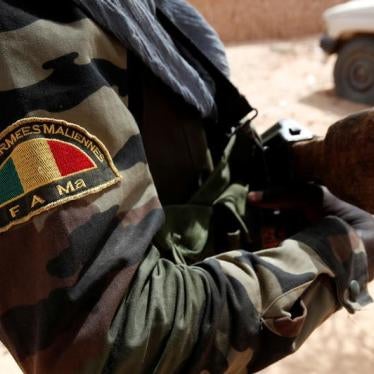
    The Mali Defense Ministry’s stated commitment to investigate serious alleged abuses by the security forces during operations in central Mali is a meaningful step toward accountability, Human Rights Watch said today.
    A Malian soldier during a military operation in northern Mali, October 19, 2017.
  • October 17, 2017
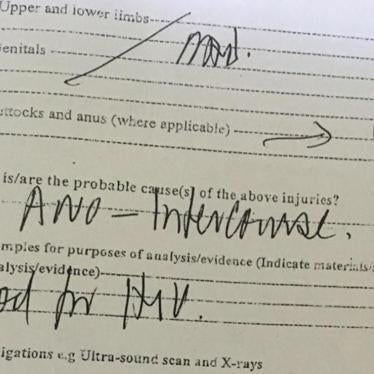
    Doctors, medical professionals, and national medical associations should heed the World Medical Association’s October 2017 resolution to end forced anal examinations on people accused of homosexual conduct, Human Rights Watch said today.
    A medical report filled out by a doctor in Kampala, Uganda, after conducting a forced anal examination on a man suspected of consensual same-sex conduct.
  • October 17, 2017
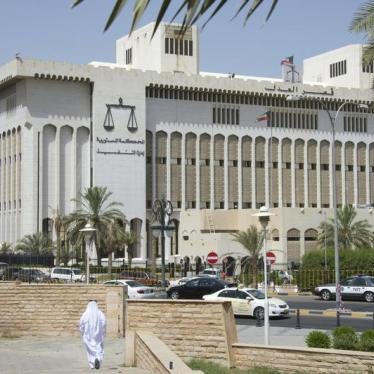
    The Constitutional Court’s decision on October 5, 2017 to strike down Kuwait’s overly broad DNA law is a positive step for the right to privacy in the country, Human Rights Watch and GeneWatch said today. The 2015 law had required all Kuwaiti citizens, residents, and visitors to provide DNA samples to authorities, in violation of their right to personal privacy. Kuwait was the only country to require nationwide compulsory DNA testing.
    A general view of the Kuwait Palace of Justice (court house) in Kuwait City, Kuwait.
  • October 11, 2017
    California Governor Jerry Brown has signed into law three bills that recognize young people’s vulnerability to abuse and their capacity to grow and mature, Human Rights Watch said today. The bills, signed on October 11, 2017, will protect children in police custody, limit prison terms for youth and young adults, and offer young people a chance to rebuild their lives.
  • September 5, 2017
    "Take them to Canada," Chechen despot Ramzan Kadyrov said when renewing his cynical vow to rid the North Caucasus territory of gay people. This week, the Canadian government announced that nearly 30 victims of the anti-gay purge in Chechnya have been safely resettled. Canada deserves praise for standing up – in word and deed – to Kadyrov's gruesome purge by publicly condemning his actions, pressing the Russian government to intervene, and now providing safe haven in Canada to individuals who were stranded in Russia, at risk from Chechen security forces and even their own families. The Canadian group, Rainbow Railroad, provided safe passage for these men out of Russia where they were under the temporary care of the Russian LGBT network.
    LGBT-rights supporter waves an amalgamation of the Canadian and rainbow flags in front of the Supreme Court of Canada in Ottawa, 1999. In 2017, Canadian government condemned Ramzen Kadyrov’s purge of gay men in Chechnya and announced that nearly 30 victim
  • August 31, 2017
    Most countries are making steady progress to eradicate cluster munitions, but stronger effort is required to deter use in countries that have not joined the international treaty to ban these weapons, Human Rights Watch said today during the release of the Cluster Munition Monitor 2017 report. Cluster munition attacks by Syrian government forces on opposition-held areas that began in 2012 have continued unabated.
    Trained technicians from Syria Civil Defense (“White Helmets”) identify and mark unexploded submunitions and other explosive remnants of war for clearance and destruction in Idlib governorate on June 8, 2017.
  • August 24, 2017
    Qatar’s adoption of a new law on domestic workers provides labor rights for domestic workers for the first time, Human Rights Watch said today. Qatari authorities should enact strong enforcement policies and close loopholes that place domestic workers at risk of exploitation.
    A female employer and her children are accompanied by their domestic worker, back right, as they walk through The Avenues, an indoor luxury shopping center in Kuwait City.