US Expulsions of Third-Country Nationals to Countries in Africa
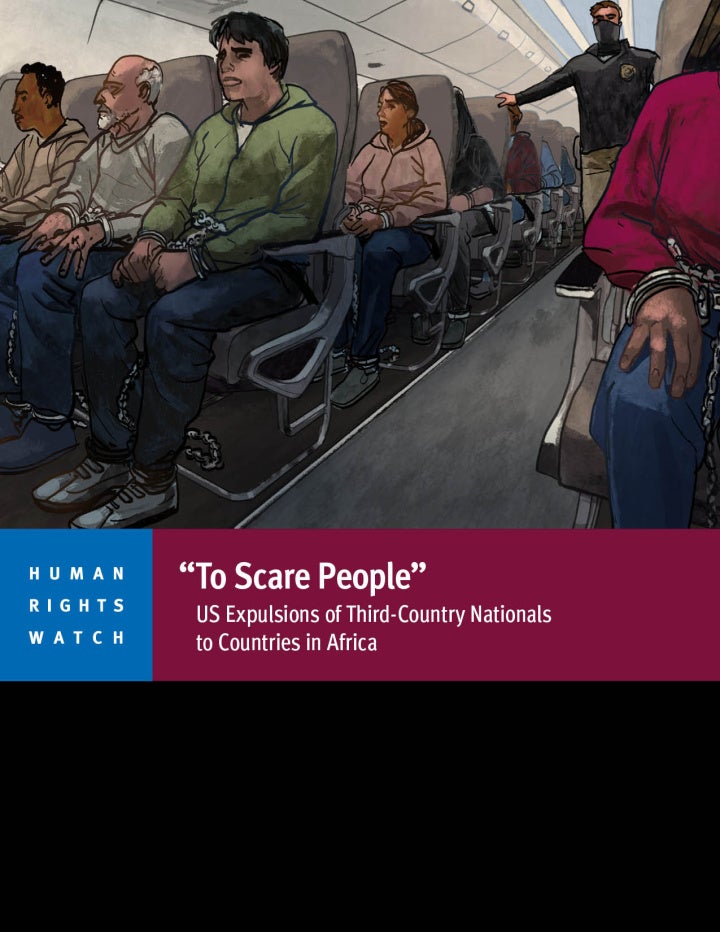
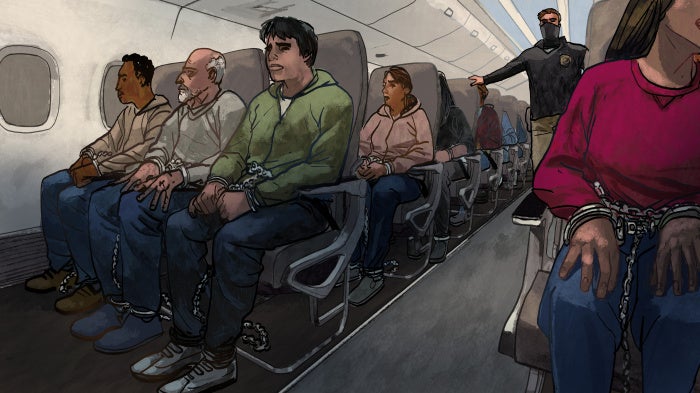
The 125-page report, “‘To Scare People’: US Expulsions of Third-Country Nationals to Countries in Africa,” documents that US authorities denied the more than 500 people transferred to third countries a meaningful chance to contest their removals or to articulate their fears of being removed to these countries. Some countries arbitrarily detained people they had accepted, and some have sent people onward to the risk of persecution or torture in their home countries, violating the international law principle of nonrefoulement.
Racism and racially motivated violence against the Rima (Gypsy) minority in Bulgaria has escalated dramatically since 1994. The violence ranges from police torture to mob attacks — including violent attacks by guards employed by private security firms.
Under the anti-terror law, which was introduced in 1991, many left-wing and pro-Kurdish journalists, writers and publishers continue to be tried, and many go on to be sentenced to prison terms and fines. Penal Code provisions that make it a crime to insult Ataturk, secularity, Islam, the security forces and the president continue to be used to restrict free expression.
Initial attempts to purge former Communists from public life in Bulgaria were relatively weak when compared to similar laws passed in the former Czechoslovakia or the former German Democratic Republic. Efforts to initiate a decommunization program gained momentum, however, after the election victory of the Union of Democratic Forces in October 1991.
Containing background information about human rights violations in Iraq gathered in mid-1992 from victims, eyewitnesses and family members currently living in exile in Syria and Jordan, this report serves as a supplement to our Human Rights in Iraq (1990) and Endless Torment: The 1991 Uprising in Iraq and its Aftermath (1992).
As details regarding a war crimes tribunal develop, we believe that integral to any investigatory effort is a parallel commitment to the safety and integrity of the witnesses who will testify, and to the development and implementation of fair procedural and evidentiary rules.
Hundreds Arrested and Press Muzzled in Aftermath of Election Annulment
On June 12, 1993, Nigerian citizens overcame ethnic and regional rivalries in an effort to rid themselves of military rule and hold a legitimate presidential election. Gen. Babangida and his cronies, however, have shown no intention of allowing civilians a significant voice in government and annulled the election and postponed his exit from politics.
Helsinki Watch Releases Eight Cases for War Crimes Tribunal on Former Yugoslavia
With great fanfare, the U.N. Security Council, in February 1993, called for the establishment of an international tribunal to investigate and prosecute perpetrators of war crimes in the Balkan conflict.
Poland's transition to democracy is endangered by government and private restrictions on freedom of expression. In a distressing series of arrests and prosecutions for "slandering" the state, President Walesa has relied upon a repressive Communist-era law to punish government critics.
In August 1993, the Indian government repatriated nearly 7,000 of the more than 80,000 Sri Lankan Tamils then residing in government-run refugee camps in the southern state of Tamil Nadu. The refugees fled northeastern Sri Lanka in June 1990 after fighting broke out between government forces and a guerrilla army.
Israeli Undercover Operations Against “Wanted” and Masked Palestinians
Undercover units of the Israeli army have been responsible for over 120 killings in the occupied West Bank and Gaza Strip since 1988. Many of the victims were shot while posing no serious imminent threat to soldiers or others.
Executions Continue, No Appeal of Death Sentences to Higher Court
In a major shift of policy, the Egyptian government in October 1992 began to try in military courts civilians accused of "terrorism" offenses, bypassing the security-court system staffed by civilian judges that has been in place under Egypt's long-standing emergency law.
Between April 29 and May 28, in a move unprecedented since Lebanon’s civil war, the Hrawi government shut down 4 news organizations and filed criminal charges against 4 journalists for violating Lebanon’s restrictive press regulation. The recent measures recall the fall of 1976, when the newly-arrived Syrian troops forcibly shut down 5 newspapers in Beirut.
A narrative account of the Iraqi government’s organized attempt to eradicate the Kurds living in northern Iraq, this report captures in riveting detail the multiple phases of the Anfal campaign. Anfal, meaning "the spoils," is the name of the eighth sura of the Koran. It is also the name given by the Iraqis to a series of military actions that lasted from February 23 until September 6, 1988.
In Greece, some citizens are paying a heavy price for their government's hard line on Macedonia. In particular, freedom of expression has been abrogated through an intensive campaign which combines propaganda and a series of extraordinary criminal prosecutions for dissenters.