(Amman) – The Syrian transitional government is signing billions of dollars in reconstruction deals without a human rights framework that would ensure that rebuilding respects, protects, and fulfills the rights of affected people, Human Rights Watch said today.
In March 2026, the transitional government unveiled a national recovery blueprint, and billions of dollars in international pledges for aid, and financing and investment commitments have followed. But the legal frameworks governing reconstruction do not require the government or developers to consult affected communities, including those still displaced, before projects are approved. The process should also require negotiating—instead of imposing—compensation terms and providing an independent mechanism for residents to challenge decisions about their homes and land.
“Syria's reconstruction is progressing slowly, but without a rights framework, it could leave many Syrians with a raw deal,” said Hiba Zayadin, senior Middle East advisor at Human Rights Watch. “The legal framework being finalized now will determine whose homes are rebuilt, whose claims are recognized, and whose voices are heard.”
Human Rights Watch conducted field research in Syria in May 2026, including interviews with residents of Ghadfa village in the Idlib countryside who had returned from displacement camps. Human Rights Watch also interviewed an activist, whose identity is being withheld for their protection, calling for the repeal of Decree 66 and the restoration of property rights in Marota City.
Human Rights Watch reviewed Syrian government statements and documents including President al-Sharaa's March 2026 remarks on reconstruction published by the Syrian Arab News Agency, and the Constitutional Declaration of March 2025. Human Rights Watch also reviewed reports and data from the World Bank, the International Rescue Committee, the International Organization for Migration, UNHCR, OCHA, the Arab Reform Initiative, and The Syria Report.
People returning to their communities are finding homes destroyed, and villages without water, electricity, or health care services. Housing, land, and property claims from the Assad era remain unresolved. Reconstruction projects are being initiated without meaningful participation by affected residents.
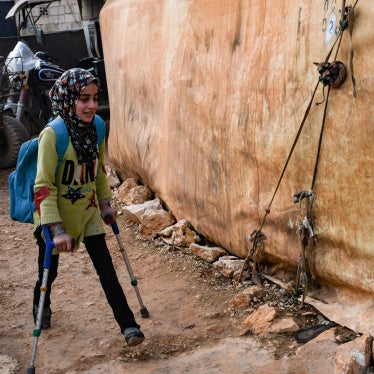
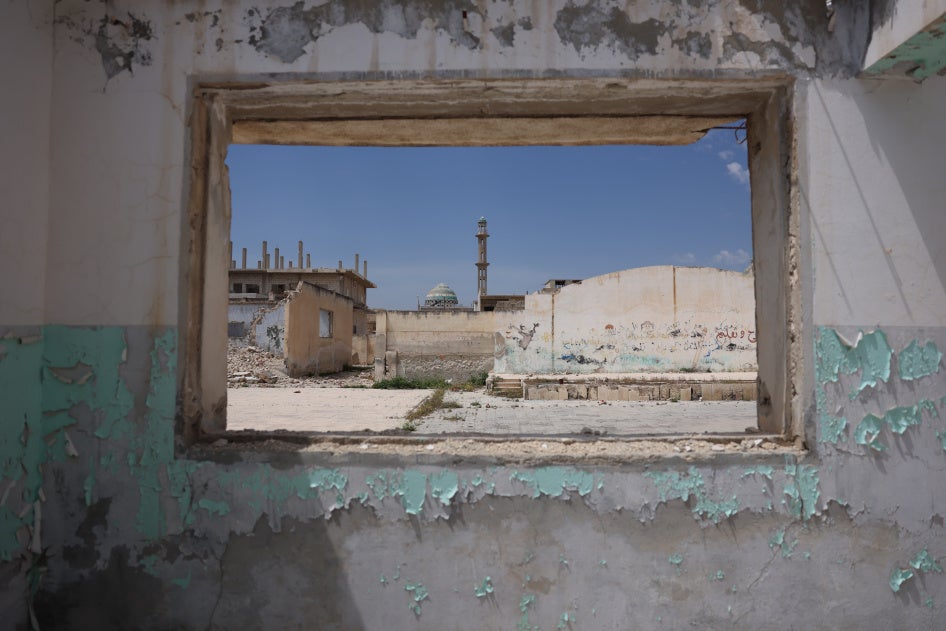
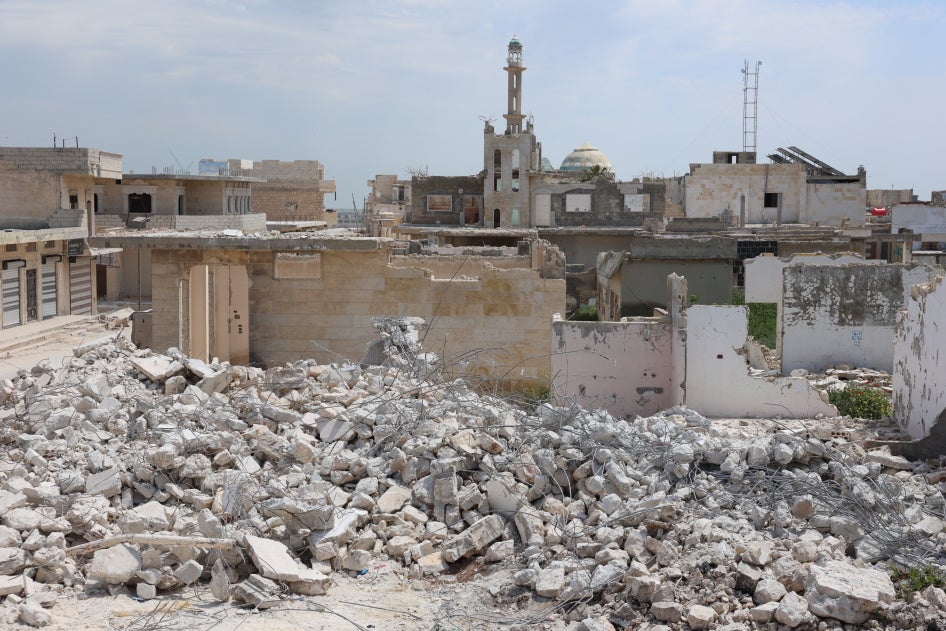
In Jobar, a neighborhood east of central Damascus, approximately 95 percent of buildings were destroyed, according to The Syria Report. In Ghadfa, in the Idlib countryside, residents who returned from displacement told Human Rights Watch in May 2026 that they had no running water, functioning electricity grid, adequate sanitation, operating schools, or nearby medical services.
Syria is emerging from more than a decade of conflict, which caused mass devastation to cities, homes, and infrastructure across many parts of the country.
In October 2025, the World Bank estimated physical damage at US$108 billion and average reconstruction costs at $216 billion, with the full range between $140 billion and $345 billion. The transitional government has moved quickly to attract reconstruction investment, successfully restoring diplomatic ties and welcoming foreign capital, as the US and European countries lifted crippling sanctions that had frozen investment for years and impoverished Syrians.
Gulf states have led investment. Saudi Arabia has pledged $6.4 billion across real estate, infrastructure, telecoms, and energy; and together with Qatar, jointly cleared Syria's $15.5 million in World Bank arrears in April 2025, unlocking engagement after 14 years of suspension.Qatar has committed $4 billion, and the UAE's DP World secured a 30-year concession over Tartus port.
The World Bank has since approved over $1 billion in grant-funded projects, and the International Monetary Fund has established a technical cooperation program with Damascus. Among European governments, France, Germany, and to some extent Italy, have emerged as the most active bilateral partners.
The EU, which pledged €620 million (about $713 million) for humanitarian aid and socio-economic recovery in 2026-2027, announced an investment conference in Syria in 2027 and is strengthening its political ties with Syria. EU member states are in a strong position to lead by example and mobilize other donors to ensure that human rights frameworks are strongly anchored in Syria’s reconstruction and recovery.
But as the Global Governance Institute noted in August 2026, pledges and announcements have far outpaced actual investment on the ground, and meaningful disbursements from international creditors will only follow once governance and legal frameworks are in place.
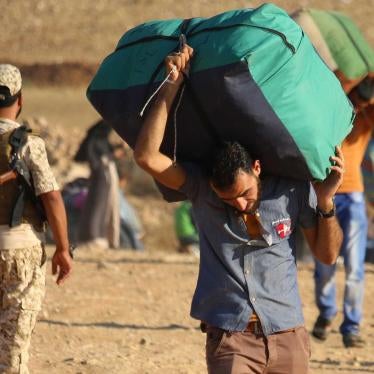
According to a July 2026 report by the International Rescue Committee, over 3.5 million refugees and internally displaced Syrians have returned to their communities since December 2024, but not all returns have been fully voluntary. Many were driven by the deteriorating conditions for displaced people, the end of aid, precarious legal status, and unaffordable rent in places where they were living.
Syria is bound by the International Covenant on Economic, Social and Cultural Rights, which under General Comment 4, defines the right to adequate housing as including guarantees security of tenure, access to services, habitability, and suitable location. It is also bound by the International Covenant on Civil and Political Rights, which guarantees the right to an effective remedy. Both treaties require rights to be respected without discrimination on grounds including ethnicity and religion.
The UN Basic Principles and Guidelines on Development-Based Evictions establish what consultation, compensation, and due process must look like before any displacement for development purposes. The UN Guiding Principles on Internal Displacement and the Pinheiro Principles on housing, land, and property restitution establish clear standards for how states should manage return and reconstruction in post-conflict settings.
International donors should ensure that their funding supports rights-aligned recovery and does not cause or contribute to violations. Businesses and investors should conduct human rights due diligence before entering reconstruction agreements and throughout their implementation.
“The legal frameworks governing Syria's reconstruction are still being written,” Zayadin said. “That is an opportunity, but only if the international community and the transitional government use it to build protections for affected communities. A durable recovery depends on getting things right.”
Background
In October 2025, the International Organization for Migration found that conditions for Syrians returning to their communities remained fragile, with widespread housing, land, and property disputes, limited access to public services, and pervasive explosive ordnance contamination hampering safe movement and livelihoods.
Halfway through 2026, the UN humanitarian appeal for Syria was just under one-third funded. Since May, the World Food Programme has halved emergency food assistance in Syria, from 1.3 million people to 650,000. About 5.5 million people remain internally displaced, according to the March operational update by UNHCR, the UN refugee agency.
The gap between pledges and delivery has real consequences for rights. While affected residents can in principle pursue individual cases through Syrian courts, the judiciary remains under-resourced and inaccessible for most property disputes, with documentation requirements prohibitive for many returnees. There is no practical avenue to contest reconstruction decisions more broadly, and no specialized grievance mechanism for reconstruction disputes has yet been established.
Some reconstruction is underway. The Al-Rastan Bridge in Homs, a key economic artery linking several Syrian provinces, reopened in June 2026 after rehabilitation financed by the Syria Humanitarian Fund in partnership with the UN Development Program (UNDP). Rashid Bridge over the Euphrates in Raqqa reopened in July 2026 after a four-month reconstruction project. And the World Bank approved a $146 million grant in 2025 to rehabilitate the national electricity transmission infrastructure.
While these infrastructure projects are meaningful, efforts remain modest relative to the scale of need, and there is no framework in place to ensure that projects uphold the rights of Syrians as reconstruction proceeds.
Economic, Social, and Cultural Rights in Reconstruction
Under the International Covenant on Economic, Social and Cultural Rights, to which Syria acceded in 1969, and under Article 12 of Syria’s Constitutional Declaration of March 2025, the Syrian government has an obligation to respect, protect, and fulfill economic, social and cultural rights throughout the reconstruction process. These include the rights to adequate housing, water and sanitation, electricity, health, education, food, and social security. Electricity is also essential to the realization of many other rights, including powering water and sanitation systems, healthcare facilities, schools, and homes. The government should ensure that all these rights are secured without discrimination of any kind including on the grounds of ethnicity or race, or religion.
The conditions Human Rights Watch documented in areas of return place these rights at serious risk. In Ghadfa, for example, residents described living without running water, a functioning electricity grid, adequate housing, operating schools, or nearby medical services. Residents must purchase water privately and pool money to pay teachers’ salaries, shifting the cost of public services onto households already facing severe economic hardship.
The government should make a commitment to provide as much of its available resources as possible toward the full realization of economic, social and cultural rights, Human Rights Watch said. It should ensure minimum essential levels of these rights. Reconstruction plans and budgets should use transparent, rights-aligned criteria to address the most serious rights deprivations.
Syria is also under an obligation to respect the right to property, including property held in association with others, without discrimination. This right is protected under Article 17 of the Universal Declaration of Human Rights, Article 5(d)(v) of the International Convention on the Elimination of All Forms of Racial Discrimination, to which Syria acceded in 1969, and Article 31 of the Arab Charter on Human Rights, which Syria ratified in 2007.
The Right to Participate
International human rights law requires that communities affected by reconstruction have meaningful input into decisions that affect their homes, land, and neighborhoods before those decisions are made. The relevant instruments include Article 11 of the International Covenant on Economic, Social and Cultural Rights, which guarantees the right to adequate housing and has been interpreted to require genuine participation in housing-related decisions; the UN Basic Principles and Guidelines on Development-Based Evictions and Displacement, which establish that consultation must be meaningful, timely, and capable of influencing outcomes; and the UN Guiding Principles on Internal Displacement, which require that displaced persons participate in the planning and management of their return and reintegration. In Syria, these standards are not being met.
President Ahmed al-Sharaa outlined in March 2026 that for cities where destruction has reached 90 to 100 percent, the government cannot finance construction alone and is considering an investment-based reconstruction model, with legal frameworks still being finalized.
But the Arab Reform Initiative, drawing on 45 interviews with residents, civil society actors, officials, investors, and others between July 2024 and May 2026, found that reconstruction decisions are already being made without community participation, clear compensation standards, or accessible grievance mechanisms.
It documents how this gap is already generating conflicts. In Homs, Aleppo, and Damascus, projects announced without prior community consultation have triggered protests, partial reversals, and deepening distrust of public authorities.
In Damascus, Decree 66, an Assad-era law issued in 2012 was used to displace thousands without due process or adequate compensation and has not been repealed by the transitional government. The Damascus governor suspended its implementation in October 2025 pending legal review, but no presidential decree has resolved its legal status, and the projects it enabled continue to be marketed to investors.
Law No. 10 of 2018 extended the Decree 66 model nationwide, requiring residents to prove ownership within a short time or forfeit their rights, which has disproportionately affected those displaced by conflict.
Wartime redevelopment frameworks, including the Marota City and Basilia City development projects in Damascus, are being repackaged as investment opportunities for the private sector or other governments, according to the Arab Reform Initiative, risking legitimizing past dispossessions rather than providing redress. Both projects are managed by Damascus Cham Holding, a company established under Assad and now operating under the transitional government.
A presidential committee was formed in December 2025 to review Decree 66 procedures, and some compensation decisions were issued in May 2026, but the legal framework governing both projects remains unresolved and affected residents continue to await a durable solution.
In Jobar, the neighborhood east of central Damascus where approximately 95 percent of buildings were destroyed, authorities told residents they could not rebuild even on their own initiative and that a proposed foreign-backed project would provide them with new housing with floor area equivalent to only 50 percent of the area of their former homes, according to the Syria Report and Al Jazeera.
Former homeowners would receive new units equivalent to only 50 percent of their former homes as compensation; residents of informal settlements would receive 30 percent of their land area, with no recognition of structures built on it; and tenants would receive nothing.
The Right to Return in Safety and Dignity
The UN Guiding Principles on Internal Displacement and the 1951 Refugee Convention stipulate that returns of displaced persons and refugees must be voluntary, safe, and dignified. To be voluntary, a decision to return must be free and informed, not driven by deteriorating conditions in displacement. Safety requires that adequate housing and public services are available upon return. Dignity requires that property rights are respected and that residents' claims are received and fairly adjudicated. Though UNHCR has said economic conditions in Syria remain dire, political momentum around returns is accelerating.
During President al-Sharaa's state visit to Berlin in March 2026, Chancellor Friedrich Merz and al-Sharaa expressed a shared hope that 80 percent of Syrians in Germany would return within three years; a figure Merz subsequently clarified was aspirational rather than a formal target.
A September 2025 UNHCR survey found that while 18 percent of Syrian refugees expressed a desire to return within 12 months, the most cited concerns among those considering it included housing availability, limited employment opportunities, lack of financial resources, and inadequate access to basic services.
Many returns, whether of refugees or internally displaced people, are not voluntary in any meaningful sense. Funding cuts to displacement camps in northwest Syria, including the near-total collapse of US humanitarian funding in 2025, have left camp residents with little choice but to return to communities that cannot yet support them.
The transitional government's “Syria Without Camps” initiative aims to phase out displacement camps entirely by 2027. And yet, the communities to which displaced people are expected to return often lack the required infrastructure and public services to guarantee an adequate standard of living.
During the visit to Ghadfa, Human Rights Watch interviewed three residents who had returned from displacement camps to find no running water, no electricity, and no functioning schools. They said they truck in water privately and pool money to pay teachers' salaries. Individual solar panels on buildings have replaced an electricity grid that does not function.
Noureddine Othman, head of Ghadfa's municipal council, said that before the war the village had 8,500 residents, at least five schools, and a hospital serving the surrounding area. It now has an estimated 13,000 people, he said, with only 7 houses out of about 1,500 with concrete roofs. Many residents have pitched tents where their homes once stood or on top of damaged structures that lack roofs.
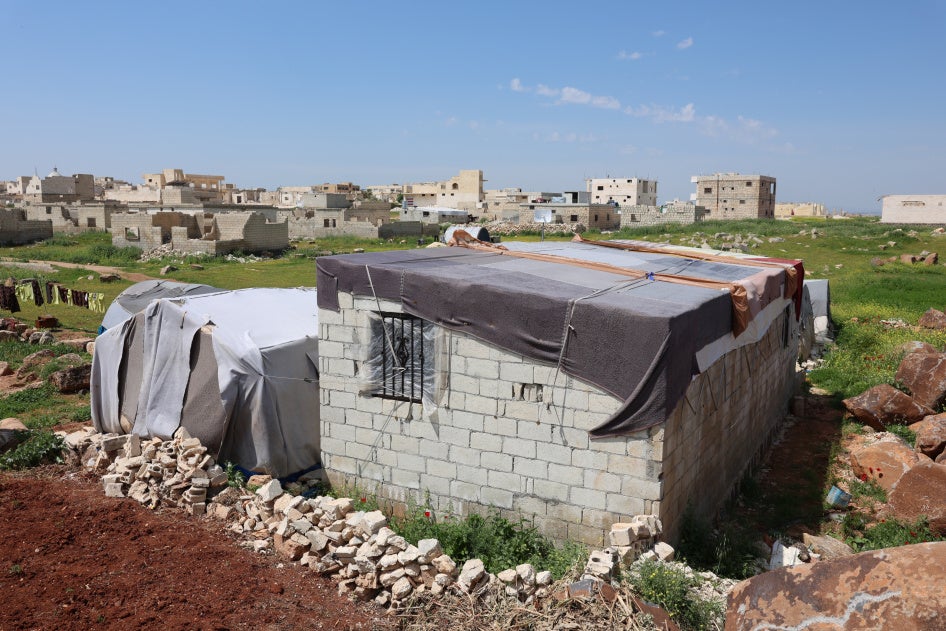
“I returned after the fall [of Assad] and found nothing, not even a room to rest in, so I went back to displacement for another five or six months,” he said. “My wife and I eventually came back and we're living in a room with no kitchen and no bathroom. We came back hoping God would send us some organization, someone, to help us [get back on our feet].”
Sohaib al-Othman, a Ghadfa resident who had recently returned with 13 family members including 3 children with disabilities, said: “After years of displacement, I returned home to find the house in complete ruins. We are deprived of everything needed for a dignified life; water, sewage, electricity, medical services. The thing I struggle with the most is that the nearest operating medical point to me is 50 kilometers away and I don't have a vehicle.”
The transitional government should treat the need to restore public services as an immediate rights obligation, not a future phase of reconstruction, Human Rights Watch said.
The Right to an Effective Remedy
The right to an effective remedy, guaranteed under the ICCPR, requires accessible, independent, and enforceable mechanisms for people whose rights are violated during reconstruction to seek redress. Syria's reconstruction framework does not yet provide such mechanisms. Communities confronting decisions about their land, homes, and neighborhoods have no independent formal channel through which to challenge those decisions. They resort instead to street protest, social media pressure, and political mediation, as residents of Jobar, Marota, and Basilia City are all reported to have done.
An activist who called for the repeal of Decree 66 and the restoration of residents' property rights in Marota City in Damascus told Human Rights Watch on June 20 that appeals through official channels have gone unanswered. The authorities had repeatedly cited political instability and the absence of a People's Assembly as reasons for the delay. The People’s Assembly began functioning in July.
“Then we were shocked to learn that Damascus Cham Holding Company was promoting investment opportunities for Gulf investors that included the sale of our land,” he said. “We met with the minister of justice, who promised to refer our case to the presidency. This remained only a promise, and no action was taken.”
Recommendations
To Syria’s Transitional Government
- Ensure that the rights and freedoms guaranteed under Article 12 of the Constitutional Declaration of March 2025, including all rights under international human rights treaties ratified by Syria, are applied fully to reconstruction and recovery processes; adopt interim guidance requiring all state authorities involved in reconstruction to comply with those obligations, without discrimination on grounds of ethnicity, religion, or political opinion.
- Incorporate binding community participation requirements in legal frameworks and planning processes before any reconstruction project is approved, contracted, or presented to investors;
- Treat displacement as a last resort in reconstruction, prioritize restitution and return for all those displaced; and where restitution is not possible, establish clear, fair compensation standards that reflect actual use and occupancy for all those displaced by reconstruction, including those with informal tenure and tenants;
- Institute a moratorium on demolition where ownership and compensation arrangements have not been publicly established and accepted by residents;
- Repeal or independently review Decree 66 and Law No. 10 of 2018, which extends its provisions across Syria, to assess what restitution is owed to affected residents;
- Create accessible, independent grievance mechanisms for all reconstruction projects;
- Ensure reconstruction processes are linked to transitional justice on housing, land, and property;
- Prioritize immediate restoration of public services—water, sanitation, electricity, schools, healthcare—in areas of active return, not as a future phase of reconstruction.
To International Donors and Investors
- Make rights compliance a binding condition of reconstruction financing, including consulting communities, protecting property, and providing grievance mechanisms;
- Require human rights impact assessments before funding projects in areas with unresolved displacement or contested property;
- Use the upcoming EU-Syria investment conference to make rights standards a prerequisite, not an afterthought, and encourage participating companies, to adopt human rights due diligence frameworks;
- Coordinate with other international donors to ensure reconstruction financing is consistently conditioned on rights compliance across all bilateral and multilateral channels;
- Require fulfilling conditions for voluntary, safe, and dignified return in any political return timelines;
- Fund public service delivery alongside capital investment and maintain humanitarian funding as reconstruction scales up.
To International Financial Institutions
- Require prior assessment of the human rights impacts of fiscal consolidation, privatization, or user fees to ensure that they do not discriminate, result in unjustified retrogressive measures, or deny anyone minimum essential levels of water, healthcare, housing, or other rights;
- Ensure that financing and technical assistance programs incorporate human rights impact assessments and housing, land, and property protections as core conditions, not peripheral considerations;
- Support the establishment of an independent property dispute resolution mechanism as part of governance reform programming.
To Corporations and Financial Actors
- Conduct human rights due diligence before entering reconstruction agreements, including the need to resolve contested ownership and community opposition;
- Require evidence of community consultation and grievance mechanisms before investing;
- Enter agreements involving land or property only if mechanisms are in place to resolve claims over land or property from affected communities, including through compensation and replacement land where appropriate.