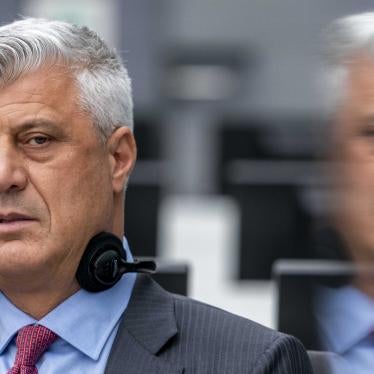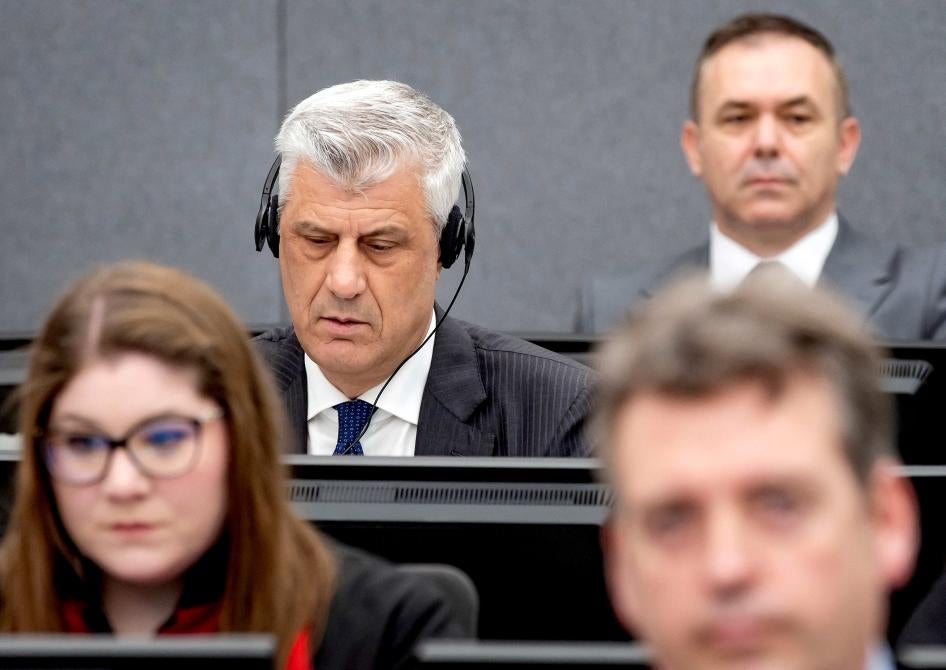
(Berlin, September 17, 2026) – The convictions of Kosovo’s former President Hashim Thaçi and three senior former Kosovo Liberation Army (KLA) leaders for war crimes on September 16, 2026, are an important step toward accountability for victims of the 1998-1999 Kosovo conflict, Human Rights Watch said today.
The Kosovo Specialist Chambers, based in The Hague, found Thaçi, Kadri Veseli, Jakup Krasniqi, and Rexhep Selimi guilty of war crimes including murder, torture, cruel treatment, and arbitrary detention. The court acquitted the four men on charges of crimes against humanity. The convictions were for crimes committed during the war in Kosovo and northern Albania, against Kosovo Albanians, Serbs, Roma, and others. The court sentenced Thaçi and Krasniqi to 25 years, Veseli to 18 years, and Selimi to 13 years in prison.
“This verdict sends an important message to victims and their families that even powerful leaders are not beyond the reach of justice,” said Hugh Williamson, Europe and Central Asia director at Human Rights Watch. “The court’s findings underscore that accountability for serious wartime crimes should apply to everyone, regardless of their position or affiliation.”
The judgment documents the scale and severity of the abuses. The judges found that between April 1998 and June 20, 1999, the defendants were criminally responsible for the arbitrary arrest and detention of 385 people at KLA detention sites, the torture of 303 people, the cruel treatment of 49 people, and the murder of 96 people. The victims included Kosovo Albanians perceived as political opponents or collaborators, as well as Serbs and Roma.
The judges found that the accused shared a common criminal purpose to target, detain, and if necessary, kill perceived opponents of the KLA, which sought independence from Serbia. They found that the four men worked together to implement the criminal plan, including through detention facilities, military police, intelligence structures, and special units.
The court acquitted all four defendants of the six crimes against humanity charges, finding that the prosecution had not proved beyond reasonable doubt that the specific acts were “directed against a civilian population:” one of the required elements to establish crimes against humanity, in addition to the acts being part of a widespread or systematic attack. The court also found the four men not guilty in relation to a number of other alleged war crimes incidents, which it found were either not proven beyond reasonable doubt, absorbed by another more specific charge, or outside the court’s jurisdiction. The latter included alleged incidents after June 20, 1999, when the court found that the armed conflict had ended and the conduct could therefore not qualify as war crimes.
The judges stressed that the KLA itself was not on trial and that the case was not about the legitimacy of the KLA’s struggle, the crimes Serbian and Yugoslav forces committed against Kosovo Albanians, or an effort to balance crimes committed by one side against those committed by another. The judgment concerned the individual criminal responsibility of the four defendants for specific crimes against Serbs, Roma, and Kosovo Albanians.
The judges said that the trial had taken place in a “climate of witness intimidation.” The court said some witnesses had lied before the judges or changed previous accounts, and that fear for their safety may have affected some testimony. Separately, Thaçi faces a second case, along with four others, before the Kosovo Specialist Chambers for alleged obstruction of justice.
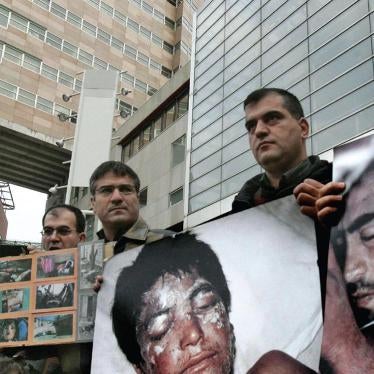
The judgment comes against a wider backdrop of incomplete accountability for crimes committed during the Kosovo conflict, including crimes committed by Serbian and Yugoslav forces, Human Rights Watch said.
As Human Rights Watch has documented, Serbian and Yugoslav forces were responsible for systematic and widespread crimes, during the conflict including torture, killings, rape, and forced expulsions.
At the senior level, former Serbian President Slobodan Milošević and, in separate trials, seven other high-ranking Serbian and Yugoslav officials were tried at the International Criminal Tribunal for the former Yugoslavia. One man was acquitted and six were convicted; Milošević died during his trial. Some Serbian and Yugoslav officials convicted by the United Nations tribunal have subsequently been publicly celebrated in Serbia, underscoring the continuing need for political leaders in Serbia and the region to acknowledge established facts about wartime crimes and support accountability for them.
At the domestic level, Serbian courts have convicted 17 individuals by final judgment for war crimes related to Kosovo, including 15 Serbs. Domestic prosecutions in Serbia have largely focused on lower-level perpetrators rather than senior military or police officials. For the vast majority of war crimes, however, no one has been held to account. The September 16 ruling should spur renewed efforts to deliver justice for all the victims of the Kosovo war, Human Rights Watch said.
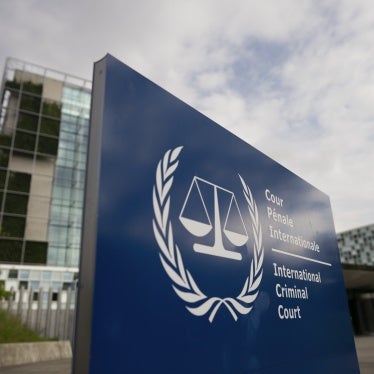
The Kosovo Specialist Chambers has jurisdiction over crimes against humanity, war crimes, and other crimes under Kosovo law related to allegations made in a 2010 Council of Europe report. Dick Marty, the Swiss senator who wrote it, said in the report that some senior former members of the KLA were responsible for abductions, beatings, and summary executions during and after the war. Human Rights Watch documented post-war attacks on Serbs and Roma.
Based on the Council of Europe report, the European Union, with strong support from the United States, created the Special Investigative Task Force (SITF), based in Brussels with an international staff, to investigate the allegations. The task force’s lead prosecutor presented his findings in 2014, including on witness intimidation, and concluded there were credible grounds to issue indictments.
After Kosovo amended its constitution and introduced a new law in 2015, the Kosovo Specialist Chambers was created, based in The Hague with funding from the EU, as well as from Canada, Norway, Switzerland, Türkiye, and the United States. All three of the chief prosecutors have come from the United States.
“For the Kosovo Albanians, Serbs, Roma, and others who suffered these dreadful crimes, this judgment provides a measure of long-delayed justice,” Williamson said. “It is a reminder that all victims of serious crimes committed during and after the Kosovo war deserve justice, regardless of the ethnicity or affiliation of the victim or perpetrator.”