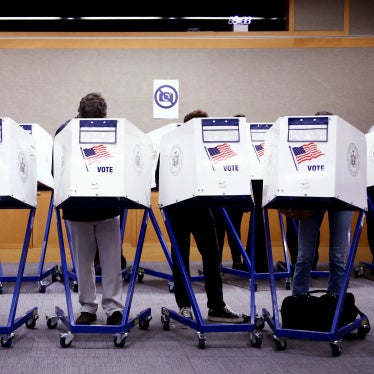
(New York) – The Trump administration’s decision not to invite the leading international election observation body to monitor crucial US midterm polls fuels fears of serious human rights concerns around the upcoming elections, Human Rights Watch said today.
“The US government has long criticized Russia and other governments for dodging external scrutiny of their elections,” said Philippe Bolopion, executive director of Human Rights Watch. “Now the Trump administration is mimicking that behavior.”
The Organization for Security and Cooperation in Europe (OSCE), which has observed every US federal election since 2002, called the decision “regrettable” and “not in line with” US commitments. Just over a month before the elections, the United States is mired in several controversies that raise concerns about the rights of voters, Human Rights Watch said.
The Supreme Court on September 25, 2026, granted an emergency appeal by the Trump administration to overturn a ruling that had temporarily barred the government from using the current version of the Department of Homeland Security’s Systematic Alien Verification for Entitlements (SAVE) database to verify voters’ citizenship.
Since 2002, the OSCE has observed 12 rounds of elections in the United States, including six midterm elections. OSCE observers were invited to observe the 2018 midterms during President Donald Trump’s first term and issued a 38-page report at the time. Most recently, the organization observed the 2024 election, which brought President Trump into office for a second term. The organization deemed that election “well-run” and said that candidates campaigned “freely across the country,” with “voters engaging actively.”
Human Rights Watch wrote to the State Department seeking comment on the OSCE’s September 23, 2026 press release but has not yet received a response. The Trump administration has previously threatened to quit the OSCE, and its ambassador to the OSCE, Darrell Owens, has been pushing an effort to “reform, refocus, and refine” the OSCE since his confirmation by the US Senate in June.
This is the first time the United States has declined to invite in OSCE monitors since they began observing US elections. The OSCE Parliamentary Assembly president, Pere Joan Pons, said that the Trump administration’s decision “represents a significant departure from an established democratic practice.”
It is notable that an administration ostensibly committed to combatting fraud is unwilling to invite external observers who have cultivated expertise in exactly this issue, Human Rights Watch said. The decision is a serious one, and its consequences will reverberate beyond the United States.
The 57 OSCE participating countries all made a reciprocal commitment to support democratic elections by enabling trained monitors from other OSCE countries to monitor major elections in their countries. Most countries continue to abide by this commitment and work to implement the OSCE’s recommendations. The United States should be signaling to other governments how vital it is to uphold the rights of voters, not breaking with a tradition of cooperation, Human Rights Watch said.
In recent years, the OSCE has been unable to monitor elections in Belarus, Georgia, and Tajikistan due to the refusal of these governments to engage with monitoring procedures in a timely way, and in Russia’s case a refusal to issue an invitation at all.
In 2024, the United States issued a pointed critique of Russia for its noncooperation with the OSCE, saying that “for decades, the United States has invited OSCE observers to assess our own elections and encouraged fellow participating States to do the same. We value the thorough, professional, impartial assessments of the OSCE observers and we take their recommendations seriously.”
The lead-up to the 2026 midterm elections in the US has been accompanied by a series of new federal policies which, if implemented, could make access to polling places more difficult and limit US voters’ ability to exercise their right to vote.
Trump and senior officials in his administration have been advancing a largely debunked claim that the outcomes of US elections have been affected by widespread noncitizen voting. The administration’s rhetoric has often implied, without any evidentiary basis, that state and local officials have deliberately conspired to push noncitizens to vote unlawfully.
The US Department of Justice has sent letters to local election officials warning them of the risk of criminal prosecution if they allow noncitizen voting and have been pressuring states to use the SAVE database to screen their voter rolls.
Continued use of the database, which the Supreme Court greenlighted on September 25, could lead states to wrongfully block people from voting. Reliance on this incomplete source has already incorrectly flagged some naturalized citizens’ voter registrations for further scrutiny. Practically, these flags create barriers to access the polls since only some people are being asked to meet administrative burdens and provide additional proof of citizenship.
The Trump administration is also proceeding with plans to send about 1,000 monitors to midterm polling places. This move has sparked concern because the effort is framed around preventing ineligible people from voting, rather than ensuring that eligible voters are able to cast their ballots. Wyoming Governor Mark Gordon, a Republican, expressed concern about the “aggressive” conduct of some Justice Department monitors during the primary cycle. That track record raises concerns about whether their presence during the general election will deter some people from voting, Human Rights Watch said.
When asked directly, neither President Trump nor the heads of the Department of Homeland Security or the Federal Bureau of Investigation have ruled out sending armed federal agents to polling places.
The specter of Immigration and Customs Enforcement (ICE) officers serving warrants at polling places has led to a legal challenge from Latino civil rights organizations, the NAACP and a group of unions, the city of Denver, and Democrats, who all allege in four separate lawsuits that the presence of forces with ICE’s abusive track record will chill voter turnout. During the 2026 primary election cycle, ICE enforcement activities in and around polling places in New York, Texas, California, and on the main road leading to at least one polling place in Florida drew criticism for the same reasons. Princeton University’s Bridging Divides Initiative reported that a Pennsylvania polling place delayed opening while immigration enforcement proceeded nearby.
“The test for November 3 will not be only on who wins, but whether everyone’s rights are respected before, during, and after the vote,” Bolopion said. “Without external monitors, it will be harder for the world to reliably know if this happened.”