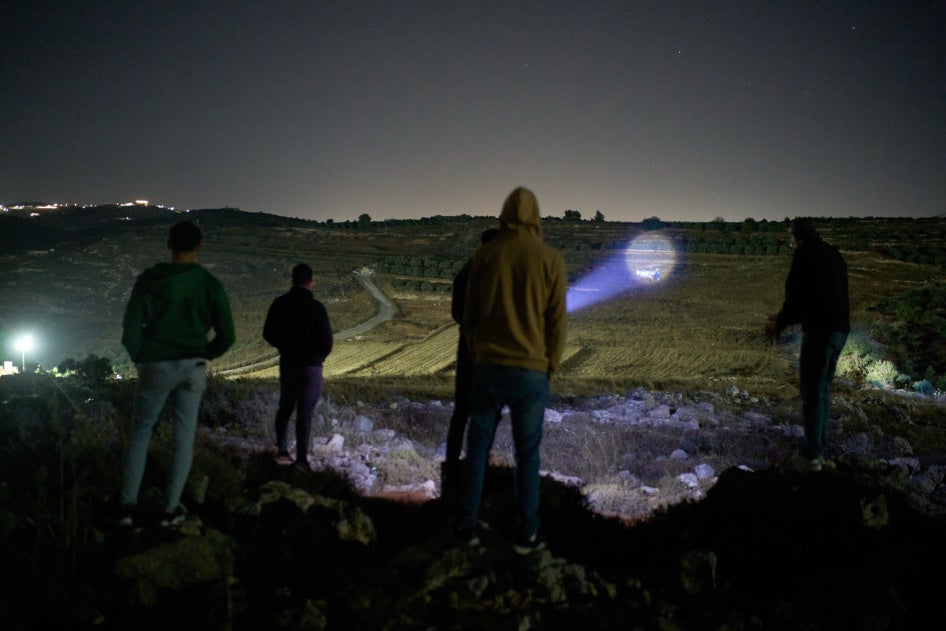
- Escalating Israeli settler attacks on Palestinians in the West Bank have fully or partially displaced 107 communities since January 2023 alongside unprecedented settlement expansion.
- Settlers responsible for attacks operate with the financial, material, and legal backing of the Israeli state. Attacks by armed settlers often occur alongside Israeli army units or with soldiers standing by.
- Other countries should impose targeted sanctions on those implicated in ongoing grave abuses, suspend arms transfers to Israel, ban trade with illegal settlements, and consider suspending preferential trade agreements with Israel.
(Beirut) – Attacks by settlers in the occupied West Bank are increasingly driving the forced displacement of Palestinian communities, with dozens at risk of erasure, Human Rights Watch said today. Israeli authorities are arming, funding, and granting impunity to the violent settlers responsible for these escalating deadly abuses.
Settler violence spiked in March and April 2026, with killings, including of children, as well as assaults, sexual violence, physical and mental abuse, arbitrary detention, arson, property destruction, and theft. The attacks occurred during the United States and Israel’s war with Iran, but the rising trend has been clear since the current government took office in December 2022.
“The Israeli government and the settlers share the same goal of maximum land and minimum Palestinians, with the authorities not only failing to stop settler violence, but actively enabling it,” said Sarah Sanbar, acting Israel and Palestine researcher at Human Rights Watch. “Settlers shoot, attack, and expel Palestinians from their land, and the state provides the weapons, the legal cover, and the budget to do it.”
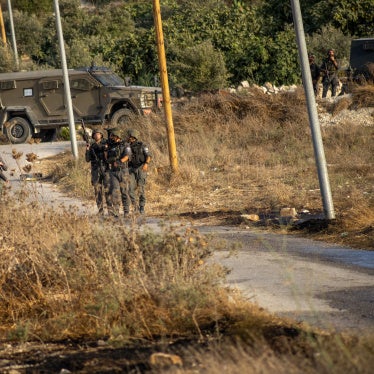
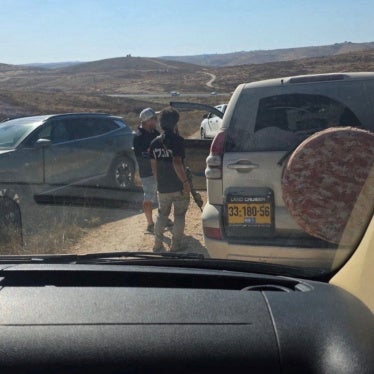
In April and May, Human Rights Watch investigated settler attacks in seven Palestinian West Bank communities: Al-Mughayyir, Mikhmas, and Taybeh, in Ramallah governorate; Jalud and Qaryut, in Nablus governorate; and Khirbet Humsa and Muarrajat East, in the Jordan Valley. Armed settlers, at times acting alongside Israeli army units or with soldiers standing by yet failing to intervene, attacked Palestinian residents and property, contributing to a pattern of forced displacement.
Human Rights Watch spoke to 20 witnesses and reviewed videos that witnesses filmed and CCTV footage of multiple incidents. The Israeli military has not replied to questions from Human Rights Watch about the attacks.
People interviewed reported organized attacks targeting Palestinians’ livelihoods and food security by restricting access to grazing land and water, stealing or killing livestock, and destroying or burning agricultural fields and crops. As a result, many either sold their livestock, often at a loss, or had to bear the cost of grain to feed them at home.
Human Rights Watch found that attacks increasingly target the area of the West Bank under joint Israeli-Palestinian Authority security control, known as “Area B” under the 1995 Oslo II Accords.
The attacks and lack of state protection have created a coercive environment that leaves many Palestinians saying they have no choice but to leave their homes, Human Rights Watch said.
“I have known war in this region for all my life, but never like this,” said Um Muhammad Muammar, 72, a resident of Qaryut whose two sons were killed by settlers. “My sons’ children are now fatherless; their wives are now widows. What more can we say?”
According to the United Nations Office for the Coordination of Humanitarian Affairs (OCHA), more Palestinians were forcibly displaced by settler attacks, demolitions, and evictions in the first four months of this year than the whole of 2025. OCHA has documented an average of 6.6 settler attacks per day that resulted in casualties, property damage, or both, higher than any year on its record.
While the Israeli military remains responsible for the majority of killings in the West Bank, fatalities attributed to settlers have risen sharply. OCHA recorded at least 15 Palestinians, including two children, killed by settlers as of July 24, putting 2026 on track to surpass OCHA’s previous record of 16 such killings set in 2023.
It found that settler violence has completely or partially displaced 107 communities comprising 5,900 Palestinians since January 2023. The Israeli military expelled another 32,000 Palestinian refugees from their West Bank homes in January 2025, essentially emptying the Jenin, Tulkarem, and Nur Shams camps. The E1 settlement project east of Jerusalem, for which the government opened a new construction tender on August 18, 2026, would forcibly displace over 18 more Bedouin communities in the area.
Settlers responsible for displacing Palestinians operate with the financial, material, and legal backing of the Israeli state. In March, the Times of Israel reported that the government had approved about 50 million shekels (about US$16 million) for illegal settlement outposts, funding that has been used for all-terrain vehicles, night-vision goggles, and drones that settlers use to harass Palestinian communities. According to Amnesty International, the Ministry of Settlement and National Missions’ budget has increased 122 percent under the current government.
Israeli authorities fail to prosecute settlers for violence against Palestinians, effectively granting them impunity. At the end of 2025, Yesh Din, an Israeli human rights organization, reported that of the hundreds of cases it had documented since 2005, only three percent had resulted in convictions. In November 2025, the Israeli news outlet N12 News reported a 70 percent drop in police cases against settlers for attacking Palestinians since Itamar Ben-Gvir became National Security Minister in 2022, despite the unprecedented rise in such attacks since then. Just one Israeli has been charged for killing a Palestinian in the West Bank since 2019, according to the Guardian.
The line between settlers and state security forces is deliberately blurred, making it difficult to distinguish settlers from soldiers. Following the October 7, 2023 attacks on southern Israel by Palestinian armed groups, the Israeli military called up 5,500 West Bank settlers who are army reservists and assigned them to West Bank “regional defense battalions.” These settler-soldier units act with wide autonomy, advancing settler objectives while holding full military authority and committing abuses against Palestinians with impunity.
At the same time, the National Security Ministry formed civilian “rapid response squads” in settlements and gave them special policing powers, uniforms, and weapons. Ben-Gvir also loosened licensing requirements for firearms, in some cases personally overseeing the distribution of rifles to settlers.
Settler violence and the displacement it causes are both a manifestation of and a vehicle for Israel’s expanding illegal settlement enterprise. In July 2026, Israeli Defense Minister Israel Katz told Channel 7 News that his government had approved the establishment of 104 new settlements since taking office, nearly doubling the total number from 127 to 231. During the war with Iran, the Israeli cabinet secretly approved what i24 News stated was the largest single settlement expansion in the history of the settlement enterprise, comprising 34 settlements, 10 of which were preexisting outposts that were retroactively “legalized” under Israeli law.
These outposts, which often serve as launching pads for attacks, are illegal under international humanitarian law. Lacking formal permits from the Israeli government, they are also considered illegal under domestic law, though the Israeli government frequently retroactively “legalizes” them. Their “legalization” under domestic law has no bearing on their continued illegality under international humanitarian law.
Under the current Israeli government, settlers have established 248 new outposts in the West Bank, 65 in 2026 alone as of August 1, according to Israeli group PeaceNow. Often serving as precursors to larger settlements, these outposts—and their retroactive “legalization” under domestic law—push the frontier of settlement expansion and the appropriation of Palestinian land. Katz told Channel 7 News that his government had “legalized” about 160 outposts during its tenure.
Israeli organizations Kerem Navot and PeaceNow reported in July that these outposts currently effectively control more than 1 million dunams (100,000 hectares) of land—approximately 18 percent of the West Bank—four times what they controlled before the current government took office.
Article 49 of the Fourth Geneva Convention prohibits an occupying power from forcibly transferring, displacing, or deporting the civilian population of an occupied territory in whole or in part. The only exception is temporary evacuation of an area if necessary for the security of the population or imperative military reasons. The International Committee of the Red Cross’s 2025 Commentary on the Fourth Geneva Convention notes that forcible transfers can be indirect when a party does not expressly order or is not directly involved in the deportation, “but commits violations of international humanitarian law or human rights law with the effect to cause the population to leave.” Article 49 also prohibits the occupying power from transferring its own civilian population into the territory it occupies.
The evidence shows that Israel has failed to uphold its obligations to protect against, prevent, investigate, and prosecute acts of violence against the occupied population and has further enabled this violence by continuing to provide material support for settler groups responsible for abuses against Palestinians, Human Rights Watch said. The reallocation of displaced Palestinians’ land for illegal settlements indicates that this displacement is not temporary and cannot be considered permissible evacuations under the Fourth Geneva Convention.
Other countries should act to prevent further atrocities across the Occupied Palestinian Territory, including by imposing targeted sanctions on those implicated in ongoing grave abuses, suspending arms transfers to Israel, banning trade with illegal settlements, considering suspending preferential trade agreements with Israel, and supporting the International Criminal Court and its ongoing investigations, including by executing its arrest warrants.
“The impunity Israeli authorities accord settlers stems directly from the free pass Israel’s allies and donors have granted it,” Sanbar said. “Accountability starts with the settlers committing crimes but doesn’t end there. Israel and the governments that give it a blank check share responsibility and should be held to account.”
In July 2024, the International Court of Justice found that Israel’s occupation of Palestinian territory is unlawful and that Israel is in breach of the prohibition of racial segregation and apartheid. The court found that Israel has systematically failed to prevent or punish settler attacks on Palestinians’ life and bodily integrity, concluding that settler violence, alongside land confiscation and resource deprivation, has contributed to the creation of a coercive environment.
The court further found that Israel’s policies and practices often leave little choice to Palestinians living in Area C—under Israeli security and civil administration—but to leave their area of residence, and that Israel’s practices are contrary to the prohibition of forcible transfer. The court found Israel has an obligation to evacuate all settlers in the West Bank including East Jerusalem, allow displaced Palestinians to return to their homes, and provide them with reparations.
Human Rights Watch has previously found that Israeli authorities intentionally caused the massive, deliberate, and long-term forced displacement of Palestinian civilians in both Gaza and the West Bank, amounting to ethnic cleansing, war crimes, and crimes against humanity. In both cases, senior Israeli officials have declared their aim to expel and keep Palestinians out of parts of Gaza and the West Bank.
Human Rights Watch has previously called for forced displacement and prevention of the right to return committed by Israeli authorities in Gaza to be investigated as a crime against humanity. Human Rights Watch has called for investigating the military officials Maj. Gen. Avi Bluth, Lt. Gen. Herzi Halevi, Lt. Gen. Eyal Zamir, Prime Minister Benjamin Netanyahu, Defense Minister Israel Katz, and Defense Minister Bezalel Smotrich for individual criminal responsibility, including as a matter of command responsibility, for war crimes and crimes against humanity committed in the context of the forced displacement of the Palestinian population in the West Bank.
Attacks on Palestinian Communities
Khirbet Humsa
On March 13 at 1 a.m., Suhaib Abu al-Kebash, a 29-year-old shepherd, said that he, his family, and two international activists woke to loud voices and dogs barking. He left his tent and saw what he estimated to be 80 to 100 masked settlers descending on their tents from multiple sides:
They caught me and handcuffed me with [plastic zip ties] and also bound my legs. They took down my trousers and put my genitals in [a zip tie], and they put me on the floor, between 8 and 10 of [the attackers]. They broke the lights and they started to beat me with their fists in my face. They hit my father and my brother with sticks. My brother was stabbed in the hand. He was beaten everywhere.
They put us all in one tent; all of us were handcuffed [zip tied], even the children. One threw my daughter three meters. They took soil and water and threw it on us. They called us names, cursed us, and threatened us. They said: “If you stay here, we will kidnap your wife and daughters, we will beat them, we’ll do anything. If you are still here tomorrow, we will come back and burn you and burn your tents.”
An April report by the West Bank Protection Consortium found that “Israeli settlers are subjecting Palestinians to sexualised violence and other forms of gender-based abuse within a broader coercive environment that forces displacement across the West Bank.”
“We are scared any time a car comes to our area,” said Muhammad Abu al-Kebash, Suhaib’s brother and also a victim of the attack. “The children are traumatized.”
After the attack, Muhammad called the Israeli police, army, and an ambulance. He said the soldiers and police arrived two hours later and gave them first aid, but authorities stopped two Palestinian Red Crescent ambulances on Allon Road at the entrance to the Ro’i settlement, three kilometers away. Only one of the two ambulances was permitted to reach Khirbet Humsa after waiting for two hours.
Israeli authorities detained seven settlers involved in the attack that night, but they have been released until their scheduled hearing date, an Israeli activist with knowledge of the case said.
Though many neighboring herder communities have fled because of settler attacks, the Abu al-Kebash family is committed to remaining in Khirbet Humsa. “We need money or support, but whether or not we get it, we will stay here,” said Muhammad. “The only place we will go from here is the grave.”
According to Israeli human rights organization B’Tselem, between October 7, 2023, and December 31, 2025, settler violence led to the total or partial displacement of at least nine communities in the northern Jordan Valley, affecting at least 435 people, including 207 children.
Muarrajat East
Sustained attacks and harassment from Israeli settlers forced the residents of Muarrajat East, a Bedouin herding community northwest of Jericho in the Jordan Valley, to flee on the evening of July 4, 2025. The entire community of 50 families, refugees from the Naqab (Negev) in 1948, remain displaced and unable to return. Muarrajat East is in Area C, which under the Oslo II Accords is under civil and security control of Israeli authorities and comprises 60 percent of the West Bank’s territory.
Alia Mleihat, 28, a resident of the community and university student studying security and peace, said that the attacks began in 2021, when an illegal settler outpost was established on a hilltop nearby. “The settlers started to ban people from circulating on the land, and they began attacking people with the protection of the police and army,” she said. “They used to steal our sheep while the police and army watched.”
After October 2023, she said, attacks against the community intensified. Settlers, emboldened by state policies and army protection, engaged in a pattern of attacks documented in other communities: destroying property, demolishing wells and solar panels, stealing livestock and feed, and assaulting and threatening residents.
“The settlers are the ones who give orders to the army, not the other way around,” she said. “When the settlers attacked our community, the police and soldiers would close the gates around the village so no one could get out or get in to help us. We felt like we were in prison.”
On July 3, 2025, settlers established an outpost in the village center, 100 meters from the community’s school: “Settlers brought their animals and occupied the school. They banned students from going to school and denied the community access to their water resources. One family was forced to leave their house, and the settlers took it over.”
“That night, the settlers came between our houses driving [utility vehicles] and carrying weapons,” she said. “They forced [us] the people of the community to leave the land of our village in the middle of the night. It was like another Nakba [“catastrophe,” the term used to describe the mass displacement of Palestinians in 1948]. It was an atmosphere of war.”
By July 4, 2025, the entire community had fled Muarrajat East.
In February 2026, settlers demolished the remaining houses in the village following a February 4 Israeli court order for the Israeli military, the Civil Administration, and the police to enable the community’s safe return. “They destroyed all the houses to make sure we could never come back,” Mleihat said.
Forcible transfers can also be effected through acts deliberately aimed at preventing or impeding the return of the population.
Although the community moved to al-Awsaj, in Area A near Jericho, where the Palestinian Authority holds security and civil authority, attacks and harassment from Israeli settlers continue. “We came here because it’s Area A, and we thought it would be safe for us, but we were wrong,” Mleihat said. On May 3, the day before Human Rights Watch visited al-Awsaj, settlers drove through the community, harassing residents and threatening to steal livestock. “They will continue to attack us until they make us flee into Jordan.”
A June 2026 report by Amnesty International found that Israeli authorities have pursued a policy of ethnic cleansing in Area C of the occupied West Bank, and that Israel’s forcible displacement of Palestinian Bedouin and herding communities amounts to war crimes and crimes against humanity under international law.
Al-Mughayyir
Al-Mughayyir, a village northeast of Ramallah, has been a focal point of increasing settler violence in recent years. In 2025 alone, OCHA recorded at least 43 settler attacks against Palestinians in the village that caused casualties or property damage, equaling the number of such incidents in the preceding two years combined. Since 2023, settlers or soldiers have killed three boys and four men in al-Mughayyir, according to OCHA. Two of these people were killed in a settler attack on a school on April 21, 2026: Jihad Abu Naim, 32, and his nephew, Aws Hamdi Naasan, 14. Human Rights Watch interviewed their family members and other witnesses 11 days later and verified 9 videos from the incident.
Waheed Abu Naim, Jihad’s brother and a teacher at the school, said that shooting erupted near the boys’ school on the western edge of the village at around 12:15 p.m. on April 21. He said that two settlers wearing incomplete military uniforms and four soldiers approached the school premises. All six were armed.
He told the soldiers that children were studying in the school. One soldier told him, in Arabic, to go home. Another pointed his gun at Waheed and told him to get inside the school: “It was then that I understood that they are here to commit a crime.” He went back into the school and closed the gate, and the shooting started.
According to witness statements and video evidence verified by Human Rights Watch, a settler opened fire on the school from the hillside overlooking it. One video shows the moment the settler shot Aws in the head as he ran down the hill away from the shooter, on the outer side of the school wall. Researchers went to the site and saw multiple bullet holes in the school wall.
Marzouq Abu Naim, Jihad’s father, said that the school director issued a plea for help on his social media account after the shooting started. Jihad left his work at a construction site and went to the school to respond to the plea. According to video evidence and witness statements, he was shot in the right side of his chest at the top of the hill. Residents transported him to a hospital in the neighboring town of Khirbet Abu Falah, where he was pronounced dead. Settlers shot and injured two other people during the attack: a man in his thirties in the stomach and a man in his sixties in the leg, witnesses said.
Human Rights Watch wrote to the Israeli military requesting information on any investigations opened into the incident but received no response.
Escalating settler attacks in al-Mughayyir have taken a particularly heavy toll on Aws and Jihad’s family. Settlers killed Aws’ father, Hamdi, on January 26, 2019. Family members said that Israeli soldiers shot dead Aws’ best friend, Mohammed Naasan, 14, in the village in January 2026.
Rehab Naasan, Aws’ paternal grandmother, said: “Aws said to me: ‘If something happens to me, bury me next to my friend.’ I told him: ‘Please don’t speak like this. We could not bear anything happening to you; we already lost your father.’ But he insisted. The day after, he went to school and he didn’t come back.”
Residents of al-Mughayyir said nine settlement outposts encircle the village, seven of them established since 2023, including one in Area B. Residents said the establishment of these outposts coincided with the significant increase in settler attacks against the village.
The largest outpost, Adei Ad, was “legalized” by the Israeli government as a settlement in May 2025 and serves as a hub for the others around al-Mughayyir. The Israeli government “legalized” another nearby outpost, Malachei HaShalom, on June 11, 2025, and designated 750 dunams (75 hectares) of land around it as state land.
The Israeli military has closed all but one road leading into and out of the village. A village council member said that settlers have stolen or prevented access to 98 percent of al-Mughayyir’s land, including all the village’s grazing lands and olive groves, with severe impacts on people’s livelihoods.
In August 2025, the head of the Israeli military’s Central Command signed an order for the uprooting of olive trees on 300 dunams (30 hectares) of al-Mughayyir’s land, ostensibly for security reasons after a Palestinian reportedly shot and wounded a settler who had trespassed on the village’s land. According to Kerem Navot, settlers from the Shiloh area carried out clearing operations on about 620 dunams (62 hectares), more than twice the area covered by the order. After the uprooting, settlers took over parts of the land.
Al-Mughayyir also hosts around a dozen families first displaced from Ein Samia to al-Khalayil, on the outskirts of al-Mughayyir in Area B, in May 2023 following sustained settler attacks. In February 2026, they were displaced again from al-Khalayil to al-Mughayyir by the Israeli military, who cited an order declaring the area a “closed military zone.” According to +972 Magazine, less than a month later, settlers erected an outpost on the site from which the families were displaced.
“They do these attacks because they see us as an obstacle to their aims, so they want us either to leave or die so they can take our lands,” a resident said. “But we know our history. We would rather die in front of military vehicles than leave our land.”
Qaryut
Qaryut, a Palestinian village between Ramallah and Nablus, has faced repeated attacks by Israeli settlers. “I have known war in this region for all my life, but never like this,” said Um Muhammad Muammar, 72. “My sons’ children are now fatherless; their wives are now widows. What more can we say?”
Around noon on March 2, 2026, settlers attacked Um Muhammad’s family house. She said that settlers shot three of her sons: Jamil, 46, Fahim, 48, and Muhammad Muammar, 52. The eldest two brothers were killed, while Jamil survived but walks with crutches from the bullet wound in his leg.
Jamil said that on the morning of the attack, he and his brothers went to see the source of a noise on the land behind their house and saw two settlers operating an excavator. He said that upon seeing them, one of the settlers fired shots in the air, and the brothers did not approach them.
Shortly afterward, he said, two settlers, one in uniform, approached the brothers who were watching the excavator from behind their house. “[The settler in uniform] tried to arrest one of us, without any question or reason to arrest us,” he said. “He started to threaten us, saying ‘you will see what I will do.’ […] He started to shoot in the air. […] We didn’t speak or argue, we went back home and sat under this olive tree.”
About 15 minutes later, a group of 30 to 40 settlers, including the settler in uniform who attempted to arrest them earlier, approached the house. He said two of them were carrying M16s, and three or four others had pistols: “The settlers started to throw stones against the house and broke the windows, and others shot the ground around us. Those who had guns started shooting, those without threw stones.”
He said that the uniformed settler, kneeling in a sniping position, shot Muhammad in the head and Fahim in his stomach. Jamil and some neighbors who came to help eventually managed to reach the brothers under continued gunfire. He said that two other neighbors who came to help were also shot and injured, one in the hand and one in the chest.
“We put them in our private cars and sent them to the medical center,” he said. “I stayed and went back to the house to protect it and the children and wives.” He said he was shot by the same sniper who killed his brothers when he approached his house.
He said that Muhammad was pronounced dead at the hospital, while Fahim succumbed to his injuries at the Qabalan medical center. Bashar al-Qaryuti, a first responder and activist based in Qaryut, said that during the attack, the Israeli military closed the road to the area, obstructing the ambulance and preventing him and other neighbors from reaching the family quickly.
“[Fahim] was injured, but they didn’t allow the ambulance to reach him on time,” his mother said. “Maybe he would still be alive if they had. [Fahim] was still conscious, his son was around him, he was even laughing.”
Al-Qaryuti said that the deliberate disruption of medical transport is a common occurrence in Qaryut, and that Israeli settlers have attacked his ambulance and team on at least five occasions. In April 2024, a settler shot and killed his ambulance driver, Mohammed Awad Allah Musa, as he and his team were evacuating injured Palestinians from an ongoing attack in nearby al-Sawiya, al-Qaryuti said.
He meticulously documented the incident, gathering evidence including photos, videos, and the bullet that killed Musa, which he turned over to the police and the army. Despite his efforts, to his knowledge, there was no investigation into the case.
“It is impossible to reach justice through the Israeli legal system,” he said. “I am ready to provide any court with all information, with pictures, with evidence, with documents, to testify in front of them. There is no accountability against settlers, and this is why they increase their attacks against Palestinians.”
Instead, sometimes soldiers and police intervene to support the settlers. “The military supports them fully,” he said. “Some of the soldiers are settlers themselves.”
A statement issued by the Israeli military spokesperson following the March 2, 2026 incident said: “IDF forces rushed to the area of the village of Qaryut, which is under the Samaria Regional Brigade, following a report of altercations between Israeli civilians and Palestinians that included stone throwing. Later, a report was received of two Palestinians who were killed as a result of shooting and several Palestinians who were wounded. Upon receipt of the reports, a command field inquiry was immediately launched at all levels and found that the shooter was an active IDF reservist. After the inquiry, he was stripped of his weapon. A criminal investigation has been opened following the incident.”
Settlers or soldiers have killed three Palestinians in Qaryut since October 2023. In addition to these cases, B’Tselem reported that soldiers escorting settlers shot and killed Bana Labum, 13, firing into her bedroom window on September 6, 2024.
Qaryut has also lost significant amounts of agricultural land, particularly since October 2023, and is surrounded by seven outposts, residents said. Al-Qaryuti said that of the 22,000 dunams (2,200 hectares) of the village’s land, only 360 dunams (36 hectares), all in Area B and comprising the built-up sections of the village, remain accessible to residents of Qaryut.
“Before it was easier,” Um Muhammad said. “They have always been stealing and occupying the land, but it was never like this. Ever since [the settlers] came, they started to suffocate us bit by bit.”