(Beirut) – Egyptian authorities are denying medical care to a death row prisoner with an apparent brain tumor, following a forced disappearance and an unfair trial, Human Rights Watch said today.
The Egyptian authorities detained the prisoner, Ahmed al-Waleed al-Shal, in 2014 shortly after he graduated from medical school at age 24. He was convicted in a mass trial for alleged involvement in a violent attack, and sentenced to death following confessions he told prosecutors and his family were obtained through torture. For over a decade, his family said, he has been held in abysmal conditions and denied appropriate medical care for an apparent mass in his brain. In recent months, his symptoms have drastically worsened.
“The Egyptian authorities have inflicted immense suffering on Ahmed al-Waleed al-Shal and his family by failing to provide him necessary medical care despite an apparent brain tumor,” said Amr Magdi, senior Middle East and North Africa researcher at Human Rights Watch. “Allowing al-Shal immediate surgery and freeing or transferring him on medical grounds, given the years of failure to provide adequate medical care, would be a long-overdue act of justice.”
Al-Shal was convicted in the February 28, 2014, murder of Abdullah al-Metwally, a guard of one of the judges who tried former president Mohammed Morsy after he was removed from office in 2013. The National Security Agency responded with mass arrests, detaining nearly two dozen alleged members of the Muslim Brotherhood, an Islamist group that to which Morsy belonged. Al-Shal’s mother, Nasiela Haroun, told Human Rights Watch that authorities arrested him on March 6, 2014, outside his university and forcibly disappeared him, ignoring inquiries about his whereabouts.
On March 12, the Interior Ministry published a statement regarding eleven men arrested in this case, and a video showing three of them, including al-Shal, confessing to crimes. A prosecutor’s office only informed the family of al-Shal’s whereabouts weeks later, his mother said.
The authorities brought terrorism-related charges against 23 men, including al-Shal, and a 17-year-old child, for allegedly shooting and killing al-Metwally in al-Mansoura city. On September 7, 2015, a criminal court convicted and sentenced nine men, including al-Shal, to death following a flawed mass trial. In June 2017, the Cassation Court upheld the death sentences against six of them, including al-Shal. Based on court documents Human Rights Watch reviewed, four of the twenty-four were eventually acquitted.
Haroun said that when the family finally visited al-Shal in the infamous Scorpion Prison several weeks after his initial arrest, he had wounds consistent with cigarette burns “arranged in geometrical shapes” on his neck. She said he told her and other family members that, while he was disappeared, officers at two National Security Agency sites, in al-Mansoura and Cairo, severely tortured him, including with electric shocks, cigarette burns, suspension by his legs, and inserting a wooden stick in his anus, to force confessions.
She said that officers told him they would arrest and rape her if he refused to sign confessions and threatened more torture if he changed his account before prosecutors. Despite his apparent marks of torture, prosecutors ignored al-Shal’s request for a forensic examination, based on court records Human Rights Watch reviewed. A defense memo Human Rights Watch reviewed cited a doctor who examined al-Shal upon arrival to the prison as stating that, “nothing negates the possibility that his wounds could have been caused according to the way he described to prosecutors.”
Al-Shal’s family contend that he was targeted because of his peaceful activism. Haroun said he participated in anti-government protests following the 2013 military coup while holding posters of his brother, Khaled, a veterinarian killed by police during the violent dispersal of the mass Rabaa sit-in in August 2013.
Haroun said al-Shal experienced several years in abysmal prison conditions in Wadi al-Natroun Prison in a 1.5 by 2.5 square meter cell with three other prisoners, taking turns sleeping on the floor. The guards let them use a toilet outside the cell once a day, she said.
Haroun said that between 2002 and 2005, he had surgery twice to remove a benign brain tumor. Human Rights Watch reviewed supporting medical documents. While he was in prison, she said, his health deteriorated, with balance difficulties, right hand motor disorder, headaches, dizziness, and double vision. Haroun said that prison doctors for years did not offer him appropriate medical care.
After multiple complaints, she said, he was taken to a public hospital in 2023, where, after an MRI, a neurosurgeon informed him of a mass in his brain, saying he needed surgery urgently. Officers instead took al-Shal back to prison, Haroun said.
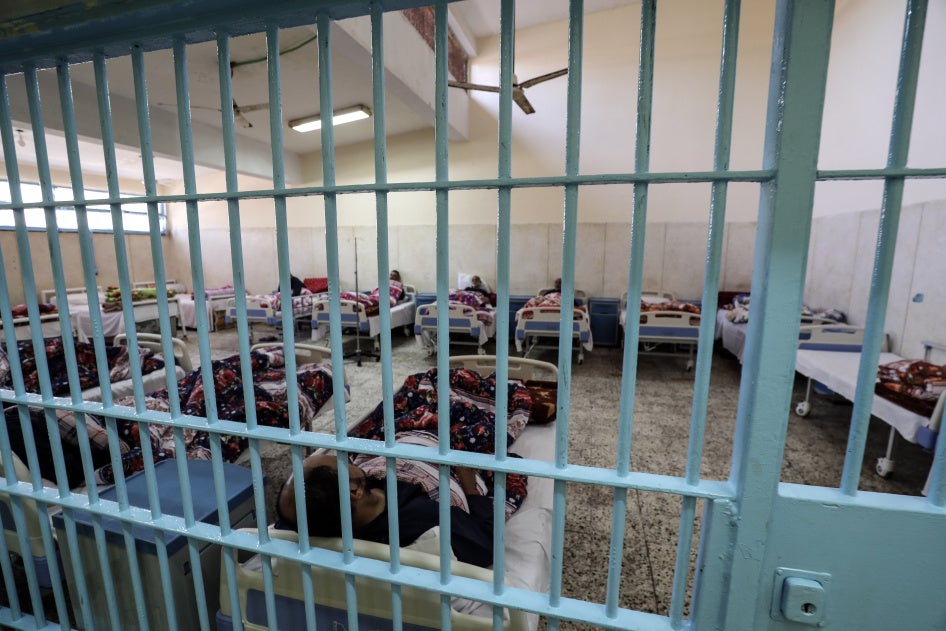
After several other complaints to the cabinet, public prosecutor’s office, and the Interior Ministry, Haroun said, the administration transferred al-Shal to the medical central in Wadi al-Natroon Prison Complex in 2023, where he has been ever since. After his condition worsened, she said, the prison hospital conducted another brain image in 2026, but a doctor refused to tell him the results and told him he had “nothing,” and that his symptoms were “psychological.”
However, al-Shal’s mother said the family feared that the mass in the brain had increased in size given his deteriorating symptoms. The prison administration never allowed the family access to his medical records, and a prison guard told the family informally that only “National Security” could let him undergo surgery, his mother said.
The authorities should provide al-Shal with immediate adequate medical care, including releasing him from detention on humanitarian medical grounds, or transferring him to an equipped medical facility qualified to provide adequate care, Human Rights Watch said. The authorities should also ensure him a fair retrial.
The Committee for Justice, an independent group, said in a report that prosecution documents and defendants’ accounts showed that at least seven other defendants in the case were disappeared for periods of up to three months. It said that the documents also show that all those sentenced to death retracted their confessions in court and told prosecutors they had been severely tortured. Prosecutors referred only some for forensic examination, with significant delays.
Human rights groups reported that many defendants had no lawyers present during interrogation. A Human Rights Watch review of prosecution documents found no record of inspection of any of the places named as secret detention sites or officers identified in alleged torture. Court documents showed that judges based their decisions mainly on an unsubstantiated, even contradictory, National Security Agency account despite a lack of corroborating evidence.
The Office of the UN High Commissioner for Human Rights, UN independent mechanisms, and the African Commission for Human and Peoples Rights have repeatedly condemned unlawful mass death sentences in Egypt. Several UN experts and working groups expressed “serious concern” over the death sentences against al-Shal and his codefendants over due process and fair trial concerns and said that if they were executed, it would amount to “arbitrary executions.”
The authorities should uphold Egypt’s obligations, including under the Convention against Torture and other Cruel, Inhuman or Degrading Treatment or Punishment and investigate the alleged torture and ill-treatment of al-Shal and his codefendants. Human Rights Watch opposes capital punishment in all countries and under all circumstance as unique in its cruelty and finality, and is inevitably and universally plagued with arbitrariness, prejudice, and error.
“Executing a man following torture-tainted confessions and years of denied medical care would be grossly unjust,” Magdi said. “Granting al-Shal a medical pardon and his fellow defendants a fair retrial would be a positive step in Egypt’s long road to fixing its broken justice system.”