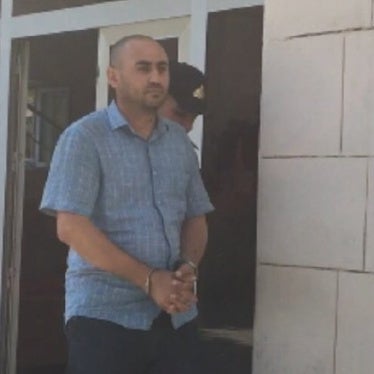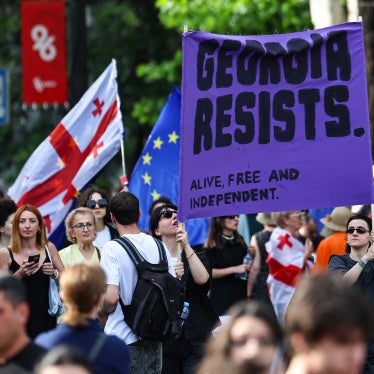
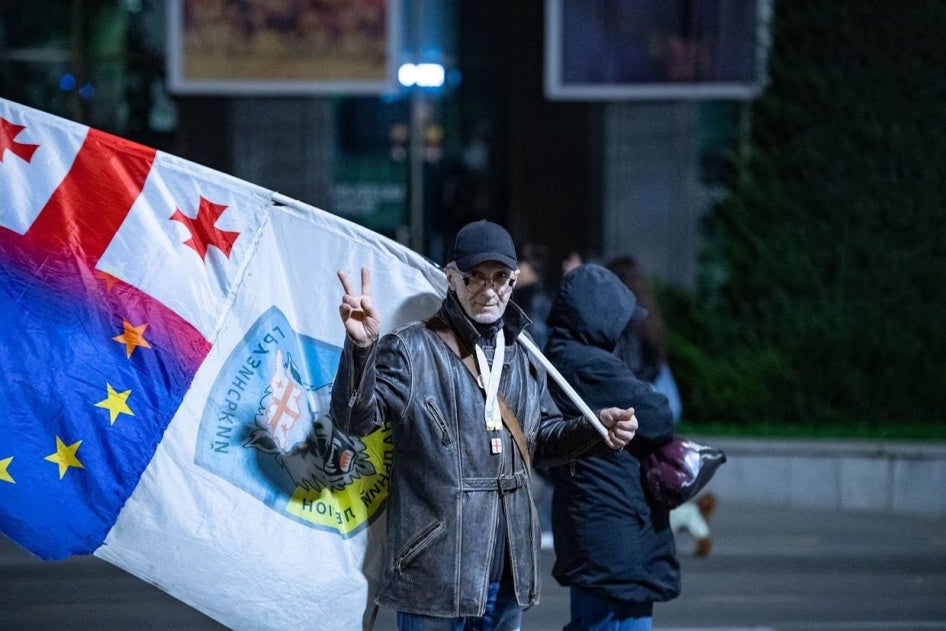
Georgia’s crackdown on dissent reached a dangerous new low last month when a Tbilisi court sentenced activist Zurab Menteshashvili to nine months in prison for participating in a peaceful protest. The case highlights how Georgia’s recent protest-related legislative amendments are being used to turn peaceful acts of dissent into criminal offenses.
On May 29, the court convicted Menteshashvili, 61, for standing on a roadway and blocking traffic during a protest outside Georgia’s parliament building in October. Police had first detained Menteshashvili on October 24, 2025, for similar conduct, and a court sentenced him to seven days’ detention. After his release, Menteshashvili attended another peaceful protest and was arrested again on October 31. Prosecutors this time charged him under amendments adopted on October 16, 2025, that criminalized repeated violations of assembly-related regulations. Outrageously, he has been in pretrial detention since November 1, 2025, and is expected to remain imprisoned until August 1, 2026.
Menteshashvili’s lawyer told Human Rights Watch that his client has no prior criminal convictions. He also said prosecutors did not accuse Menteshashvili of blocking traffic but alleged that he stood on a roadway other protesters had already blocked earlier.
Menteshashvili’s case is unfortunately not isolated, as several activists await trials on similar charges. Shalva Esartia, for example, is an activist from Zugdidi also currently in pretrial detention. Authorities charged him for allegedly disobeying police after he had received previous administrative sanctions for similar conduct. Pretrial detention for protest-related, often lasting months, for nonviolent offenses is unjustified and raises serious concerns that the authorities are using detention to punish dissent rather than as a measure of last resort.
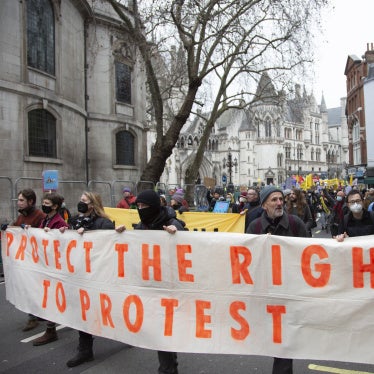
International human rights law protects peaceful assembly, including protests that may temporarily disrupt traffic or ordinary public life. Criminal penalties for peaceful protest require exceptional justification and must meet strict tests of legality, necessity, and proportionality. The European Court of Human Rights has repeatedly held that peaceful participation in demonstrations should not, in principle, expose people to criminal liability.
Georgian authorities should quash Menteshashvili’s conviction, release him, and drop criminal proceedings against all those prosecuted solely for peaceful protest. Parliament should likewise repeal provisions that allow the authorities to criminalize repeated administrative offenses related to peaceful assembly.