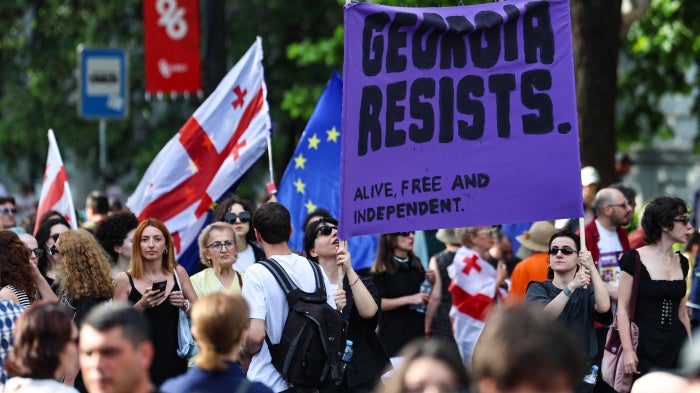
Georgia’s human rights record sharply deteriorated in 2025 as the ruling Georgian Dream party adopted sweeping laws aimed at decimating the country’s vibrant civil society and silencing critical media. Authorities also excessively interfered with largely peaceful protests. The measures go against Georgia’s human rights commitments on freedoms of expression, assembly, and association, as well as on equality and non-discrimination. New “foreign agents” legislation, adopted in March, requires organizations and individuals receiving foreign funding to register in the state registry and imposes onerous reporting obligations under threat of criminal prosecution. Other repressive amendments require governmental approval for all foreign grants and further curtail peaceful protests, independent media, and free speech. Authorities also approved the removal of the term “gender” and “gender equality” from all laws and abolished the parliament’s Gender Equality Council.
The October municipal elections were held amid a sweeping crackdown on dissent and a partial opposition boycott. On election day, tens of thousands of people rallied to protest the government’s repressive policies. The demonstration escalated into unrest when some protesters attempted to storm the presidential palace. Police arrested over 60 people on charges of inciting violent overthrow and attempting to change the constitutional order.
The European Union and its member states denounced the backsliding as an “assault on fundamental rights,” recalling that Georgia’s accession process remains “de facto halted.” They called on Georgia to reverse the crackdown and repeal the repressive laws. In January, the EU suspended visa-free travel for holders of Georgian diplomatic and service passports. Several EU countries also imposed travel bans on senior government officials. In July, Brussels warned about possible suspension of visa-free travel for Georgian citizens if the country failed to fulfill key human rights-related obligations. In its enlargement report published in November, the European Commission said Georgia “further derailed from the EU path,” and described it as a “candidate country in name only.”
Freedom of Association
In March, parliament adopted a “foreign agents“ law, requiring individuals and entities to register as “foreign agents” if they operate under the vaguely defined “influence” of, or receive funding from, a foreign principal and engage in “political activities” in the interests of this principal. It also obliges them to file onerous annual financial declarations with excessive details, submit two copies of any public statement within 48 hours of publication, and mark all such statements with the “foreign agent” label. Failure to register carries criminal fines up to 10,000 GEL (about US$3,700) and/or a maximum five years in prison, while noncompliance with reporting or labeling requirements can result in fines up to 5,000 GEL (about US$1,850) or six months’ imprisonment. The law poses an existential threat to Georgia’s civil society. It is an escalation from similar legislation adopted in May 2024—the Law on Transparency of Foreign Influence—which remains in force but envisages mostly administrative sanctions for noncompliance.
In April, the ruling party amended the Law on Grants to require governmental approval for any foreign donor funding to local organizations. Receiving a grant without official approval results in a fine equal to twice the amount of the grant. In June, amendments extended the approval requirements to “technical assistance” and “knowledge sharing.”
In June, at least eight leading civil society organizations received court orders demanding that they file an inordinate number of documents, including sensitive and confidential information about survivors of human rights violations who had received pro bono legal aid.
In August, the Anti-Corruption Bureau, the state agency responsible for enforcing the “foreign agents” law, sent notices to seven out of the eight NGOs, demanding explanation for not registering as foreign agents and warning of criminal liability. The bureau sent inspection notifications to dozens of other NGOs following the amendments to the Law on Grants in April.
In March, authorities froze the bank accounts of five civil society groups, including Human Rights House Tbilisi and Shame Movement, on spurious allegations that they had used donor funds to support protesters during the 2024 demonstrations. In August, authorities also froze the accounts of seven prominent NGOs—the International Society of Fair Elections and Democracy, Institute for Development of Freedom of Information, Georgian Democracy Initiative, Union Sapari, Social Justice Center, Civil Society Foundation, and Democracy Defenders—as part of a criminal investigation for alleged “sabotage.” Officials claimed that the groups used their project funds to support demonstrators who committed “violent acts” against police. The prosecutor’s office also summoned several heads of those NGOs to testify in the same probe.
Freedom of Assembly and Excessive Use of Police Force
Massive, nationwide protests erupted after the ruling party’s November 2024 decision to abandon Georgia’s EU accession process. Police and other security forces repeatedly used brutal and excessive force against largely peaceful demonstrators, chasing down, encircling, and beating protesters, and subjecting many to torture and ill-treatment in police custody. Riot police and informal violent groups associated with the authorities harassed and attacked opposition activists and independent journalists. Survivors reported head trauma, broken noses and facial bones, concussions, rib and limb fractures, and scratches and bruises all over their bodies. Some women protesters reported that police had threatened them with sexual violence.
Police wore riot gear or full-face masks, with no visible insignia, hindering accountability for excessive use of force. Although authorities launched some investigations into allegations of police abuse, at the time of writing, they had not identified or prosecuted any officers responsible.
In contrast, the authorities charged hundreds of protesters with the administrative or misdemeanor offense of police disobedience and prosecuted them in perfunctory trials. Authorities also prosecuted dozens of protesters on spurious criminal charges, including for alleged use of violence against law enforcement, sentencing at least 35 protesters to lengthy prison terms.
In June, authorities dismantled Special Investigation Service, an independent agency established in 2022 to investigate crimes committed by law enforcement officials, and transferred its functions to the prosecutor’s office, further eroding accountability.
In February, the parliament passed several restrictive amendments to the administrative and criminal codes, raising maximum administrative detention from 15 to 60 days, introducing fines and jail time for “verbally insulting” public officials, and criminalizing “resisting law enforcement” and public calls to civil disobedience.
In June, based on complaints made by ruling party members, a court fined over a dozen activists for critical social media posts, some of which included offensive language against ruling party members. The court deemed them to constitute “insult” and issued fines ranging from 3,000 to 4,000 GEL (US$1,100 – 1,500). Parliament later added detention as a penalty for failure to pay fines imposed for the administrative offenses of insulting a public official, petty hooliganism, disobeying police orders, and violating protest rules.
In October, authorities further increased penalties for protest-related offenses, introducing administrative detention of up to 60 days and criminal liability of up to 4 years’ imprisonment for repeat violations.
In December 2024, parliament adopted amendments that authorized police to “preventively” detain individuals for 48 hours if they had previously been implicated in an administrative offense and were deemed likely to reoffend.
Jailing of Political Opposition
Courts convicted eight opposition politicians, including six opposition party leaders, sentencing them to months in jail for boycotting the ruling party’s parliamentary investigative commission tasked with probing alleged crimes by the former President Mikheil Saakashvili’s government. Two of them were released under a presidential pardon in September.
In September, authorities arrested another opposition leader, Levan Khabeishvili, on bribery charges over his public promises to pay money to riot police if they refused to disperse protesters. Prosecutors later added an “inciting coup” charge.
Freedom of Expression and Media
In April, parliament adopted amendments to the Broadcasting Law, banning all foreign funding and in-kind assistance to broadcast media and expanding the power of the Communications Commission, a body dominated by ruling party appointees, to regulate broadcasters’ content. Local groups warned the changes would stifle critical and independent media.
In June, the ruling party filed complaints with the Communications Commission against two major opposition-leaning channels, Formula and TV Pirveli, for, among other things, questioning the government’s legitimacy in their reporting language. The complaint challenges the use of such language as “illegitimate government,” “regime,” and “state capture.” The commission has the authority to impose sanctions, ranging from warning and corrective actions to suspension or revocation of a broadcasting license.
Another set of legislative amendments narrowed protections for individuals and media facing defamation lawsuits. The amendments reverse the burden of proof to the defendant, remove the presumption in favor of free speech, eliminate source protection, limit public interest exceptions, and increase liability for defamation. Defendants, including journalists, will be required to prove the truth of their statements, rather than plaintiffs proving that their statements are false.
In August, a court sentenced Mzia Amaghlobeli, a well-known journalist and founder of the independent newspaper Batumelebi and online outlet Netgazeti, to two years in prison on politically motivated charges of “resistance, threat, or violence against a public official” over slapping a local police chief during a tense night of protests in January. International organizations and diplomatic missions condemned the conviction as “politicized and disproportionate.”