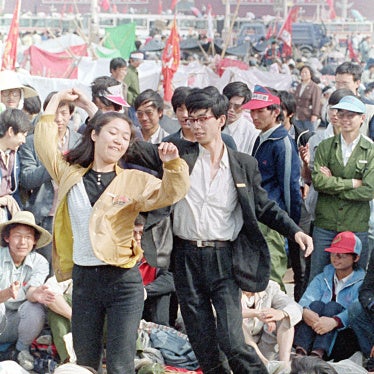

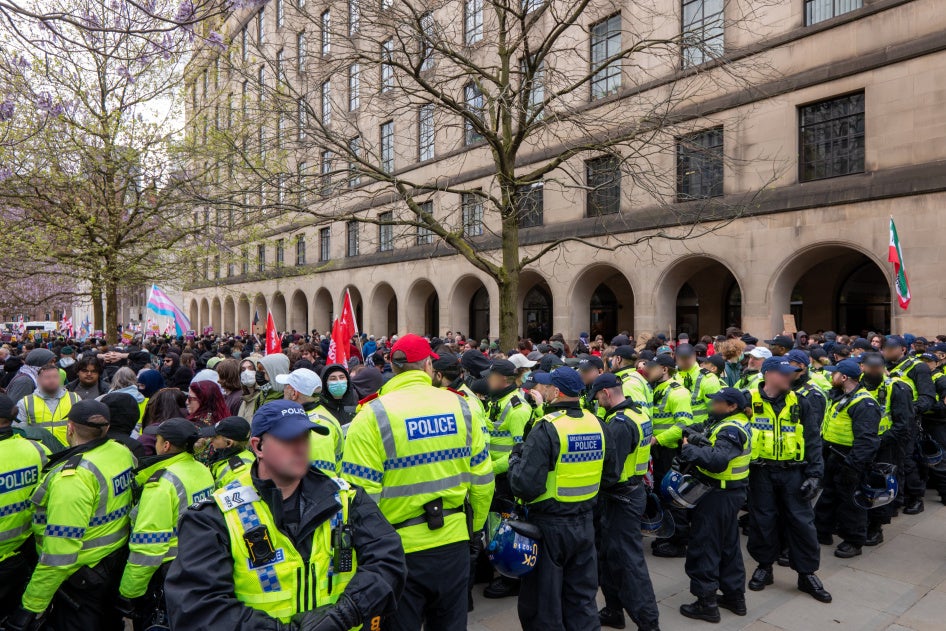
Tens of thousands of protesters marched simultaneously through central London on 16 May in two separate large-scale demonstrations. Though the protesters were from opposing sides of the political spectrum, the protests were, by and large, peaceful—calling into question the need for the cumulative disruption and house of worship provisions enacted as a part of the Crime and Policing Act 2026, which were not yet in force and therefore could not be invoked.
The legislation is the latest in a string of steps that successive UK governments have taken to restrict the right to protest, as described in Human Rights Watch’s report Silencing the Streets.
One of the most troubling provisions of this new law gives police the power to restrict protests based on the “cumulative disruption” caused by other protests in a given area. However, the legislation provides no definition of what constitutes “an area.” In practice, this could allow police to shut down protests across large parts of cities in England and Wales and raises concerns about arbitrary decision making and discretionary enforcement.
The idea of “cumulative disruption” also means that protests don’t need to be connected to each other to be restricted. For example, a climate protest could be curtailed because of disruption caused by an unrelated anti-war march that took place days earlier. Already, Prime Minister Keir Starmer has signaled that this power may be used to block pro-Palestinian protests.
Even if protests are linked, decisions to restrict freedom of expression and peaceful assembly should be made on a case-by-case basis. But this law leaves the door open for officials to impose arbitrary restrictions on protest without any clear, individualised assessment of necessity and proportionality.
The cumulative disruption law ignores a basic democratic reality: Protest movements rarely succeed overnight. They are often disruptive by design, and it is precisely their cumulative impact that drives change. From the suffragettes to the anti-apartheid movement, sustained protest has been a catalyst for political action when governments have failed to move.
A law that criminalises cumulative impact attacks the very mechanism by which civil society holds power to account. Along with other measures in the Crime and Policing Act 2026, this provision makes the UK a less free and less democratic society and creates a framework that future governments could use to erode fundamental human rights and the rule of law.