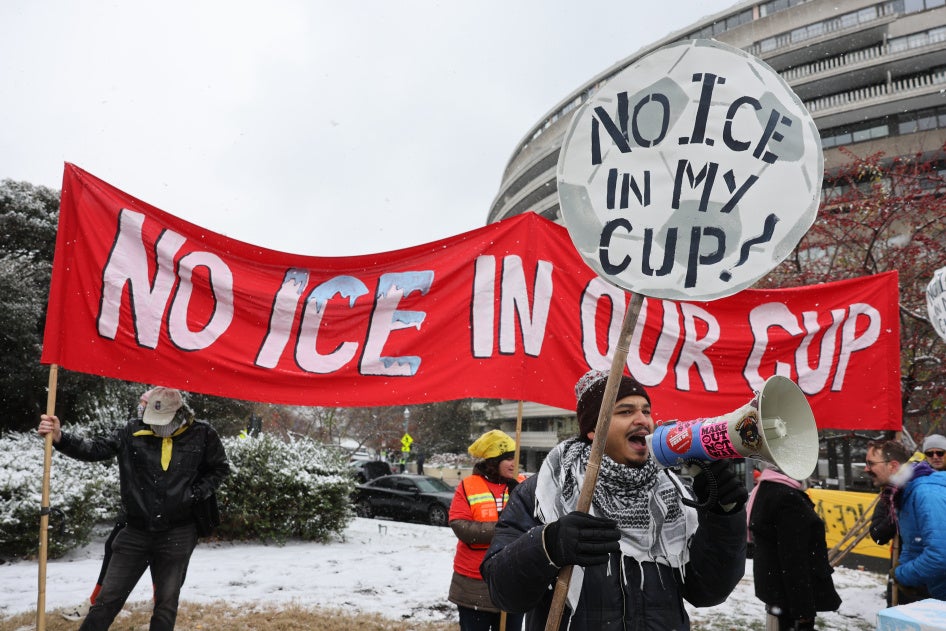
(New York) – World Cup city host committees and FIFA have fallen short on the steps needed to protect players and fans, Human Rights Watch said today, with the tournament two months away.
All but one of the host city committees have either failed to present action plans required by the Fédération Internationale de Football Association (FIFA) or produced plans that ignore or fail to adequately address risks, including those faced by immigrants, lesbian, gay, bisexual, and transgender (LGBT) people, and journalists.
“Despite years to prepare, the specter of immigration enforcement at FIFA events, and emerging threats to media freedom, host committees have failed to deliver coherent plans for the world’s largest sporting event,” said Minky Worden, director of global initiatives at Human Rights Watch. “FIFA and these cities need to act immediately to strengthen human rights protections or risk a tournament defined by exclusion and fear.”
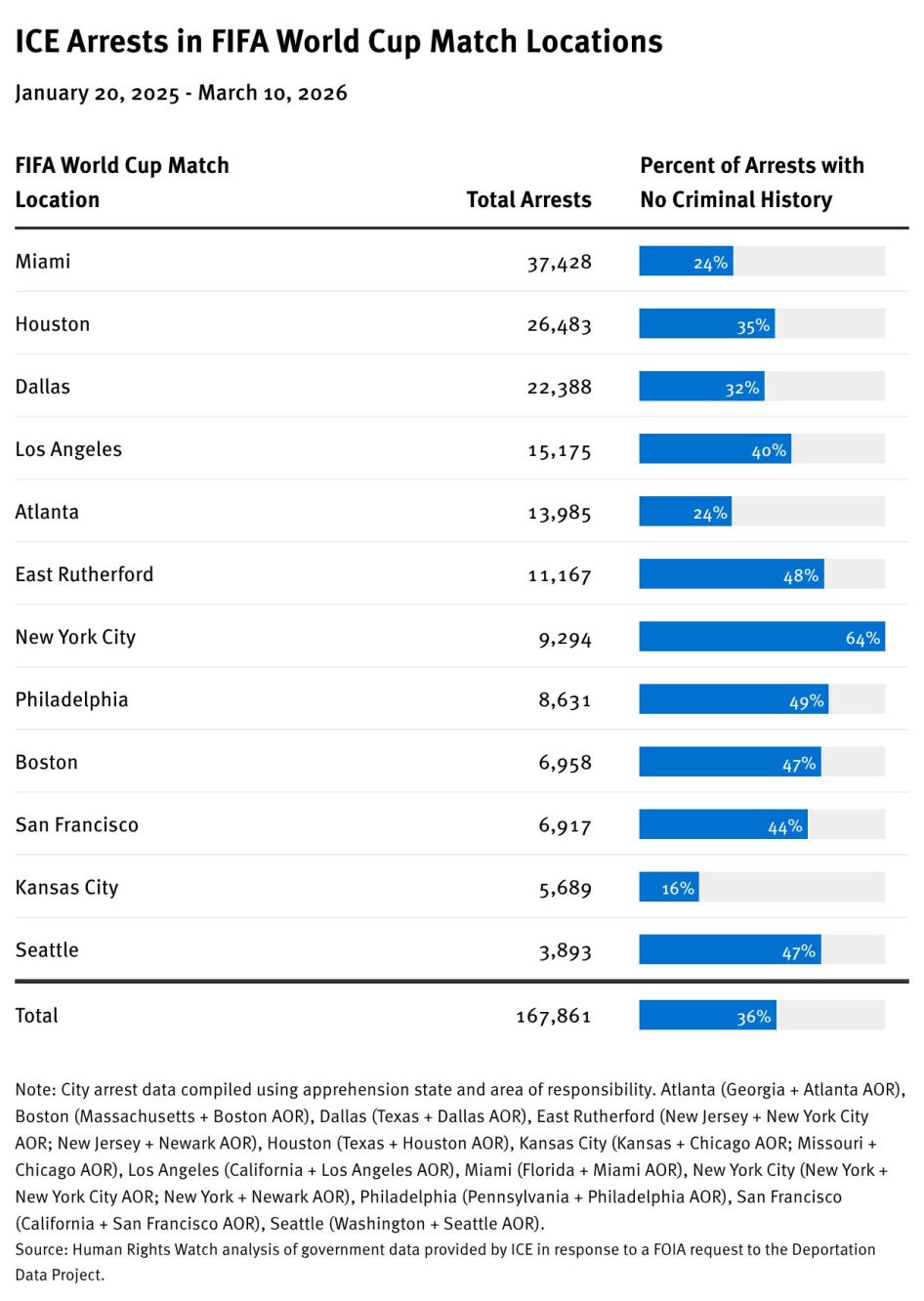
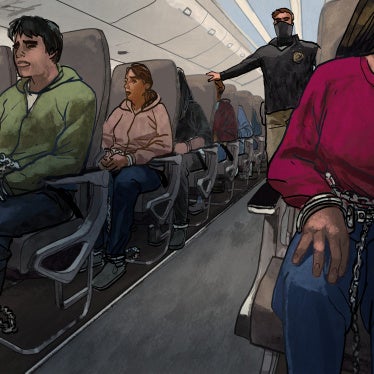
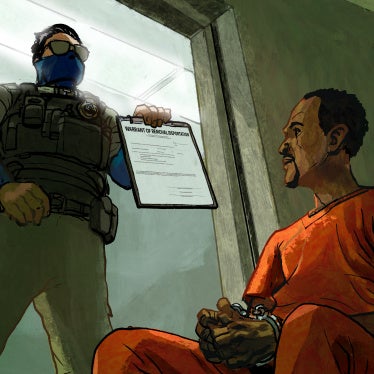
From January 20, 2025 to March 10, 2026, US Immigration and Customs Enforcement (ICE) arrested at least 167,000 people in and around the 11 US cities where games will be played, based on ICE data provided in response to a freedom of information request to the Deportation Data Project newly analyzed by Human Rights Watch. Those arrests are part of an abusive campaign of immigration enforcement that has entailed widespread human rights violations across the United States. At the FIFA Club World Cup final in 2025, ICE detained a fan initially arrested for a minor civil offense.
The 2026 FIFA Men’s World Cup was the first with human rights bidding requirements, the first with a Human Rights Strategy as part of the award of the tournament, and the first with a mandatory Human Rights Framework imposed on host city committees. The framework states that “all FIFA World Cup 2026™ Host City Committees will develop tailored Host City Human Rights Action Plans in consultation with FWC26, local governmental and non-governmental stakeholders, and community groups.” The framework includes guidance covering migrant workers’ rights, “regardless of employment or immigration status.” The framework also acknowledges groups or populations that face “heightened” rights risks, including immigrants, migrant workers and their families, refugees and asylum seekers, journalists, and LGBT people.
Host city committees are nonprofit local organizing bodies responsible for coordinating with host city authorities and delivering tournament-related activities, including fan festivals, transportation coordination, volunteer programs, and community engagement. The original March 2025 deadline for the plans was extended to August 29, 2025. But of 16 host cities, only Atlanta, Dallas, Houston, and Vancouver have published plans. Boston, New York/New Jersey, Kansas City, Miami, Philadelphia, Los Angeles, Seattle, Toronto, San Francisco, Mexico City, Guadalajara, and Monterrey have not.
“For the Miami Host City Committee—the city where FIFA bases its North American operations—failing to release a human rights action plan for stakeholder input is a clear ‘own goal,’” said Yareliz Mendez-Zamora, policy coordinator at American Friends Service Committee Florida. “Miami and other host cities should fulfill their responsibility to protect fans, workers, and athletes and put in place the rights protections we need to make the World Cup a success, not only in soccer but in human rights.”
The four host cities that have published plans have articulated some useful information and commitments. Both the Houston and Dallas plans state that the host committees will establish a “Worker Support Hub” to address grievances and provide other services. But the plans don’t explicitly address risks faced by undocumented workers and fans.
The risk of abusive immigration enforcement in Houston and Dallas is real. Local authorities in both cities have signed 287(g) agreements, which deputize local law enforcement to enforce federal immigration law. Since President Donald Trump took office in January 2025, ICE has arrested 22,388 people in Dallas and 26,483 in Houston. Human Rights Watch has called for an “ICE Truce” during the games.
Atlanta’s plan contains more explicit information on immigrants’ rights, stating that the Atlanta Police Department does not operate under federal enforcement agreements. However, 287(g) agreements are in effect and, according to media reports, actively expanding in the metro area and throughout Georgia. Under Georgia’s 2024 state law HB 1105, the Atlanta Police Department must comply with immigration status checks for certain misdemeanors. Since January 2025, ICE has arrested 13,985 people in the Atlanta area, according to the Deportation Data Project.
The published action plans do little to address discrimination against LGBT people. Soccer has long struggled with homophobia and in 2025, FIFA canceled previously planned additional anti-racism and anti-discrimination messaging at the US Club World Cup venues without explanation. The Dallas and Houston action plans contain no references to LGBT people. The Atlanta plan, in contrast, promises at least “two FIFA-connected community events developed in partnership with Atlanta’s LGBTQ+ organizations.” The first half of the World Cup takes place during Pride month, June, which will bring increased visibility and protests related to LGBT rights.
“An overwhelming sentiment among stakeholders in host cities is that the World Cup is something that will happen to them, rather than for or even with them,” said Jennifer Li, coordinator of Dignity2026 and director of the Center for Community Health Innovation at Georgetown Law, who works closely with local groups across host cities. “The failure to publish human rights plans shows a lack of both investment and experience by host committees and FIFA alike, who have procrastinated for months and are now afraid to show their homework. The list of host cities was announced four years ago and the FWC26 Human Rights Framework was published in June 2024. That we are still unclear on the action plans or timeline for implementation is reckless.”
Although they discuss freedom of expression, the Houston and Dallas action plans also contain no references to the risks faced by journalists covering the World Cup. In Los Angeles, which has not published a plan, Human Rights Watch documented that US officers fired tear gas, pepper balls, hard foam rounds, and flash-bang grenades directly at protesters, journalists, and other observers at protests against immigration raids in June 2025.
Human Rights Watch wrote to FIFA President Gianni Infantino on January 13, 2026, about what steps FIFA would take to address US immigration enforcement and ICE activities at World Cup events. FIFA did not reply in writing. Human Rights Watch wrote to FIFA on April 6 requesting details on steps to protect journalists.
FIFA and host city committees need to take concrete steps in the weeks remaining before kickoff.
- FIFA should insist that all 16 host committees work with local stakeholders to publish and implement full Human Rights Action Plans before May 11.
- Every plan should explicitly address immigration enforcement risks, including that ICE could target World Cup venues, fan festivals, and surrounding areas with abusive operations. Given the abusive nature of the Trump administration’s immigration enforcement efforts, FIFA should seek a public guarantee from federal authorities to refrain from immigration enforcement at games and venues.
- Every plan should include LGBT-specific protections and anti-discrimination messaging. FIFA and host committees should plan to support abuse victims.
- FIFA should update and strengthen its media freedom policy to help guarantee the safety and accreditation of journalists covering human rights issues in all three host countries, consistent with FIFA’s commitments to human rights defenders and media representatives.
- Host cities in states with 287(g) immigration enforcement agreements should publicly clarify how those agreements will impact the tournament and what protections and legal support services exist for workers, residents, fans, and other groups at risk of detention.
FIFA should make clear that failure to publish a Human Rights Action Plan may affect cities that want to host events in future tournaments.
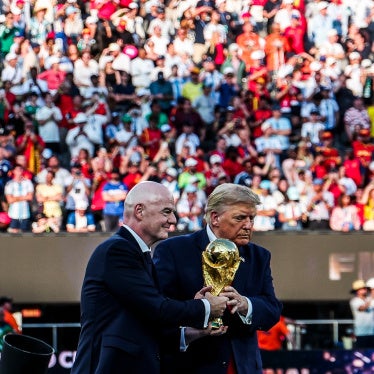
“Since awarding Trump the ‘FIFA Peace Prize’ in December, FIFA has gone silent on every concrete human rights promise it said it would stand up for,” Worden said. “The irony is that FIFA is still expecting ‘Human Rights Action Plans’ when the organization itself has taken no public action to address key risks and uphold the full spectrum of human rights at the world’s largest sporting event.”