Human Rights Watch respectfully seeks leave to submit an amicus curiae to the African Court on Human and Peoples’ Rights (hereafter the Court) in relation to its forthcoming advisory opinion on the human rights obligations of states in the context of the climate change crisis.
Our research shows that climate change already negatively affects communities in Africa, demonstrating the need for national policies to protect the rights of people undergoing displacement and planned relocations. We provide the following input based on our August 2025 report, “‘Waiting for God’: Flood Displacement and Planned Relocation of Fisherfolk in Saint-Louis, Senegal,” and other work on the issue of internal climate displacement and planned relocation.
I. Human rights impacts of planned relocations in Africa: the case study of Khar Yalla, Senegal
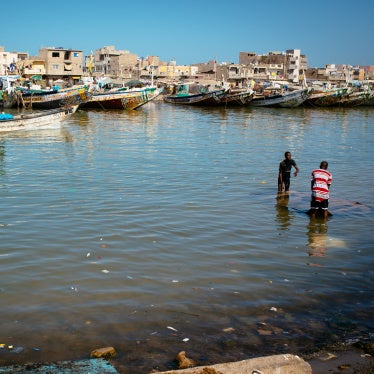
In this research, we documented how coastal flooding in 2015–2016 displaced fishing families from the Langue de Barbarie peninsula in Saint-Louis, forcing them to relocate to Khar Yalla, a site acknowledged by officials to be unsuitable for permanent living.
Based on interviews with 101 people, including displaced residents of Khar Yalla, community members, officials, academics, and civil society representatives, Human Rights Watch found that inaction from the Senegalese government violated the displaced families’ economic, social, and cultural rights and excluded them from a planned relocation benefitting others from their communities also displaced by the same climate-related hazards. Senegalese authorities have not provided a durable solution for the displaced families or meaningfully consulted them about their future.
Nearly a decade after the floods, families remain in precarious conditions in Khar Yalla that raise serious concerns under the African Charter on Human and Peoples’ Rights, including the rights to health (Article 16), education and cultural life (Article 17). Conditions also raise concerns about rights to an adequate standard of living, including rights to adequate housing and electricity.
HRW found that the living conditions that many face in Khar Yalla violate their rights to adequate standard of living, including to housing and electricity. There is severe overcrowding, most houses lack electricity, and there is no waste collection or disposal system. Every rainy season (June to September), Khar Yalla repeatedly floods, and septic water and garbage enter the houses. Additionally, households still have only the temporary, revocable occupation permits distributed by municipal authorities in 2016, which prohibit them from modifying the houses.
HRW found that the people in Khar Yalla also endure other ongoing violations to their rights to an adequate standard of living, as well as their rights to education, health, and to take part in cultural life. Khar Yalla has no state-run, secular school, health clinic, or employment opportunities. There is no affordable transportation to schools, health care, or their jobs in the Saint-Louis city center or the Langue de Barbarie. Authorities have made no efforts to help the people in Khar Yalla retrain for other professions and thwarted the community’s own initiatives. The authorities have also done little to help the people in Khar Yalla with access to other incomes or direct provision of essentials such as food to ensure an adequate standard of living. Consequently, the people in Khar Yalla are dislocated from their culture, an estimated third of the children in Khar Yalla do not attend primary or secondary school, many people have foregone preventative care, and most breadwinners’ incomes have dropped to the point that families are often unable to put food on the table.
The families are living in protracted displacement in Khar Yalla because authorities have failed to facilitate one of the three possible settlement options identified as durable solutions in international guidance: dignified return, local integration at a site of temporary stay, or permanent relocation to a site where living conditions are comparable or better. The families in Khar Yalla cannot rebuild their homes in the Langue de Barbarie, because their land will soon become a no-build zone. Khar Yalla’s exposure to flooding and lack of essential services make it inappropriate for permanent human habitation, as Senegalese government and World Bank officials acknowledge. Thus, moving the Internally Displaced Persons (IDPs) to Khar Yalla did not constitute a relocation that could offer comparable living conditions to what the IDPs had lost, and the site is not appropriate for local integration. Moreover, authorities have actively prevented local integration by only giving the people in Khar Yalla revocable, temporary occupation permits for the houses and disrupting several of their attempts to improve the site or find in situ sources of employment. The families in Khar Yalla are not forced to live there, but they cannot afford to move elsewhere because of the depletion in income they have experienced since being displaced.
II. Senegal’s legal obligations
Senegal derives its human rights obligations from its constitution, customary international law, as well as a number of African regional and international human rights treaties to which it is party. These include the African Charter on Human and Peoples’ Rights (ACHPR), the International Covenant on Economic, Social and Cultural Rights (ICESCR), the Convention on the Elimination of All Forms of Discrimination Against Women (CEDAW), the Convention on the Rights of the Child (CRC), and the Convention on the Rights of Persons with Disabilities (CRPD). Senegal’s obligations under international climate instruments such as the UN Framework Convention on Climate Change (UNFCCC) and Paris Agreement should be informed by its obligations under international human rights law, and vice versa.
Under the African Charter, Senegal must respect, promote, protect, and fulfill the rights guaranteed in the Charter for all individuals and peoples within its jurisdiction, including in the context of climate-related environmental harms and adaptation responses.
In addition, the African Commission on Human and Peoples’ Rights (ACHPR) has clarified in its landmark decision in Social and Economic Rights Action Center (SERAC) and Center for Economic and Social Rights v Nigeria that states have obligations not only to refrain from violating rights directly, but also to prevent third-party harms and to adopt positive measures to ensure the effective enjoyment of rights affected by environmental degradation.
The African Commission on Human and Peoples’ Rights (ACHPR) has also recognized climate change as a serious threat to the enjoyment of human rights in Africa. In ACHPR Resolution 153 on Climate Change and Human Rights, the ACHPR acknowledged that climate change poses significant risks to the realization of a wide range of rights protected under the African Charter and called on states to integrate human rights considerations into climate policies and responses. The ACHPR emphasized the particular vulnerability of African populations to climate impacts and the need for international cooperation to address these challenges.
Rights in implementing climate adaptation measures
Senegal has international human rights obligations to address climate change, including by adopting and implementing robust and rights-respecting climate adaptation policies that are consistent with the best available science, as emphasized by the International Court of Justice in a 2025 advisory opinion.
International guidance stresses that planned relocation to protect persons or communities may be a necessary measure for states to “prevent and reduce disaster risk and exposure to it, and to address the negative impacts of environmental change, including climate change.” But upholding these obligations cannot come at the expense of human rights protection. As a state party to the Paris Agreement, International Covenant on Civil and Political Rights (ICCPR), and ICESCR, Senegal has to ensure adequate adaptation for its people and has acknowledged the need to “respect, promote and consider their respective obligations on human rights … the rights of indigenous peoples, local communities … and people in vulnerable situations.” States’ existing human rights obligations require them to uphold the rights of those harmed by climate change, including all their economic, social and cultural rights, such as the rights to an adequate standard of living and culture. This includes obligations to dedicate the maximum available resources toward the progressive realization of economic, social, and cultural rights.
Under the African Charter, environmental harms that threaten human health, livelihoods, or cultural survival engage multiple Charter rights. The ACHPR has interpreted these provisions to require states to take reasonable and effective measures to prevent environmental harm that undermines human rights, including through adaptation strategies such as planned relocation, with appropriate regulation, monitoring, and participatory decision-making processes. Planned relocation may in some circumstances constitute a necessary adaptation measure of last resort, particularly where communities face severe climate risks. However, such measures must be consistent with human rights obligations, including meaningful consultation, non-discrimination, protection of livelihoods, and the provision of adequate housing and services.
Rights of internally displaced people
The Senegalese government’s obligations to respect and fulfill its people’s social, economic, and cultural rights under its Constitution and African regional and international human rights law apply to everyone in the country or otherwise within its jurisdiction, including IDPs. The Senegalese Constitution guarantees all citizens “fundamental individual freedoms, the economic and social rights as well as [their] collective rights,” which include cultural freedoms and the rights to health and education. National governments bear primary responsibility to ensure protection and assistance during displacement, and to facilitate durable solutions for IDPs. This is emphasized in the 1998 Guiding Principles on Internal Displacement, an authoritative restatement of existing international human rights, humanitarian and refugee law as it relates to the protection of internally displaced persons. Similarly, the legally binding Kampala Convention, which Senegal has signed but not yet ratified, requires State Parties to ensure assistance to IDPs by meeting their basic needs in a non-discriminatory manner, and to facilitate durable solutions to displacement by promoting satisfactory conditions for voluntary return, local integration, or relocation on a sustainable basis and in circumstances of safety and dignity.
Right to an adequate standard of living, including the rights to housing and electricity
As Senegal has ratified the International Covenant on Economic, Social and Cultural Rights (ICESCR), the African Charter, and other treaties, the Government of Senegal has accepted the obligation to respect, protect, and fulfill the rights to an adequate standard of living, which includes the rights to adequate housing and electricity. These obligations require Senegal to create conditions to ensure individuals can meet their own basic needs.
According to the UN Committee on Economic, Social and Cultural Rights, adequate housing requires security of tenure, access to essential services and infrastructure, safe and habitable conditions, and a location that allows reasonable access to employment and basic services such as healthcare and education.
Human Rights Watch also recognizes that the right to an adequate standard of living includes the right to sufficient, reliable; safe, clean, accessible, and affordable electricity for everyone without discrimination. Access to electricity is critical to ensuring other basic rights including rights to health, water, and education.
Right to education
Under the CRC and the African Charter on the Rights and Welfare of the Child, Senegal is obligated to provide free, compulsory primary education and ensure secondary education is accessible to all without discrimination. Education should meet the standards of availability, accessibility, acceptability, and adaptability, including adequate and quality school infrastructure across the country.
Right to health
Under the ICESCR and ACHPR, Senegal is obligated to respect, protect, and fulfill the right to the highest attainable standard of physical and mental health. The CESCR has emphasized that upholding these obligations entails ensuring the availability, accessibility, acceptability and quality of health facilities, goods and services. This includes the duty to ensure that access to these healthcare resources is accessible without discrimination, especially for the most marginalized sections of the population, and without cost-based barriers.
Right to take part in cultural life
The ICESCR protects the right to enjoy one’s culture and take part in cultural life, which can include traditional fishing activities. The CESCR interprets culture broadly to cover ways of life, production methods, and customs. Similarly, the UN Human Rights Committee recognizes traditional fishing of minority groups as a protected cultural right and states that traditional fishing practices of minority groups can constitute cultural rights that are protected under the ICCPR. The Committee stresses that cultural rights, while individual, “depend on the ability of the minority group to maintain its culture,” and that states may therefore need to take measure to protect a minority group’s identity and ability to “enjoy and develop their culture … in community with the other members of the group.” The ACHPR similarly recognizes that cultural rights are fundamental to human dignity and development, and member states have obligations to ensure the enjoyment of these rights by all individuals and peoples.
Promoting equitable burden sharing: high-income states’ obligations to facilitate rights-respecting adaptation in Senegal
The Paris Agreement requires that “developing” countries receive “continuous and enhanced international support” to implement their mitigation and adaptation obligations, including through financial assistance from “developed” countries. This reflects the principle of common but differentiated responsibilities (CBDR), which acknowledges that responsibility among countries is unequally distributed due to their differing contributions to the causes of climate change and their varying economic capacities, a principle also embedded in the UNFCCC.
Human rights instruments bolster this legal obligation and provide guidance on the nature of support that high-income countries should provide. The ICESCR confers positive duties on states to fulfil the “progressive realization of rights” both “individually and through international assistance and cooperation.’” States, particularly high-income ones, have committed to “cooperate to mobilize the maximum of available resources for the universal fulfilment of economic, social and cultural rights” and “provide international assistance to contribute to the fulfilment of economic, social and cultural rights in other States.” These commitments are increasingly significant as climate change weakens the capacity of Senegal and other climate-exposed states to adapt to climate change and fulfill their obligations under the ICESCR.
Consistent with obligations to the Paris Agreement and ICESCR, high-income states should provide low-income countries like Senegal and communities like Khar Yalla with assistance by scaling up financial and technical support for durable solutions to climate displacement and human rights-respecting adaptation measures.
III. Normative implications for state obligations under the African Charter in the context of the climate crisis
Drawing from the situation documented in Senegal, Human Rights Watch respectfully submits that the Court may wish to clarify that states parties to the African Charter have binding obligations to address the human rights impacts of climate change, including those arising from adaptation measures such as planned relocation.
The African Charter provides strong normative foundations for articulating these obligations.
- Duty to prevent foreseeable climate-related human rights harm
Articles 4, 16, and 24 of the African Charter require states to take reasonable and effective measures to prevent environmental harms that threaten life, health, and human dignity. In the context of climate change, this entails:
- Adopting science-based climate mitigation and adaptation policies.
- Assessing foreseeable climate risks
- Implementing preventive measures to protect communities exposed to climate hazards
Where governments fail to take reasonable measures to protect populations from known climate risks, such omissions may amount to a violation of Charter rights.
- Duty to ensure rights-respecting climate adaptation
Climate adaptation policies, including planned relocation, should comply with human rights standards under the African Charter. States should therefore ensure that planned relocation measures:
- Are necessary and proportionate
- Involve meaningful consultation and participation of affected communities
- Protect livelihoods and cultural practices
- Provide adequate housing, services, and infrastructure
- Ensure security of tenure and durable solutions
Failure to implement planned relocation in a rights-respecting manner may violate rights protected under Articles 14, 16, 17, 21, and 22 of the African Charter.
- Duty to protect communities from displacement and ensure durable solutions
States have obligations to prevent arbitrary or avoidable displacement arising from environmental degradation and climate impacts. Where displacement occurs, states must ensure:
- Protection of internally displaced persons
- Non-discrimination in access to services
- Timely implementation of durable solutions, including voluntary return, integration, or relocation in safety and dignity
These obligations are reinforced by the Kampala Convention, which reflects Africa-specific standards for addressing internal displacement. The Kampala Convention requires State Parties to ensure assistance to IDPs by meeting their basic needs in a non-discriminatory manner, and to facilitate durable solutions to displacement by promoting satisfactory conditions for voluntary return, local integration, or relocation on a sustainable basis and in circumstances of safety and dignity.
- Duty to ensure participation in climate decision-making
The African Charter emphasizes participation in governance and development, particularly through Article 13 and Article 22. In the climate context, this implies that:
- Affected communities and peoples must be meaningfully consulted in climate adaptation planning.
- Planned Relocation decisions must involve free, informed and participatory processes.
- States must ensure special consideration for marginalized groups, including women, children, older persons, and persons with disabilities.
- Duty of international cooperation and climate justice
Finally, the African Charter’s recognition of peoples’ right to development in Article 22 and to a general satisfactory environment favorable to their development in Article 24 requires states to ensure that people can meaningfully participate in the development process, benefit from the development and not be subject to conditions incompatible with their survival as people including their way of life. The Court should examine obligations on the international community to support African peoples facing severe climate impacts. The Court may therefore clarify
- How states should ensure that all peoples are officially recognized and are able to fully participate in development decisions concerning their lives and livelihoods.
- That high-emitting states have responsibilities to support climate-vulnerable states, including through climate finance and technology transfer
- That international cooperation is essential for ensuring that African states can fulfil their human rights obligations in the context of climate change.
IV. Conclusions
Human Rights Watch hopes that our analysis can assist the African Court in defining the obligations of States with respect to internal displacement and planned relocation in the context of the climate change crisis, including to advance adaptation, climate justice and access to climate finance. We would welcome the opportunity to discuss these issues further with the Court.