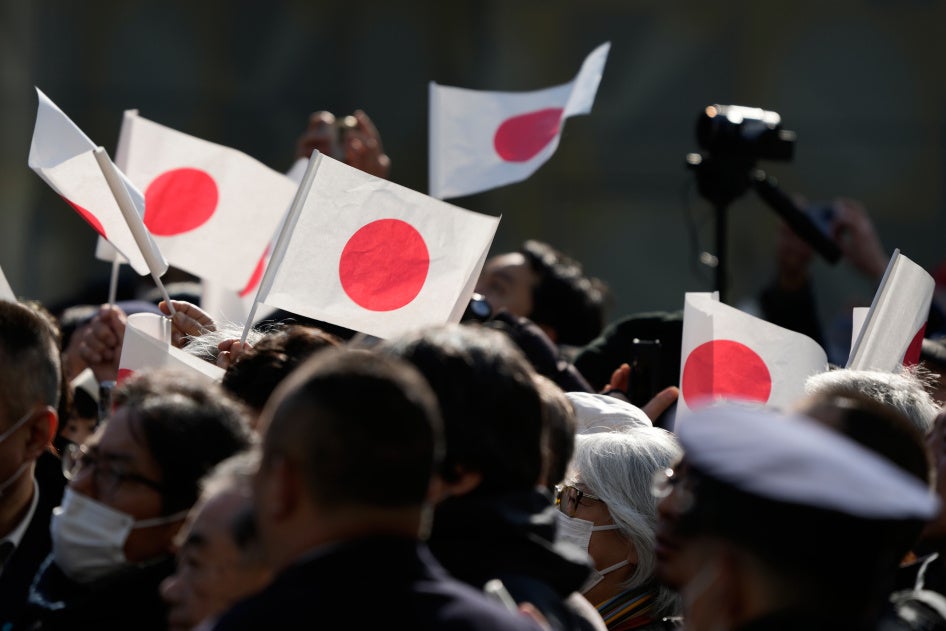
Japanese Prime Minister Sanae Takaichi and the ruling Liberal Democratic Party’s coalition partner, the Japan Innovation Party, said on March 17 that they would present a law forbidding the desecration of the national flag during the ongoing Diet session.
Currently, Japan’s penal code only makes it a criminal offense to damage foreign flags, which the two parties described in their October coalition agreement as a “contradiction” that they pledged to “correct.”
For Takaichi, passing this law has been a long-running political goal. In 2012, when the Liberal Democratic Party was in the opposition, she attempted to amend the penal code and criminalize the “damaging, removal, or defacement” of the Japanese flag “with an intent to insult Japan.” The bill, which included penalties of up to two years’ imprisonment and a fine of up to 200,000 yen (US$2,500), was scrapped. Her second attempt in 2021 was also unsuccessful.
The United Nations Human Committee in a General Comment on freedom of expression has expressed concern regarding laws on such matters as “disrespect for flags and symbols.”
In the United States, similar laws have been found to be unconstitutional. In 1984, Gregory Lee Johnson was arrested and charged after he burned a US flag to protest the policies of President Ronald Reagan. The US Supreme Court ruled that flag burning is a form of free speech protected under the First Amendment of the US Constitution. Five years later, the US Congress passed the Flag Protection Act of 1989, which made desecration of the US flag a criminal offense, but in 1990, the Supreme Court ruled the law “inconsistent with the First Amendment.”
Some governments have used flag desecration laws to stifle dissent. For instance, in Hong Kong, two laws criminalizing the desecration of China’s national flag and Hong Kong’s regional flag have long been used against democracy activists. In 2019, a Hong Kong court sentenced a 13-year-old girl to 12 months of probation for burning a Chinese flag during a pro-democracy protest. Democracy activist Koo Sze-yiu has been convicted at least eight times for violating the anti-flag laws.
While Japan’s ruling coalition has yet to submit its bill, such laws need to be consistent with international human rights law, notably the International Covenant on Civil and Political Rights. It’s difficult to envision a flag desecration law that would meet its strict standards.