
During a Jan. 14 news program by NHK, Shinnosuke Kawashima, the Japanese public broadcaster’s Tehran bureau chief, described the atmosphere in the Iranian capital following countrywide massacres of protesters on Jan. 8 and 9.
“The Iranian government has repeatedly emphasized ‘the situation is under control,’ but access to the internet remains largely restricted and the atmosphere is tense in Tehran,” he said.
The reporting came amid a campaign of denial and cover-up by Iran’s authorities in a bid to conceal the true scale of the atrocities they were committing. Soon after Kawashima’s broadcast, the authorities reportedly arrested him and transported him to Ward 7 of Tehran's Evin Prison on Feb. 23.
A Japanese government spokesperson has confirmed that Iranian authorities detained a Japanese national on Jan. 20 and Tokyo has been urging Tehran to release them, without disclosing their identity. NHK has reportedly neither confirmed nor denied Kawashima’s detention and Iranian officials have not announced his arrest. On March 6, Japan’s foreign minister disclosed that Iran has detained another Japanese national since June 2025, who is reportedly not a journalist.
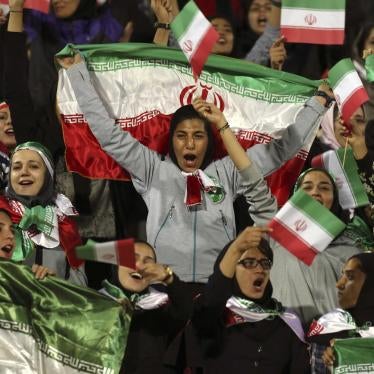
Since Dec. 28, when the most recent protests started and engulfed the country, Iran’s security and intelligence forces have carried out mass arrests. Tens of thousands of people, including children, are reported to have been arrested.
Human Rights Watch documented that people in detention were held in unofficial and secret facilities, subjected to torture and disappearances, and were at risk of death in custody or of arbitrary, summary and secret executions.
Now, amid ongoing strikes by the United States and Israel across Iran, which have included apparent targeting of security facilities where detainees are commonly held, they also face the possibility of being seriously injured or killed in an airstrike. Imprisoned people, who could include Kawashima, confined within the prison walls, are unable to flee and seek safety.
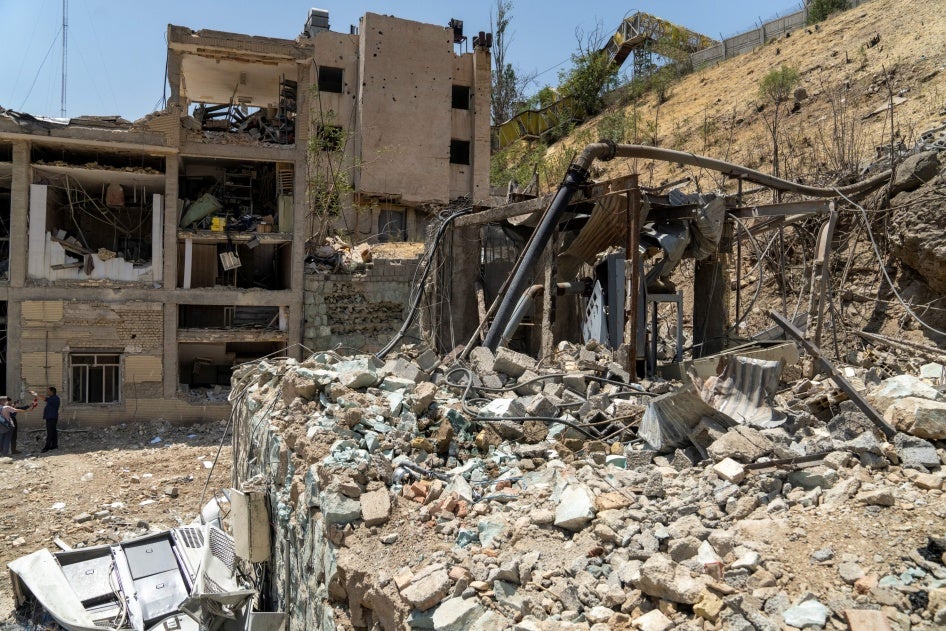
This wouldn’t be the first time a prison was hit. On June 23, during the 12-day war between Israel and Iran, Israeli forces carried out an unlawful attack on Evin Prison, where hundreds of arbitrarily detained people including journalists and human rights defenders are held. The strikes hit several buildings across the prison complex, reportedly killing at least 80 people, including prisoners, family members and prison staff.
Based on evidence examined, including witness statements, verified videos and photographs and satellite imagery, Human Rights Watch found that the strikes were unlawfully indiscriminate and an apparent war crime.
For imprisoned people, the horror did not end there. In the aftermath of the attack, Iranian authorities subjected survivors to mistreatment and held them in cruel and unsafe conditions. The treatment of prisoners in the attack’s aftermath bore all the hallmarks of Iranian authorities’ extensive use of repression and violence, in particular during times of crisis, heightening fears about what may happen to such detainees across the country as the conflict continues.
Since the start of the current hostilities on Feb. 28, people in detention, their families and human rights organizations have repeatedly called on Iranian authorities to immediately and unconditionally release all arbitrarily detained people and others on humanitarian grounds. This is based on domestic regulations that allow for imprisoned people's conditional release or leave during times of armed conflict.
Journalists remain among those who have been detained. On Feb. 18, Reporters Without Borders said Iranian authorities had detained at least seven journalists since the mass protests began in December and called on the Iranian government to immediately release “all media still in jail.”
Likewise, on Feb. 26, the Committee to Protect Journalists called on Iranian authorities to immediately release Kawashima, as well as all other journalists “detained for their work, return all confiscated property and end the harassment of NHK’s staff.”
The Japanese government has issued a request to the Iranian authorities for "the early release of two Japanese nationals" and to "ensure the safety of Japanese nationals in the region."
However, the government should do more. Tokyo should demand that Tehran immediately release all those arbitrarily detained, disclose the fate and whereabouts of people forcibly disappeared and halt any planned executions. The Iranian authorities should also allow independent international bodies, such as the U.N. Fact-Finding Mission on Iran, as well as humanitarian agencies unhindered access to the country.
In addition, the Japanese government should urge the United States, Israel and Iran to respect international humanitarian law — also known as the laws of war — and prioritize the protection of civilians. Human Rights Watch has previously documented likely war crimes carried out by Iran and apparent war crimes carried out by the United States and by Israel, as well as acts of genocide in the case of Israel. All three states have seriously failed to protect civilians in times of conflict.