Japan is a liberal democracy with an active civil society. In October, the Liberal Democratic Party’s (LDP) Sanae Takaichi became Japan’s first woman prime minister following Shigeru Ishiba’s resignation, which came after the LDP–Komeito coalition lost its majority in both lower and upper house elections. The conservative LDP has governed almost continuously since its founding in 1955.
Japan has no laws prohibiting racial, ethnic, or religious discrimination, discrimination based on sexual orientation or gender identity, or discrimination based on age. Japan does not have a national human rights institution.
Death Penalty
Japan retains the death penalty. Serious concerns also remain about people on death row, including their inadequate access to legal counsel and that they are notified of their execution only on the day it takes place. At time of writing, Japan had executed one death row inmate in 2025; 105 people remained on death row.
Criminal Justice System
Japan’s pretrial criminal justice system has long been criticized for “hostage justice,” in which suspects who maintain their innocence or remain silent are detained for prolonged periods to get them to confess.
In March, four former detainees filed the first lawsuit of its kind at the Tokyo District Court, arguing that laws allowing prolonged pretrial detention and denying bail violate the Constitution.
In May, the Tokyo High Court issued a landmark ruling declaring the investigation and prosecutions in the Ohkawara Kakohki Co. case—a typical example of “hostage justice”—illegal.
Three individuals, including the company president, were wrongfully detained for nearly a year on false charges. Shizuo Aishima was diagnosed with cancer during detention. Despite eight bail requests, none were approved, and he died, prompting widespread criticism.
After the ruling became final, police and prosecutors conducted internal reviews. Their August reports proposed limited reforms but failed to address prolonged detention, probe police misconduct such as fabrication of evidence and unlawful interrogation, or expand videotaping of interrogations.
At time of writing, the judiciary reportedly was planning to launch a study group on proper bail use.
Asylum Seekers and Refugees
Japan’s asylum and refugee determination system remains strongly oriented against granting refugee status. In 2024, the Justice Ministry received 12,373 applications for asylum but recognized only 190 people as refugees. The ministry also categorized 335 people as needing humanitarian considerations and 1,661 people were granted protection under Japan’s expanded refugee definition, allowing them to stay in Japan.
In March, the Justice Ministry announced it had deported 17 people since June 2024 under a revised law, after they had applied for asylum more than twice.
Rights of Migrant Workers and Xenophobia
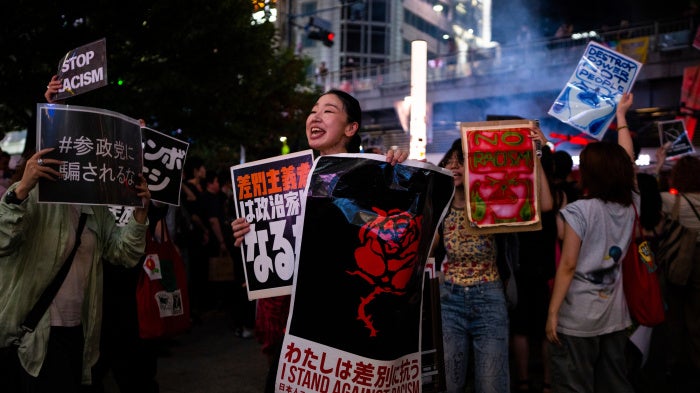
An unprecedented number of migrant workers live and work in Japan, while record numbers of foreign tourists visit each year. During July’s upper house election, immigration was a core theme, with right-wing parties using xenophobic rhetoric to appeal to voters. In October, Prime Minister Takaichi created a new cabinet post on issues involving foreign nationals in Japan.
Women’s Rights
Japan still has a significant gender gap, evident in global metrics including the World Economic Forum’s Global Gender Gap Index. Japan ranks last among the Group of Seven (G7) nations, mainly due to limited female representation in politics and business. In January, Japan's Foreign Ministry instructed the United Nations Office of the High Commissioner for Human Rights not to allocate any of Japan’s UN voluntary contributions to the UN Committee on the Elimination of Discrimination against Women. The request followed the committee’s 2024 recommendation that Japan revise the Imperial House Law, which allows only men to succeed to the throne.
Sexual Orientation and Gender Identity
The LGBT movement in Japan continued to advance despite backlash against transgender rights, which has caused the Diet to again stall on revising the abusive Gender Identity Disorder Special Cases Act, despite a landmark 2023 Supreme Court ruling. Meanwhile, the marriage equality movement advanced. By the end of the year, five of the six high courts that had heard challenges to the ban on same-sex marriage had found it unconstitutional. A Supreme Court ruling is expected as early as 2026.
Children’s Rights
Children’s rights reforms made progress in 2025. In March, the Diet voted to make public high school free for all children. Combined with the introduction of free early childhood education in 2019, public education is now available free from age 3 through high school.
In June, the Diet revised the Basic Act on Sport, requiring national and local governments to adopt measures against physical, sexual, verbal, and other abuse. Child abuse, including corporal punishment, remains widespread in sports at all levels.
Economic, Social, and Cultural Rights
In June, the Supreme Court ruled that the Ministry of Health, Labor and Welfare’s 2013–2015 cuts to social security entitlements were illegal, finding them an “excessive or abusive exercise of discretion.” The Court determined the cuts, which reduced some social assistance programs by up to 10 percent, were based on flawed calculations and failed to reflect recipients’ actual living expenses. The ruling marked an important affirmation of judicial oversight in protecting economic, social, and cultural rights.
Social security programs in Japan aim to realize the constitutional “right to maintain the minimum standards of wholesome and cultured living.” As of March 2025, about two million people received social security benefits. However, due to stigma and barriers to access, only about 20 percent of eligible individuals are said to receive them.