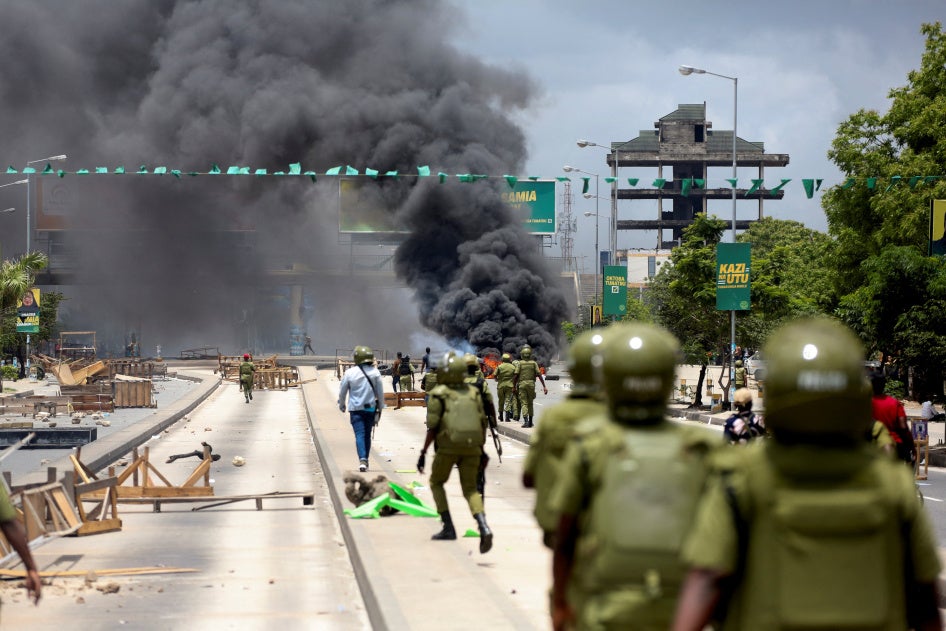
- Tanzanian security forces cracking down on protests during and after the country’s 2025 general elections killed and injured people who were not participating in demonstrations.
- Based on initial research into the killings, Human Rights Watch believes that hundreds of people across the country may have been killed.
- The Tanzanian authorities should recognize that impunity for rights abuses encourages further political violence. They should end the continuing political repression and the detention of government critics, civil society and media.
(Nairobi) – Tanzanian security forces cracking down on protests during and after the country’s disputed 2025 general elections killed and injured people who were not participating in those demonstrations, Human Rights Watch said today.
Human Rights Watch documented the killing of 31 people not participating in protests and received credible information of another 19 such deaths. Based on initial research into the number of people killed countrywide, Human Rights Watch believes that at least hundreds were killed. The government commission established to investigate the election-related violence should investigate these and other abuses, and ensure accountability.
“The Tanzanian authorities’ brazen crackdown on dissent during the elections devastated many people’s lives,” said Oryem Nyeko, senior Africa researcher at Human Rights Watch, “The commission of inquiry should deliver justice for the victims and accountability and ensure that such violations do not happen again.”
Following weeks of calls for protests against intensifying political repression, protesters took to the streets in Dar es Salaam and other cities on election day for the president and parliament, October 29, 2025. Police officers used beatings, lethal force and tear gas to disperse protesters and enforce a five-day nationwide lockdown, killing and injuring many, including people who were not protesting. In some cases, witnesses said, military and police officers set up roadblocks and prevented wounded people from reaching hospitals. Some of them died.
Between October 2025 and February 2026, Human Rights Watch interviewed 48 people, including 34 witnesses, 7 journalists, and 5 civil society members and activists, in 6 of Tanzania’s administrative regions – Arusha, Dar es Salaam, Geita, Mwanza, Ruvuma, and Mjini Magharibi in Zanzibar, and reviewed court documents and media reports. Researchers analyzed 15 photographs and videos sent to researchers by witnesses or posted to social media corroborating witness accounts.
Police officers enforcing the lockdown beat and shot at people, including vendors, at a market in Buhongwa, a Mwanza neighborhood, on the morning of October 30, killing at least 7 and injuring about 50 others, according to witnesses. “The police were shooting directly at any group of people,” one witness said.
On October 30, a 31-year-old man said, police officers responding to protests in Songea, in southwestern Tanzania, shot him at around 4 p.m. as he returned from work: “Because the shots were being fired indiscriminately, you would just hear the sound of gunshots sometimes above or passing below. So, I didn't hear the gunshot, I was just startled to find my leg numb.”
The authorities arrested over 2,000 people, including children, accusing many of destroying government property and of treason, which is punishable by death. International law prohibits arbitrary arrest and detention.
A 39-year-old man who works as a boda boda (motorcycle taxi) driver said police in Dar es Salaam arrested him on October 30, as he transported a customer. He said they falsely accused him of participating in the protests, severely beat him, and charged him with treason.
He was finally released along with hundreds of others on December 24,after President Samia Suluhu Hassan told the public prosecutions director to review the cases of those arrested. The driver said that he is unable to work due to leg injuries from the beatings.
Following international pressure, on November 18, the Office of the President formed an “independent commission” of former officials and retired civil servants to “investigate events that led to the breach of peace during and after the general elections.” It is unclear whether the mandate covers people killed and injured while not protesting and arbitrary arrests. The commission is set to conclude its work on April 3, 2026.
On March 6, Human Rights Watch wrote to the Tanzania Police Force and to the Commission of Inquiry to share the findings and to ask for information, but has not received a response.
Domestic, regional, and international human rights standards, including the African Charter on Human and Peoples' Rights, to which Tanzania is a party, prohibit the excessive use of force by law enforcement officials and provide the right to a remedy for gross human rights violations.
Under the UN Basic Principles on the Use of Force and Firearms, security forces should use force only when non-violent means are ineffective and only in proportion to the seriousness of the offense and the legitimate objective to be achieved. Law enforcement officers should use firearms only to defend themselves or others from an imminent threat of death or serious injury, or, in some circumstances, where necessary in response to a serious crime involving a grave threat to life. The intentional lethal use of firearms is permitted only when strictly unavoidable to protect life.
Concerned governments and Tanzania’s developmental partners should publicly call on the government to thoroughly investigate these abuses, prosecute those responsible, and ensure reparations, Human Rights Watch said. They should also support civil society’s role in documenting human rights violations.
“The Tanzanian authorities should recognize that impunity for rights abuses encourages further political violence,” Nyeko said, “They should end the continuing political repression and the detention of government critics, civil society and media.”
For further details on the findings, please see below.
Tanzania’s government intensified repression of the political opposition, government critics, and the media before the October 2025 elections.
On April 9, police arrested Tundu Lissu, chairman of the main opposition party, Chama cha Demokrasia na Maendeleo (Chadema), charging him with treason and publishing “false information” online, following his critical remarks at a rally. Lissu’s party had called for an electoral boycott after the government’s failure to implement electoral reforms.
Days after his arrest, the Independent National Electoral Commission (INEC) barred Chadema from participating in the elections, ostensibly because the party had not signed a government-mandated code of conduct.
In the run-up to the polls, the authorities arrested protesters and restricted media outlets that covered these issues. The authorities were implicated in the abduction and extrajudicial killing of at least 10 government critics.
Following weeks of calls by activists to protest about these issues, on the morning of election day protests started in Tanzania’s commercial capital, Dar es Salaam, and in other cities, notably Mwanza and Arusha.
At around 1 p.m., the government imposed nationwide internet restrictions, and at 5 p.m., police Inspector General Camillus Wambura, announced a lockdown in Dar es Salaam starting at 6 p.m. He told residents to remain home indefinitely, with only police and other security agencies allowed on the streets.
Despite the restrictions, protesters returned to the streets the next day in Dar es Salaam and other places, including Namanga on the Kenya border. Internet access was briefly restored and then suspended again.
Protests largely subsided after October 30, and on November 1, the Election Commission announced that Hassan had won the presidency. She was sworn in for a second term on November 3 , and the government spokesperson, Gerson Msigwa, announced a “gradual resumption of normal activities” with the internet gradually restored and residents allowed to leave their homes the next day.
Dar es Salaam, October 29-30
At around 10 a.m. on election day, demonstrators in Dar es Salaam blocked Mandela, Bagamoyo and Morogoro roads, leading to the city center, with burning tires and debris, media reported.
A 20-year-old woman told Human Rights Watch that she and her mother were sitting outside their home in Dar es Salaam’s Ubungo district when they were shot in the legs, around 2 p.m., as they tried to move inside:
I didn't see where the police were, but those who saw them say they were on the road, firing [bullets] even here into the neighborhood. I don't know if they were actually on the road, or if they moved closer to the area, I didn't know because I saw people coming, running, and I went inside, that's when it found me.
Both she and her mother said that they could not work after the shooting because of their injuries.
A 39-year-old man said that at around 4 p.m., police officers in a white van shot and injured him at his basket weaving business in Ubungo. The unrest prevented him from getting hospital treatment, he said, and instead he asked a pharmacy worker for help. During his three-week recovery, he was unable to work, putting his family under financial strain.
The Tanganyika Law Society reported that at around 6:30 p.m., police officers shot and killed a lawyer, Peter Elibariki Makundi, on Shekilango Road, as he returned home from shopping.
The next day, media reported, military and police officials mounted checkpoints for motorists and pedestrians. Media reported that, despite these restrictions, protesters returned to the streets where police had dispersed crowds the previous day with gunshots and teargas.
In Dar es Salaam’s Temeke district, at around 4 p.m. on October 30, 49-year-old Master Tindwa Mtopa was shot outside his home. A resident of the area said that though their neighborhood was calm, patrolling police told people to return home, and opened fire.
Family members said that security forces at a checkpoint stopped them from taking Mtopa to the hospital. Two hours later, they managed to do so, when a relative in the army accompanied them. Mtopa died at the hospital.
A 57-year-old Temeke resident said that she was shot in the back on a motorcycle near a police station in Buza, a Dar es Salaam neighborhood, soon after she passed a military roadblock. She said she had surgery for her injuries.
A 27-year-old man said that two police officers arrested him in Buza on October 30, after he passed a roadblock with a passenger on his motorcycle taxi. He said the officers took him to a nearby police station, accused him of burning tires on the road, and repeatedly slapped and beat him with a metal stool, badly injuring his legs. He was detained there overnight and transferred twice in the next week, he said.
He said that officers made him sign a paper he did not understand, photographed him, and took him to the Kisutu Resident Magistrate’s Court. He and others were charged with treason and remanded to Segerea Prison before a court hearing on November 19.
On December 24, he was taken to court where charges were dropped and he was released. He said that although he received medical treatment in prison, he was unable to work due to his injuries.
Mwanza, October 30-31
Five witnesses in Mwanza said that police opened fire on people in a market in Buhongwa, south of Mwanza city center, on October 30.
A resident said that people had left their homes to work or shop, unaware of the lockdown or believing it applied only to Dar es Salaam. The initial police announcement mentioned Dar es Salaam and was later expanded nationwide.
The witnesses said that around 8 a.m., about 20 police officers arrived at the market in police vehicles and told people, mainly vendors, to leave. When they delayed, the officers beat them with sticks.
“People delayed leaving because they had to organize their things,” said a man who was here. “They [the police] started beating people who were carrying their things. After about 40 minutes they started shooting live bullets. They were firing straight to the people. It wasn’t like shooting to the sky.”
Multiple witnesses described the killing of five workers at the market: a motorcycle taxi driver named Hassan; Masanja Kabo, a shoe salesman, reportedly shot in the chest while closing his business; a man called Chacha, about age 24, also a market vendor; a Maasai man who sold herbs, shot seated near the market; and James Ijide, a tailor, who witnesses said was shot from behind, as he and others ran for safety.
A witness said the officers shot Kabo from about 10 meters away: “When they started to fire, Masanja started to collect his things,” the witness said, “When he was shot he was running toward the Buhongwa dispensary. He was shot when he was near the entrance. They shot him from behind in the head.”
Witnesses said that Hassan’s shooting precipitated a riot until soldiers in a military vehicle arrived and calmed the situation. Once they left, the violence continued. Another witness said:
This time the police were shooting directly at any group of people. This is when [James Ijide] the tailor was shot. The police officer who shot him was hiding himself in school buildings in Buhongwa. The police officer saw the people running in the grounds near the [nearby] school. That police officer aimed and shot that tailor in his leg. No one went to help him because everyone was running. After this incident, people became angry and started destroying and burning properties.
A witness said that Ijide died at home, unable to get to the hospital because of road closures.
Human Rights Watch received four photographs showing Ijide, as identified by witnesses. One shows him between two people on a motorbike geolocated approximately 375 meters north of the market, near the school. In another photograph, he is lying on the ground with blood on his legs and torso. A man has applied a makeshift tourniquet and is applying pressure to Ijide’s upper thigh.
A community leader said seven people were killed and about 50 people injured. The bodies of those killed remained there until police told people to collect them at 6 p.m.
Community members retaliated by burning a nearby police station, a petrol station, a motorcycle and other vehicles, said a journalist who was at the scene: “What triggered them to do that was the incident in Buhongwa where people were killed without any reason.”
Another witness said:
Some people went hiding [out of fear] because if they can shoot people who are not demonstrating, anything is possible. Also, there were reports of other places reported of people coming to their houses and picking people. People thought that being inside your home was not safe.
Witnesses said that at about 8:30 p.m. on October 31 about seven uniformed police officers arrived at Mjimwema center, 16 kilometers north of Buhongwa, where people were watching football in a small restaurant. Reuters reported that earlier that evening, police patrolling the area had ordered people on the streets to return home.
The officers began shooting at people sitting outside, a witness said, killing two. Others fled, running in different directions, including inside the restaurant. The officers ordered those in the building to come out and lie face down. The witness, in hiding after the initial shootings, said: One of [the men who was lying down] stood up while raising his hands. He asked the police not to kill them. They did not listen to him and he was the first person to be killed. After shooting him, they shot all of them who were lying on the ground.
A few moments later, the officers fired a tear gas canister and left. The witnesses said 14 people were killed and at least two survived.
Six days later, three videos shared online showed the scene. In one, 13 bodies are lying mostly face down in pools of blood – one inside the bar, 2 in the doorway, and 10 in the street just outside. These videos also match a photograph shared directly with Human Rights Watch by a witness which, he said, was taken five minutes after the attack.
Deutsche Welle reported on January 14 that it had obtained and analyzed bullets from this incident that matched ammunition used by small arms and light weapons consistent with Kalashnikov-style assault rifles used by Tanzanian police. Human Rights Watch has not reviewed the bullets.
A resident of Ilemela in Mwanza said that as he approached his home, he saw two police officers, as they were chasing protesters, fire towards his home. When he reached the house, he found his 16-year-old relative, who had been inside the house with three other relatives with a gunshot wound to the thigh:
I was watching that bullet hit the door. The bullet hit her in her thigh, it went through her and hit the refrigerator. So, after that shooting I saw those police officers leaving. They went toward where they left their car. So, I went straight to my house and pushed the door. When I arrived there, I found her lying down while bleeding a lot.
He said that he carried her outside and asked the police to take her to the hospital, but they refused and threatened to beat him. The officers eventually agreed, but left him behind, as he attempted to get in the vehicle. He and another relative spent seven hours searching for her until a hospital staff member told them she had died. They eventually located her body in the mortuary.
Arusha, October 29-30
In Arusha city, protests erupted on the morning of election day in the Mianzini and Sakina neighborhoods. A resident of Sakina, who said he was not participating in the protests, said he saw about 20 uniformed police officers, and some without uniforms whom he believed were also police, open fire in the direction of a large crowd protesting the cost of living and the country’s leadership.
“Everyone was searching for a place to run,” he said. “I ran also to where I live. After running, I still kept hearing the gunshots.
In Mianzini, a man who joined the protests said he personally saw nine people killed as the police responded:
The first person was shot in the face, another was shot in the chest and died instantly. Three were killed on a motorcycle that was ran over by a police car. A pregnant woman was shot in the back.
The same witness said he saw many injured by gunshot wounds or from officers beating them with batons. “It did not matter if you were part of the protests or not,” he said.
Family members and witnesses described the killing of their relatives in Arusha that day.
At around 4 p.m., the police shot and injured a man in his early 40s, as he left a mosque in the city’s Ngarenaro ward, his brother said.
Another Arusha resident said she learned from a relative that police dispersing crowds in Arusha’s Uswahilini area shot her husband, 47, as he returned home from voting in the evening. The family later found his body with two gunshot wounds to the head at Mount Meru hospital.
A 32-year-old woman was shot in the back on October 29 as she returned from a market in Mianzini. A relative who was with her said she was pregnant:
During that chaos, I saw someone else shot on the other side. As I rushed to lift that person, on the other side, I saw her fallen on the ground. I was the one who carried her and took her to the hospital, but actually, when I lifted her, she had already died. The situation was really bad. People had their legs broken there, people died there in Mianzini. I have a friend, and we work together making bricks on the road there. He was also shot in the thigh, and he still has a wound.
The family struggled to recover her body from the mortuary because of the large number of bodies there, the relative said.
We succeeded with [getting] the body, although we had a lot of trouble. It took us about four days of struggling just to get the body, because when you went to the hospital, there were so many bodies that you couldn't know who your person was. There were many bodies at the hospital, laid out all the way to the entrance. You weren't allowed to bring a phone in. So, I found her right in the corner, underneath other bodies.
A 41-year-old man was shot in the head in Mianzini, that day, while running errands. His wife described when they found him:
He was in a bad state, he was still breathing. When we got there, we found him covered with a cloth, I uncovered the cloth, he had been shot in the back of the head. There was no transport, they carried him to a health center, and when we arrived, we found his brother there too [who had also been shot twice].
The family took him both to Mount Meru hospital, where staff told them to leave. They were informed later that he had died. His brother recovered after surgery.
Elsewhere, on the city’s outskirts, people also said their relatives were shot and killed.
The family of a 27-year-old woman was told by a neighbor that police shot and killed her niece at the gate of her house in Ngulelo, northeast of Arusha city, at around 3 p.m. Her relative said that when family members collected her body from the hospital, police officers told them not indicate on the form that she had been shot.
The brother of a 27-year-old man learned from a colleague that his brother had been found fatally shot in the head in Kilala, at a bus stand on the Arusha-Moshi highway, at around 3 p.m. on the city’s outskirts.
The mother of a 37-year-old victim said she was told by a witness that her son, a motorcycle mechanic and Kilala resident, was shot in Kilala on his way home from work, as police confronted protesters there. She said he later died in the hospital.
Protests north of Arusha city spread to Namanga on the Tanzania-Kenya border, the morning after the October 30 elections. Witnesses said that police officers shot live bullets and tear gas from a police station on the Tanzania side toward stone-throwing protesters, mainly on the Kenya side, about 20 meters away. The police killed at least two of the protesters.
Relatives of a 32-year-old man, who lives in Arusha region, said that the police shot and badly injured him in the mouth as he was eating at a restaurant on the Kenyan side.
Researchers received five photographs, taken by a journalist, that show him injured and sitting on the back of a motorcycle. Human Rights Watch geolocated these to the Kenya border town of Namanga, approximately 75 meters from the Tanzania border. Researchers also received two videos of him at a medical center. In the photographs and videos, he is bleeding from a deep wound on his chin.
The Kenyan authorities took him and two other men who were shot in an ambulance to a Nairobi hospital for treatment. His family said they were afraid to take him to hospital in Tanzania because they had heard injured people would be arrested.