- Ecuador is failing to comply with key provisions of an Inter-American Court of Human Rights ruling to protect the Tagaeri and Taromenane Indigenous peoples from nearby oil facilities in Yasuní National Park.
- The court ruled that oil extraction generated environmental pollution and increased the risks of forced contact with the Indigenous groups, potentially exposing them to diseases, displacement, food shortage, and conflicts over resources.
- Ecuador should take immediate steps to suspend oil extraction in a nearby area called Block 43 and fully comply with the court’s ruling to respect the rights of Indigenous peoples in the national park.
(Quito) – Ecuador is failing to comply with key provisions of an Inter-American Court of Human Rights ruling to protect the Tagaeri and Taromenane Indigenous peoples, Human Rights Watch said today. The groups live in voluntary isolation near oil facilities inside Yasuní National Park.
On March 14, 2025, the court ordered Ecuador to take measures to protect the Indigenous groups, including by immediately stopping oil operations in an area of Yasuní National Park called Block 43. Ecuador’s government was already obliged to stop oil production in Block 43 based on a 2023 national referendum. Despite a court-ordered deadline of March 2026 to improve protective measures and monitoring, the government has produced few results.
“Ecuador continues to allow extraction from Block 43, putting oil production above the rights of Indigenous communities,” said José Rodríguez Orúe, Kenneth Roth practitioner-in-residence at Human Rights Watch. “Ecuador should take immediate steps to suspend oil extraction in Block 43 and fully comply with the court’s ruling to respect the rights of Indigenous peoples in the national park.”
Despite the court order, during 2025 the government allowed oil production from Block 43 to continue and has not provided information on nearby environmental conditions. The government has also failed to meet a September 2025 deadline to establish a court-ordered technical commission to monitor the movements of people living in the area to determine whether a protected zone inside Yasuní National Park should be expanded to protect Tagaeri and Taromenane territory.
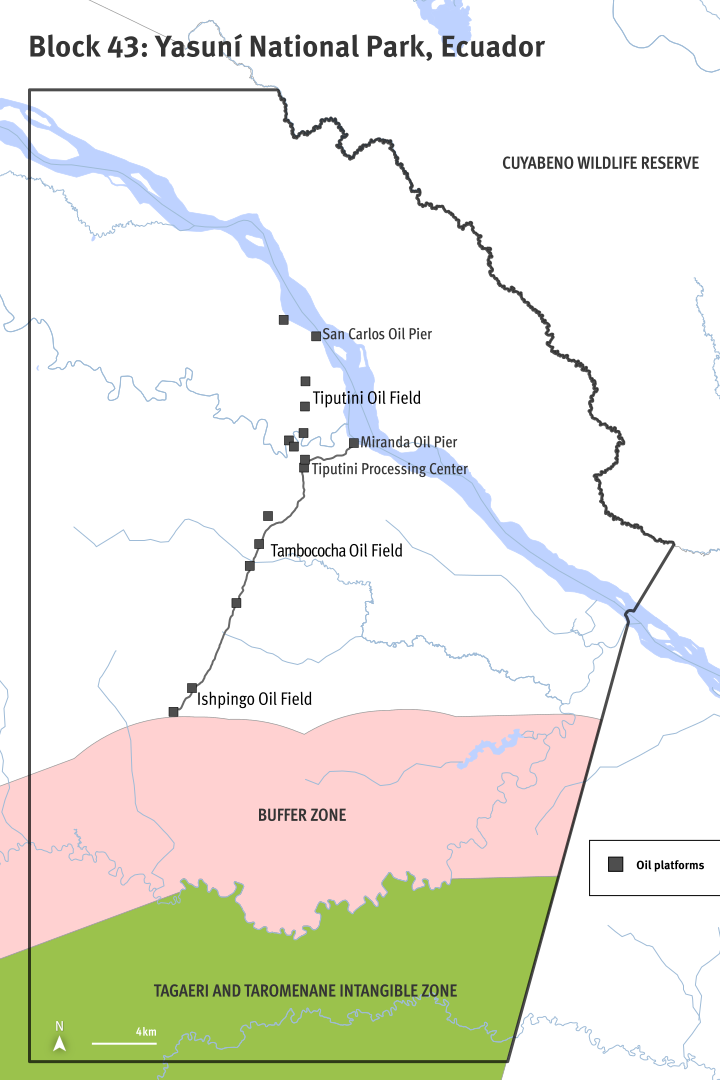
In November and December 2025, Human Rights Watch interviewed 13 leaders and community members of the Waorani Indigenous people and a leader from a Kichwa community situated within Block 43. Human Rights Watch also interviewed eight representatives of civil society organizations, journalists, academics, and economists. Researchers reviewed a range of external sources, including academic studies, news reports, legal documents, satellite imagery, oil industry publications, and publications by the Waorani Nationality of Ecuador (NAWE). The semi-nomadic Tagaeri and Taromenane live in the Ecuadorian Amazon, including a section of Yasuní National Park. In 1999, Ecuador established the “Tagaeri Taromenane Intangible Zone,” a core area of the national park where all extractive activity is forbidden. A ten-kilometer buffer zone separates oil facilities and the no-go zone.
Oil operations continued in other park areas, including an adjacent area to the north, oil Block 43. A 2024 government report that explained the challenges of complying with the referendum noted “signs of presence” of the Tagaeri and Taromenane peoples to the south of Block 43 and acknowledged that oil operations “posed a threat” to their survival.
The Inter-American Court of Human Rights ruled that oil extraction in Block 43—which overlaps with ancestral Indigenous territory—generated environmental pollution and increased the risks of forced contact with the Tagaeri and Taromenane, potentially exposing them to diseases, displacement, food shortage, and conflicts over resources. The court also noted the result of the national referendum on August 20, 2023, ordering the facility’s closure within one year.
It ordered the government to take “all necessary legislative, administrative, and other measures to ensure that this [referendum] is effectively implemented and that oil exploitation in Block 43 is prohibited.” Environmental defenders filed a compliance case against the government in November 2025 for failing to close Block 43.
Data from the state oil company, Petroecuador, showed that, except for a period in July 2025 when national oil production dropped due to damaged pipelines following a landslide, Block 43’s crude output remained constant throughout 2025, with an average of 1.2 million barrels of oil extracted each month.
The authorities have failed to provide public access to information about the required environmental monitoring since April 2024. Under Ecuadorian law, the Ministry of Environment, Water and Ecological Transition must submit these reports to the National Assembly every six months. An August 2025 ministerial letter on file with Human Rights Watch confirmed the submission of the October 2023-April 2024 monitoring report, yet the ministry has not disclosed the two subsequent reports that were legally due by that date.
The Tagaeri and Taromenane are part of the broader Waorani Indigenous people. Oil extraction near their territory increases the risk of unwanted encounters with outsiders and may expose them to pollution, severe health risks, and conditions that could make return to isolation virtually impossible.
The interviews with Waorani community members—who share the same language and culture and live in nearby areas affected by the oil operations—provide insights into how the Tagaeri and Taromenane might experience the impacts of oil operations in Block 43.
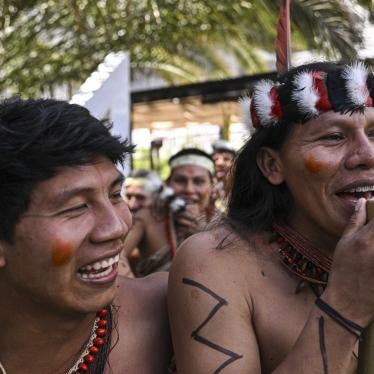
The Waorani community members said they believed that oil activity in and around Block 43 negatively affected the water quality of rivers—the primary source of drinking water—as well as the health and well-being of their communities. “Our rivers are being polluted, the animals are dying, rashes cover our skin after we bathe, we have no drinking water,” said Isabel Baihua, leader of the Waorani Women’s Association of Orellana.
The American Convention on Human Rights and the Escazú Agreement, to which Ecuador is a party, require the government to ensure people can access information needed to protect the rights to health and to a healthy environment. But Waorani community members said the authorities do not provide the information they need to make informed decisions to protect their health from the environmental impacts of oil extraction in Block 43.
The government has also not established the commission the court ordered to monitor the movements of the Indigenous groups to recommend expanding the no-go zone’s boundaries.
Ecuador’s ability to protect the Tagaeri and Taromenane Indigenous peoples has been further weakened by changes that have undermined key ministries. President Daniel Noboa downgraded the previous Ministry of Environment, Water and Ecological Transition into a vice-ministry within a new Ministry of Environment and Energy. The Ministry of Women and Human Rights was also downgraded to a vice-ministry under the Government Ministry. In its judgment, the court had flagged concerns that institutional changes and budget cuts had led to the state’s failure to prevent incursions of loggers and other third parties into Tagaeri and Taromenane territory.
The government of Ecuador should work with the Waorani people and communities affected by oil extraction in Block 43 to ensure its suspension and progressive closure.
“The Ecuadorian government’s refusal to close Block 43 undermines the democratically expressed will of its people, and its refusal to comply with the Inter-American Court of Human Right’s orders erodes its commitments to the regional human rights system,” Rodríguez Orúe said. “The government needs to respect the rule of law, and ultimately, the will of the Ecuadorian people.”
Oil-Related Threats to Indigenous Peoples in Yasuní National Park
Yasuní National Park is one of the most culturally diverse and biodiverse areas on Earth. The national park was established by law in 1979 and was designated a UNESCO biosphere reserve in 1989. It overlaps with the ancestral territories of the Kichwa and Waorani Indigenous peoples. The Waorani were the last Indigenous group in Ecuador to be contacted by the outside world, in the 1950s. After contact, the Waorani fragmented into several clans and communities, with the Tagaeri and Taromenane deciding to remain in isolation.
Dr. Patricio Trujillo, an Ecuadorian anthropologist who researches the Tagaeri and Taromenane, said that these groups follow semi-nomadic cyclical mobility patterns on ancestral hunting trails and rivers.
In 2013, Ecuador’s National Assembly declared oil exploitation in Blocks 31 and 43 inside Yasuní National Park to be “of national interest,” overriding prohibitions on extraction in national parks. Block 43—with the highest oil production in Yasuní—contains 247 wells across three fields. Ishpingo, the field furthest south, is the newest and most productive field, and the one closest to the Indigenous groups’ buffer zone.
In 1999, Ecuador established the Tagaeri Taromenane Intangible Zone, a core area of the park with the greatest environmental protection, to protect the “lands of habitation and development” of the groups. While all extractive activity, including oil operations, is banned in the zone, a 2024 government report identified the area south of Block 43 as suitable for hunting and seasonal mobility of the Tagaeri and Taromenane, acknowledging that “competition for subsistence resources in these areas may lead to situations of ... forced contact with Indigenous peoples living in voluntary isolation.” Maps produced by the citizen-led Critical Geography Collective that were used by the Inter-American Court, show that the impacts of oil extraction in the Ishpingo field already extend to the buffer zone.
Waorani community members interviewed by Human Rights Watch affirmed that the Tagaeri and Taromenane still appear to use territory near Block 43 infrastructure. They said they hear war cries as they cross ancestral hunting paths and find pottery and animal carcasses left behind by their relatives living in isolation.
According to official spills reports disclosed by Petroecuador, 29 spills occurred in Block 43 between 2016 and 2024, the most recent period for which data is available. However, in the company’s 2024 statement on the feasibility of closing the oil block, it said that “no spills have been recorded,” classifying the 29 incidents as “operational events” that, it said, “had no environmental impact” and were properly contained.
By contrast, in an official document on file with Human Rights Watch, the Ministry of Environment, Water and Ecological Transition said that the last publicly reported incident in Block 43, a June 2024 diesel spill, reached the Salado River that flows through the Tambococha field, affecting a Kichwa community dependent on fishing.
Human Rights Watch has documented that, around the world, communities most exposed to the extraction, manufacturing, use of, and disposal of fossil fuel products often face ongoing rights violations or other harmful human rights impacts tied to toxic air, unsafe water, and polluted ecosystems.
Many Waorani communities live close to Yasuní oil facilities, and people interviewed said they believe they are exposed to harmful water pollution. They said that children and older people have become ill after bathing or drinking river water and that fish deaths have reduced the availability of staple food.
“When the oil spills, animals, fish, trees, and people die,” one said. A Waorani elder leader born in what is now Block 43 said that two older people from her community had fallen ill after bathing in the rivers: “their whole body was red, blisters covered their skin … now we avoid the big river and seek nearby streams. Before oil extraction began in Block 43, my family and I were free to bathe and fish in the river. Now we can’t bathe in it; the fish are not healthy; they’re covered in oil.”
Ministry of the environment monitoring reports to the National Assembly from 2016 to 2024 repeatedly show “very polluted” and “moderately polluted water” in Block 43 under the Biological Monitoring Working Party Index, which assesses river water quality but doesn’t determine whether pollutants related to oil production are causing that pollution.
In its last publicly disclosed monitoring report issued in April 2024, the ministry noted that Petroecuador had not presented its biotic monitoring data since 2022, as required under Ecuadorian law, and that it failed to “submit biotic monitoring data for the exploitation phase of Block 43 from October 2023 to April 2024 for review and comment.” The ministry started an administrative proceeding against the company in May 2024.
Spills in Block 43 are part of a broader pattern of chronic oil pollution in Ecuador. Between 2020 and 2022, the ministry recorded an average of 22.5 oil spills each month. In the Amazon, the impacts have historically fallen heavily on Indigenous peoples and communities that depend on rivers for water, bathing, and fishing. Oil contamination in Ecuador’s Amazon has long been associated with skin irritation and dermatitis and newer research continues to document the wider pollution of rivers and fish, on which Amazonian communities depend.
Waorani community members also described poor air quality, which they attributed to gas flaring from nearby oil operations in Block 43. A Waorani leader from the Nampaweno community inside Yasuní said, “When it rains, pollutants fall to the ground harming our cassava and plantain crops. Communities that have no flaring have healthy crops.”
Scientific literature shows that gas flaring can produce acid rain that damages staple crops such as cassava, with effects strongest in closest proximity to flare sites. Throughout 2025, satellite imagery analysis and remote sensing carried out by Human Rights Watch detected intermittent flaring from the Central de Procesos Tiputini, an oil and gas processing facility to the north of Block 43.
Waorani community members also reported that sound and light pollution from oil operations in Block 43 have driven animals away from traditional hunting areas, affecting their ability to hunt wild games, another staple food source.
“It’s like having a helicopter outside of your home every hour, every day,” said Sofía Torres Caiza, president of the Citizen Oversight Committee, which was intended to oversee compliance with Block 43’s closure between 2023 and 2025.
One Kichwa leader living in the area said: “Before Block 43 we lived without noise, now it’s 24 hours of nonstop noise. When the animals hear that noise, they start to move away. They used to stay within our territory, and we rely on hunting to feed our families, but now there isn’t as much wildlife anymore.”
The Inter-American Court of Human Rights Ruling
In March 2025, the Inter-American Court of Human Rights formally communicated to Ecuador a ruling it had finalized in September 2024. The court found that Ecuador violated the rights of the Tagaeri and Taromenane Indigenous peoples living in voluntary isolation by, among other things, authorizing oil operations that surround the area where oil extraction is forbidden without proper environmental and human rights risk assessments and failing to stop illegal loggers from operating inside the zone. This exposes the Indigenous groups to a serious risk of human rights violations associated with forced contact, pollution, and conflicts over limited resources, the court said.
The court held that, given the close relationship between territory, natural resources, and the survival of Indigenous peoples in voluntary isolation, Ecuador should have applied the precautionary principle when determining and implementing measures to protect their territory. Under that principle, a government may be required to implement mandatory preventive measures to head off the risk of irreversible harm, even where there is no scientific certainty about the environmental or health impacts at issue.
The court concluded that, with the expansion of extractive activities in Yasuní, oil fields surrounding the no-go zone and its buffer have impacts that encroach upon those areas. The court underscored that oil blocks adjacent to the no-go zone, including Block 43, pollute that area, and that roads enabling access to oil facilities have enabled illegal logging, fishing, and hunting to proliferate inside Indigenous territory, increasing risks of forced contact, disease transmission, and conflicts, jeopardizing the survival of the Indigenous groups.
The court underscored that while authorities knew local groups lived and moved near Block 43, the government failed to demonstrate how the risks posed by oil operations were “taken into account when analyzing the granting of permits and concessions.”
The court found that oil extraction in Block 43 violated several rights enshrined under the American Convention on Human Rights, including the rights to health, territory, a healthy environment, self-determination, and to live with dignity. It acknowledged that “there is a risk that an oil spill affects waterways and, therefore, ends up affecting the territory” of the Indigenous groups.
In 2023, Ecuadorians voted in a referendum to halt oil extraction in Block 43. Protecting Indigenous peoples living in voluntary isolation from the impacts of oil production was a core component of the underlying 10-year campaign that sought to keep oil in Block 43 “indefinitely underground.”
Ecuador’s Constitutional Court ordered that the government should implement the result at the latest by August 2024, progressively halt extraction, protect the Tagaeri and Taromenane, revoke permits, and restore the environment. The Inter-American Court of Human Rights considered that compliance with the referendum would help minimize the harmful impacts that oil extraction on the rights of the Indigenous groups and ordered Ecuador to adopt “all necessary legislative, administrative, and other measures to ensure that this [referendum] is effectively implemented and that oil exploitation in Block 43 is prohibited.” The government has not complied.
The court also ordered Ecuador to identify additional measures to fix serious gaps in producing reliable information about environmental conditions in the no-go zone, including potential contamination of water, air, and the broader ecosystem, and noise from nearby extractive activity. The court also ordered Ecuador to take steps to improve monitoring of the movements of peoples in isolation in areas surrounding the no-go zone.
Non-Compliance with the Inter-American Court of Human Rights Ruling
Ongoing Oil Production
In a letter to a National Assembly member dated August 1, 2025, on file with Human Rights Watch, the ministry of the environment acknowledged that there was no final plan for phasing out oil production in Block 43, despite the referendum and the court order. The ministry also acknowledged that environmental licenses had not been revoked, and withdrawal of infrastructure remained stalled. As of March 2026, Ecuador has shut down a handful of wells in Block 43.
Oil production in Block 43 remained stable throughout 2025, according to Petroecuador’s yearly production reports, with an average of 1,245,225 oil barrels extracted each month. Ecuador was still extracting over 44,000 barrels of oil per day from Block 43, based on Petroecuador data, 9.4 percent of the country’s total crude output in 2025.
Despite President Noboa’s initial promise to comply with the 2023 referendum, his government has continued extracting oil from Block 43, alleging that an immediate compliance would harm the country’s economy and therefore postponed the closure until 2029. However, experts, environmental human rights defenders, Indigenous leaders, and academics interviewed by Human Rights Watch said that Block 43’s closure presents a critical opportunity to start a transition away from fossil fuels, on which Ecuador depends for about 12 percent of its GDP.
In February 2026, Human Rights Watch wrote to Petroecuador requesting comments on our finding that oil operations in Block 43 continued after the Inter-American Court's Ruling. At the time of publication, Petroecuador had not replied.
Reduced Access to Information
The ministry of the environment is required to present environmental monitoring information to the National Assembly every six months by law, but currently there are no publicly available monitoring reports. Pedro Bermeo from the citizen collective Yasunídos said, “These reports are rarely uploaded online; we always struggle to find them.”
As a result, interested parties are forced to seek information through freedom of information requests—which are often denied or ignored—said Indigenous leaders, oversight bodies, civil society organizations, and legislators.
Waorani leaders and community members also reported that the authorities provide little information about the potential health impacts of oil activities in Block 43. They said that the government does not warn them about potential pollutants and health hazards in the rivers from which they draw water, including when an oil spill or other associated polluting incidents occur. When coupled with the skin irritation and blisters that some community members have experienced, and the dead fish observed in surrounding areas, this lack of information leaves community members to consider their water unsafe for drinking or bathing.
“Information about the environmental conditions in Block 43 is kept secret, the government has never given it to us, even though we’re the affected people – it puts our lives at risk,” said Nemo Andy Guiquita, a Waorani leader from the Confederation of Indigenous Nationalities of Ecuador.
In September 2025, the Citizen Oversight Committee established by the Council for Citizen Participation and Social Control—the public entity charged with promoting public participation to monitor implementation of the 2023 referendum—reported repeated refusals by state institutions to provide information regarding environmental impacts of oil extraction in Block 43 and measures to protect the Tagaeri and Taromenane peoples.
In April 2024, in a response to a freedom of information request filed by the Citizen Oversight Committee, the ministry of the environment provided information on the environmental conditions inside Block 43 in a Google Drive folder with data up to October 2023. Human Rights Watch reviewed the folder and concluded that monitoring reports showed no cumulative risk assessments to determine the environmental impacts of continued oil extraction over the Tagaeri and Taromenane peoples. Much of the information from the ministry was from monitoring data by the state oil company.
Mariana Yumbay, a member of the National Assembly, filed a freedom of information request in 2025 asking the ministry of the environment to provide information on the closure of Block 43 and the environmental impacts of oil operations in the area. In its August 2025 reply, the ministry provided an additional environmental monitoring report for the October 2023-April 2024 period, but by that time authorities had been legally required to have produced two additional reports.
“[The ministry] takes far too long to provide us with incomplete information, and from what little they have given us, it is evident that the government is not complying with the orders to shut down Block 43,” Yumbay said.
Government Inaction on Protection Measures
The Inter-American Court of Human Rights ordered Ecuador to act with the utmost diligence within defined timelines to correct failures in monitoring and protection of the Tagaeri and Taromenane Indigenous peoples.
The court acknowledged that Ecuador had established a protective framework for the Tagaeri and Taromenane peoples but found the implementation of these measures insufficient to stop illegal logging, fishing, and hunting in their territory.
The court ordered Ecuador to create a Technical Evaluation Commission to map the presence of isolated peoples outside the no-go zone every two years and recommend expanding the protected zone if needed in light of those findings. The commission was to include Waorani and civil society representatives and operate under the supervision of the court. Ecuador had until September 2025 to establish it.
The Waorani Nationality of Ecuador and counsel for plaintiffs before the court confirmed that the government had not yet established the commission. “The government does not have the will to dialogue with the Waorani people … we don’t want to just participate, we deserve the right to speak and decide on how the closure and reparation of Block 43 happens,” said Juan Bay, president of NAWE.
The court found that Ecuador had failed to establish the required commission and criticized its existing protection measures as inadequate due to their lack of implementation. Human Rights Watch analyzed information presented by the Women and Human Rights Ministry to the Oversight Committee in June 2025 regarding the measures it was taking to ensure the protection of the Indigenous peoples. Although the ministry reported that it had carried out three patrols in the no-go zone to look for signs of Tagaeri and Taromenane presence and had also provided routine training to oil workers on how to avoid contact with Indigenous peoples living in isolation, it did not provide any information regarding third party incursions into the region or any measures it has taken to prevent such incursions.
The now downgraded Vice-Ministry of Women and Human Rights is responsible for conducting patrols to look for signs of Tagaeri and Taromenane presence and to monitor any threats to their rights, including by third-party incursions. However, the Citizen Oversight Committee noted in September 2025 that the entity lacked a protection plan or targets to carry out these functions.
In its final 2025 report concluding that the government had not complied with the 2023 referendum, the Citizen Oversight Committee emphasized that, “Although the ministry acknowledges the existence of protocols, patrols, and training, the reported actions are merely formal and do not constitute concrete measures for redress or effective protection … the absence of an operational and funding plan confirms the lack of actual implementation.” The committee noted that the ministry failed “to demonstrate cumulative risk assessments for ongoing operations in Block 43 (such as traffic, noise, gas flares, and construction), nor did it include safety measures to prevent exposure.”