Daily Brief Audio Series
With their massive and deliberate forced displacement of Palestinian civilians in Gaza since October last year, Israeli authorities are responsible for war crimes and crimes against humanity.
This is the conclusion of HRW’s latest report.
To start off with, let’s talk about what the term “crimes against humanity” means in international law.
These are certain crimes committed by members of government forces or a non-state armed group that are knowingly committed as part of a widespread or systematic attack on a civilian population. This means the multiple commission of such crimes committed pursuant to a state policy.
In this case, we are talking about Israel’s mass displacement of nearly all of Gaza’s population, often multiple times, as well as preventing their return home.
The laws of armed conflict applicable in occupied territory permit displacement of civilians only for imperative military reasons or for the population’s security. They require safeguards and proper accommodation to receive displaced civilians.
Israeli officials claim that, because Palestinian armed groups are fighting from among the civilian population, the military has lawfully evacuated civilians to attack the groups while limiting civilian harm. Human Rights Watch research shows this claim to be largely false.
There is no plausible, imperative military reason to justify these actions. What’s more, the military’s empty “evacuation orders” have not ensured civilians’ security. In fact, they’ve caused grave harm.
As my expert colleague, Nadia Hardman, says: “The Israeli government cannot claim to be keeping Palestinians safe when it kills them along escape routes, bombs so-called safe zones, and cuts off food, water, and sanitation.”
Israeli forces have also carried out deliberate, controlled demolitions of homes and civilian infrastructure. This includes areas where they have apparent aims to create “buffer zones” and security “corridors,” from which Palestinians are likely to be permanently displaced.
They have systematically razed to the ground orchards, fields, greenhouses and other civilian infrastructure, violating their obligation to ensure Palestinians can return home.
These actions do not comply with the laws of war.
For too long, the world has been letting the government of Israel get away with war crimes and crimes against humanity. Governments need to change Israeli leaders’ calculations, by adopting targeted sanctions and other measures. They should also halt weapons sales to Israel.
In addition, the International Criminal Court prosecutor should investigate Israel’s forced displacement and prevention of the right to return as a crime against humanity.
The report is new, the details are appalling, and the legal analysis on crimes against humanity adds to the world’s knowledge of the horrors in Gaza.
But the world has known for some time that Israeli authorities are committing widespread atrocities in Gaza. And the question remains: when will governments finally say stop?
Over the past decade or so, we’ve seen refugees turned into a major political issue in North America, Europe, and elsewhere. The fate of people seeking safety from war and repression has been pushed to the fore by politicians and media outlets. Both are desperate for attention, and many have been willing to spread fear and hate to get it.
The issue often gets rolled into a general one about immigration and boiled down to an us-vs-them argument. When asked for their opinion, the public sometimes gets questions that are essentially: “what do you think of them?” or “do you want more of them or fewer?”
The answers from the public sometimes reflects the same fear-driven framing.
It’s like the old saying: ask a stupid question, get a stupid answer.
Here’s the real question pollsters and reporters should ask the public: do you want your government to send people to places where they will likely be tortured?
That’s a much more relevant question. It’s framed in a way that gets to the heart of the issue: the morality and legality of what your government is doing or planning to do.
In the US talk of “sending people back” and threats of “mass deportations” have been at fever pitch throughout the recent presidential election campaign, worrying refugees in the country. We’ve seen the US send asylum seekers back before, to places like Cameroon, where they were indeed abused.
The EU and its member states work with repressive governments abusing asylum seekers and migrants to prevent them reaching the EU. The EU also helps send them back to Libya, where they face torture.
Just last week, the German government deported a Tajik political activist, knowing full well about Tajikistan’s use of torture against government critics. And European politicians in several countries keep seriously suggesting sending Syrian refugees to Syria, where torture is rampant.
The UK is no better. Just witness the alarming political push by the last government to send asylum seekers to Rwanda, where torture is commonplace. So driven to enact this cruelty on people, the UK Home Secretary at the time called it her “dream” and her “obsession.”
But ask normal people in any of these places the right question – do you want your government to send people to places where they will likely be tortured? – and surely, most people will give you the right answer: of course not.
And in fact, when pollsters ask questions closer to something like this – in the US, the EU, and the UK – people respond with compassion. Around the world, the vast majority of people support the idea that people fleeing war or persecution should be able to seek safety in another country.
So, next time you hear attention-seeking politicians and media rattling on about asylum seekers, remember what the real question is. Then, maybe ask those around you: do you want your government to send people to places where they will likely be tortured?
When was the last time you renewed your passport?
It probably wasn’t too big a deal. Maybe you complained about it taking too long or costing too much, but no more than that. You may not even remember.
It’s one of those tedious bits of bureaucracy you just have to go through every five or ten years. Even if you live abroad, it’s probably not complicated. You simply go to your nearest embassy or consulate with the forms filled out. Or you may even be able to do the whole process online and have your shiny new passport sent to you in the post.
But some authoritarian regimes have turned such routine paperwork into a method of controlling citizens living abroad. You can’t just pop in at the embassy. Forget about doing it online. No, you have to go back “home.”
Once you’re there, authorities can do what they like with you. You know this, and you know what they do to people who say things they don’t like. So, you shut up, even when abroad, because you need that document.
In the country where you live, the government requires it for all sorts of things, like your visa and residency permit. You need legal status in your host country, and those documents are essential for everything, like being able to work, study, and take part in social programs. Without an ID, it’s extremely difficult to claim your rights.
Turkmenistan is one example of an authoritarian regime that practices this kind of transnational repression: extortion by passport. (Belarus is another.) Turkmenistan authorities compel citizens living abroad to go back to Turkmenistan to renew their passport.
Going back entails huge risks for them. Turkmenistan is among the most repressive countries in the world. Authorities sometimes disappear dissenters, and for years, their families don’t even know if they’re alive. Torture is commonplace.
In short, Turkmens living abroad have a terrible choice: live undocumented in their host country, risking all kinds of hardships and deportation there, or return to Turkmenistan for a passport and risk being banned from foreign travel or worse, disappeared or tortured.
The best solution to all this would be if Turkmenistan simply issued passports abroad, like many other countries do. But until that happens, countries hosting Turkmen migrants – like Türkiye – need to realize this is a problem and act accordingly.
Expired passport or not, no country should force anyone to return to Turkmenistan if they would face the risk of persecution or torture there. And no Turkmen migrants living outside should suffer just because Turkmen authorities refuse to renew their passports abroad.
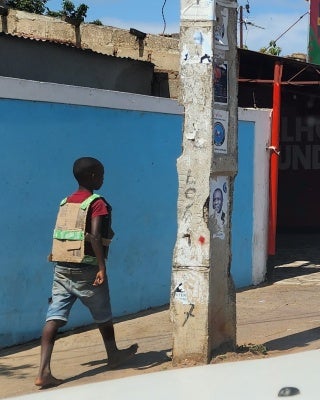
The photograph shows a barefoot boy walking along a street in Maputo, the capital of Mozambique. He’s wearing a homemade “bullet-proof vest” pieced together from bits of cardboard.
Some readers may be thinking: well, that’s not going to stop bullets. But surely that’s the point, and this child knows it better than most people do.
For weeks, he’s been surrounded by deadly violence that’s engulfed Maputo and other parts of the country following the announcement of election results.
On October 24, Mozambique’s election commission declared the ruling party, Frelimo, had won the October 9 elections. Party leader Daniel Chapo would be the president-elect. The major opposition party, Podemos, cried foul.
International observers, including the African Union, the European Union, and the Commonwealth, have raised serious concerns about the credibility of the electoral process. They’ve called for a thorough investigation into allegations of election irregularities.
Indeed, the elections and the campaigning period saw widespread irregularities, political killings, and restrictions on freedom of expression and assembly.
Tensions then increased between election day and the announcement of results two weeks later, when things exploded. Post-election protests across the country on October 24 and 25, were met with live bullets and tear gas from security forces, killing at least 11 people and injuring dozens of others.
Since then, many days have unfolded in a similar pattern: thousands of people come out to protest, and authorities use excessive force against them. Security forces continue to fire live ammunition at protesters and have indiscriminately fired into residential areas. Media report dozens more killed and hundreds injured.
On Thursday last week, violence broke out as a planned protest quickly descended into a standoff between security forces and protesters.
Heavily armed police and soldiers had used military-style vehicles to block peaceful protesters from reaching the heart of the city. One group managed to break through the security cordon, and police tried stopping them with tear gas, which got into people’s homes. Some people responded by throwing stones and bottles at the police.
It seems these clashes and excessive responses by security forces won’t end soon.
We can roll out the inevitable list of “shoulds.” Of course, authorities should investigate these events, especially the killings. Of course, security forces should follow international law enforcement standards and not use live ammunition when they don’t absolutely have to. Of course, concerned governments should press Mozambican authorities on these things.
But until then, what’s a child in Maputo supposed to do? Wearing a cardboard “bullet-proof vest” won’t help, he knows, but neither will anything else he does. It seems a moving symbol of the powerlessness people feel in the face of the deadly violence raging around them.
So often in crises and conflicts around the globe, the outside world sees the results of violence in gruesome images. But sometimes, a photo that’s not bloody at all tells the story even better.
We’ve talked a lot about the US elections and the results over the past few weeks. Some friends of the Daily Brief have been pinging us: “Hey, you know there’s more to the world than the US, right?”
Indeed. So, today, let’s remember what else is going on around the globe.
Here are twelve other human rights stories we’ve been covering recently. Rather than focusing on events that generally are getting international media attention – like atrocities in expanding conflicts in the Middle East and eastern Europe – these are stories you don’t hear about in the news very much.
In alphabetical order…
1) Afghanistan has slipped off some folks’ radar, but the Taliban’s repression of women continues regardless – “Brutal. Outrageous. Sadistic. Dystopian.” We recently looked at abuses and threats against former policewomen in particular.
2) Australia jails ten-year-old kids. If that sounds extreme, that’s because it is.
3) Azerbaijan is hosting the COP29 climate conference next week. What do you need to know about the country? It’s an authoritarian petrostate with a long list of political prisoners.
Speaking of climate change…
4) Brussels – that is, the European Union – was on the cusp of introducing a useful new regulation to combat deforestation, the second largest source of the greenhouse gas emissions causing the climate crisis, after the burning of fossil fuels. Then, the European Commission put the brakes on. Because global warming will wait for Brussels, right?
5) Burkina Faso’s civilians are caught between Islamist groups and junta forces. Both are slaughtering them.
6) Haiti’s children face a “hunger trap” amid rampant insecurity. They are forced to join violent gangs just to survive.
7) Hungary’s authoritarian government has been making Ukrainian refugees homeless.
8) Kyrgyzstan still has a problem with “bride kidnapping” – that is, abducting women for forced marriage. Some attempt to justify this as “tradition,” a word too often used to try to defend human rights abuses.
9) Myanmar’s armed conflict between the junta’s military forces and the ethnic armed group, Arakan Army, sees both sides committing atrocities. When people try to flee to safety in Bangladesh, they sometimes get pushed back by Bangladesh border guards.
10) Rwanda is a country where torture is commonplace, in official prisons and jails, as well as in unofficial facilities. A court case earlier this year offered some hope authorities might start facing the problem. We’re still waiting for that.
11) Sudan’s atrocity-ridden conflict rages on, mostly outside the international spotlight. We will keep reporting on it, drawing attention to it, and ringing alarm bells about it, as this Daily Brief has done again and again, since the beginning, last year.
12) The UN Human Rights Council in Geneva has shown that not all the news is awful. We recently reported some positive steps there, concerning situations in Sudan, Venezuela, and Russia.
So, yes, there have been other things going on in the world besides the US elections. And many get very little media attentional internationally.
We will continue to cover them all here, in the Daily Brief.