Reports

State Censorship, Control, and Increasing Isolation of Internet Users in Russia

The 50-page report, “Disrupted, Throttled, and Blocked: State Censorship, Control, and Increasing Isolation of Internet Users in Russia,” documents the impact of the government’s increasing technological capacities and control over the internet infrastructure. Human Rights Watch found that this allows the authorities to carry out more widespread and nontransparent blocking and throttling of unwanted websites and censorship circumvention tools, as well as internet disruptions and shutdowns under the pretext of ensuring public safety and national security.

Illustration of a keyboard blocking a man's view
A woman looks out of the window of a damaged building

Search

  • August 31, 2016

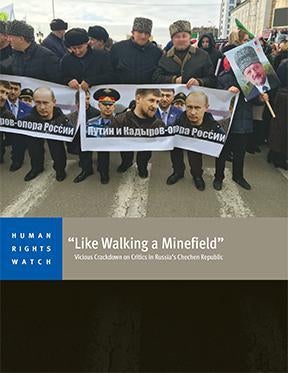
    Vicious Crackdown on Critics in Russia’s Chechen Republic

    This report describes how local authorities punish and humiliate people who show dissatisfaction with or seem reluctant to applaud the Chechen leadership and its policies. The report also details increasing threats, assaults, and detention of journalists and human rights defenders.
     

    photo gallery
    map content
    Cover for Chechnya Report
  • June 29, 2016

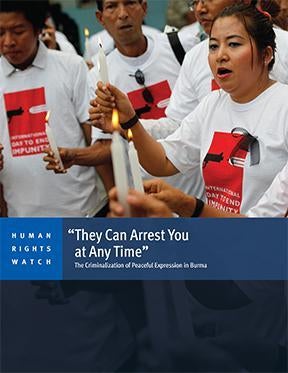
    The Criminalization of Peaceful Expression in Burma

    This report documents the use and abuse of a range of broad and vaguely worded laws to criminalize peaceful expression, including debates on matters of public interest, and provides specific recommendations for the repeal or amendment of those laws.

    photo gallery
    cover image for Burma Report
  • June 15, 2016

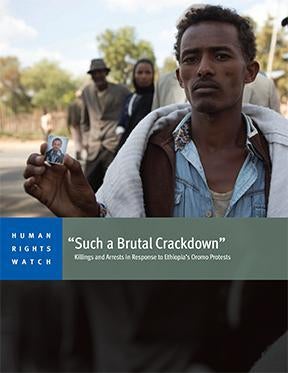
    Killings and Arrests in Response to Ethiopia’s Oromo Protests

    This report details the Ethiopian government’s use of excessive and unnecessary lethal force and mass arrests, mistreatment in detention, and restrictions on access to information to quash the protest movement. Human Rights Watch interviews in Ethiopia and abroad with more than 125 protesters, bystanders, and victims of abuse documented serious violations of the rights to free expression and peaceful assembly by security forces against protesters and others from the beginning of the protests in November 2015 through May 2016.


    map content
    video content
    cover image
  • May 26, 2016

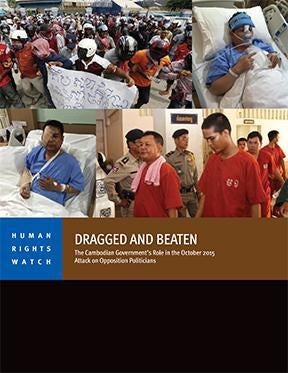
    The Cambodian Government's Role in the October 2015 Attack on Opposition Politicians

    This report shows that the three officials charged in the mob attack were not acting alone. The ruling Cambodian People’s Party (CPP) transported protesters to the National Assembly in Phnom Penh a day after Hun Sen threatened to retaliate against the CNRP for demonstrating against him in Paris. Police stood by during the assault that inflicted serious injuries on assemblymen Kung Sophea and Nhay Chamraoen. After the attack, the mob went to the home of deputy CNRP leader Kem Sokha and threw stones and menaced those inside.


    cover
  • May 24, 2016

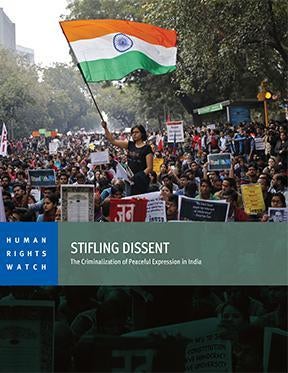
    The Criminalization of Peaceful Expression in India

    This report details how criminal laws are used to limit and chill free speech in India. It documents ways overbroad or vague laws are used to stifle political dissent, harass journalists, restrict activities by nongovernmental organizations, arbitrarily block Internet sites or take down content, and target marginalized communities, particularly Dalits, and religious minorities.

    video content
    India Cover
  • May 22, 2016

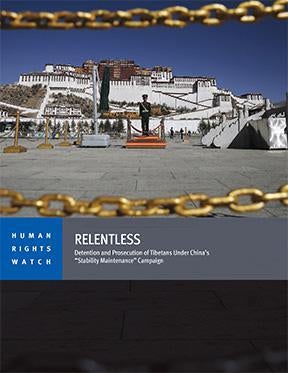
    Detention and Prosecution of Tibetans under China’s “Stability Maintenance” Campaign

    This report shows how changing patterns of unrest and politicized detentions, prosecutions, and convictions from 2013-2015 correlate with the latest phase of the government’s “stability maintenance” campaign – a policy that has resulted in unprecedented surveillance and control in Tibetan villages and towns.

    map content
    Tibet cover image
  • May 18, 2016

    Life under ISIS in Sirte, Libya

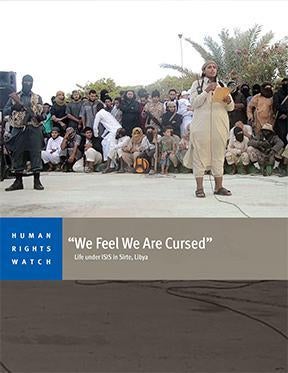
    The report, “‘We Feel We Are Cursed’: Life under ISIS in Sirte, Libya,” also finds that ISIS is inflicting severe hardship on the local population by diverting food, medicine, fuel, and cash, along with homes it seized from residents who fled, to fighters and functionaries it has amassed in the Mediterranean port city. As the de facto government in Sirte, ISIS has the duty to ensure that all residents are able to exercise their basic human rights, including the rights to food and health.

    map content
    cover
  • May 3, 2016

    Attacks on Media Freedom in Somalia

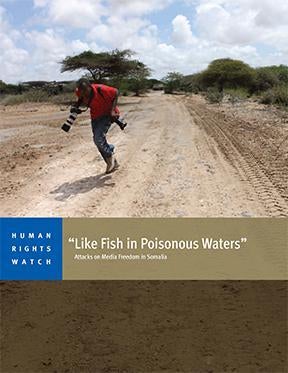
    This report documents killings, threats, and arbitrary detention of journalists since 2014. The Somali federal government and regional authorities have used various abusive tactics to affect media coverage, including arrests and forced closures of media outlets, threats, and occasionally, criminal charges. Al-Shabab has targeted journalists as part of its campaign against the Somali government and for reporting deemed unfavorable. Government authorities have failed to adequately investigate and prosecute those responsible for abuses, leaving journalists to live in fear.


    map content
    video content
    cover
  • March 23, 2016

    Repression and Abuse of Women Human Rights Defenders, Activists, and Protesters in Sudan

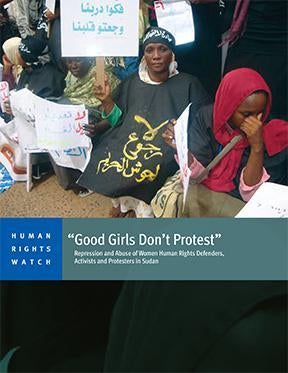
    This report documents efforts by Sudanese authorities to silence women who are involved in protests, rights campaigns, and other public action, and who provide social services and legal aid, as well as journalists.

    video content
    report cover
  • January 10, 2016

    Pre-election Threats to Free Expression and Association in Uganda

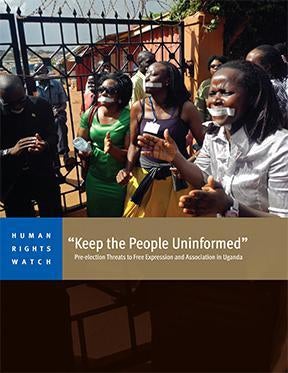
    This report documents how some journalists and activists are facing increased threats as the elections in Uganda loom. While print journalists working in English have some relative freedom, radio journalists – particularly those working in local languages whose listeners are based in rural areas – face harassment and threats from an array of government and party officials. These include the police; resident district commissioners, who represent the president; internal security officials; and the Ugandan Communications Commission, the government broadcasting regulator.

    map content
    Employees of the Daily Monitor newspaper with their mouths taped shut, sing slogans during a protest against the closure of their premises by the Uganda government, outside their offices in the capital Kampala May 20, 2013.
  • November 10, 2015

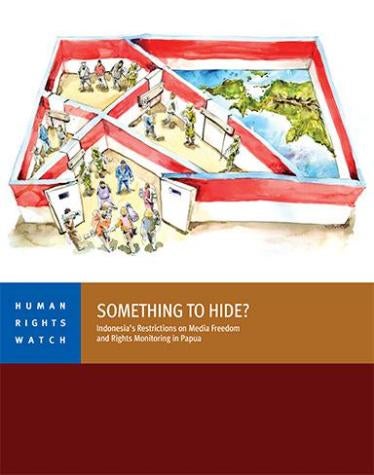
    Indonesia’s Restrictions on Media Freedom and Rights Monitoring in Papua

    This report documents the government’s role in obstructing access to the provinces of Papua and West Papua (collectively referred to as “Papua”), including government backlash since Jokowi’s announcement.

    map content
    video content
    cover indonesia report
  • October 26, 2015

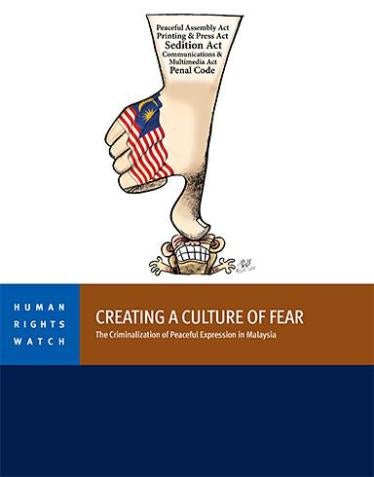
    The Criminalization of Peaceful Expression in Malaysia

    Thise 141-page report documents the government’s use and abuse of a range of broad and vaguely worded laws to criminalize peaceful expression, including debates on matters of public interest. The report also spotlights a disturbing trend of abuse of the legal process, including late night arrests and unjustifiable remands, and a pattern of selective prosecution.

    cover malaysia report
  • October 16, 2015

    Protest and Police Crackdown in the Terai Region of Nepal

    This 44-page report documents Human Rights Watch investigations into the killings of 25 people, including 16 members of the public and 9 police officers, in five Terai districts between August 24 and September 11, 2015. Human Rights Watch found no evidence that any of these victims were posing a threat at the time that they were killed.

    nepal report cover
  • July 15, 2015

    Media Freedom Under Attack in the Western Balkans

    This 69-page report documents physical attacks and threats, including death threats, punitive lawsuits, and smear campaigns targeting journalists in Bosnia and Herzegovina, Kosovo, Montenegro, and Serbia. The report is based on interviews with 86 journalists, most of whom report on sensitive issues such as war crimes and corruption, in the four Western Balkan countries. Human Rights Watch also documented several cases of cyberattacks against online media outlets critical of the governments. None of the countries are adequately investigating or prosecuting the attacks on journalists, Human Rights Watch found.

    video content
    cover image
  • July 13, 2015

    China’s Restrictions on Foreign Travel by Tibetans and Others

    This 53-page report shows the evolution of a discriminatory two-track system for passports applications: a fast-track system is available in areas that are largely populated by the country’s ethnic Chinese majority, but only a slow-track system is allowed for those in most ethnic and religious minority areas. 
    passport