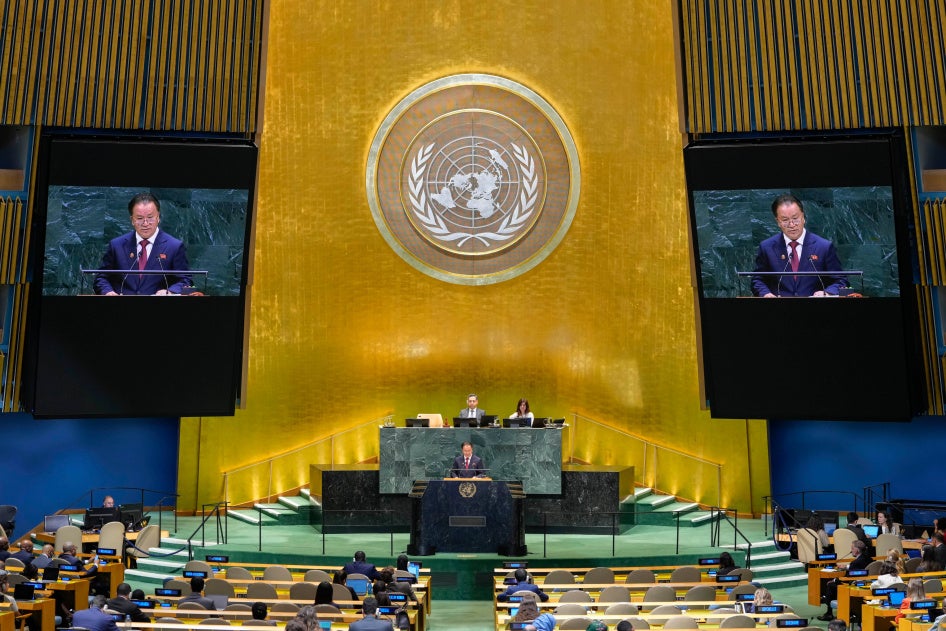
North Korean Vice Foreign Minister Kim Son-gyong, in his September 28 address to the United Nations General Assembly, asserted that the country’s status as a permanent nuclear state is “uncompromisingly and permanently fixed, both physically and legally.” This was an unmistakable reference to a March constitutional amendment that codified the centrality of North Korea’s nuclear doctrine.
Meanwhile, South Korean President Lee Jae Myung has announced plans to pursue dialogue with North Korea aimed at the eventual denuclearization of the Korean peninsula. But it is crucial that his diplomacy-first approach does not disregard accountability for North Korea’s grave human rights violations.
While missile tests and nuclear arsenals dominate headlines, North Korea remains among the world’s most repressive states. The government enforces fearful obedience through forced labor, torture, public executions, enforced disappearances, and collective punishment against dissidents’ families. Many North Koreans suffer from chronic hunger and have little to no access to health care, while the government devotes massive resources to developing nuclear weapons. Multiple UN reports and findings, statements by the UN High Commissioner for Human Rights, and UN Human Rights Council resolutions on North Korea have affirmed that human rights violations—forced labor, in particular—have financed the nuclear weapons program and are inextricably linked to it.
Security and accountability are not competing goals. Several existing sanctions on North Korea—which include UN and US sanctions—require that North Korea take positive steps on human rights before being lifted. And if human rights inspections in North Korea exposed additional information about Pyongyang’s abuses, there would need to be a response under UN policy and international law.
Past reconciliation efforts with North Korea sidelined human rights without producing meaningful dialogue or advancing negotiations. Rather than repeat those mistakes, the South Korean government should adopt an inter-Korean policy that integrates human rights standards into every dialogue with—or about—North Korea.