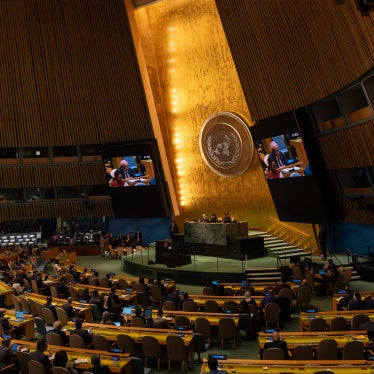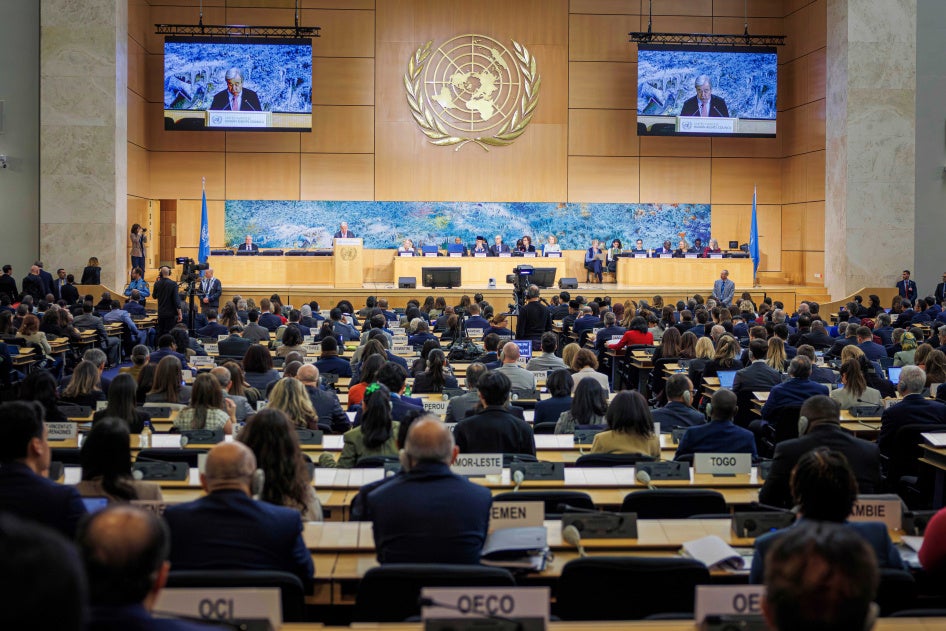
This statement was delivered by Human Rights Watch at the 63rd regular session of the UN Human Rights Council during a general debate on the Universal Periodic Review (UPR) held on September 28, 2026.
As the 4th cycle of the UPR approaches its end, it is incumbent on the Council to address cases of ‘persistent non-cooperation’ in accordance with the institution building package.
The UPR of the United States, re-scheduled for 10 November, is a case in point. If the US again fails to participate, the HRC should be ready to respond to this persistent non-cooperation, as affirmed in Council Decision 19/101.
States should not be rewarded for non-cooperation and should not avoid scrutiny of their domestic human rights situation, by simply not participating in their UPR review. The Council should have a discussion in plenary on how to address 'persistent non-cooperation' in the UPR, and, for states who fail to cooperate, such as the US, that must include a plenary discussion on the human rights situation in that country.
At a time of sharp deterioration in rights in the US, where the government is violating immigrants and asylum seekers’ rights, curtailing free expression, taking actions that may end up limiting access to the polls, and substantively undermining key oversight, accountability and transparency mechanisms, the HRC can’t afford to look the other way.
The UPR was created to ensure that each state, regardless of its size or power,
undergoes a review of its human rights record. The universal nature of the UPR is its most unique and valuable feature. The HRC must take action to defend the very essence of the UPR, which has received the highest level of participation from states across the world.