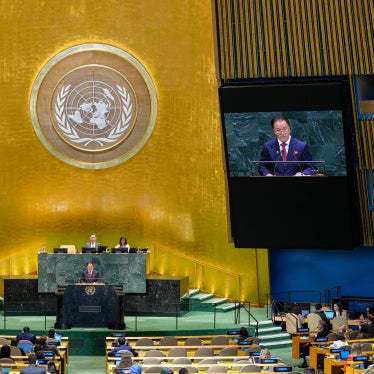

In the early hours of September 5, a UN disarmament meeting in Geneva concluded three years of work on autonomous weapons systems, colloquially known as killer robots. While the final report was significantly watered down, it left the door open for more concrete action in November, with a record number of states now supporting negotiations on legally binding rules.
The stakes could not be higher, given growing reports that autonomous weapons are already being deployed on the battlefield. These systems, which select and engage targets without human intervention, pose a host of legal, ethical, accountability, and security concerns.
During the final session of the Convention on Conventional Weapons (CCW) Group of Governmental Experts (GGE) on Lethal Autonomous Weapons Systems, many states demonstrated a commitment to complete their mandate—to develop a “set of elements of an instrument”—and advance toward negotiations of a legally binding instrument, which would govern the use of autonomous weapons. In total, 76 states have now expressed their support for moving to negotiations. As reported by Stop Killer Robots, 70 of these states are High Contracting Parties, meaning they are voting members of the CCW. This makes up a majority of the Convention’s Parties, marking the strongest political momentum yet for a CCW treaty process.
The UN’s final report has some positive elements. It includes a characterization of lethal autonomous weapons systems, affirms that human control and judgment are required for compliance with international law, and incorporates restrictions on systems that cannot comply with that law.
The final report does not, however, fully reflect the breadth of progress achieved at the GGE. Certain states, including Russia and the United States, weakened the text by insisting on changes to widely supported provisions. The final version removes references to design and development; narrows the scope of the treaty from all international law to only international humanitarian law; and cuts the reference to ethical considerations. It also removes references to predictability, reliability, explainability, and traceability.
Nevertheless, the adopted final text provides a sufficient foundation for launching negotiations. The November CCW Review Conference is now a decisive moment where states should adopt a mandate to begin negotiations on a new law. The need for meaningful human control is urgent. States now have the opportunity to turn over a decade of work into concrete legal progress.