- Many refugees and asylum seekers in Egypt, most from Sudan and South Sudan, have faced a months-long campaign of arbitrary arrest, unlawful detention, and deportation.
- Refugees and asylum seekers are losing their residency status because of bureaucratic delays and are being jailed and deported for lacking documents the government has failed to provide.
- Egyptian authorities should stop arresting and deporting asylum seekers and refugees, particularly those based solely on expired residency permits, uphold international obligations, and amend its Asylum Law and bylaws to protect refugees and asylum seekers from further legal limbo.
(Beirut) – Many refugees and asylum seekers in Egypt, mostly from Sudan and South Sudan, have faced a months-long campaign of arbitrary arrest, unlawful detention, and deportation, Human Rights Watch said today. Egyptian authorities are arresting refugees and asylum seekers whose residency permits have expired due to the government’s prolonged administrative delays, including people with valid UNHCR cards.
Refugees and asylum seekers in Egypt are required to renew their residency permits with the government annually, but due to government backlogs, some people are being given renewal dates as late as 2028, leaving them exposed to these abuses. At the same time, refugee status determination, long handled by the Office of the United Nations High Commissioner for Refugees (UNHCR) in Egypt, is due to be transferred to the government under the 2024 Asylum Law. However, the government has yet to implement the law’s bylaws, and UNHCR also faces a backlog in processing asylum applications.
“Refugees and asylum seekers in Egypt are losing their residency status because of bureaucratic delays, and are being jailed and deported for lacking the very documents the government has failed to provide,” said Michelle Randhawa, senior refugee and migrant rights officer at Human Rights Watch. “Detaining asylum seekers and refugees simply because their documents expired due to the government’s administrative delays is both arbitrary and draconian.”
In April and May 2026, Human Rights Watch interviewed 19 refugees and asylum seekers from South Sudan, Sudan, Eritrea, and Ethiopia. To protect confidentiality, their names are not being used. Human Rights Watch sent detailed questions to the Egyptian Foreign Ministry on June 23 but has received no response.
Human Rights Watch found that a severe backlog in initial residency and renewal appointments is leaving refugees and asylum seekers vulnerable to arbitrary arrest, detention, and deportation, even when registered with UNHCR. Beginning in late 2025 and continuing into 2026, Egyptian authorities intensified a campaign of arrests, detention, and deportations, targeting asylum seekers and refugees often based solely on their expired residency permits.
In March, UN experts expressed alarm over reports of deportations and arbitrary arrests, warning that these practices “were reportedly carried out without individualized assessments to determine the risk of refoulement,” being returned to a country or territory where they are likely to face persecution. While the Egyptian government does not release official statistics, human rights organizations and the media report that thousands of refugees and asylum seekers have been arrested or deported in 2026.
As of May, Egypt hosted more than 1.1 million refugees and asylum seekers registered with UNHCR. The number of refugees and asylum seekers in Egypt has more than tripled since the start of the conflict in Sudan in April 2023. In 2025, Egypt had the highest number of new asylum applications in the world, according to UNHCR, and UNHCR’s Cairo office had the agency’s largest Refugee Status Determination operation worldwide.
A 27-year-old man from South Sudan with a UNHCR card and residency appointment scheduled for September 2028, who was deported to South Sudan’s capital, Juba, on April 1, said that “I asked [the Egyptian police] what the problem is. They said, ‘You don’t have residency, you Sudanese are too many in this country, we don’t want you anymore.’ I told them that…I have all my documents, I have an appointment for residency, and I have a UNHCR card. But they didn’t let me go… I told them I didn’t want to go back. … this place isn’t safe.”
Although Egypt is a state party to the 1951 Refugee Convention, which requires it to respect the principle of nonrefoulement, its 2024 Asylum Law does not include that fundamental principle. Egypt is also a state party to the 1969 Organization of African Unity Convention Governing the Specific Aspects of Refugee Problems in Africa, which also strictly forbids refoulement.
Egyptian authorities should immediately cease all arbitrary arrests, detention, and deportations of asylum seekers and refugees, particularly those based solely on expired residency permits, uphold international obligations, and amend the 2024 Asylum Law and its bylaws to protect refugees and asylum seekers from further legal limbo. Authorities should include a temporary status provision for asylum seekers and refugees waiting for residency appointments to ensure they are not penalized for delays beyond their control.
The hasty timeline imposed by the government for carrying out the 2024 law—despite the clear lack of infrastructure—risks worsening the precarious situation in which tens of thousands of refugees and asylum seekers live or effectively ending their legal protection. The government should instead create a comprehensive, multi-year transition process and cooperate closely with UNHCR and international and local civil society groups to ensure there is no interruption of fundamental protections.
Seeking asylum is a universal human right, and detention cannot be used as punishment for irregular immigration status. In 2018, the Working Group on Arbitrary Detention stated that “[a]ny form of administrative detention or custody in the context of migration must be applied as an exceptional measure of last resort, for the shortest period and only if justified by a legitimate purpose.”
Detaining an individual solely because their immigration documents have expired due to state-level administrative delays or processing backlogs is not justifiable and proportional detention and is considered arbitrary. Administrative detention is permitted in strictly limited circumstances that must include an individualized assessment of necessity.
“Despite a new asylum law in place, Egypt is running roughshod over refugee rights,” Randhawa said. “Instead of throwing refugees and asylum seekers into legal limbo, Egypt should amend the Asylum Law to include safeguards against arbitrary detention and adhere to the principle of nonrefoulement.”
Refugee Registration in Egypt
The Office of the United Nations High Commissioner for Refugees (UNHCR) provides one of three documents to people it registers. A white certificate, valid for six months, states that the person has made an asylum claim, but without supporting documents to verify their identity. A yellow card, valid for 18 months, is given to people who make an asylum claim with the necessary identity documents. When UNHCR formally recognizes a person as a refugee, it issues them a blue card valid for three years.
Despite UNHCR’s statement that the white certificate “serves as proof of an asylum application…and based on which, he/she should be accorded international protection considerations,” only people with yellow or blue cards are eligible for to apply for a residency permit in Egypt.
In December 2024, President Abdel Fattah al-Sisi signed into law Asylum Law No. 164 of 2024, establishing Egypt’s first formal asylum system and transferring refugee status determination handled by the UNHCR in Egypt since 1954 to the Permanent Committee for Refugee Affairs, a government entity under the prime minister’s authority.
Human Rights Watch and other organizations’ analysis of the law show that it grants overly broad discretionary powers to the Committee, excludes asylum seekers from temporary protections and access to services granted to refugees, increases the risks of arbitrary detention and deportation, fails to explicitly prohibit refoulement, and was adopted without meaningful consultation with UNHCR.
The Egyptian government only published the bylaws to implement the Asylum Law in the Official Gazette on May 21, and they will come into force three months after publication. These lay out the new asylum infrastructure, giving the government an extendable six months to transfer refugee status determination from UNHCR to the Committee, even though the technical committees to accomplish this have not yet been appointed.
The bylaws also contain no mention of how the government will address a significant backlog of asylum applications with UNHCR, or the significant backlog of asylum seekers and refugees requesting appointments for initial residency permits and renewals. The bylaws also do not detail how the transition of refugee status determination will take place.
Bureaucratic Backlog
UNHCR reported that between 2022 and May 2026, the total number of registered refugees and asylum seekers in Egypt increased by 281 percent, rising from just under 290,000 to over 1.1 million. With the outbreak of war in Sudan, UNHCR estimated that over 250,000 Sudanese refugees entered Egypt between April and June 2023.
At the end of April 2026, UNHCR reported that approximately 841,000 people fleeing Sudan had been fully registered out of just over 1 million asylum applications. This means there are approximately 160,000 people waiting to be processed. As of April 2026, UNHCR had finalized more than 22,000 refugee status determination decisions for Sudanese asylum seekers since the outbreak of the conflict.
Under Egyptian law, noncitizens are required to maintain valid residency and pay renewal fees for each family member over age 12. To alleviate the growing backlog of residency appointments resulting from the steep increase in asylum applicants, the Cairo office of the General Administration of Passports in Abbasiya—the only office that issues residency permits—said it increased daily appointments and extended asylum-based residency permits from six months to one year. However, there remains a severe backlog in initial residency and renewal appointments, with appointments scheduled as far out as 2028 in some cases.
Impact of Lack of Residency on Daily Life
Seven refugees and asylum seekers Human Rights Watch interviewed had valid residency permits; another twelve were waiting for their residency appointments. Those without residency permits described feelings of anxiety and fear because of the ongoing arrests and deportations, despite having valid UNHCR cards.
A 29-year-old man from Sudan who has a yellow UNHCR card and residency appointment scheduled for 2027, described the uncertainty and paralysis: “The first thing I do when I wake up is I pray to God that I reach wherever I am going safely. I have no way of knowing if I will come back home.... I’m trying to follow protocol, if I could I would get my residency renewed tomorrow, but they gave me an appointment for 2027.”
A 31-year-old man from Ethiopia with a blue UNHCR card whose residency expires in October said, “I hear of people getting appointments in 2028, so while waiting for my renewal appointment to come I will lose residency. I can’t do anything about it.... It’s hard times for refugees in Egypt, when I go out to buy things, even though I have residency, I am scared.”
Those awaiting appointments receive a piece of paper with their name, UNHCR case number, and residency appointment date, among other information. However, interviewees uniformly said the document offers no protection if they are stopped by Egyptian authorities.
A 41-year-old woman from Abyei, a disputed territory between Sudan and South Sudan, was in Khartoum with her husband and children when the war broke out and they fled to Egypt in September 2024. She said they received their yellow UNHCR cards in June 2025, but their residency appointments were scheduled for 2028. The only documentation they have demonstrating their pending residency appointment is the piece of paper. “This paper holds no value to the Egyptian authorities, it doesn’t help at all,” she said. “Someone should tell the authorities we aren’t doing anything wrong, we went through UNHCR, we are waiting for our appointment, we are going through the process, we shouldn’t be punished for this.”
A 33-year-old man originally from South Sudan who had been living in Sudan, said that he fled to Egypt in January 2024 after Sudan’s Rapid Support Forces (RSF), who are fighting government forces for control of the country, had detained him for eight months near Karari, Sudan. He has a blue UNHCR card and his residency appointment is scheduled for December. He said, “I have a paper saying my appointment date, my name, my case number, and my nationality. This paper wouldn’t help me if I ran into the Egyptian police, even the [blue] UNHCR card wouldn’t help me. If they find you without residency you get deported.”
A 47-year-old man from South Sudan who renewed his and his family’s residency in February said that during the period they did not have residency, “We got a paper from UNHCR, but it wasn’t stamped so Egyptian authorities don’t even respect it, they could just throw it away.… They just look at us as Sudanese, and they know there are a lot of us here.… The harassment is there every minute of the day because of the language and culture [differences], and my skin color.”
Undermining Access to Justice and Other Basic Human Rights
Two people interviewed said that police ignored their attempts to file police reports for crimes against them because they did not have residency.
The 33-year-old man said that in 2025 his wife was attacked and her phone was stolen. When he went with her to file a police report, he said: “The police demanded our residency. When we said we only have appointments they refused to open a police case.”
A 24-year-old woman from South Sudan who has a recently renewed residency permit, said that during the almost two-and-a-half years that she was without residency, her brother, who also did not have residency at the time, was attacked and beaten up. When she went with her brother to the police station to file a police report, she said, “The police [told him] they can’t do anything because [he] didn’t have residency.”
Human Rights Watch has also previously documented that tens of thousands of refugee and asylum-seeking children in Egypt are out of school, in many cases due to significant bureaucratic registration barriers including lack of residency.
Arbitrary Arrests and Detention
Human Rights Watch found that the lack of valid residency exposes asylum seekers and refugees to arrest and detention, even when they present UNHCR documentation. Media and human rights organizations have described a crackdown with police checkpoints around neighborhoods with higher numbers of refugees, and police stopping them as they run errands, and racial profiling of Black refugees and asylum seekers.
In February 2026 reports, Amnesty International and the Refugees Platform reported that Egyptian police were confiscating valid documents.
A 55-year-old woman from Kordofan, Sudan, currently an epicenter of fighting, whose residency appointment is scheduled for 2028 said that in March she was walking on the street in Cairo when two Egyptian men wearing civilian clothes stopped her and asked for her residency. They did not identify themselves as police, and she said that when she showed them her yellow UNHCR card and passport they told her, “We don’t want your UNHCR card or your passport, we want [your] residency…”
A 26-year-old woman from South Sudan with a yellow UNHCR card and a residency appointment set for August 2027, said, “You either have residency or you get arrested.”
Three people interviewed said that after they were arrested because they did not have valid residency, they were held for extended periods of time in Egyptian police stations. Two were deported, one was released and told to go to the General Administration of Passports and pay 400 Egyptian pounds [approximately US$8] to regularize his status.
A 22-year-old man said that two police officers in civilian clothes arrested him on March 7. “They asked for residency, I gave them my yellow card, but they said this doesn’t work.… I tried to explain to them I have an appointment but [that] didn’t help.” He said he was taken to Cairo’s El Nozha Police Station and held there for more than a week before being transferred to the May 15 Central Prison for another month or so, and then deported to Juba, South Sudan on April 16.
A 27-year-old woman from South Sudan with valid residency, said that on April 9, she was detained with two other women by two Egyptian authorities who did not identify themselves. She and one of the women had valid residency, but the third did not. She said:
We were in a taxi, and we were stopped because they saw we were Black.… They made us get out of the taxi and they told the driver to leave. They asked for our IDs, but one of us didn’t have valid residency so they wanted to take us [to the police station], but then we each gave them 700 pounds [approximately US$14] each and they let us go.... You only know they are really police if they arrest you.
Detention Conditions
The three asylum seekers interviewed who had been arrested and held in police stations in Cairo were held in overcrowded rooms and denied regular access to food, clean drinkable water, and showers. One said he experienced physical abuse and another said he witnessed police abusing other detainees.
In June, the Refugees Platform reported that 12 Sudanese asylum seekers had died in Egyptian custody since January. Reuters also reported in June that refugees and asylum seekers who are detained in Egypt experience “extortion, overcrowding, scarce water and abuse” while in custody.
A 28-year-old man from South Sudan who has a yellow UNHCR card and a residency appointment scheduled for 2028 said that he was arrested on February 1, and held in a crowded room in Cairo’s El Tagamoa El Awal police station for about two weeks:
There was nowhere to sit or sleep. [The police] didn’t treat us like humans.... People had skin problems…there were showers, but we went three-four days without a shower [so] the skin diseases would spread to others around.
The 27-year-old man from South Sudan arrested on February 25, said of the police station in Cairo:
The treatment was bad. They didn’t…give us water. There was a tap near the toilet, but the water wasn’t good. This room had such a small window. … We couldn’t see outside. One police officer slapped me twice … [another] police officer kicked me.
The 22-year-old man who was arrested on March 7, was taken to El Nozha Police Station:
The room couldn’t hold us, we were [over 100 people] … I mostly had to stand, I couldn’t sit. Whenever someone lying down got up, someone would immediately switch with them. … there was a … very small window, it was very hot inside. … There were many people suffering…in the room. People were sick, bad air caused people to not be able to breath well. … There were bed bugs everywhere biting everyone, it was terrible.
Mixing Administrative and Criminal Detention
The four people who had been arrested and held in police stations all described detention conditions that mirrored criminal detention, including being held alongside accused criminals.
The man arrested on February 25 said:
Inside the room, there were Egyptians. They called themselves “the bosses.” … [They] had been arrested for drug offenses, and one of them [said he] had killed someone. The police would give food and water to the bosses, and they would decide who gets it.
The man arrested on February 1 said Egyptians arrested for crimes were held in the same room as refugees and asylum seekers:
There were Egyptians in [the room with us] who had been arrested.… They had committed crimes. They said [to us], “We don’t want you Sudanese here, you will get deported.” … There were two toilets in the room, one was for…only Egyptians. They... said that we are foreigners so we can’t use that one.
According to Principle 9 of the UN Commission on Human Rights Working Group on Arbitrary Detention, “[an] asylum-seeker or immigrant must be placed in premises separate from those for persons imprisoned under criminal law.”
Deportation Without Due Process
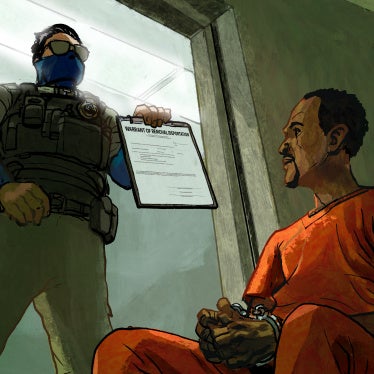
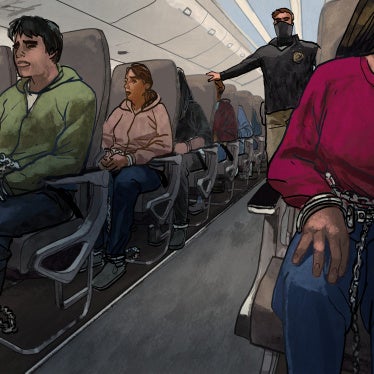
Human Rights Watch documented multiple accounts of deportation without meaningful procedural safeguards, including individualized risk assessments. Two people interviewed said they were deported, and four others said their immediate family members had been deported.
“They didn’t tell us anything,” said the man arrested on February 25. “No one asked me if I wanted to go back…I never got to speak to my embassy, I wasn’t allowed.”
The 22-year-old man deported to Juba on April 16 said the day before his deportation he was taken back to El Nozha Police Station, where he felt coerced to sign a piece of paper without the chance to read it:
No one explained to me what I was signing, it looked like a form that an office would have. They asked me to write my name. They didn’t let me read it. I think it said I consented to being deported. I would not have consented if they had asked me if I wanted to be deported. I want to be with my family, why would I consent to leave them? It felt like I would never leave and I was afraid that if I didn’t sign the paper I’d be taken back to May 15 [Prison].
A 38-year-old married father of five young children originally from Abyei, came to Egypt from Sudan to escape the war. He said that his wife was arrested by Egyptian police in January for not having residency. “Things are bad in our family since my wife was taken,” he said. “I have been struggling to care for the children, I am really struggling, I am all on my own, no one is helping me.” He said his wife was deported to Juba, South Sudan around April 23.
A 32-year-old married woman with one child originally from Abyei who fled Sudan to Egypt after the war began, described the aftermath of her husband’s deportation to Khartoum, Sudan:
I’m at a loss; I don’t know what to do.... Sudan isn’t safe so I don’t know how to plan my life or my son’s life. [My husband] is not feeling safe or secure or stable, the situation is not stable in Sudan because of the war.