While people in many Latin American countries are prone to take their grievances to the streets, Bolivia stands out for the intensity and duration of protests. The roadblocks that paralyzed much of the country for seven weeks seem to have come to an end, but the conditions that produced them remain unchanged. Bolivia’s government should use the newly-gained breathing room to strengthen the country’s institutions and establish channels for social participation and dialogue that can help prevent another crisis.
A severe economic downturn and political actors pursuing their own interests fueled the protests. Yet, underlying the current juncture, the recurring waves of large-scale demonstrations in Bolivia reflect a deeper crisis of the country’s system of government.
Democratic institutions, including the justice system, have failed to provide paths for the peaceful resolution of conflicts. It is no wonder that, after years of decline, support for those institutions is at recordlows. Lack of confidence in the judiciary stands out. Polls indicate that only about 12 percent trust it.
A recent visit to the basement of the Constitutional Court gave us tangible evidence of why. There, we saw piles upon piles of pending cases—22,000 in all. Many involve requests to review a person’s incarceration. We were told that people can wait at least three years for a decision on the legality of their detention.
As the protests were unfolding, we met with the highest authorities in the justice system, at the Constitutional and Supreme courts, the Council of the Magistrature, and the Attorney General’s Office, as well as key lawmakers and civil society organizations. We heard again and again that Bolivians across the country do not see the courts as a place where they can obtain justice fairly or within a reasonable time frame.
The dysfunction of the justice system contributes to narrowing the country’s mechanisms for peaceful resolution of conflicts. For instance, the Constitutional Court currently cannot rule on whether a law violates basic rights protected by the Constitution, for lack of quorum. So, the way to oppose such a law is to mobilize people on the streets.
The justice system has been plagued by political interference and inefficiency for years, as Human Rights Watch and othershave documented.
In December 2023, five members of the Constitutional Court postponed the end of their terms indefinitely, even though the Constitution prohibits it. When they were finally removed in November 2025, the other justices of the court found more than 2,000 case files in their office drawers, the current president of the court, Paola Prudencio, told us. Some of the files had been there for as long as six years.
Prudencio said that “the self-postponed” judges chose the cases they wanted to rule over and issued inconsistent and often contradictory decisions. Judges and lawyers described them to us as “jurisprudence à la carte.” Replacing the “self-postponed” judges requires a national election, since the justices of the highest courts in Bolivia are elected by popular vote. Manyexperts have argued that this system has failed to produce qualified judges.
The level of judicial corruption across the board in Bolivia is astonishing even in the context of a region where it is a serious problem.
A lawyer in Santa Cruz de la Sierra told us that “[t]here are fees for everything in the justice system.” By “fees,” he actually meant bribes, as the services are supposed to be free. He said people routinely have to pay to move their cases forward, including to receive notifications. Those who can pay more may be able to shape how the notification process unfolds, including whether the other side is notified late or not at all.
Low pay, temporary appointments, weak judicial careers, and political pressure make judges and prosecutors vulnerable to corruption and outside influence, lawyers and judges told us. They also said that the institutions that are supposed to investigate and prosecute corruption frequently fail to act, or act selectively, according to their particular interests.
Judges complain of lack of resources, and they have a point. The justice system received just 0.46 percent of the government’s budget in 2024. That translates into crumbling infrastructure, scarcity of trained personnel, and poor or non-existent services in many areas of the country. On June 29, the president of the Supreme Court and other judicial authorities threatened a strike starting on July 6 if the government does not appropriate 5 percent of its budget to the justice system. A serious debate about increased funding is necessary, but pouring money into a broken system, without structural reform, would be throwing money down the drain.
Failures of the justice system have a clear impact on human rights. In a striking example, blatant political interference, for years, into the investigation of at least 37 people killed during protests in 2019 has led to impunity, even though several international reports, including one by Human Rights Watch, pointed to evidence of extrajudicial killings. Public outrage over those deaths continues to drive protesters today.
Bolivia’s ombudsperson, Pedro Callisaya, told us that his office prepares for two busy times a year: a wave of protests in April and another in October. He calls them “camel humps.” During those times, his office deploys personnel to monitor rights violations and acts of violence.
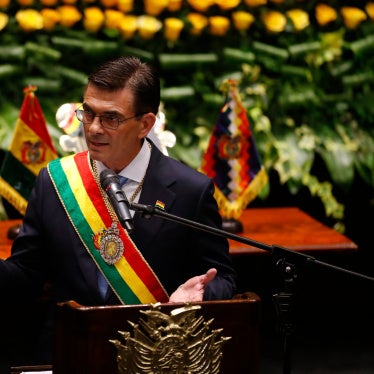
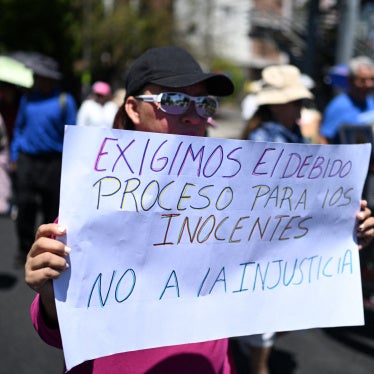
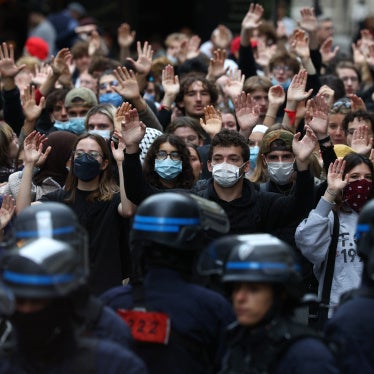
This year, the “humps” came early. Thousands of Bolivians marched in January and then in early May. What started as wage demands and opposition to economic and legislative measures taken by the government has turned into a call for President Rodrigo Paz, in office only since November, to resign.
Demonstrators blocked dozens of roads for weeks starting in early May, causing serious medicine and food shortages, particularly around La Paz, because deliveries could not get through. There have been clashes between protesters and police during government efforts to reopen roads and create “humanitarian corridors.” At least one person was killed in circumstances that remain unclear. As of early June, the Ombudsperson’s Office documented that seven people needing medical attention died because they could not be taken to hospitals in time due to roadblocks.
In late June, President Paz reached an agreement with some organizations promoting the protests and deployed law enforcement to lift the remaining road blockages. To prevent another crisis, Rodrigo Paz should address not just the immediate triggers, but also the structural weaknesses that lead to cycles of social instability.
Many Bolivians believe that power and money matter more than the law. When courts and other democratic institutions cannot offer a credible path to resolve disputes, people are more likely to look elsewhere, including street mobilization and road blockades, to make their voices heard.
There is broad consensus in the country that the justice system is profoundly dysfunctional and needs thorough reform. Previous governments of both the left and the right have lacked the political will to do this because for those in power, it is convenient to have subservient judges. President Paz listed the overhaul of the justice system as one of his legislative priorities. He should follow through with his promise.
The roads may be clear now, but there is no guarantee that the country won’t go through another camel hump in a few months. Bolivia needs to urgently repair its system of government. Now is the time to do it. The government and Congress should undertake a concerted effort, with broad social participation and input, to embark on a serious justice reform, treated as state policy and capable of addressing the failures that drive people away from the courts and toward the streets.