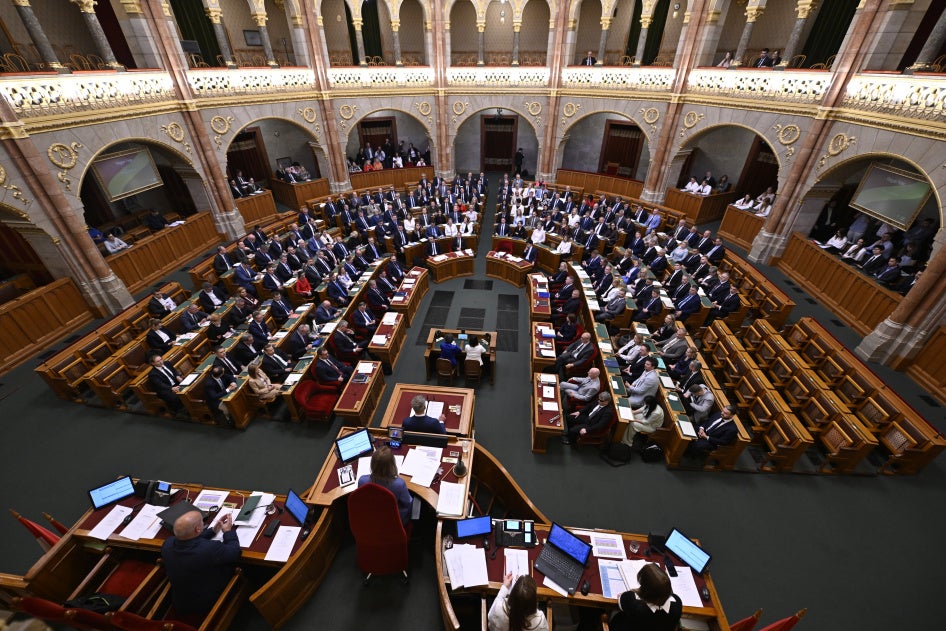
(London, June 25, 2026) – The new Hungarian government’s plan to make sweeping changes to key institutions through a rushed 17th amendment to the constitution, risks halting advances to restore the rule of law, Human Rights Watch said today. The plans to remove the country’s president and the head of its constitutional court lack due process safeguards.
If the 17th Amendment is passed, the current term of Hungary’s President Tamás Sulyok would cease the following day. He would be replaced by a new president elected by parliament for a maximum term of five years, or until a new constitution enters force. Prime Minister Péter Magyar has made clear that replacing the sitting president, elected by a Fidesz majority parliament in 2024, is a priority for his government. Sulyok has refused to resign.
“Hungary’s new government has a mandate to set right the damage done to the rule of law during 16 years of Fidesz rule, including reversing its arbitrary stacking of key state institutions with Fidesz loyalists,” said Benjamin Ward, deputy Europe and Central Asia director at Human Rights Watch. “But restoring the rule of law requires respecting due process and taking time to ensure genuine consultation before enacting sweeping constitutional changes.”
A proposed 17th Amendment to the constitution, published on June 22, 2026, would make wide-ranging changes to Hungary’s government, with the impact of summarily removing the president and the head of the constitutional court. The president can already be impeached under the constitution, although any such process would be conducted by the constitutional court. The government has chosen not to pursue that route and instead to change the constitution to remove the president, Human Rights Watch said.
The government has given the public, including civil society, only five days, until June 27, to respond to these major changes, before putting them to a parliamentary vote, where they are expected to pass given the new ruling party’s two-thirds supermajority.
The government’s announcement also set out a plan for a broader, consultative process for an entirely new constitution to follow later in the year. The government contends that “given the urgency of the situation” it needs to change several constitutional rules before a future inclusive, consultative process begins to replace Hungary’s 2011 Fundamental Law, the current constitution.
The 17th Amendment would also introduce a mandatory retirement age of 70 for Constitutional Court judges and terminate the mandate of any sitting justice already older than 70, the month after the amendment enters force. The current president of the court, Péter Polt, is 70, so the change would effectively end his term. The prime minister has made clear he wants Polt to step down, which Polt has not done.
The proposal is reminiscent of Fidesz’s 2011 judicial changes, which reduced the mandatory retirement age for all judges to 62, in order to force out senior judges. The Court of Justice of the European Union found the lowered mandatory retirement age unlawful in 2012. The Fidesz government subsequently lifted the mandatory retirement age for judges in 2013 to allow five of its preferred Constitutional Court judges to remain in their posts.
The amendment also creates maximum term limits of 12 years for all members of parliament, with term limits to be used to assess eligibility of candidates in the first general election after the amendment passes. While term limits for elected officials are not unlawful, the Council of Europe’s constitutional advisory body, the Venice Commission, has advised against their use while acknowledging that states have a right to establish such limits in line with their constitution.
Human Rights Watch has identified many challenges facing the new Hungarian government in its efforts to restore the rule of law and respect for human rights in the country.
Some initial steps have been promising, including: allowingthe country’s prolonged state of emergency to lapse; restoring Hungary’s membership of the International Criminal Court; dropping charges against key Pride march organizers; and dropping a politically motivated espionage probe into a leading independent journalist. The new government has also passed significant media reforms, amending legislation governing the ownership structure of public media, and proposing legislation to abolish the Sovereignty Protection Office.
“Hungary’s new government has good reason to embark on a major institutional overhaul, but the ends do not justify the means in a state that respects the rule of law,” Ward said. “The progress the government makes on restoring the rule of law after years of damage is precious and fragile, and can be undone with hasty legislation that rides roughshod over due process and fairness.”