(Beirut) – Bahraini authorities have excluded migrant workers from an emergency wage support program during the Iran conflict, Human Rights Watch said today. Migrant workers, three-quarters of the private work force, are excluded even though they have contributed to the emergency fund for years. Many are now in dire situations due to job losses and unpaid or delayed wages.
“The impact of the regional conflict has been widespread, but it has especially harmed migrant workers carrying out essential work at grave risk, including some who were killed,” said Michael Page, deputy Middle East and North Arica director at Human Rights Watch. “Bahraini authorities are essentially stealing salary contributions migrant workers have made by denying them access to this emergency support when they need it the most.”
In March 2026, Human Rights Watch interviewed 38 migrant workers based in Bahrain, Kuwait, Oman, Qatar, Saudi Arabia, and the UAE regarding the risks they face due to the regional conflict, as well as the family of SM Tareq, a Bangladeshi migrant worker who was killed in Bahrain on March 2. Human Rights Watch also conducted interviews with six Bahrain-based migrant workers in April 2026.
Bahraini authorities are paying a month’s salary to insured Bahraini nationals in the private sector from the Unemployment Insurance Fund, with unanimous parliamentary approval. The funds have reached almost 95 percent of eligible workers according to media reports, with parliamentary calls to extend the program for two additional months.
Migrant workers have faced harm including unpaid wages, salary deductions, and rising prices due to regional conflict. But in addition to not receiving the emergency funds, they do not have access to other forms of comprehensive social security other than ad hoc support programs, both in Bahrain and in most of their home countries. The Philippines, for example, provided a one-time US$200 cash transfer to Filipinos who were affected by the conflict in 10 countries including Bahrain.
In 2020, the Bahraini government had initiated a similar unemployment insurance fund program during the Covid-19 crisis, supporting 100,000 Bahrainis from the private sector for reduced and lost wages but similarly excluding migrant workers. According to 2022 research by the Migrant Rights Research Open Repository (MRRORS)—an organization that advocates for migrants’ rights—despite migrant workers’ contributions to the fund, few benefited from it and their payments were less than for other workers.
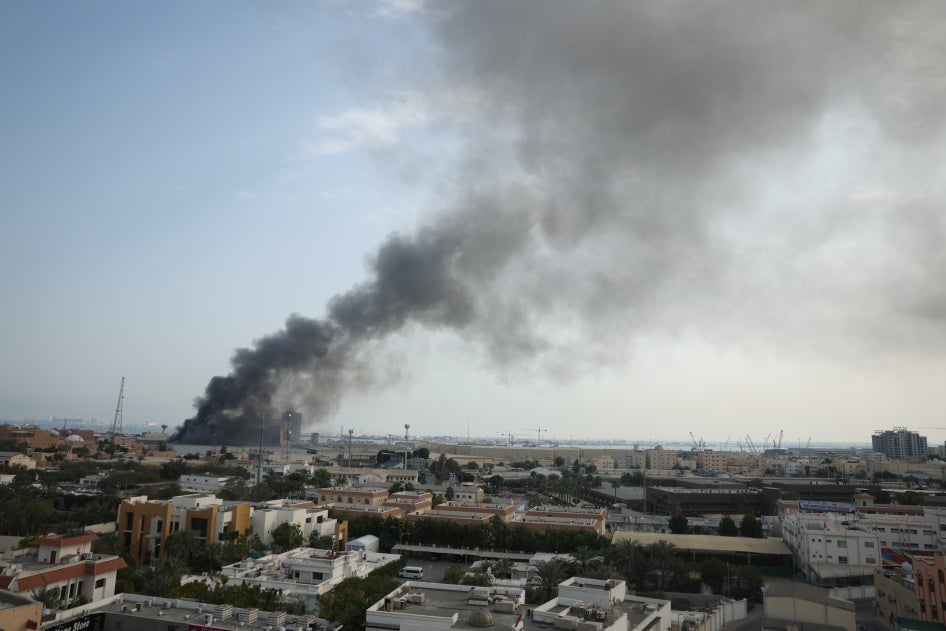
For research published in March, Human Rights Watch spoke with migrant workers in Bahrain who had been struggling to pay for everyday expenses as they lost work after the regional conflict began. In an April 2026 interview, one Nepali worker said: “Bahrain is so small that missile drops in any corner make you feel like it’s in your proximity… We heard explosions close to our house…it was especially difficult for my child.” He said that since the conflict began, he has been working fewer hours and getting paid less as he works for a car rental company that depends on tourists.
His loss of wages, lack of access to social security, and rising cost of living due to the conflict including expensive school fees for remote classes for his children forced him to send his family back to Nepal. “The majority of my colleagues have sent back their family members back home,” he said.
Another worker hired by a US military base camp contractor said his company told the workers they could take unpaid leave and remain in Bahrain or go back home, or shift to another company branch for a pay cut either in Bahrain or another country. He chose to return home and said: “The company had said that if the base doesn't open even up after three months, you can find your own way for your own work... two months have already passed.”
“As far as I know, this [payment scheme] is only for Bahrainis,” a worker from Bangladesh said. “However, on Facebook and among many Bangladeshis around me, I see them waiting for their salary too. But I think they will not get it… When the time comes [for payment disbursement], everyone will understand the sad reality.”
Another Bangladeshi worker on azad (free) visas, an arrangement in which companies or individuals sell their visa allocations to workers for profit, said: “Private employees from other countries will not receive payment [from Bahraini authorities]... For those of us on free visas, compensation is out of the question. We are counting the days hoping for a job or some work.”
The daughter of Tareq, who was killed in the conflict, said that, “keeping Amma [Tareq’s wife, and her mother] together has been the hardest. She collapses… loses consciousness. A few days ago, she had to be admitted to hospital.”
Mohammad, another relative, said that Tareq worked in Bahrain for 27 years: “Everything depended on him. Now that he is gone, nobody can say how this family will survive… But rent is due on the first of every month. Next month's food, his daughter's education…all of it has fallen into uncertainty overnight…”
As this conflict revealed, many whose families back home depend on them for support held onto their jobs despite the fears of living and working through a crisis. A worker from a US base camp who finally left the country described his fear: “Back in February, there were hints of danger, but we didn’t know its level or nature. We were told to stay safe and leave the base area…We could frequently see missiles and drones coming in.”
But evacuating from the camp did not entirely ease concerns. “They threatened to strike American companies and investments. Since many places have American involvement, it created uncertainty as we wouldn’t know if a place could be a target.”
He also feared food and water shortages: “When water desalination plants were threatened, people panicked and bought up bottled water within hours.” Leaving Bahrain was difficult: “Flights were suspended and we traveled…Normally tickets cost 40 dinars [about $106], but I paid 240 dinars [about $636] via Dammam [Saudi Arabia].”
Under international human rights law, governments have an obligation to ensure that all workers, including migrants, in their countries are paid a fair wage and have access to social security to be able to realize their right to an adequate standard of living, including in times of crisis. There should be no discrimination, including on the grounds of nationality, in the fulfillment of these rights.
As a signatory to the Global Compact for Safe, Orderly and Regular Migration, Bahrain has committed to protecting migrants’ rights by ensuring their safety and security, upholding equality and nondiscrimination, and extending access to social security on an equal basis. It is critical for Bahrain to set up its social security system in a way that adequately fulfills and protects the rights of migrant workers, Human Rights Watch said.
“The discriminatory nature of an emergency measure that excludes migrant workers despite their contributions is alarming,” Page said. “There is an urgent need for more structural reforms to ensure that migrant workers have equal access to social security benefits, including in times of crisis.”