
(Remarks at an event on academic freedom at the John Jay College of Criminal Justice – City University of New York: “Defending Academic Freedom: A Teach-In”)
What does an attack on academic freedom in a country’s universities look like? Here’s a previously published description: “politically motivated attacks on dissident faculty and students were accompanied by damaging ideological and institutional constraints, including political screening of faculty, restrictions on what could be discussed in seminars, limitations on autonomous organizational activity on campus, and restrictions on access to campuses by groups and individuals whose ideas did not meet the approval of state authorities.”
This is from a 1998 report by Human Rights Watch on academic freedom in Indonesia under President Suharto, that country’s de facto dictator from 1967 to 1998.
Today, in the United States, some of that probably sounds a little too familiar for comfort.
The Universal Declaration of Human Rights states that education should be available to all and should promote “respect for human rights and fundamental freedoms.” In order for universities to do that, teachers and students need academic freedom.
Academic freedom is closely tied to fundamental human rights guarantees. Most obviously, the freedom to pursue research and scholarship and discuss sometimes uncomfortable ideas without censorship and persecution is directly linked to the freedom to exercise basic civil and political rights in the International Covenant on Civil and Political Rights (ICCPR).
Attacks on academic freedom in the US are real and worrying. PEN America found in a recent report that “more than half of US. college and university students now study in a state with at least one law or policy restricting what can be taught or how campuses can operate.”
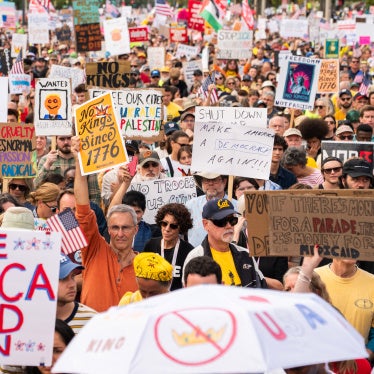
We’re all familiar with the crackdowns on US campus protests following the Israeli military assault on Gaza in the wake of the Hamas-led attacks in Israel on October 7, 2023.
I’ll come back to that. I want to start in Florida.
Florida has become a kind of laboratory for censorship, book bans and restricting education. To understand what the current US administration has been trying to do with universities, it’s helpful to look at what Governor Ron DeSantis and his administration have been doing for years in Florida – both at the Kindergarten-12th grade level, where governments have more authority, and at the university level.
Based on HRW’s research, beginning in 2021, Florida has passed laws and adopted policies that censor and distort the curriculum and educational environment of K-12 classrooms in ways inconsistent with international human rights standards on education, access to information, and discrimination. This has led to the removal of information, instruction, and books from classrooms.
Proponents of Florida’s new laws claim they seek to reform divisive and inappropriate school curricula, but they themselves are imposing a curriculum riddled by harmful gaps and inaccurate information that reinforces discrimination.
Florida’s discriminatory educational legal framework for K-12 schools is primarily built out of three laws. The “Stop WOKE Act”, the so-called “Don’t Say Gay or Trans” act, and a third law that extends the “Don’t Say Gay or Trans" law.
The discriminatory educational censorship in Florida has:
- Prompted Florida teachers to stop or significantly circumscribe teaching students about LGBTQ+ subjects and racism in US history;
- Caused many Florida public school students, particularly Black and LGBTQ+ students, to feel demoralized, unheard, and unseen by both the Florida state and US federal government;
- Fomented fear of reprisals in teachers and students for asking critical questions, or sharing divergent views on US history;
- Prompted Black students to ask, in the words of one of their teachers, “Why do they hate us so much?” (That’s the title of HRW’s report on Florida’s discriminatory censorship laws).
The Trump administration’s ideological assault on universities began with what it claims is a fight against antisemitism on US college campuses. The Trump administration threatened and in several cases cut funding to elite universities across the country, including Columbia and Harvard, among others. It often cited the failure to crack down on campus protests against the Israeli military assault on Gaza as proof of ignoring antisemitism.
Some universities caved in to the administration’s demands. Under pressure from the Trump administration, Columbia introduced took the questionable step of adopting the problematic IHRA working definition of antisemitism, which HRW, the American Civil Liberties Union, and dozens of other human rights and civil rights organizations – including Israeli and Palestinian groups – have warned is prone to misuse by those who conflate criticism of Israeli government policies and advocacy for Palestinian rights with antisemitism. (I assume everyone here knows about CUNY’s “fired four” professors, three of whom were reinstated earlier this year.)
But it was never really about combatting antisemitism, a very real problem like Islamophobia, homophobia and other forms of intolerance that the Trump administration hasn’t prioritized. The demands the administration put on universities showed it was more about suppressing ideas that they associate with what they call “woke” ideologies. The main demands centered on several key issues: admissions policies aimed at supporting racial diversity, trans and LGBTQ+ rights, gender studies programs, teaching critical race theory, or numbers of foreign students. The University of Maine reportedly came into the administration’s crosshairs because of, among other things, a floating offshore wind program.
In fact, views that the Trump administration considers to fall under the term “woke” feel a bit like what “communism” was for the witch hunts of the McCarthy era – a kind-of all-purpose catch-anyone accusation. And you don’t need academics to make the McCarthy comparison. Laura Loomer, the far-right political activist and top ally of President Trump, said it herself: “Joe McCarthy was right. We need to make McCarthy great again.”
The Trump administration’s crusade against language and ideas it doesn’t like isn’t confined to US universities, law firms, media, or nongovernmental organizations. In my work at Human Rights Watch, I’ve seen the Trump administration doing it with the United Nations and its member states. The US delegation works hard in negotiations on resolutions, declarations and texts to remove words like gender, climate, racism, diversity. Unsurprisingly, this has inspired self-censorship. Last year, in a futile effort to prevent defunding by the Trump administration, the UN’s International Organization for Migration (IOM) started scrubbing its website of language that could be associated with DEI. The Trump administration defunded it anyway, along with most of the UN.
But there’s some good news. The Commission on the Status of Women, the UN’s main forum for women’s rights, is currently meeting in NY. Last week the US delegation demanded the removal of all references to gender, sexual and reproductive health and rights from the draft outcome document. Not only did the US fail, they cast the sole vote against it. Its adoption prompted multiple rounds of applause that must have been humiliating for the US delegation.
Obviously fighting government attempts to restrict academic freedom isn’t like voting on a UN outcome document. But we can take inspiration from those who push back. It’s up to us to protect academic freedom, to stand up for brave students and faculty who speak truth to power. To make sure that McCarthy stays where he belongs, in the trash can of history.