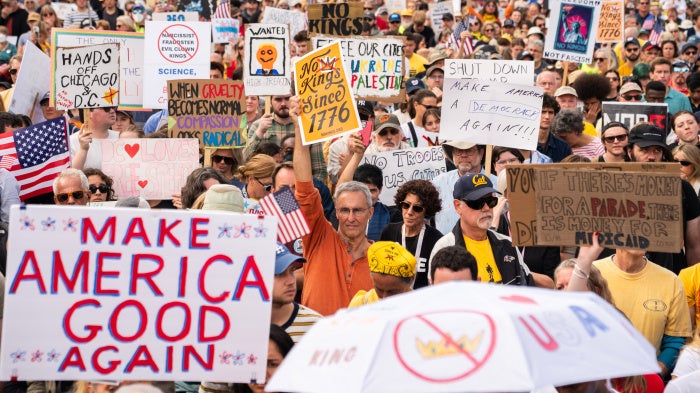
United States President Donald Trump’s second administration has been marked from the start by blatant disregard for human rights and egregious violations. The US took significant steps backward on immigration, health, environment, labor, disability, gender, criminal justice, and freedom of speech rights, among others.
On the first day of his second term, Trump ordered the termination of all federal diversity, equity, and inclusion programs, the first of a series of actions that eroded initiatives and institutions designed to combat racial and other discrimination. The actions included a spate of executive orders and policies that gutted meaningful civil rights enforcement in various government departments and eliminated virtually all federal initiatives aimed at redress for past invidious discrimination including ongoing legacies of chattel slavery. The administration also reshaped the country’s refugee resettlement efforts, so they now benefit white South Africans almost exclusively.
Starting in January, Immigration and Customs Enforcement (ICE) agents and other law enforcement personnel, often masked, conducted hundreds of unnecessarily violent and abusive raids in hundreds of locations. Starting in June, President Trump deployed national guard troops to cities led by opposition Democratic Party officials under the guise of combatting “insurrection” and crime, despite falling crime rates. At time of writing, troops had been deployed to five cities, four of which have Black mayors. Protests against administration actions in Los Angeles, Chicago, and elsewhere, were met with violence by federal agents and local police forces.
The administration’s racial and ethnic scapegoating, domestic deployment of national guard forces in pretextual power grabs, repeated acts of retaliation against perceived political enemies and former officials now critical of him, as well as attempts to expand the coercive powers of the executive and neuter democratic checks and balances, underpin a decided shift toward authoritarianism in the US.
Some states and localities took positive steps to resist abusive actions and support human rights, but such efforts paled in comparison to the federal-government-led assault on rights.
Structural Racism and Other Discrimination
In early January 2025, before President Trump’s second-term inauguration, the US Department of Justice issued a report on the Tulsa race massacre of 1921, which decimated that city’s growing Black middle class, an emblem of the lasting impact of slavery and Jim Crow racism. The report confirmed white law enforcement and residents were responsible for the attack, but ultimately concluded legal redress was not available.
Starting on inauguration day, the new administration initiated drastic backsliding on racial justice, dismantling civil rights mechanisms and eliminating federal diversity, equity, and inclusion efforts. It aggressively sought to erase Black history, including Harriet Tubman’s legacy, and to downplay or obscure racial injustice and resist accountability.
Indigenous peoples continued to face obstacles to realization of their rights, including those affected by the Thacker Pass lithium mine in Nevada. The Thacker Pass case exposed the need for new federal reforms to ensure projects on Indigenous lands proceed only with the free, prior, and informed consent of affected Tribes, and take into account negative cultural, environmental, and health impacts.
H.R. 40—a Congressional 30-year old bill advocating for a national reparations commission to study the legacy of enslavement—remained under consideration. Several state and local initiatives advanced or were already being implemented to study and provide reparations, reflecting efforts to address historical racial injustices.
Democracy and the Right to Vote
Important pillars of US democracy came under serious attack in 2025. The current administration advanced efforts to restrict voting, including an executive order that sought to impose proof-of-citizenship requirements, shorten mail-in ballot deadlines, and limit fixes for ballot errors, though courts struck down some provisions as unlawful.
Congressional House Republicans pushed the SAVE Act mandating documentary proof of citizenship for voter registration, but the bill failed in the Senate. These and other efforts that would weaken voting protections are expected to return ahead of the 2026 mid-term elections.
The administration launched sweeping measures to weaken core pillars of civil society it associates with opposition to its policies, including executive orders cutting university research funding over purported ideological disagreements, restricting government access for law firms engaged in certain legal work, threatening the tax-exempt status of some non-governmental organizations and misusing the Federal Communications Commission and Department of Justice in attempts to intimidate and silence critics. The administration has also moved to erode US oversight institutions by politicizing federal agencies and purging independent officials.
Immigrants and Asylum Seekers
Since taking office in January, the Trump administration has imposed broad anti-immigrant policies, utilized racial profiling in immigration enforcement, limited asylum claims based on intimate partner violence, and sought to preclude newly arriving asylum seekers from lodging claims, despite their right to do so under US and international law.
The administration arrested and summarily deported an increasing number of primarily Black and Brown immigrants, violating due process rights and fomenting fear. Courts stopped particularly egregious abuses, such as an attempt to deport unaccompanied children to Guatemala. In many areas, local law enforcement expanded collaboration with federal immigration enforcement agencies, in some cases with dire consequences.
Immigration enforcement raids occurred throughout the country, including in Colorado, Los Angeles, Washington D.C., Chicago, and at factories, farms, and meatpacking sites. Raids occurred in streets, homes, workplaces, regular immigration check-ins, courthouses, medical centers, and university campuses. Federal guidance that had limited immigration enforcement in “sensitive locations” such as schools, hospitals, and places of worship was revoked, extending arrests to such locations.
Many raids were violent and abusive, terrorizing entire communities. While a legal challenge is ongoing, the US Supreme Court allowed law enforcement to continue using ethnicity and perceived national origin as factors that may justify detaining people to determine their immigration status.
Some immigration enforcement actions were accompanied by National Guard deployments and were met with widespread protests. In Los Angeles and Chicago, law enforcement responses violated free speech and assembly rights and involved excessive and in many cases entirely unwarranted use of force.
In what constituted the international crime of enforced disappearance, the administration used the Alien Enemies Act—a 1798 law previously only invoked three times and only in the context of wars declared against foreign nations—to expel 252 Venezuelan immigrants to a notorious maximum security prison in El Salvador where they were subjected to torture and inhuman and degrading conditions. After months of incommunicado detention, they were transferred to Venezuela.
The US also transferred third-country nationals to other countries, including Costa Rica, Panama, Ghana, Mexico, South Sudan, Eswatini, and Rwanda, under a variety of bilateral agreements that lacked transparency and that in some cases involved the US sending millions of dollars to the recipient countries. These transfers were challenged in the courts as due process and nonrefoulement violations.
The administration sought to terminate Temporary Protected Status designations for Afghanistan, Cameroon, Ethiopia, Haiti, Honduras, Myanmar, Nepal, Nicaragua, South Sudan, and Venezuela, threatening the legal status of thousands of people who cannot safely return to their countries of origin.
Numerous immigrant university students were detained and put into deportation proceedings because of their political speech, particularly on Palestine issues, prompting court challenges. Senior government officials indicated that visa applicants’ social media posts and public comments were being used as a criterion for denying US admission.
New detention facilities were opened at military sites and in states including Florida. Abusive conditions—including gross medical neglect, overcrowding and lack of sanitation—were reported in facilities. By late August, ICE had already detained more than three times as many people as in all of 2024. In December, the administration suspended immigration processing for nationals from 19 countries and suspended pending asylum procedures for all nationalities.
Criminal Legal System
The US has among the highest incarceration rates in the world, with nearly 2 million people in jails, prisons, and immigration detention facilities on any given day. Most in jails are held pretrial, not convicted of a crime but often unable to afford bail to secure release. Federal and some local authorities attempted to increase pretrial incarceration and roll back other measures that reduce incarceration.
Black people and Latinos are disproportionately overrepresented in prison populations.
Though crime rates across the US continued to fall, including in the cities targeted, national guard forces were deployed in Los Angeles, Chicago, Washington D.C., Portland, and Memphis, possibly unlawfully and often over local opposition. The deployments were ostensibly to combat crime and protect immigration agents in the performance of their enforcement efforts.
In 2025, the US Department of Justice dropped prosecutions of current administration allies, and threatened or prosecuted perceived opponents, while curtailing enforcement of laws targeting white collar crime, corruption, and racial discrimination.
The president expanded the death penalty in Washington DC by ordering the federal prosecutor to seek death wherever possible, despite local abolition of the death penalty in 1981, and US states executed 47 people.
Enforcement of laws and policies criminalizing houselessness reportedly increased following the Supreme Court’s 2024 Grants Pass decision, as did efforts to involuntarily detain people with mental health conditions or who use drugs. Police killed 1301 people in 2025.
While the United States has seen an overall decline in youth incarceration over the past two decades, it still confines youth at a rate more than twice the global average. Children continue to be prosecuted as adults in all 50 states with racial and ethnic disparities persisting throughout the criminal legal system, including at arrest, detention, and sentencing. This year, the president called for harsher punishment of children and Congress advanced legislation to increase the prosecution of children as adults in Washington, DC. The United States remains the only country in the world that sentences children to die in prison.
Sexual and Reproductive Health Rights
Three years after the Supreme Court overturned Roe v. Wade, anti-abortion lawmakers continued to advance legislation to restrict sexual and reproductive rights.
Since 2022, multiple states banned abortion and others restricted access. The fragmented legal landscape created fear, caused harmful delays, and forced many to travel considerable distances for health care. State lawmakers moved to limit medication abortion, halt sexuality education, prosecute healthcare providers, and criminalize those helping youth travel out of state to access health care.
Laws in 25 states requiring parental consent or notification for abortion had devastating impacts on young people’s health and lives.
In the two years following the overturning of Roe, prosecutors initiated at least 412 cases charging pregnant people with crimes related to pregnancy, pregnancy loss, or birth.
The current administration blocked Planned Parenthood from receiving reimbursements from Medicaid, the public health insurance program for people with low incomes. As a result, more than a million people lost insurance coverage for health care they were receiving from the nonprofit organization, the single largest provider of reproductive health care in the US.
The administration’s sweeping financial cuts to reproductive healthcare programs further threatened the right to health. The administration fired staff working on reproductive health, froze funds for family planning, cervical cancer screening, and other services, and dismantled a research project that investigates significant and unjust racial inequities in pregnancy and newborn health.
The budget reconciliation law enacted in July extended tax cuts that disproportionately benefit the country’s wealthiest while significantly reducing public spending on health and other public programs essential for human rights. The law will strip millions of people of health insurance coverage in coming years, including millions of women of reproductive age.
Sexual Orientation and Gender Identity
In many parts of the US, officials at all levels continue to target the rights of lesbian, gay, bisexual, and transgender (LGBT) people. The current administration has escalated attacks on transgender communities. It has taken executive actions that prohibit government use of the term gender, narrowly define sex as that assigned at birth, restrict and withdraw support for gender-affirming care for youth, and roll back protections for transgender students.
Twenty-seven states now ban medically indicated gender-affirming care for youth, and several impose criminal penalties on providers. In June, the Supreme Court upheld these bans, which have a devastating impact on young peoples’ health and well-being. Eight states require school staff to disclose students’ gender identity to parents and twenty states restrict bathroom access for transgender people in schools. Nineteen states restrict classroom discussion of sexual orientation and gender identity.
Less than half of US states prohibit discrimination based on sexual orientation and gender identity. Congress has failed to enact comprehensive federal protections for LGBT people in education, housing, public accommodations, and federally funded programs.
Disability and Older Peoples’ Rights
During the first 100 days of the current administration, older people and people with disabilities faced heightened income and food insecurity after avoidable delays in Social Security payments, and cuts to federal financial support for supplemental nutrition programs like Meals on Wheels. People with disabilities were further affected by the termination of federal programs mandating accessibility and accessibility guidance.
Environment and Human Rights
In January, the US withdrew from the Paris Agreement, the landmark international treaty aiming to limit global temperature rise. In July, the Environmental Protection Agency (EPA) proposed revoking its prior finding that greenhouse gases endanger public health, jeopardizing regulations curbing climate-warming pollutants.
The current administration’s closure of EPA environmental justice offices, deregulation, and budget cuts have drastically limited any ability to address harms concentrated within poor communities, disproportionately people of color, undermining people’s health and livelihoods.
Technology and Human Rights
Administrative actions and the lack of federal comprehensive data protection legislation further eroded privacy. The administration ordered extensive sharing of sensitive personal data across government agencies, with the “Department of Government Efficiency” (DOGE) centralizing government-collected sensitive personal data, creating an opportunity for mass privacy violations.
ICE procured phone-hacking and other surveillance technology, including reactivating a contract for commercial spyware that poses a risk to rights and risks exacerbating agency harassment of journalists, activists, and lawyers.
US agencies monitored social media and used other types of surveillance to flag people for deportation based on their speech, in particular speech on Palestine issues.
The administration revoked an executive order that sought to ensure fair and accountable AI systems, launching an AI Action Plan that centers deregulation and investment in military AI.
Digital labor platforms misclassify millions of gig workers, denying them labor rights and often paying them less than state or local minimum wages. Gig workers. managed by algorithms, have no understanding of how they are assigned work, pay rates, or why they are deactivated. In July, federal lawmakers proposed legislation that would bring much-needed transparency to the sector and ensure fair treatment of gig workers.
Foreign Policy
The Trump administration rapidly downgraded human rights as a pillar of US foreign policy and worked to undermine international institutions created to uphold human rights standards and accountability. In his first year after his re-election, President Donald Trump emboldened autocratic governments through transactional deals, prioritizing short-term security and commercial and political gains over human rights.
Beginning in February, the administration abruptly terminated nearly all US foreign aid, including funding that supported human rights defenders, local civil society groups, and life-saving humanitarian assistance for populations facing conflict, displacement, or famine. The dismantling of the United States Agency for International Development (USAID) removed one of the primary instruments for US global engagement on human rights. US foreign aid cuts were applied broadly, undermining programming across the globe, including in crisis-affected regions and repressed societies. Those cuts are having widespread impacts around the globe, including limiting human rights organizations’ ability to operate and undermining access to health services and emergency care, including for LGBT people, women, children, and older people.
A sweeping restructuring of the US State Department institutionalized the retreat from human rights in US foreign policy. The Bureau of Democracy, Human Rights, and Labor faced deep funding and staffing reductions and a hollowing out of its mandate to advocate for human rights within the government, while offices dedicated to women’s rights and atrocity prevention were eliminated outright.
In an escalation of US hostility toward independent accountability and global justice efforts, the administration abolished the State Department’s global criminal justice office and expanded a sanctions regime against the International Criminal Court (ICC). The sanctions targeted not only ICC staff, including judges, but also a UN human rights expert and nongovernmental organizations assisting survivors seeking justice for atrocities.
The Trump administration politicized and badly distorted the State Department’s annual human rights report mandated by Congress. The 2025 report omitted key categories of violations and whitewashed the conduct of certain allied governments. Reports downplayed grave violations in countries such as El Salvador, where the US government sent deportees, including Venezuelan nationals, who were subjected to torture. This selective approach undermined the credibility of the reports, long considered a flawed but important resource for civil society and policymakers worldwide.
Trump withdrew the United States from multilateral forums central to global human rights protection including the UN Human Rights Council, the World Health Organization, and the Paris Climate Accords. The administration withheld assessed dues to the United Nations and canceled nearly all voluntary funding streams, undercutting the UN’s ability to adequately support human rights mechanisms, humanitarian operations, and peacekeeping missions.
The Trump administration carried out a series of lethal military strikes on small boats in the Caribbean, killing alleged drug smugglers in operations that were brazenly unlawful extrajudicial killings under international human rights law.
These Trump administration actions posed a significant threat to the global human rights framework. The administration’s open abandonment of a longstanding— but uneven —US commitment to make rule of law, democracy, and human rights central elements of foreign policy signaled to other governments that the United States cannot be relied on to stand up for international human rights law or use its influence to press for accountability for violations.