(Johannesburg) - Authorities in Zimbabwe have intensified their crackdown against critics of an effort by the ruling Zimbabwe African National Union - Patriotic Front (ZANU-PF) party to push forward a constitutional amendment to extend President Emmerson Mnangagwa’s term of office, Human Rights Watch said today. The proposed amendment has attracted considerable opposition from those who consider it an attack on the country’s democracy.
Under the constitution, President Mnangagwa would have to step down in 2028 after serving two five-year terms. However, following a controversial ZANU-PF resolution, the government gazetted Constitutional Amendment No 3 on February 16, 2026. The amendment would extend the term of office for both the president and parliament from five to seven years, effectively postponing the 2028 elections until 2030.
“Zimbabwe’s leaders should demonstrate their commitment to the rule of law by respecting the country’s constitution and international human rights obligations for freedom of expression and assembly,” said Idriss Ali Nassah, senior Africa researcher at Human Rights Watch. “Civil society, legal experts, and ordinary people should be allowed to peacefully express their views without fear.”
Over the last few months, the police and unidentified armed men have threatened, harassed, and beat up several people who are opposed to the proposed constitutional amendment.
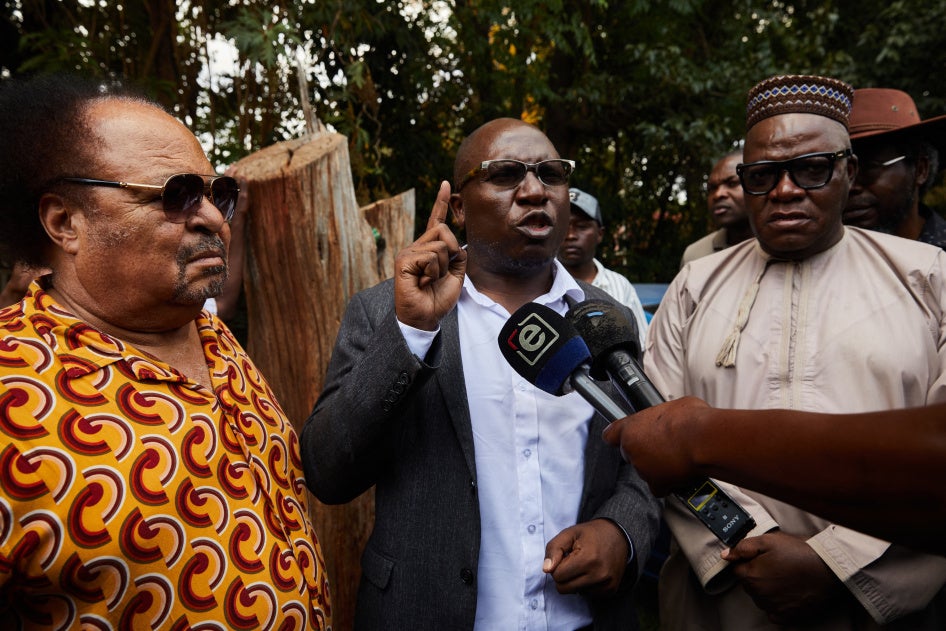
On March 1, in Harare, about 5 to 10 armed men wearing balaclavas reportedly forced their way into the offices of the National Constitutional Assembly (NCA), an opposition political party. According to Lovemore Madhuku, a prominent lawyer and leader of the NCA, some of the men assaulted members who had gathered for a meeting, including injuring Madhuku. Madhuku has brought a constitutional court case seeking to halt the constitutional amendment process.
Madhuku told Human Rights Watch that the men accused him of “wanting to create problems in the country” and demanded to know why he was opposing the bill. Madhuku said the men identified themselves as police officers and accused his party of holding an “unsanctioned meeting.”
He said that they used the long batons commonly used by the police to beat him on his back and on the head and delivered blows to his face. He also said that uniformed officers remained stationed outside in their marked vehicles. After the attack, Madhuku said, the men left in two unmarked vehicles, followed by two Zimbabwe Republic Police vehicles. A police statement posted on X said that its officers “were not involved in the alleged incident” and that the police were “keen to know what actually transpired.”
Another civil society group, the Constitutional Defenders Forum, said that on February 27 the police gave them a letter ordering them to stop their opening meeting scheduled for the next day because it did not comply with the Maintenance of Peace and Order Act. The Forum is a citizen-driven initiative committed to defending Zimbabwe’s Constitution, constitutionalism, and the rule of law.
Under the Maintenance of Peace and Order Act, groups planning a meeting must provide written notice to the police seven days in advance of processions and demonstrations, and five days in advance of public meetings. The Forum maintains that it did. The police have frequently and selectively used the requirement to deny civil society and the opposition permission to hold meetings and to mobilize.
On March 5, the Forum posted a video to social media that Human Rights Watch geolocated, showing armed police officers in several vehicles at the Harare law offices of Tendai Biti, the Forum leader. In a post on X, the Forum reported that armed men besieged Biti’s premises, assaulted people there, and issued death threats against him.
The police admitted to having deployed officers at Biti’s offices “for the maintenance of law and order” but denied the assault allegations. Biti told Human Rights Watch that authorities had decided to “unleash violence and place the country under a state of siege” to silence alternative voices.
On October 28, 2025, the Southern African Political Economy Series (SAPES) Trust’s offices in Harare was badly damaged in a suspected arson attack. The assailants reportedly abducted the night guard and locked the property’s gates with new padlocks before fleeing. The attack took place just hours before SAPES was to host a dialogue of civil society and opposition leaders in response to ZANU-PF’s effort to extend President Mnangagwa’s term.
A few hours later, the police and suspected ZANU-PF supporters reportedly shut down a similar event focusing on “Constitutional Crossroads: Citizens Respond to Zimbabwe’s Constitutional Crisis” in Bulawayo.
The authorities should appropriately investigate all of these alleged attacks and prosecute those responsible for abuses, including any members of security forces, Human Rights Watch said. More generally, Zimbabwe should reform its security force responsibilities and procedures to ensure that they act professionally and according to law.
Zimbabwe should respect rights to freedom of expression and assembly as provided by the International Covenant on Civil and Political Rights and the African Charter on Human and Peoples’ Rights, instruments that it has ratified.
“Members of the civil society and the political opposition should be allowed to freely operate and mobilize against the government’s proposals,” Nassah said. “Constitutional amendments need to be debated fairly and openly, without fear of repression.”