(Nairobi) – An Al-Qaeda-linked armed group summarily executed ten long-haul truck drivers and two teenage apprentices in late January 2026 in southwestern Mali, Human Rights Watch said today. The killings, in an attack on a fuel convoy, are apparent war crimes.
On January 29, the Group for the Support of Islam and Muslims (Jama’at Nusrat al-Islam wa al-Muslimeen, or JNIM) attacked a military-escorted fuel convoy of at least 40 trucks enroute to the city of Kayes, Kayes region. Witnesses said JNIM fighters fired on the convoy, with soldiers returning fire, and then burned at least 12 trucks and executed the truck drivers and apprentices. The victims’ bodies were recovered two weeks later, blindfolded, with their hands tied behind their backs and their throats slit.
“JNIM’s summary execution of 12 truck drivers is the latest example of the armed group’s depravity and disregard for basic legal principles,” said Ilaria Allegrozzi, senior Sahel researcher at Human Rights Watch. “All armed groups are bound by international law to protect civilians.”
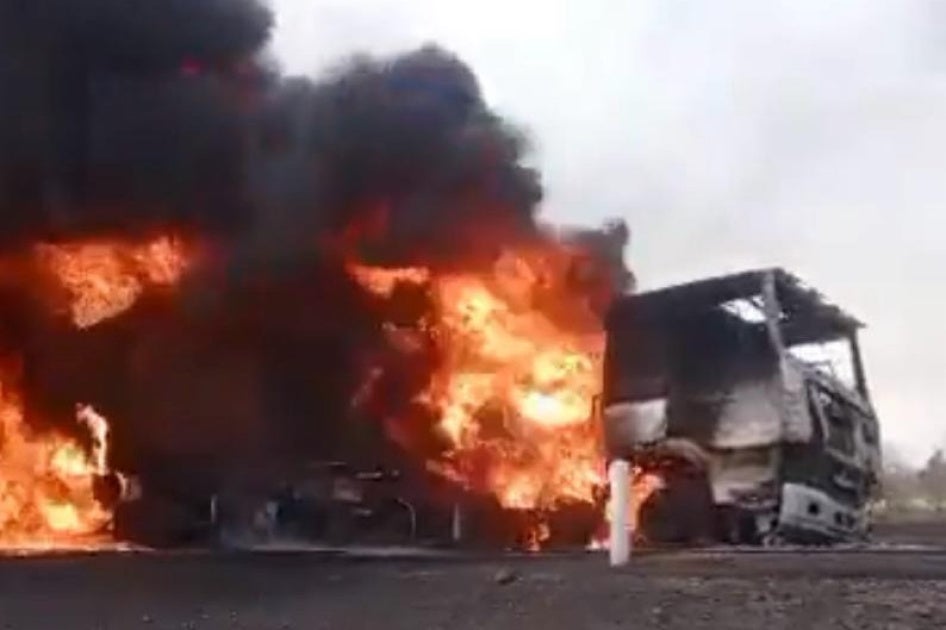
Between January 30 and February 28, Human Rights Watch remotely interviewed 12 people, including 3 witnesses to the attack, a relative of one of the victims, and 8 journalists, union officials, and villagers. Human Rights Watch also geolocated a video shared online on January 29 showing at least 11 tank trucks burnt or still in flames on the road about seven kilometers south of Ambidedi village.
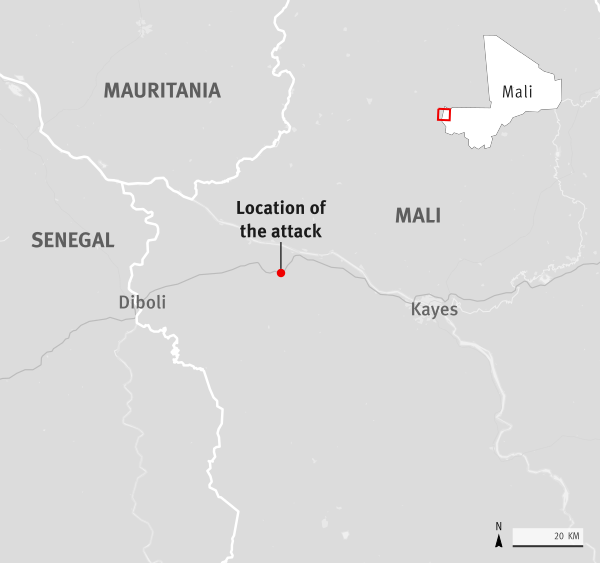
In a statement released the day of the attack, JNIM claimed to have targeted Malian troops between Diboli and Kayes but provided no further information. Malian authorities did not issue any public statement on the incident and did not respond to a March 2 letter from Human Rights Watch seeking comments.
Since September 2025, JNIM has cut off fuel supplies into Mali, blocking and attacking tanker truck convoys from neighboring countries and triggering severe shortages that have halted transport, disrupted electricity, caused prices to spike, and paralyzed daily life in the capital, Bamako, and elsewhere. Bina Diarra, known as Abou Houzeifa Al-Bambari, one of JNIM’s senior leaders in Mali, wrongly stated in a November 2025 video that all fuel transport vehicles were “military targets.”
Three truck drivers and other witnesses said that the convoy left Dakar, Senegal, on January 27, and crossed the border to Diboli, Mali, on January 28. They said that travelers and bus drivers on National Route 1 warned them that the road was unsafe, with Islamist fighters stopping vehicles to check passengers’ identification. However, the drivers also said that Malian soldiers based in Kayes had traveled to Diboli without incident on January 28 to escort the convoy back on the same road the next day.
The truck drivers said that since there was no imminent threat, and prolonging their stay in Diboli would increase the risk, the convoy proceeded as planned on January 29. “When we left Diboli, we could feel the fear in our heads and stomachs,” said a 48-year-old truck driver. “We worried this would be our last journey.”
The truck drivers and residents said that the convoy was meant to supply fuel to Kayes and other localities in the region. While fuel is used for civilian purposes, it also plays a crucial role in sustaining military operations in Mali and can be a legitimate military target. There are several military bases in the Kayes region, including the 4th Military Region headquarters.
Witnesses said the convoy stretched along about 1.5 kilometers on National Route 1 with an escort of seven military vehicles. “There were six military pickup trucks and one [military] Landcruiser with at least four soldiers in each vehicle,” a 50-year-old truck driver said. “Four [military] vehicles [were] at the head of the convoy, and three others were moving between the end and the middle [of the convoy].”
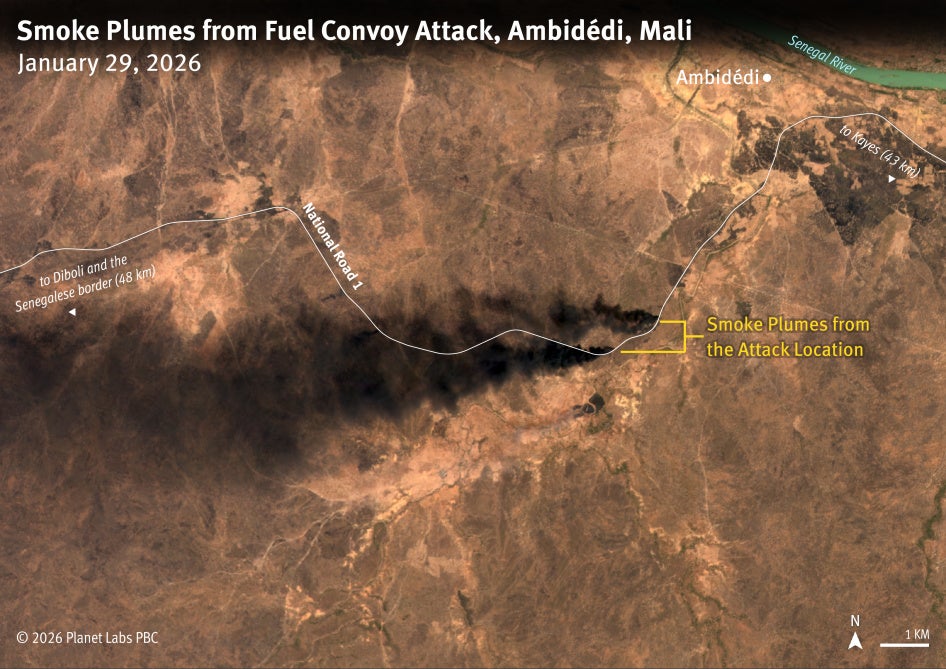
JNIM fighters attacked the convoy at about 9:30 a.m., about 7 kilometers south of Ambidedi village and 43 kilometers from Kayes. Satellite imagery from January 29 captured at 11:55 a.m. shows massive smoke plumes from the attack location.
Witnesses said the attackers opened fire on the front of the convoy, triggering an exchange of gunfire, as forward-positioned soldiers responded and those at the rear advanced to reinforce them. The attackers then shifted their fire toward the middle and back of the convoy. “I saw jihadists on motorbikes, they wore turbans and shouted ‘Allah Akbar,’” the 48-year-old driver said. “They started shooting, the military responded and it was in the crossfire that I jumped out of my truck and fled.”
Witnesses said most drivers at the head of the convoy followed the soldiers’ advice not to panic or stop, while some drivers further back abandoned their trucks and fled or turned back. JNIM fighters captured several of those fleeing, later executing 12 while releasing others. JNIM abandoned the 12 bodies by the roadside. “No one dared recovering them out of fear of another attack,” said a 45-year-old truck driver.
On February 9, Mali’s truck driver union called a nationwide strike, urging authorities to retrieve the bodies and return them to their families or ensure their burial. On February 11, soldiers recovered the bodies. A man said that the victims, including two teenagers, were found blindfolded, with their hands tied behind their backs and their throats slit. The following day, the military buried the bodies in the Kayes cemetery.
The government has not provided information to family members of drivers who have been missing since the attack. The brother of one said he went to the Kayes regional hospital, where the military had taken several injured truck drivers. “The doctor told me he was not among the six injured admitted,” the man said, and he still did not know whether his brother was dead or alive.
Human Rights Watch received a list of six missing drivers: two Senegalese nationals, ages 39 and 49; two Malians, 46 and 52; one Burkinabè, 35, and one Ivorian, 47.
All parties to Mali’s armed conflict are bound by international humanitarian law. Under customary laws of war, attacking forces must distinguish at all times between civilians and combatants. Deliberate attacks on civilians and civilian objects are prohibited. Common Article 3 to the four Geneva Conventions of 1949 prohibits the murder and cruel treatment of anyone in custody, whether a civilian or a captured combatant. Serious violations of the laws of war committed with criminal intent—that is, deliberately or recklessly—are war crimes.
The legality of the attack on the fuel convoy would depend on whether the attackers took all feasible steps to verify that the fuel was intended for armed forces use. Whether the attack on the trucks was lawful or not, the cruel treatment and execution of the truck drivers was clearly unlawful, Human Rights Watch said.
“The massacre of truck drivers highlights the need for the Malian authorities to step up efforts to protect civilians and hold those responsible for abuses to account,” Allegrozzi said. “The government should seek assistance from the African Commission on Human and Peoples’ Rights for this effort.”