Introduction
- Human Rights Watch submits the following information regarding Niger’s human rights record since its 2021 Universal Periodic Review (UPR), including efforts towards the implementation of UPR recommendations, as well as developments in the human rights situation since then.[1] This submission is not a complete assessment of all recommendations supported by Niger, nor a comprehensive review of all measures taken by Niger to protect human rights.
- In 2021, the Nigerien delegation expressed support for 248 state recommendations out of 254, including those relating to the rights to freedom of expression and association, detention conditions, and the fight against terrorism.[2]
- It took note of 6 recommendations that all called for the decriminalization of consensual sexual relations between adults of the same sex and protection against discrimination based on sexual orientation and gender identity.[3]
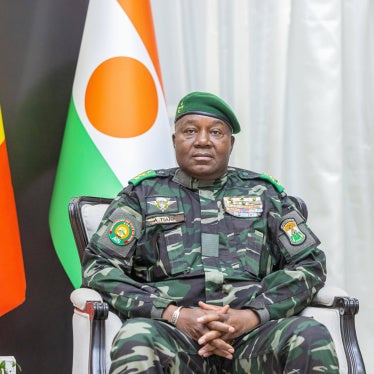
- On July 26, 2023, Nigerien army officers of the self-proclaimed National Council for the Safeguard of the Homeland (Conseil National pour la sauvegarde de la patrie, CNSP), led by Brig. Gen. Abdourahamane Tiani, overthrew democratically elected President Mohamed Bazoum, and detained him, as well as his wife, and several other members of his government.[4] Bazoum remains arbitrarily detained despite rulings by a regional court and UN bodies calling for his release.[5]
- Since the military coup, the human rights situation in Niger has deteriorated significantly.[6] The junta has cracked down on media, peaceful dissent, and the political opposition. Human rights activists, journalists and political opponents have faced arbitrary arrests, threats, and harassment, and the activities of all political parties have been banned. In March 2025, military junta leader Abdourahamane Tiani was sworn in as the country's transitional president without elections, which further solidified his grip on power and delays the return to civilian democratic rule.[7] Tiani also signed a decree abolishing multiparty politics across the country.[8]
- In January 2025, the junta left the Economic Community of West African States (ECOWAS), limiting opportunities for its citizens to seek justice through the ECOWAS Community Court of Justice.[9]
- In September 2025, Niger announced it would leave the International Criminal Court, which will jeopardize access to justice for victims of atrocity crimes.[10]
Post-Coup Crackdown on Political Opposition
- Since the July 2023 coup, former President Mohamed Bazoum and his wife have been detained at the presidential palace in Niamey, the capital, with no access to family members or lawyers. Bazoum faces a criminal trial after the junta lifted his presidential immunity in 2024 following a proceeding that failed to meet basic due process standards.[11] In November 2024, the UN Working Group on Arbitrary Detention found that the detention of Bazoum and his wife was arbitrary and called for their immediate release.[12]
- Since the coup, the junta arbitrarily arrested and detained scores of officials from the ousted government, including former ministers, including Sani Mahamadou Issoufou, former oil minister; Hamadou Adamou Souley, former home affairs minister; Kalla Moutari, former defense minister; and Ahmad Jidoud, former finance minister, as well as other people close to Bazoum.[13] In April, the junta released about 50 people from prison, including several former government officials, military officers, and a journalist who had been arrested following the coup. Among those released were Issoufou, Moutari, and Foumakoye Gado, secretary general of Bazoum’s Nigerien Party for Democracy and Socialism (Parti nigérien pour la démocratie et le socialism, PNDS-Tarayya).[14] Several others, however, remain behind bars on politically motivated charges, including prominent human rights activist and junta critic Moussa Tiangari.
Recommendations:
- Release all those detained on politically motivated charges, including former President Bazoum and his wife.
- Respect the rights of Nigerien citizens to choose their leaders in credible, free, and fair elections.
- Allow independent human rights monitors, including the Office of the UN High Commissioner for Human Rights and the African Commission on Human and Peoples’ Rights, to visit Niger, including visiting Bazoum and other political detainees, and carry out investigations.
- Conduct credible and independent investigations into alleged abuses by military authorities and security forces, including individuals involved in the coup, and fairly prosecute perpetrators.
- Niger should reconsider its decision to withdraw from ECOWAS and the ICC.
Freedom of Expression and Association
- During the 2021 UPR, Niger supported 15 recommendations calling for the protection and support of human rights defenders and civil society and guaranteeing the rights to freedom of opinion, expression, association, and information.[15] The new government failed to implement the accepted recommendations.
- The military authorities dissolved all political parties, threatened, harassed, intimidated, and arbitrarily arrested journalists, human rights activists, and dissidents. They have used the judiciary for political gain and adopted a new terrorism law that threatens rights. These violations are incompatible with Niger’s regional and international human rights obligations.
Media
- On August 3, 2023, the CNSP indefinitely suspended the international news broadcasters Radio France Internationale and France 24.[16]
- On September 30, 2023, men who identified themselves as security force members arrested Samira Sabou, a blogger and journalist, in Niamey. Her whereabouts were unknown for seven days. The Niamey judicial police initially denied arresting her. On October 11, she was charged with “production and dissemination of data likely to disturb public order” and released pending trial.[17] She had previously been questioned by members of the military about a social media post in which she shared a message from Bazoum.[18]
- On January 29, 2024, the interior minister issued a decree suspending the activities of Maison de la Presse (Press House), an independent media organization that promotes freedom of information.[19]
- On April 13, 2024, security forces arrested Ousmane Toudou, a journalist and former communications adviser to Bazoum. Following the coup, Toudou had denounced the military takeover through a widely shared social media post. In May 2024, he was charged with “plotting against state security” and sent to pretrial detention.[20] He was released on April 1, 2025.[21]
- On April 24, 2024, security forces arrested Soumana Maiga, editor of the newspaper L’Enquêteur, after the media reported a story published by a French newspaper about alleged installations of listening equipment by Russian agents on official state buildings. Maiga was brought before a judge in May, detained on a charge of infringement of national defense, and released pending trial on July 9, 2024.[22]
Civil Society
- In an August 22, 2023 decree, Tiani announced the removal from office of six academics and state officials. The day before, they had signed a petition distancing themselves from an August 1 statement by the National Union of Teachers and Researchers in support of the CNSP.[23]
- On October 3, 2023, Samira Ibrahim, a social media user known as “Precious Mimi,” was convicted and given a six-month suspended sentence and a fine for “producing data that could disturb public order.” She was charged for a Facebook post in which she referred to Algeria’s refusal to recognize the new Nigerien government.[24]
- On May 29, 2024, the justice and human rights minister issued a circular suspending all visits by human rights organizations to Nigerien prisons “until further notice.”[25]
- On December 3, 2024, security forces arrested prominent human rights activist and critic of the junta Moussa Tiangari at his home in Niamey. His whereabouts remained unknown for two days. On December 5, 2024, he was located at Niger’s Central Service for Combating Terrorism and Organized Transnational Crime.[26] On January 3, 2025, the Niamey High Court charged him without basis for “criminal conspiracy in connection with a terrorist enterprise” and “plotting against the authority of the state through intelligence with enemy powers,” among other offenses. If convicted of plotting with enemy powers, he could face the death penalty. Since then, he remains in pretrial detention and has not had his case come before a judge. On July 4, 2025, a court in Niamey rejected an appeal filed by Tiangari’s lawyers to dismiss the case against him.[27]
- In February 2025, the military authorities ordered the International Committee of the Red Cross to leave Niger without explanation.[28]
Judiciary
- In 2021, Niger supported recommendations calling on the country to continue to reform its judicial system and ensure its independence.[29] Since then, several ordinances have been signed by the military authorities contrary to these recommendations.
- On June 12, 2024, the justice and human rights minister amended a 2019 law on cyber-crime by reinstating prison sentences for defamation-related crimes. This law, which criminalizes the “dissemination, production and making available to others of data that may disturb public order,” was the basis of a crackdown on human rights online in 2020.[30]
- On August 27, 2024, Tiani signed an ordinance creating a database establishing “an automated data processing file containing personal data of people, groups of people or entities involved in acts of terrorism.” People can be listed in the database if suspected of “activities that may disrupt public peace and security” or for “disseminating data or comments likely to disturb public order.” Those included can be stripped of their Nigerien nationality.[31]
- On October 10, 2024, Tiani signed a decree based on this database provisionally removing the Nigerien nationality of nine people who held senior positions in Bazoum’s government, accusing them of “conducting activities likely to disturb public peace and security” and “conspiracy against the State and treason,” among other charges. Eight out of the nine people only possessed a Nigerien passport. Niger is a party to the UN Convention on the Reduction of Statelessness, which prohibits depriving someone of their nationality if it would leave them stateless.[32]
- On August 7, 2025, the interior minister signed four decrees dissolving four main justice-sector unions. He said the unions had “deviated” from their roles and prioritized “private interests.”[33]
Recommendations:
- Enable journalists to operate and investigate freely, including allegations of human rights violations; immediately release journalists arrested and prosecuted for their reporting.
- Allow all civil society actors, including individuals, nongovernmental organizations, and unions, to carry out their activities without intimidation or hindrance.
- Release all individuals prosecuted for the peaceful expression of their views.
- Ensure counterterrorism measures respect the rights to privacy and access to information.
- Immediately end any legal provision that would deprive someone of their nationality and leave them stateless.
- Allow workers to associate and organize freely in compliance with Niger's international legal obligations, revoke the decision to dissolve justice-sector unions, and ensure the independence of the courts.
Armed Conflict with Islamist Armed Groups
- During the 2021 UPR, Niger supported 11 recommendations to continue its efforts in the fight against terrorism and ensure it does so in strict compliance with international human rights and humanitarian law, including by protecting civilians and prosecuting security forces responsible of violations.[34] The Niger government has failed to implement the accepted recommendations.
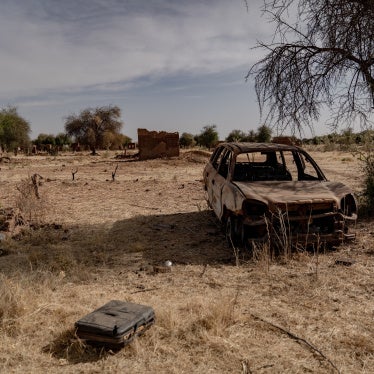
- Islamist armed groups have been carrying out attacks in Niger since 2015. Since March 2025, the Islamic State in the Sahel Province (IS Sahel) has escalated its attacks against civilians in the western Tillabéri region. Human Rights Watch documented at least five attacks across the region between March 21 and June 23, 2025, in which IS Sahel summarily killed over 127 civilians and burned and looted dozens of homes. Witnesses said the Nigerien army did not adequately respond to warnings of attacks and ignored villagers’ requests for protection.[35]
- In August, the junta began an initiative known in the Hausa language as “Garkuwar Kassa” (Shields of the Homeland), aimed at recruiting and training civilians to assist the armed forces, raising concerns about creating abusive militias.[36]
Recommendations:
- Credibly investigate allegations of human rights abuses and violations of international humanitarian law by all parties to the conflict and prosecute those responsible according to international fair trial standards.
- Ensure security forces are appropriately trained in international human rights and humanitarian law and uphold these standards during counterinsurgency operations.
- Develop robust protection strategies for civilians in conflict-affected areas, including the Tillabéri region, to deter attacks by Islamist armed groups, and create more responsive warning systems.
[1] Additional information on the human rights situation in Niger can be found at: https://www.hrw.org/africa/niger.
[2] Human Rights Council, Addendum to the Report of the Working Group on the Universal Periodic Review: Niger, U.N. Doc. A/HRC/48/5/Add.1 (July 16, 2021), para. 2 and 4, https://docs.un.org/en/A/HRC/48/5/Add.1; Human Rights Council, Report of the Working Group on the Universal Periodic Review: Niger, U.N. Doc. A/HRC/48/5 (July 15, 2021), https://docs.un.org/en/A/HRC/48/5.
[3] Ibid., recommendations 122.60 to 122.65.
[4] “Niger: Rights at Risk Since Military Coup,” Human Rights Watch news release, July 27, 2023, https://www.hrw.org/news/2023/07/27/niger-rights-risk-military-coup.
[5] Ilaria Allegrozzi, “UN Calls on Niger Junta to Free Former President,” Human Rights Watch dispatch, February 12, 2025, https://www.hrw.org/news/2025/02/12/un-calls-niger-junta-free-former-president.
[6] “Niger: Rights at Risk Since Military Coup,” July 27, 2023.
[7] “Niger’s junta leader Tiani sworn in as president for five-year transition period,” France 24, March 26, 2025, https://www.france24.com/en/africa/20250326-niger-s-junta-leader-tiani-sworn-in-as-president-for-five-year-transition-period.
[8] “Niger: quelles conséquences pour la vie politique du pays après la dissolution de tous les partis?” RFI, March 28, 2025, https://www.rfi.fr/fr/afrique/20250328-niger-quelles-cons%C3%A9quences-pour-la-vie-politique-du-pays-apr%C3%A8s-la-dissolution-de-tous-les-partis.
[9] Ilaria Allegrozzi, “Sahel States’ Withdrawal from ECOWAS Undermines Accountability,” Human Rights Watch dispatch, February 4, 2025, https://www.hrw.org/news/2025/02/04/sahel-states-withdrawal-ecowas-undermines-accountability.
[10] “Sahel Countries: ICC Withdrawal Endangers Civilians,” Human Rights Watch news release, September 24, 2025, https://www.hrw.org/news/2025/09/24/sahel-countries-icc-withdrawal-endangers-civilians.
[11] “Niger: Rights in Free Fall a Year After Coup,” Human Rights Watch news release, July 25, 2024, https://www.hrw.org/news/2024/07/25/niger-rights-free-fall-year-after-coup.
[12] Ilaria Allegrozzi, “UN Calls on Niger Junta to Free Former President,” Human Rights Watch dispatch, February 12, 2025; Human Rights Council, Avis adoptés par le Groupe de travail sur la détention arbitraire à sa 101e session (11-15 novembre 2024), U.N. Doc. A/HRC/WGAD/2024/56 (December 17, 2024), https://www.ohchr.org/sites/default/files/documents/issues/detention-wg/opinions/session101/a-hrc-wgad-2024-56-niger-advance-edited-ver.pdf.
[13] “Niger: Authorities Putting Rights at Risk,” Human Rights Watch news release, October 26, 2023, https://www.hrw.org/news/2023/10/26/niger-authorities-putting-rights-at-risk.
[14] Ilaria Allegrozzi, “Niger Junta’s Release of Detainees Falls Short,” Human Rights Watch dispatch, April 4, 2025, https://www.hrw.org/news/2025/04/04/niger-juntas-release-detainees-falls-short.
[15] Human Rights Council, Report of the Working Group on the Universal Periodic Review: Niger, U.N. Doc. A/HRC/48/5 (July 15, 2021), recommendations 122.43, 116-117, 119-122, 124-131.
[16] “Niger: Authorities Putting Rights at Risk,” October 26, 2023.
[17] Ibid.
[18] At the initiative of RSF, 80 journalists, media owners and African press freedom defenders launch a major appeal to the Niger junta,” Reporters Without Borders.
[19] Ilaria Allegrozzi, “Another Niger Media Organization Suspended,” Human Rights Watch dispatch, February 2, 2024, https://www.hrw.org/news/2024/02/02/another-niger-media-organization-suspended.
[20] “Niger: Rights in Free Fall a Year After Coup,” July 25, 2024.
[21] Allegrozzi, “Niger Junta’s Release of Detainees Falls Short,” April 4, 2025.
[22] “Niger: Rights in Free Fall a Year After Coup,” July 25, 2024.
[23] “Niger: Authorities Putting Rights at Risk,” October 26, 2023.
[24] “Niger: Authorities Putting Rights at Risk,” October 26, 2023.
[25] “Niger: Rights in Free Fall a Year After Coup,” July 25, 2024.
[26] “Niger: Prominent Civil Society Activist Arbitrarily Arrested,” Human Rights Watch press release, December 9, 2024, https://www.hrw.org/news/2024/12/09/niger-prominent-civil-society-activist-arbitrarily-arrested.
[27] Ilaria Allegrozzi, “Prominent Activist Remains Detained in Niger,” Human Rights Watch dispatch, July 7, 2025, https://www.hrw.org/news/2025/07/07/prominent-activist-remains-detained-in-niger.
[28] “Niger junta expels Red Cross without explanation,” RFI, February 6, 2025, https://www.rfi.fr/en/africa/20250206-niger-junta-expels-red-cross-citing-sovereignty-offers-no-explanation.
[29] Human Rights Council, Report of the Working Group on the Universal Periodic Review: Niger, U.N. Doc. A/HRC/48/5 (July 15, 2021), recommendations 122.105 and 112.110.
[30] “Niger: Rights in Free Fall a Year After Coup,” July 25, 2024.
[31] “Niger: New Terrorism Database Threatens Rights,” Human Rights Watch news release, September 30, 2024, https://www.hrw.org/news/2024/09/30/niger-new-terrorism-database-threatens-rights.
[32] Ilaria Allegrozzi, “Niger Counterterrorism Decree Targets Political Opponents,” Human Rights Watch dispatch, October 15, 2024, https://www.hrw.org/news/2024/10/15/niger-counterterrorism-decree-targets-political-opponents.
[33] Ilaria Allegrozzi, “Niger Junta Dissolves Justice-Sector Unions,” Human Rights Watch dispatch, August 11, 2025, https://www.hrw.org/news/2025/08/11/niger-junta-dissolves-justice-sector-unions.
[34] Human Rights Council, Report of the Working Group on the Universal Periodic Review: Niger, U.N. Doc. A/HRC/48/5 (July 15, 2021), recommendations 122.77-81, 94-95, 98, 103-104 and 115.
[35] “Niger: Islamist Armed Group Executes Civilians, Burns Homes,” Human Rights Watch report, September 10, 2025, https://www.hrw.org/news/2025/09/10/niger-islamist-armed-group-executes-civilians-burns-homes.
[36] Seydou Nomoko, “Le Niger crée une milice patriotique pour combattre les groupes djihadistes,” Le Monde, August 8, 2025, https://www.lemonde.fr/afrique/article/2025/08/08/le-niger-cree-une-milice-patriotique-pour-combattre-les-groupes-djihadistes_6627465_3212.html.