May 1, 2013
Mr. Christophe de Kepper
International Olympic Committee
Château de Vidy
1007 Lausanne, Switzerland
Subject: Update on human rights concerns related to Sochi Games
Dear Christophe,
Thank you for the informative meeting in February and for your letter of March 11, 2013 in response to our letter of January 22, 2013, as well as your response to our concerns shared with you on April 11 and 15 about Khusein Nurberdiev and numerous workers who allege nonpayment of wages during recent employment on Olympic venues.
We appreciate your willingness to engage in dialogue on crucial issues in Sochi.
We remain concerned that much of the information provided to you by the Russian authorities is inaccurate, as evidenced most significantly by false assurances provided to the IOC regarding resolution of certain cases, for example in the village of Akhshtyr, which has not in fact been the case. We are surprised that while the IOC seems committed to verifying with the Russian authorities the information provided by Human Rights Watch, it does not seek to verify the veracity of the information provided by the Russian authorities in any meaningful way.
In this letter we seek to outline ongoing, major human rights concerns around the Sochi Olympics where we believe the IOC can act as a “force for good”:
1. Unprecedented inspections, threats to, and coercion of human rights monitors working on Sochi oversight
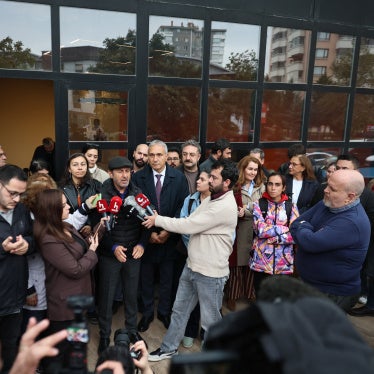
On March 27, 2013, officials from the Russian general prosecutor’s office and the federal tax inspectorate conducted an “inspection” of Human Rights Watch’s Moscow office. This was an unprecedented move: Human Rights Watch has maintained an office in Moscow for more than 20 years and this is the first time that we have been subject to an inspection (we also maintain offices in dozens of capitals that are not subject to such intrusive searches). This took place amidst a wave of invasive, menacing inspections of hundreds of human rights and other nonprofit organizations in Moscow, St. Petersburg, and other parts of Russia. More than 250 organizations in 55 regions of Russia have reported to a well-known human rights NGO that officials inspected their offices, allegedly to monitor compliance with Russian law, including a series of new laws enacted in 2012 restricting the activities of foreign and domestic NGOs in Russia mentioned in our most recent letter to you. The US, UK, German, and French governments have all criticized the Russian authorities for these ongoing inspections and insisted on explanations.
The officials arrived at our Moscow office unannounced and stayed for approximately 3.5 hours, during which time they copied dozens of documents relating to the office’s registration, activities, personnel, staff business travel, expenditures, tax payments, etc., and questioned our office director about her activities. The officials were generally respectful in their interactions and presented a copy of the notice from the Ministry of Justice authorizing the inspection. The officials also requested and took copies of six Human Rights Watch reports, including a copy of our report Race to the Bottom: Exploitation of Migrant Construction Workers ahead of Russia’s 2014 Winter Olympics in Sochi. State television and other state-sponsored media outlets crowded outside the office and harassed staff for interviews.
Two other organizations active in researching and advocacy related to Russia’s preparations for the 2014 Winter Olympic Games were also inspected during the same week. Five officials from the prosecutor’s office, the Ministry of Internal Affairs, the Ministry of Justice, and the tax inspectorate arrived without warning at Memorial, one of Russia’s most venerable and internationally respected human rights groups, to conduct an inspection. A television crew from NTV, a pro-Kremlin station, arrived together with the inspectors to film the proceedings. It is not clear how NTV learned about the inspection since most government inspections in the current wave are unannounced. NTV aired a program that same night, alleging that Memorial may have been involved in criminal activities. Memorial maintains an office in Sochi, as part of its Migration and Law Network, and is the main organization in Sochi attempting to assist exploited migrant workers.
On March 27, officials from the Federal Security Service, the Ministry of Interior’s Department for Extremism, and the prosecutor’s office inspected the office of the environmental organization Ecological Watch of the North Caucasus, located in Maykop, in the Krasnodar Region. The officials inspected and copied extensive documentation related to the organization’s registration, staff, and activities, and questioned staff about whether they engage in “espionage.” The officials also demanded to examine the organization’s email correspondence, but did not present a court order to justify such a move. Although the staff did not initially intend to cooperate, informing the officials that such a search was illegal without a court order, staff told Human Rights Watch that they felt coerced to do so, after being threatened by one official with a 50,000 ruble (US$1,800) fine if they did not cooperate.
The officials also questioned the staff extensively about their environmental research related to Russia’s preparations for the 2014 Winter Olympics, including the draft of a report titled “Ecological consequences of the preparations for the Olympic Games in Sochi” and insisted that the organization not publish the report so as to avoid bringing harm to the country.
Russia’s new law on treason, adopted in October 2012, makes it a potential crime to share with foreign and international organizations information garnered from open sources if the organization receiving the information plans to use it to “harm Russia’s national security interests.” Similarly, a highly controversial December 2012 law allows the authorities to suspend and freeze the assets of any nongovernmental organization that engages in what the law terms any work that “harms Russia’s interests.”
The results of these inspections will not be known for at least several weeks. However, the scale and scope of the inspections serves to reinforce a menacing atmosphere for human rights and other advocacy groups in Russia. The Russian prosecutor’s office has stated publicly that it plans to inspect between 30 and 100 nongovernmental organizations in each of Russia’s regions, which could amount to thousands of groups throughout the country. According to the Ministry of Justice, its staff have already participated in 500 inspections. While the pace has slowed, the inspections and follow-up demands for additional documentation continue. The inspections appear to target groups that accept foreign funding and that engage in advocacy work, and a document leaked to the media that provides instructions to local prosecutors’ offices for conducting inspections specifically urges them to analyze sources of foreign funding for the groups and their involvement in political activities.
These actions are wholly at odds with Russia’s commitment as an international host prepared to welcome thousands of visitors from outside its borders for the Olympic Games.
On April 24, Human Rights Watch and Amnesty International each published reports documenting the extraordinary crackdown on civil society in Russia since Vladimir Putin’s inauguration. We are enclosing Human Rights Watch’s report.
We urge the IOC to raise its serious concern with the Russian authorities that these inspections of organizations conducting legitimate and lawful human rights, environmental, and other work, including of several organizations that have raised concerns regarding Russia’s preparations for the 2014 Winter Olympic Games, have a profound chilling effect on civil society and should be ceased immediately.
2. Interference in attempt to hold a press conference on February 6
On February 6, 2013, during the IOC’s visit to Sochi on the eve of the one-year countdown to the Games, two environmental activists planned a press conference in the Sochi Breeze Hotel to publicize information about environmental and other concerns linked to the government’s preparations for the Olympic Games, including concerning the Kudepsta power plant. Approximately 30 minutes prior to the press conference, hotel administrators informed the activists that the conference room would not be available for their press conference. As an alternative, they attempted to hold the press conference first on the hotel’s balcony but, together with dozens of media representatives, were forced away from the hotel. They completed the press conference outside the nearby building housing the Sochi circus.
We urge the IOC to request that Russian authorities refrain from such interference in the future, since any moves to shutter a Sochi press conference, silence critical voices, and chase away journalists are wholly at odds with the Olympic Charter’s requirement that host countries guarantee press freedom.
3. Harassment of the Russian Geographic Society’s Sochi branch
The Russian Geographical Society (RGS) is Russia’s oldest and one of its most respected scientific societies. The Sochi branch, founded in 1957, has historically been one of its most active, well-known, and authoritative divisions, with members publishing academic articles and books, conducting original field research, and frequently publicizing information about environmental concerns in Sochi and the surrounding area. It is one of the leading civic organizations in Sochi. As you know, the Sochi branch of the Russian Geographic Society is a partner to the Sochi 2014 Organizing Committee.
At the 2009 Russian Geographical Society’s all-Russia Congress, members of the governing council announced the decision to remove and replace the previous leadership and regulations of the organization. Sergei Shoigu, Russia’s Emergencies Minister, was named RGS president, despite the fact that the RGS is registered as a nongovernmental organization. Then-Prime Minister Vladimir Putin was named the head of the Board of Trustees.
The organization’s Sochi branch aired its objections, made suggestions to the leadership that was installed, and provided comments on the revisions to the regulations, but received no reply to its written interventions. The Sochi branch was not invited to the 2010 congress, during which the idea that local branches of the society would no longer be given the right to independent legal status was put forth and entered into the regulations. The RGS Sochi branch made written complaints against this decision, but received no response.
The decision to deprive the RGS Sochi branch of its legal status was made by the new management of RGS in Moscow without the input of the Sochi branch office staff or members. The new management sent a notification by email, received by the staff of the Sochi branch in February 2012, informing them that, in October 2011, a court had decided to liquidate their branch. The reason given for the liquidation was that “the new [RGS] regulations do not allow local branches the right to legal status.” Four other RGS branch offices were also liquidated around the same time.
The next day, the RGS Sochi branch staff received an email calling on them to stop their activities. The RGS Sochi branch staff met with RGS leadership soon after receiving the letters, but received no clear assurances about the Sochi branch’s future. Although the staff continues to work, the future of the organization remains entirely uncertain, as the branch could be closed by the authorities at any time.
Depriving local branches of legal status eliminates the possibility of them receiving direct grant or other financial support, leaving them entirely financially dependent upon the regional offices, which are, in turn, financially dependent upon the organization’s executive management and governing council (which includes senior governmental officials). It effectively stifles the independent work of the branch offices.
On February 12, 2012, the Russian Geographic Society filed a lawsuit against its Sochi branch in the Khostin district court to strip it of its status as a legal entity and confiscate its historical building and land located on the shores of the Black Sea. The lawsuit directly criticizes the sometimes outspoken stance of the Sochi branch office and also conflates the involvement of certain members of the society in public protests or other activities criticizing Olympic preparations with the activities of the organization, alleging that the Sochi branch organized such activities. On April 24, 2012, the court declined to hear the lawsuit. However, the Russian Geographic Society apparently is considering an appeal.
We urge you to ask that the Russian Geographic Society leadership consider refraining from pursuing its lawsuit against the Sochi branch of the organization, a leading civic organization in Sochi and a Sochi 2014 Organizing Committee partner. Closure of the Sochi branch of the Russian Geographic Society threatens to further undermine the already limited scope of civil society actors in Sochi.
4. Abuses of migrant workers
We welcome your continuing concern about the treatment of migrant workers engaged in Olympic construction in Sochi and your intention to raise these concerns on an ongoing basis.
We continue to document other cases of exploitation and abuse both in interviews with migrant workers during our February 2013 visit and in partnership with Russian organizations. Since January 2013, the Sochi office of the Migration and Law Network of the leading Russian human rights organization, Memorial, has received complaints concerning more than 600 migrant workers who have faced a wide range of abuses including: nonpayment of wages, confiscation of passports, non-provision of contracts, and retaliation for complaining. In many of these cases, a leader of a brigade of 20-40 workers appeals to Memorial with complaints of abuse. Human Rights Watch has interviewed a number of these workers, and finds their allegations to be credible and consistent with those we documented in the past on some of the same sites.
With respect to your request for “concrete information” that would allow the authorities to address these abuses appropriately, we note that our report Race to the Bottom named 11 different companies on five different sites, which should be an ample starting point for any effective investigations and should raise serious concerns both about the conduct of these specific employers and the effectiveness of oversight vis-à-vis these and other companies engaged on these sites. We welcome more information as to the steps the authorities have taken to thoroughly and impartially inspect the sites and companies named in our report.
We are not in a position to share with you the names of the victims interviewed for our report, as we respect their requests for confidentiality based on their well-founded fears of retaliation on the part of employers or the authorities for speaking out about the abuses they faced. We have documented state retaliation for those seeking redress. Moreover, we feel that reducing this issue to one of the specific cases, rather than recognizing a clear pattern of exploitation across numerous sites and employers, minimizes the seriousness of the abuses and sends a signal to the Russian authorities that thorough, effective, and robust investigation and accountability for abusive employers is not necessary.
We are keen to know the government’s response to your inquiries, and we look forward to a positive outcome, including recovery of the full wages owed to Khusein Nurberdiev and the other workers named in our email to Mark Adams of April 15, 2013.
5. Environment and health concerns
Kudepsta Power Plant
As reported in the official Russian media, during the joint IOC-Russian government press conference in Sochi on March 15, 2013, Deputy Prime Dmitri Kozak identified two “problematic” Olympic construction sites: the Gornii Karosel ski jump facility and the Kudepsta power plant, indicating that “as of today, we will mobilize all resources in order to complete these facilities in time [сегодня по этим объектам осуществляется мобилизация всех ресурсов, для того, чтобы они были закончены в срок].” Regarding the Kudepsta Power Plant, Kozak further added, “It is absolutely necessary for establishing reliable energy for the Olympic Games [Он нам абсолютно необходим для обеспечения надежности электроснабжения Олимпийских игр].”[1]
We would welcome more information as to how these official statements are consistent with your understanding that “it is most unlikely that the Kudepsta power plant will be fully operational for the Games,” and that the power plant is simply part of a larger energy development plan for the area.
We would also welcome more information as to the Russian authorities’ response to the fact that certain construction works on the site were undertaken prior to conclusion of all required environmental and other assessments (which were only fully secured on March 20, 2013). We would welcome information, in particular, concerning the April 2012 construction of a temporary construction bridge without a permit, including the authorities’ explanation as to the legality of this type of construction without a permit in contrast to the legality of construction without permit undertaken by private persons (see more below, on property cases).
The construction bridge in Kudepsta was partially destroyed by a flood on March 13, 2013, as a heavy truck drove over the bridge, depressing it and causing it to become submerged in flood stage waters. The bridge was eventually dismantled fully, but pieces remain in the river. For approximately one month, in order to access the construction site, construction vehicles and heavy machinery drove directly through the river, causing erosion and polluting the river for residents downstream who use it.
In early April, another temporary construction bridge was constructed over the river, although residents have raised concerns that construction is ongoing in the absence of required permits and documentation.
Residents of Kudepsta continue to lack any information regarding the timeline for construction of the power plant, an understanding of its specific use, and the justification for the power plant’s construction adjacent to residential neighborhoods and tourist destinations, risking potential impacts on their health, livelihoods, and property values, as described in our previous letter. As residents made public during an April 23, 2013 hearing on the Kudepsta power plant, they have not been given access to the project documents for the construction of the power plant, which, under law, should be made public. On April 29, 2013, the situation escalated with private security forces dragging, sometimes aggressively, people attempting to protest the construction by standing on the pieces of the temporary bridge, as detailed in the attached press release.
We would welcome information regarding the authorities’ sharing of information with the public regarding this project, including the documentation concerning both the construction bridge as well as the power plant itself.
Akhshtyr village
Thank you for sharing information from the authorities regarding Akhshtyr. Unfortunately, facts on the ground reveal that apparently the authorities have again provided the IOC with inaccurate information about the actual situation in this village and the authorities’ efforts to address certain critical issues. Your letter indicated that a pedestrian crossing over the new Adler-Krasnaya Polyana combined road and railroad would be completed in the first quarter of 2013. In telephone interviews with residents of Akhshtyr on April 3, 2013, residents indicated that no pedestrian crossing has been constructed and they see no indication that one is under construction. They have not been informed that such a crossing will be installed.
We would welcome more information regarding the information received from the authorities. Who or which agency, specifically, took a decision to construct a pedestrian crossing? Did you visit the proposed site of construction of the bridge during your March 2013 inspection visit to Sochi in order to verify that such a bridge was on track to be completed by the end of March 2013? How do you intend to follow up with the authorities to ensure that the bridge is constructed without delay?
Residents also indicated that there is no indication of any development of a running water system in the village. They continue to receive water only once a week, by truck. We reiterate that it is crucial that a reliable source of safe drinking water will be made available to the residents of the village without delay.
We are keen to know your response to these obviously inaccurate assurances, which the IOC relayed to Human Rights Watch in letters of March 16, 2011 and in February 3, 2012, including that a reliable supply of running water had been established in the village. We very much hope that the IOC will more closely monitor and verify the information provided to you by the Russian authorities.
Landslides related to Olympic construction or dumping
Regarding the landslides resulting from Olympic construction or dumping, we would welcome information about the authorities’ response to these concerns, raised in our letter of January 22, 2013.
6. Requirement for homeowners to “beautify “properties in advance of the Olympics
While in Sochi in early February, we learned from local homeowners in areas near Olympic venues (homes that fall within the so-called “zone of international hospitality,” which extends approximately 15,800 hectares) that the local authorities are requiring them to take certain highly specific measures to beautify their homes (called the “Unified architectural requirements”), largely at their own expense. More than one of the notifications regarding the credit program provided to residents indicates that the program is undertaken “in accordance with the requirements of … the International Olympic Committee.”
The Sochi administration, in conjunction with Sberbank, has offered homeowners either a cash payment of 15 percent of the total cost of the renovations or reconstruction, or “discounted” loans, whereby the Sochi administration would assume a certain portion of the interest, based on the interbank lending rate, for 10 year loans assumed by homeowners to finance the costs of renovations or reconstruction. Residents who do not comply face administrative fines. According to local media reports citing Sochi Administration Head Anatoly Pakhomov, the authorities have issued more than 2,500 administrative violations for noncompliance.
Copies of some of the materials distributed to residents are attached.
We would welcome more information as to whether the IOC is aware of the Sochi authorities’ beautification program as well as the IOC’s position on such measures, including whether the IOC considers it appropriate, in preparation for the Games, for the Sochi authorities to insist that homeowners undertake beautification of their properties largely at their own expense and to issue administrative fines for noncompliance.
7. Violations of property rights
The IOC’s March 11, 2013 letter cites government statistics claiming that “1,542 property cases have been dealt with in a manner satisfactory to both parties.” We note that Russia’s own government accountability agency, the Accounts Chamber, has criticized the expropriation process, noting unresolved issues in the relocation of residents displaced by Olympics construction, including the lack of a methodology to determine the purchase price for land that has been seized or damaged. [2]
Human Rights Watch recognizes that that these cases are complicated, which is why we have sought to document them thoroughly, including through extensive review of the documentation and multiple interviews with the affected residents. The Russian authorities have not handled many of these cases in a manner consistent with international law and in a manner sympathetic to the many children and adults affected, as the IOC had stated was their intention, in an email from Mark Adams on June 13, 2012.
Khlistov Family
We reiterate that the Khlistov family did not receive compensation for their home of 16 years, in violation of international law. As stated previously, and as confirmed by the Russian authorities, the apartments the family received were in compensation for a dorm room which the family had been granted and had lived in several decades previously.
It is not clear to us why the IOC insists that compensation for one property should serve as compensation for two properties.
Officials from the Russian prosecutor’s office who are responsible for oversight of Olympic preparations have stated explicitly that this family should be compensated as part of the Olympic program. We have received no information from the IOC as to why the authorities have acted contrary to this position.
It was not fully accurate for us to use the phrase “nowhere to go,” when referring to this family, yet the sentiment reflects the deeply felt experience of displacement and loss felt by this family, including their two small children, as a result of having their home of 16 years demolished, without compensation.
We again kindly request more information from the Russian authorities clarifying in which ways its actions in this case are consistent with its commitments under international law. The Russian government bears primary responsibility to respect and uphold its international human rights commitments and to monitor its own officials’ actions for compliance with international law.
Aleksei Kravets
With regard to Aleksei Kravets and his 13-year-old son, we reiterate again that the family did not receive monetary or other compensation for their three-story home of nine years on the shore of the Black Sea. In circumstances parallel to those in the case of the Khlistov family, the authorities awarded Kravets and his now former wife Nadezhda a studio apartment of 33.84 square meters under shared ownership in another part of Sochi as compensation for a dorm room that the family had used since 1963 and had owned since 1993.
Again, it is not clear to us why the IOC insists that compensation for one property should serve as compensation for two properties.
We note again that prior to and during construction of the seaside home, Aleksei Kravets filed multiple notifications with the authorities regarding the construction largely based on improvements to legal structures built on land leased to his father by the Sochi authorities under an indefinite lease. The Russian authorities twice issued the home a technical passport, in 2003 and 2010, indicating that they were fully aware of the existence of the home. Kravets also twice tried, unsuccessfully, to privatize the property. Prior to the establishment of the Olympic program, the authorities never insisted that the building was illegal or forced him to leave.
Judiciary interpretations of the law by the Supreme Court of Russia and the Supreme Arbitration Court of Russia further state that the absence of a construction permit for an unauthorized construction cannot in itself be a reason to deny recognition of a person’s right of ownership to the construction as long as there is proof that they tried to obtain the permit and providing that the construction does not violate the rights of others and does not present a threat to anyone’s life or health.
Mzokov Family
Consistent with Russian law, the family’s refusal to accept the Russian authorities’ initial proposal of compensation for the expropriation of their property is their right in the event that they do not agree with the amount of compensation offered. It is not appropriate to suggest that the family is somehow at fault for not accepting the compensation offer provided to them. As the authorities apparently did not inform you, an independent appraisal valued the family’s three-story home and the portion (39/100) of the lot owned by them at 29,382,000 rubles (US$930,000). The family was not inclined to accept the significantly lower price of approximately 9 million rubles (US$285,400) offered by the authorities.
However, rather than initiating in court proceedings to allow the courts do determine appropriate compensation for Natalia Mzokova’s rightful property, as required under Russian law, the authorities sued the family for construction of an illegal structure, despite the fact that Natalia Mzokova had full legal title to the house (“lit Z”) and the portion (39/100) of the lot, as confirmed by a 1999 Khostin district court decision and official property ownership documents (attached). The Khostin district court refused to hear this case and the authorities appealed to the regional appellate court, which, in a hearing lasting only a few minutes, declared the building an illegal structure.
In a subsequent court process, the authorities sued the family in order to expropriate the property and did not include any proposal for compensation for the land plot or the structure. In August 2012, the Khostin district court refused to accept the family’s request for an independent appraisal and awarded 2,562,797 rubles (US$81,200) to the family. To date, the family has not received this money, as the authorities have refused to implement the court decision, a fact which your counterparts failed to share with you in their correspondence. A court bailiff responsible for implementation of the court decision told the family that they would not be paid because there are no funds available.
Additionally, this sum cannot be considered in any way fair compensation for the property, given that, as stated above, an independent appraisal valued the property at more than ten times this amount, and the authorities own initial appraisal itself was more than three times this amount.
While we accept that the IOC cannot intervene in a court process or decision, the question falls to the government to explain why they sued the family in the first place for an illegal structure, rather than providing them with fair compensation for their rightful property, as confirmed both by a previous court decision and official property documents.
We would also welcome further information about the authorities’ intention to implement the court awarded payment of 2 million rubles, which, while not in any way sufficient compensation for this family’s property, nevertheless should be paid, particularly insofar as the authorities have relied so heavily on court judgments in the implementation of their expropriation and resettlement program. Their respect for judicial opinion should no doubt extend also to court decisions not decided fully in their favor.
Ulitsa Akatsia
While in Sochi in February 2013, we met with several families living in a home at Ulitsa Akatsia, 5a, kadastr number: 23:49:04020521499. In March, the Sochi Administration filed a lawsuit against several residents of this house. A letter to the Sochi Administration, which includes a detailed description of the case and the lawsuit, is attached.
As stated in the letter, the treatment of the families, including many small children, in this case clearly violates Russia’s obligations under international law to protect rights to private property and to private and family life. We urge you to insist that the authorities withdraw this lawsuit against the residents at Ulitsa Akatsiya 5a and ensure fair compensation for families who own property, including by allowing for an independent appraisal of the properties and a resettlement of families who have social leases with the Sochi city administration.
In closing, we would also call your attention to what we feel is an inconsistency in the IOC’s approach to a number of the issues under discussion. For example, with respect to cases involving expropriation of property, the March 11 letter cites government statistics claiming that “1,542 property cases have been dealt with in a manner satisfactory to both parties.” While we are not aware of any specific evidence provided by the Russian authorities that demonstrates that all of these persons who lost their property were indeed satisfied with the outcome, we note in particular that in sharing this information with us that the IOC seems to rely on a large number of cases in order to downplay the significance of the individual cases we have raised with you. By contrast, by insisting to us that the exploitation of migrant workers can only be addressed through individual cases, the IOC seems reluctant to recognize a larger pattern of abuse documented by Human Rights Watch and Memorial.
Letter to the International Paralympic Committee
As we mentioned during our February 2013 meeting, we have undertaken research in Russia on accessibility for people with disabilities, including in Sochi and including in relation to the Olympic preparations. We will be sending a letter to the International Paralympic Committee regarding our findings later this week. We will share a copy of that letter with you.
Visit to Sochi
With the clock ticking down to the launch of the Sochi Games, and documented abuses piling up as set out in this letter and previous correspondence, Human Rights Watch would like to follow up on our request to meet with Mark Adams and other IOC staff in Sochi. We are keen to have you meet some of the families whose lives have been affected by rights abuses around the Games, to introduce you to our local partners, and to address our concerns in a concrete way. We would welcome specific suggestions for a time when such a trip would be possible.
Meeting with Jacques Rogge
We would also like to reiterate our request for a meeting between IOC President Jacques Rogge and Human Rights Watch Executive Director Ken Roth to discuss our concerns regarding Sochi as well as the IOC’s future work in relation to human rights abuses occurring in the context of the Olympic Games. We would welcome specific suggestions for a time when such a meeting would be convenient for you, either in Lausanne or in our offices in New York.
Sincerely,
Minky Worden
Director of Global Initiatives
Jane Buchanan
Associate Director
Cc: Mark Adams, Communications Director
[1]“Dmitri Kozak named the problematic Olympic facilities,”Fedpress.ru, March 15, 2013, http://fedpress.ru/news/society/news_society/1363323579-dmitrii-kozak-nazval-problemnye-obekty-olimpiady(accessed April 23, 2013).
[2]Courtney Weaver, “Russia’s dreams of Olympic glory gets more expensive,” The Financial Times, August 12, 2011, http://blogs.ft.com/beyond-brics/2011/08/12/russias-dreams-of-olympic-gl... (accessed July 5, 2012).