Reports

The multimedia report, “Algorithms of Exploitation: Rights Abuses in the Gig Economy and the Global Fight for Change,” documents the experiences of platform workers across nine countries, including India, Kenya, Kuwait, Lebanon, Mexico, Pakistan, Saudi Arabia, the UAE, and the United Kingdom. Human Rights Watch found that workers across all countries studied face low and unstable earnings, unsafe working conditions, and little or no protection when they are injured or unable to work.
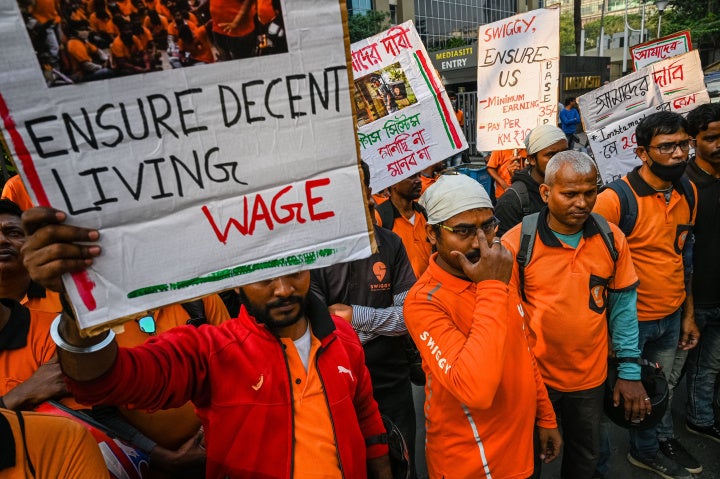
Delivery workers of an Indian food-delivery startup hold placards during a demonstration demanding a hike in their remuneration, in Kolkata, on November 22, 2022.
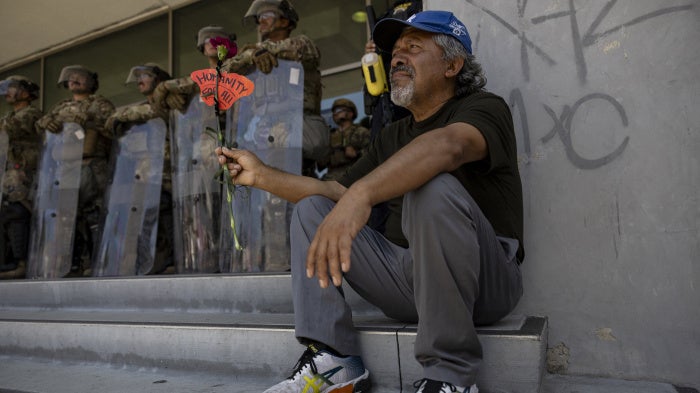
A man holds a flower and the message "Humanity for All" in front of a line of soldiers

Search

  • May 12, 2026

    EU Failure to Prevent Surveillance Exports to Rights Violators

    The 54-page report, “Looking the Other Way: EU Failure to Prevent Surveillance Exports to Rights Violators,” assesses how the EU’s landmark Dual-Use Regulation, adopted in 2021, is functioning in practice. The regulation was intended, in part, to prevent the export of dual-use technologies—those that may be used for both civilian and military purposes, including commercial surveillance technology—to places where they are likely to be used to violate international humanitarian or human rights law. But that goal is not being achieved because it is not being implemented effectively.

    video content
    cover in English
  • July 30, 2025

    State Censorship, Control, and Increasing Isolation of Internet Users in Russia

    The 50-page report, “Disrupted, Throttled, and Blocked: State Censorship, Control, and Increasing Isolation of Internet Users in Russia,” documents the impact of the government’s increasing technological capacities and control over the internet infrastructure. Human Rights Watch found that this allows the authorities to carry out more widespread and nontransparent blocking and throttling of unwanted websites and censorship circumvention tools, as well as internet disruptions and shutdowns under the pretext of ensuring public safety and national security.

    report cover in English
  • May 12, 2025

    Algorithmic, Wage and Labor Exploitation in Platform Work in the US

    The 155-page report, “The Gig Trap: Algorithmic, Wage and Labor Exploitation in Platform Work in the US” focuses on seven major companies operating in the US: Amazon Flex, DoorDash, Favor, Instacart, Lyft, Shipt, and Uber. These companies claim to offer gig workers “flexibility” but often end up paying them less than state or local minimum wages. Six of the seven companies use algorithms with opaque rules to assign jobs and determine wages, meaning that workers do not know how much they will be paid until after completing the job.

    Report cover in English
  • May 1, 2024

    Digital Metering at the US-Mexico Border

    The 68-page report, “We Couldn’t Wait: Digital Metering at the US-Mexico Border,” details how the Biden and López Obrador administrations have made a difficult-to-use US government mobile application, CBP One, all but mandatory for people seeking asylum in the United States. The result is de facto “metering,” a practice formalized early in the Trump administration that limits the number of asylum seekers processed at ports of entry each day, turning others back to Mexico.

    Report cover in English
  • December 21, 2023

    Systemic Censorship of Palestine Content on Instagram and Facebook

    The 51-page report, “Meta’s Broken Promises: Systemic Censorship of Palestine Content on Instagram and Facebook,” documents a pattern of undue removal and suppression of protected speech including peaceful expression in support of Palestine and public debate about Palestinian human rights. Human Rights Watch found that the problem stems from flawed Meta policies and their inconsistent and erroneous implementation, overreliance on automated tools to moderate content, and undue government influence over content removals.

    202312mena_ip_meta_cover
  • August 21, 2023

    Saudi Arabian Mass Killings of Ethiopian Migrants at the Yemen-Saudi Border

    The 73-page report, “‘They Fired on Us Like Rain’: Saudi Arabian Mass Killings of Ethiopian Migrants at the Yemen-Saudi Border,” found that Saudi border guards have used explosive weapons to kill many migrants and shot other migrants at close range, including many women and children, in a widespread and systematic pattern of attacks. In some instances, Saudi border guards asked migrants what limb to shoot, and then shot them at close range. Saudi border guards also fired explosive weapons at migrants who were attempting to flee back to Yemen.

    video content
    202308rmr_mena_saudiarabia_border_cover
  • June 14, 2023

    Internet Shutdowns Deny Access to Basic Rights in “Digital India”

    The 82-page report “‘No Internet Means No Work, No Pay, No Food’: Internet Shutdowns Deny Access to Basic Rights in ‘Digital India,’” finds that internet shutdowns impair essential activities and adversely affect economic, social and cultural rights under Indian and international human rights law. Indian authorities, in the name of maintaining public order, have ignored Supreme Court orders setting out procedural safeguards to ensure that internet suspensions are lawful, necessary, proportionate, and limited in scope and territory. Decisions by central and state government authorities to disrupt internet access are often erratic and unlawful, and are used for restricting protests and preventing cheating in examinations.

    video content
    202306asia_india_internetshutdowns_cover
  • June 13, 2023

    How The World Bank’s Push to Allocate Cash Assistance Using Algorithms Threatens Rights

    The 74-page report, “‘Automated Neglect’: How The World Bank’s Push to Allocate Cash Assistance Using Algorithms Threatens Rights,” details how an automated cash transfer program in Jordan known as Takaful (a word similar to solidarity in Arabic) profiles and ranks the income and well-being of Jordanian families to determine who should receive support – an approach known as poverty targeting. This system, which the World Bank has funded in Jordan and seven other countries in the Middle East and North Africa, is depriving many people of their right to social security even as they go hungry, fall behind on rent, and take on crippling debt.

    202305tech_mena_jordan_cover
  • February 21, 2023

    Digital Targeting and Its Offline Consequences for LGBT People in the Middle East and North Africa

    The 135-page report, “‘All This Terror Because of a Photo’: Digital Targeting and Its Offline Consequences for LGBT People in the Middle East and North Africa,” examines the use of digital targeting by security forces and its far-reaching offline consequences – including arbitrary detention and torture – in five countries: Egypt, Iraq, Jordan, Lebanon, and Tunisia. The findings show how security forces employ digital targeting to gather and create evidence to support prosecutions.

    video content
    202302lgbt_mena_digitaltargeting_cover
  • January 13, 2023
    A new multimedia report details the impact of criminal groups involved in illegal land grabbing and logging inside Terra Nossa, a land-reform settlement intended for small-scale agriculture and sustainable collection of forest products in the state of Pará. The situation there shows the link between environmental destruction, violence, and poverty in many rural communities that depend on the sustainable use of the forest across the Amazon.
    Terra Nossa
  • December 1, 2022

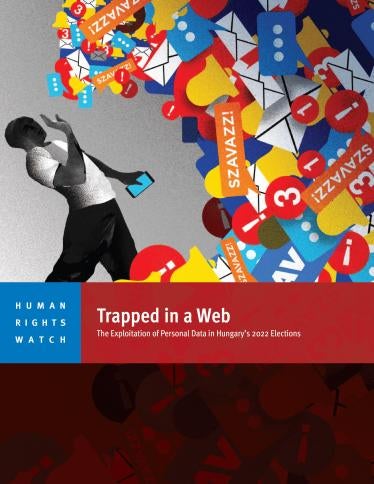
    The Exploitation of Personal Data in Hungary’s 2022 Elections

    The 85-page report, “Trapped in a Web: The Exploitation of Personal Data in Hungary’s 2022 Elections,” examines data-driven campaigning in Hungary’s April 3, 2022, elections, which resulted in a fourth consecutive term for Fidesz and Prime Minister Viktor Orbán. Human Rights Watch found that the government repurposed data it collected from people applying for services to spread Fidesz’s campaign messages. The blurred lines between government and ruling party resources, including data, and the capture of key institutions by the government led to selective enforcement of laws that further benefited Fidesz.

    202211tech_hungary_campaigndata_cover
  • May 25, 2022

    Children’s Rights Violations by Governments that Endorsed Online Learning During the Covid-19 Pandemic

    The 99-page report, “’How Dare They Peep into My Private Life?’: Children’s Rights Violations by Governments that Endorsed Online Learning during the Covid-19 Pandemic,” is grounded in technical and policy analysis conducted by Human Rights Watch on 165 education technology (EdTech) products endorsed by 49 countries. It includes an examination of 294 companies found to have collected, processed, or received children’s data since March 2021, and calls on governments to adopt modern child data protection laws to protect children online.

    video content
    202205crd_edtech_cover
  • June 16, 2021

    Digital Sex Crimes in South Korea

    The 96-page report, “‘My Life is Not Your Porn’: Digital Sex Crimes in South Korea” found that despite legal reforms in South Korea, women and girls targeted in digital sex crimes – acts of online and tech-enabled gender-based violence – face significant difficulty in pursuing criminal cases and civil remedies, in part due to entrenched gender inequity. Digital sex crimes are crimes involving digital images – almost always of women and girls – that are captured without the victim’s consent, shared nonconsensually, or sometimes manipulated or faked.

    video content
    202106wrd_southkorea_sexcrime_cover
  • September 29, 2020

    How the Tech-Driven Overhaul of the UK’s Social Security System Worsens Poverty

    The 68-page report, “Automated Hardship: How the Tech-Driven Overhaul of the UK’s Benefits System Worsens Poverty,” details how a poorly designed algorithm is causing people to go hungry, fall into debt and experience psychological distress. Human Rights Watch has also found that the government is failing to address the socio-economic inequalities which prevent people from being able to apply for and manage their benefit online.

    photo gallery
    video content
    202009eca_uk_universal credit_cover