Reports

How the U Visa Builds Trust, Counters Fear, and Promotes Community Safety

The 50-page report, “‘We Need U’: How the U Visa Builds Trust, Counters Fear, and Promotes Community Safety,” finds that the administration’s deportation policies undermine federal visa programs that provide a pathway for crime victims to obtain legal residency when they cooperate with law enforcement. Changed enforcement guidance, such as allowing Immigration Customs Enforcement (ICE) officials to apprehend people in previously safe places like courthouses and health centers, is a strong deterrent for immigrants who might otherwise report crime to police or seek a protective order.


Federal agents detain a woman exiting an immigration court hearing
A woman looks out of the window of a damaged building

Search

  • September 1, 2022

    “Filtration” and the Crime of Forcibly Transferring Ukrainian Civilians to Russia

    The 71-page report, “‘We Had No Choice’: ‘Filtration’ and the War Crime of Forcibly Transferring Ukrainian Civilians to Russia,” documents the transfers of Ukrainian civilians. The transfers are a serious violation of the laws of war that constitute war crimes and potential crimes against humanity. Russian and Russian-affiliated authorities also subjected thousands of Ukrainian citizens to a form of compulsory, punitive, and abusive security screening called “filtration.”

    202208eca_ukraine_russia_forcedfiltration_cover
  • August 8, 2022

    Human Rights Watch / ACLU Joint Submission Regarding the United States’ Record Under the International Convention on the Elimination of All Forms of Racial Discrimination

    The United Nations Committee on the Elimination of Racial Discrimination should direct the United States government to take immediate, tangible measures to dismantle structural racism in the United States, Human Rights Watch and the American Civil Liberties Union said today, releasing a joint report to the committee.

    202208us_cerd_report_cover
  • April 7, 2022

    Greece’s Use of Migrants as Police Auxiliaries in Pushbacks

    The 29-page report “‘Their Faces Were Covered’: Greece’s Use of Migrants as Police Auxiliaries in Pushbacks,” found that Greek police are detaining asylum seekers at the Greece-Turkey land border at the Evros River, in many cases stripping them of most of their clothing and stealing their money, phones, and other possessions. They then turn the migrants over to masked men, who force them onto small boats, take them to the middle of the Evros River, and force them into the frigid water, making them wade to the riverbank on the Turkish side. None are apparently being properly registered in Greece or allowed to lodge asylum claims.

    202204eca_greece_turkey_pushback_cover
  • February 10, 2022

    Asylum Seekers Abused in the US and Deported to Harm in Cameroon

    The 149-page report, “‘How Can You Throw Us Back?’: Asylum Seekers Abused in the US and Deported to Harm in Cameroon,” traces what happened to the estimated 80 to 90 Cameroonians deported from the United States on two flights in October and November 2020, and others deported in 2021 and 2019. People returned to Cameroon faced arbitrary arrest and detention; enforced disappearances; torture, rape, and other violence; extortion; unfair prosecutions; confiscation of their national IDs; harassment; and abuses against their relatives. Many also reported experiencing excessive force, medical neglect, and other mistreatment in Immigration and Customs Enforcement (ICE) custody in the US.

    photo gallery
    map content
    video content
    202202us_cameroon_deportation_cover
  • November 24, 2021

    Belarus’ and Poland’s Shared Responsibility for Border Abuses

    The 26-page report, “‘Die Here or Go to Poland’: Belarus’ and Poland’s Shared Responsibility for Border Abuses,” documents serious abuses on both sides of the border. People trapped on the Belarus border with Poland said that they had been pushed back, sometimes violently, by Polish border guards to Belarus despite pleading for asylum. On the Belarusian side, accounts of violence, inhuman and degrading treatment and coercion by Belarusian border guards were commonplace.

    202111eca_belarus_poland_border_cover
  • November 3, 2021

    International Alternatives to Detaining Immigrants

    The 94-page report “Dismantling Detention: International Alternatives to Detaining Immigrants,” examines alternatives to detention in six countries: Bulgaria, Cyprus, Spain, the United Kingdom, Canada, and the United States. Human Rights Watch found that alternatives to detention such as case management services, can effectively address government interests in immigration enforcement while protecting migrants’ rights and often offering a range of other benefits.

    video content
    202111global_altdetention_cover
  • October 21, 2021

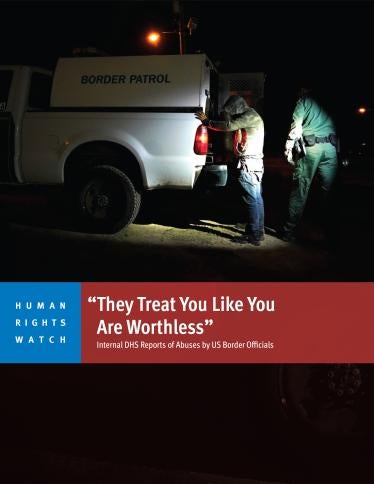
    Internal DHS Reports of Abuses by US Border Officials

    The 26-page report, “‘They Treat You Like You Are Worthless’: Internal DHS Reports of Abuses by US Border Officials,” details internal reports made by asylum officers within US Citizenship and Immigration Services (USCIS) about the conduct of personnel in the immigration enforcement arms of their same parent agency, the Department of Homeland Security (DHS). Though heavily redacted, the reports, which Human Rights Watch obtained after litigation under the Freedom of Information Act (FOIA), include allegations of physical, sexual, and verbal abuse, due process violations, harsh detention conditions, denial of medical care, and discriminatory treatment at or near the border.

    202110usp_borderabuse_cover
  • October 20, 2021

    Syrian Refugee Returns from Lebanon and Jordan

    The 72-page report “‘Our Lives are Like Death’: Syrian Refugee Returns from Lebanon and Jordan ,” found that Syria is not safe for return. Among 65 returnees or family members interviewed, Human Rights Watch documented 21 cases of arrest and arbitrary detention, 13 cases of torture, 3 kidnappings, 5 extrajudicial killings, 17 enforced disappearances and 1 case of alleged sexual violence.

    video content
    202110mena_syria_refugee_cover
  • October 7, 2021

    The Degrading Treatment of Migrant Children and Adults in Northern France

    The 81-page report, “Enforced Misery: The Degrading Treatment of Migrant Children and Adults in Northern France,” documents repeated mass eviction operations, near-daily police harassment, and restrictions on provision of and access to humanitarian assistance. The authorities carry out these abusive practices with the primary purposes of forcing people to move elsewhere, without resolving their migration status or lack of housing, or of deterring new arrivals.

    photo gallery
    map content
    202110eca_france_calais_migrant_cover
  • June 17, 2021

    Immigration Detention in Canada and its Impact on Mental Health

    The 100-page report, “‘I Didn’t Feel Like a Human in There’: Immigration Detention in Canada and Its Impact on Mental Health,” documents how people in immigration detention, including those fleeing persecution and seeking protection in Canada, are regularly handcuffed, shackled, and held with little to no contact with the outside world. With no set release date, they can be held for months or years. Many are held in provincial jails with the regular jail population and are often subjected to solitary confinement. Those with psychosocial disabilities – or mental health conditions – experience discrimination throughout the process.

    map content
    202106drd_canada_detention_cover
  • June 7, 2021

    Bangladesh’s Relocation of Rohingya Refugees to Bhasan Char

    The 58-page report, “‘An Island Jail in the Middle of the Sea’: Bangladesh’s Relocation of Rohingya Refugees to Bhasan Char,” finds that Bangladesh authorities transferred many refugees to the island without full, informed consent and have prevented them from returning to the mainland. While the government says it wants to move at least 100,000 people to the silt island in the Bay of Bengal to ease overcrowding in Cox’s Bazar refugee camps, humanitarian experts have raised concerns that insufficient measures are in place to protect against severe cyclones and tidal surges. Refugees on the island reported inadequate health care and education, onerous movement restrictions, food shortages, a lack of livelihood opportunities, and abuses by security forces

    map content
    video content
    202106asia_bangladesh_bhasanchar_cover
  • January 6, 2021

    Children and Families Sent to Harm by the US ‘Remain in Mexico’ Program

    The 103-page report, “‘Like I’m Drowning’: Children and Families Sent to Harm by the US ‘Remain in Mexico’ Program,” is a joint investigation by Human Rights Watch, Stanford University’s Human Rights in Trauma Mental Health Program, and Willamette University’s Child and Family Advocacy Clinic. Children and adults interviewed described being sexually assaulted, abducted for ransom, extorted, robbed at gunpoint, and subjected to other crimes under the US Migrant Protection Protocols (MPP), known as the “Remain in Mexico” program. In many cases, they said these attacks occurred immediately after US authorities sent them to Mexico to await US immigration court hearings on their asylum applications, or as they returned from hearings. Witnesses said that Mexican immigration officers or police committed some of these crimes.

    map content
    202101americas_mexico_us_border_cover
  • October 7, 2020

    Violence and Discrimination Against LGBT People in El Salvador, Guatemala, and Honduras, and Obstacles to Asylum in the United States

    The 138-page report, “Every Day I Live in Fear”: Violence and Discrimination against LGBT People in El Salvador, Guatemala, and Honduras, and Obstacles to Asylum in the United States, documents violence experienced by LGBT people in the three Northern Central American countries collectively known as the Northern Triangle, including at the hands of gangs, law enforcement officials, and their own families. Human Rights Watch found that Northern Triangle governments fail to adequately protect LGBT people against violence and discrimination, and that they face major obstacles if they attempt to seek asylum in the United States.

    video content
    202010lgbt_central america_us_cover
  • August 24, 2020

    Salary Abuses Facing Migrant Workers Ahead of Qatar’s FIFA World Cup 2022

    The 78-page report, “‘How Can We Work Without Wages?’: Salary Abuses Facing Migrant Workers Ahead of Qatar’s FIFA World Cup 2022” shows that employers across Qatar frequently violate workers’ right to wages and that Qatar has failed to meet its 2017 commitment to the International Labour Organization (ILO) to protect migrant workers from wage abuses and to abolish the kafala system, which ties migrant workers’ visas to their employers. Human Rights Watch found case after case of wage abuse across various occupations including security guards, servers, baristas, bouncers, cleaners, management staff, and construction workers.

    video content
    Qatar report cover
  • June 26, 2020

    Barriers to Secondary Education for Syrian Refugee Children in Jordan

    The 61-page report, “‘I Want to Continue to Study’: Barriers to Secondary Education for Syrian Refugee Children in Jordan,” documents increasingly difficult obstacles to education the further Syrian refugee children progress in school, with enrollment rates collapsing from nearly 90 percent in primary classes to just 25 to 30 percent in secondary school, according to governmental and United Nations data. With UN support, Jordan has created humanitarian education plans for Syrian refugees that aim to increase enrollment overall, but without specific secondary-school enrollment goals. Few foreign donors support secondary education. Informal education programs hosted by nongovernmental groups only reach a tiny fraction of children, Human Rights Watch found.

    202006mena_jordan_syria_kids_cover