Reports

China’s Use of Preschools to “Integrate” Tibetans

The 72-page report, “Start with the Youngest Children: China Uses Preschools to ‘Integrate’ Tibetans,” documents that a 2021 Ministry of Education directive—the Children’s Speech Harmonization plan—mandates the use of standard Mandarin Chinese for all preschool instruction in ethnic minority areas. While the kindergartens in theory can still offer supplementary sessions for minority children in their own language, minorities no longer have the legal authority to do so. By severely limiting Tibetan-language education in early childhood, a stage critical for language acquisition and identity formation, the Chinese government is speeding up its erasure of Tibetan language and culture.

A security guard outside the Shangri-La Key School in Kardze Tibetan Autonomous Prefecture, Sichuan province, China, September 5, 2023.
A man holds a flower and the message "Humanity for All" in front of a line of soldiers

Search

  • March 25, 2007

    The United Arab Emirates (UAE) is currently considering revisions to its main labor law. Like other countries in the Gulf, the UAE is heavily reliant upon the labor of migrant workers, primarily from South Asia. According to figures from 2005, 95 percent of the UAE’s labor pool, some 2.7 million workers, are migrants, many of whom work in the construction and domestic service industries.
  • March 19, 2007

    Enforced Disappearances in Thailand’s Southern Border Provinces

    This 69-page report details 22 cases of unresolved “disappearances” in which the evidence strongly indicates that the Thai security forces were responsible. The report is based on interviews with dozens of witnesses, families of victims and Thai officials since February 2005.
  • March 15, 2007

    Violations of the Rights of Children in Detention in Burundi

    This 62-page report documents the many types of human rights violations that children experience in pre-trial detention, in the investigation and prosecution of cases, and while in prison.
  • March 14, 2007

    The management of infectious disease in prisons is a human rights imperative as well as a matter of public health. Given the high level of HIV infections among those who enter prison, making condoms readily accessible to inmates is an effective and inexpensive measure that corrections officials should take to limit the spread of infection.
  • March 12, 2007

    In this first year of its existence, the Council is understandably preoccupied with institution building. But human rights violations haven’t been suspended while the Council focused on these tasks; in fact they have worsened in many locations. The Council’s attention to institution building has created a growing backlog of work that deserves the HRC’s attention.
  • February 27, 2007

    Unprotected Migrants in South Africa

    This 115-page report documents how state officials arrest, detain and deport undocumented foreign migrants, particularly those from Zimbabwe and Mozambique, in ways that contravene South Africa’s immigration law. The report also details how commercial farmers ignore basic employment law protections even when they employ documented foreign migrants and South Africans.

  • February 26, 2007

    Two Years in Secret CIA Detention

    This 50-page report contains a detailed description of a secret CIA prison from a Palestinian former detainee who was released from custody. The report provides the most comprehensive account to date of life in a secret CIA prison, as well as information regarding 38 possible detainees.
  • February 26, 2007

    This briefing paper outlines some of the key questions that candidates should consider if they are to tackle the human rights situation in the country: corruption; ethnic and political violence; reform of the security services; and reform of the electoral machinery.
  • February 21, 2007

    The Proposed UN Mission

    An increased international presence in eastern Chad is urgently needed to protect civilians threatened by worsening insecurity and brutal militia violence. Civilians in eastern Chad have long suffered the consequences of living across the border from Sudan’s troubled western region of Darfur, but violence in Chad has recently taken on its own momentum.
  • February 20, 2007

    Political Prisoners in Papua

    This 42-page report documents how the Indonesian government continues to use the criminal law to punish individuals who peacefully advocate for independence in the eastern Indonesian provinces of Papua and West Irian Jaya (hereafter referred to as Papua).
  • February 20, 2007

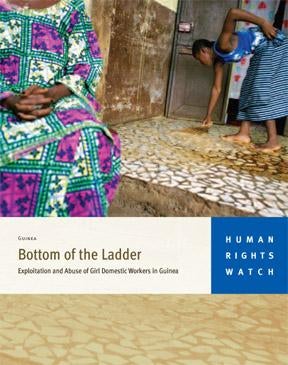
    Girls make up a minority of children who come in contact with justice systems, but are vulnerable to violence, particularly sexual abuse and rape, by police as well as staff in detention facilities. Girls who live or work on the street are often easy targets for police violence because they are young, often poor, ignorant of their rights, and lacking responsible adults to look out for them.
  • February 20, 2007

    In armed conflicts around the world, cluster munitions are the category of weapons most in need of stronger national and international law to protect civilians from harm.
  • February 20, 2007

    Many girls around the world routinely experience school-related violence that puts their physical and psychological well-being at risk, undermines their opportunities to learn, and often causes them to drop out of school entirely. Schoolgirls may be raped, sexually assaulted, and sexually harassed by their classmates and even by their teachers.
  • February 16, 2007

    A Human Rights Watch Background Briefing

    Indonesia’s military has a longstanding practice of raising independent income outside the approved budget process. It earns funds from businesses it owns, services it provides for hire, and the protection rackets it operates.